From the old papers.
The newspaper articles the From the Old Papers stories are retold from, as they were printed from 1898 to 1930, decade by decade. Each opens the story told from it and links to the whole page. 159 newspaper clippings.
The 1890s
 View photograph ↗
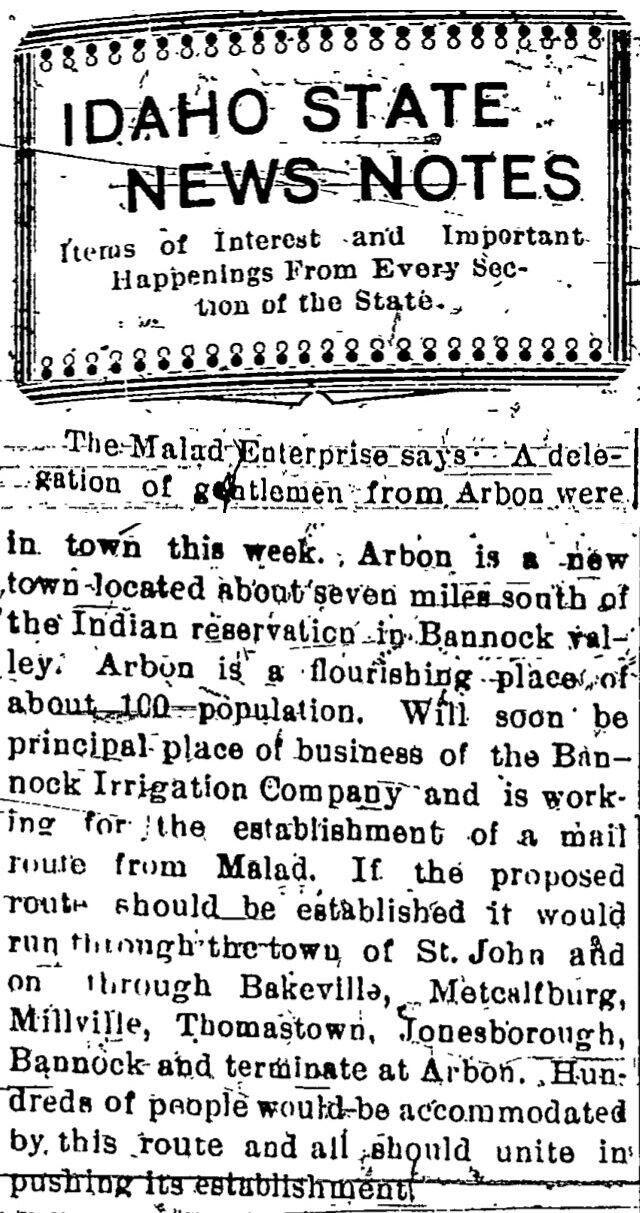
A new town called Arbon asks Malad for a mail route
Early in 1898 a delegation from Arbon, a settlement of about 100 people in Bannock Valley, came to Malad City to press for a mail route, and the Malad Enterprise wrote it up.
From: A new town called Arbon asks Malad for a mail route ↗The 1900s
 View photograph ↗
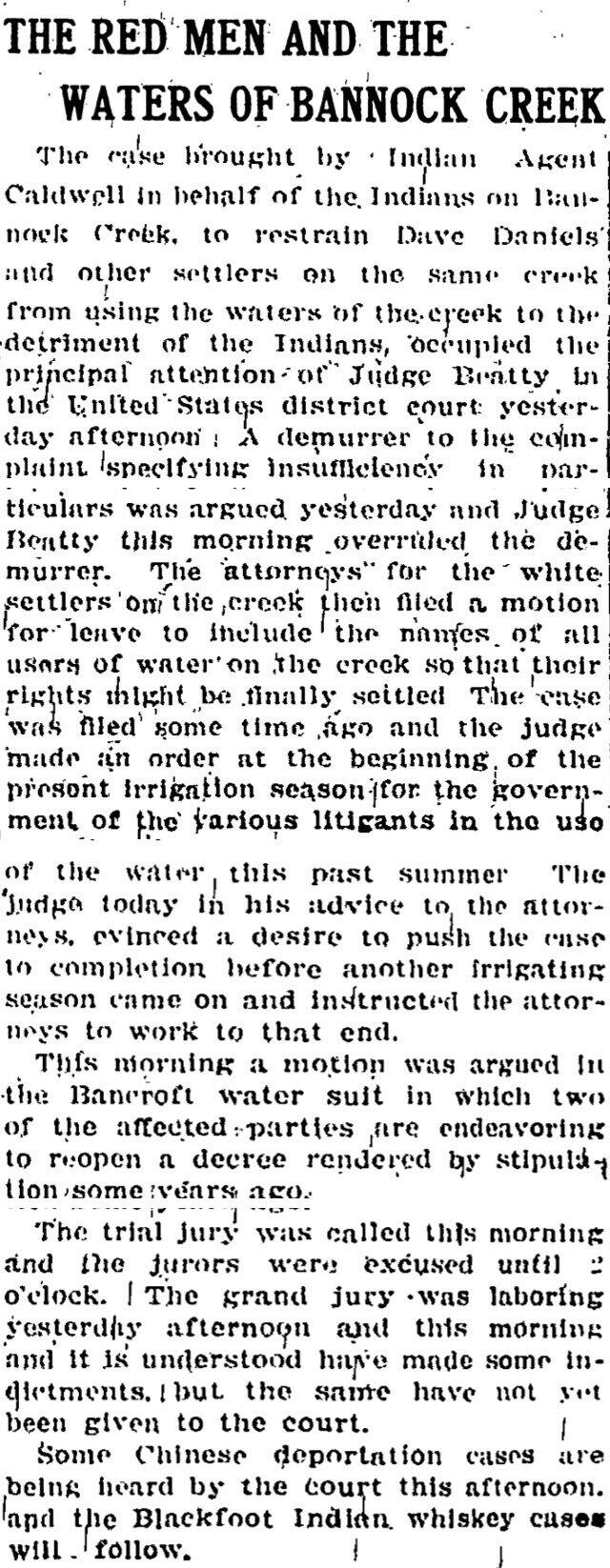
Judge lets the Bannock Creek water suit go forward against Dave Daniels
In October 1904 a federal judge let the Fort Hall agent's suit over Bannock Creek water go forward against Dave Daniels and his neighbors, and the settlers asked to bring in every user.
From: Judge lets the Bannock Creek water suit go forward against Dave Daniels ↗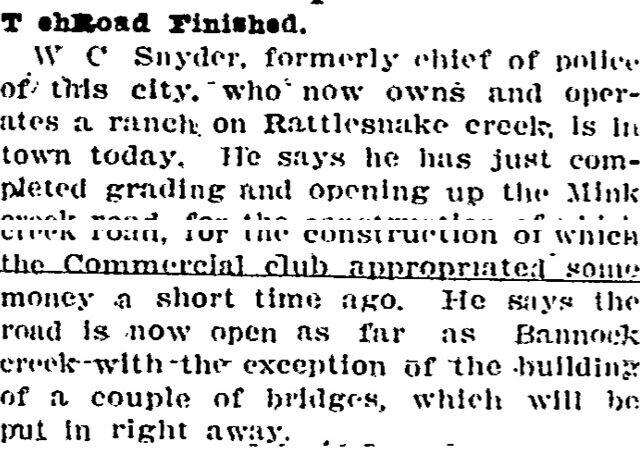 View photograph ↗
Settlers help build a road over the Mink Creek divide
A Rattlesnake Creek rancher graded a road up Mink Creek from Pocatello in 1906, and four years later settlers beyond the divide helped build the new road that won Arbon's praise.
From: Settlers help build a road over the Mink Creek divide ↗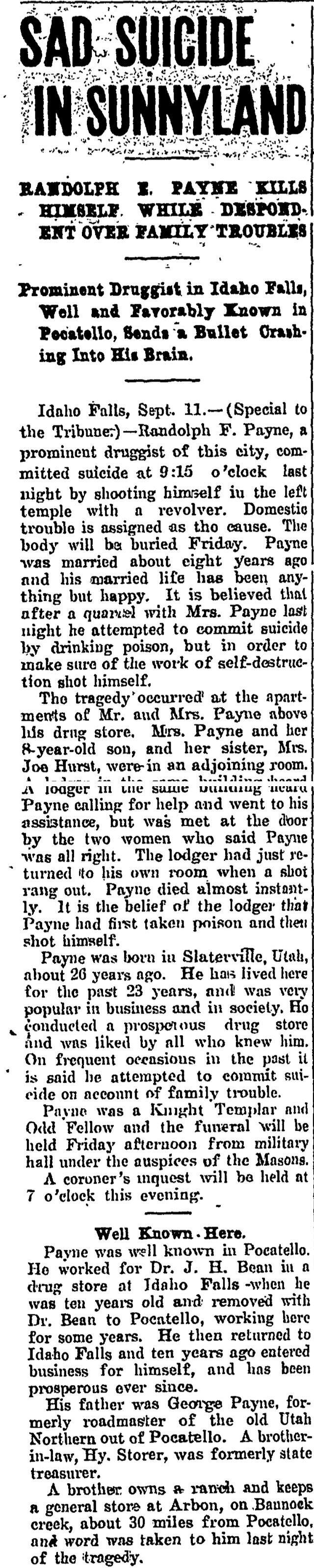 View photograph ↗
Idaho Falls druggist's death sends word to a storekeeper at Arbon
When the Pocatello Tribune reported an Idaho Falls druggist's suicide in September 1907, its closing line about his brother's store at Arbon became the oldest printed trace yet found of the Payne store.
From: Idaho Falls druggist's death sends word to a storekeeper at Arbon ↗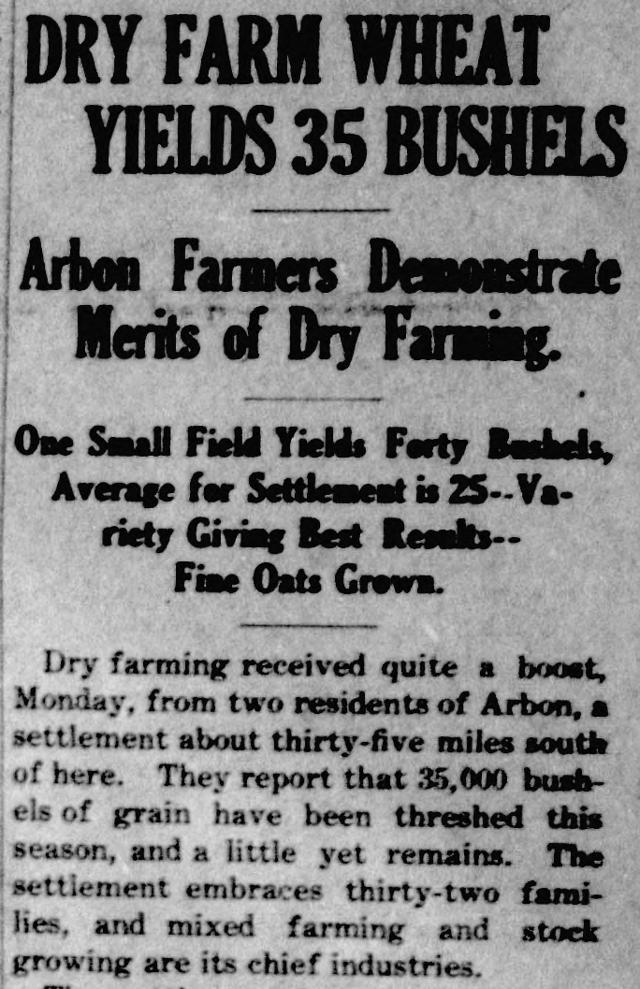 View photograph ↗
Arbon's dry farms thresh 35,000 bushels in 1907
In November 1907 two Arbon men told the American Falls Press that thirty-two families had threshed 35,000 bushels of grain, and named the best wheat fields and varieties.
From: Arbon's dry farms thresh 35,000 bushels in 1907 ↗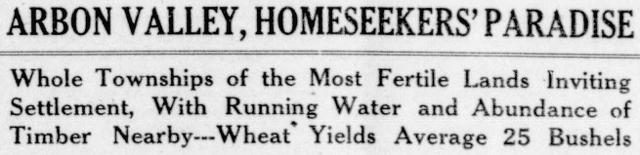 View photograph ↗
Arbon Valley, a homeseekers' paradise, goes looking for neighbors
In the winter of 1908–09 Arbon's settlers and the American Falls Press advertised the valley's open land to homeseekers, and by spring newcomers were filing on it fast.
From: Arbon Valley, a homeseekers' paradise, goes looking for neighbors ↗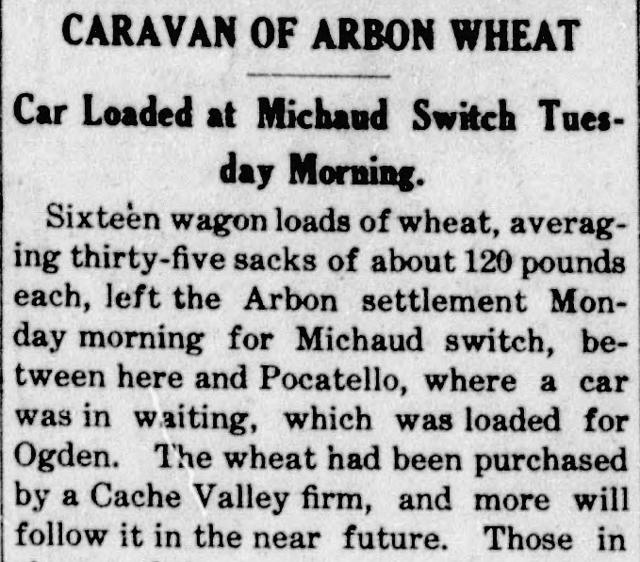 View photograph ↗
Sixteen wagons carry Arbon wheat to the railroad at Michaud
In November 1908 sixteen Arbon teamsters hauled a carload of sacked wheat to the railroad at Michaud switch, and the American Falls Press printed every driver's name.
From: Sixteen wagons carry Arbon wheat to the railroad at Michaud ↗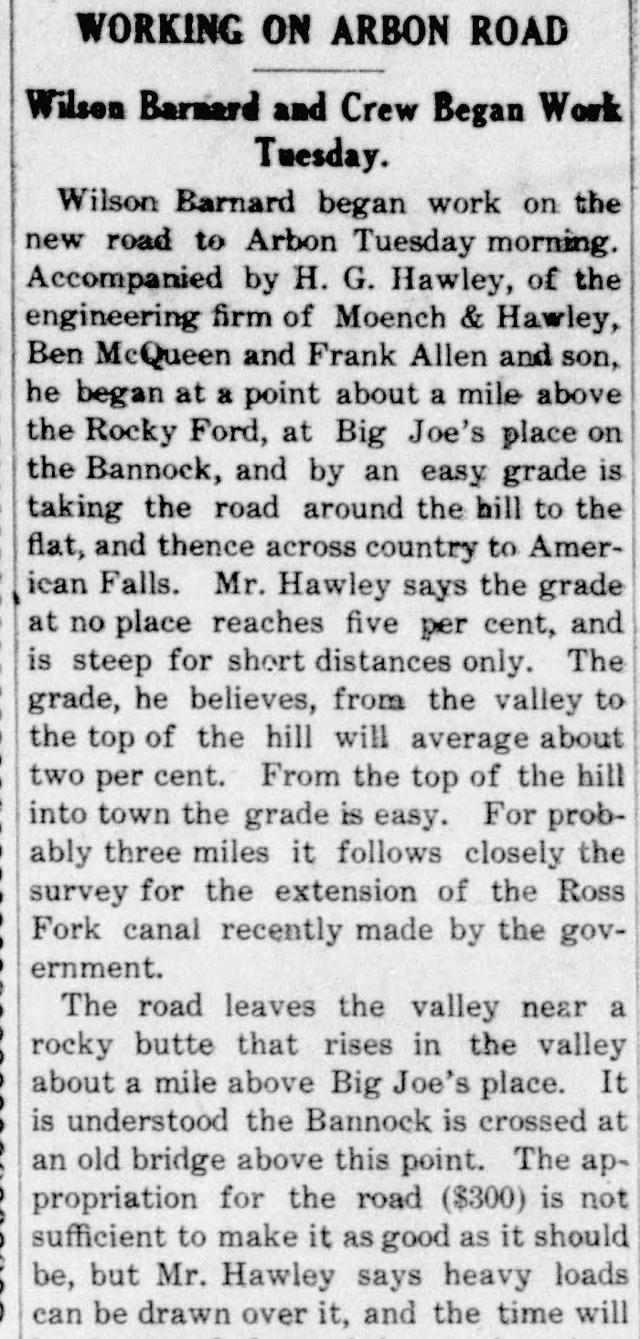 View photograph ↗
County crew starts a $300 shortcut from Arbon to American Falls
In November 1908 Wilson Barnard's crew began a $300 wagon road from Bannock Creek over the foothills to American Falls, meant to cut ten miles or more from the haul of Arbon's wheat to market.
From: County crew starts a $300 shortcut from Arbon to American Falls ↗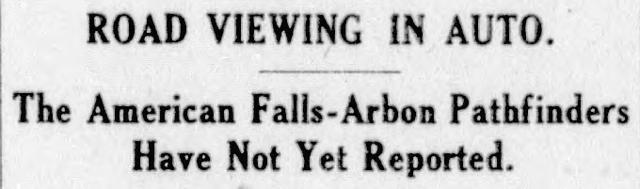 View photograph ↗
Four men drive out to view the Arbon road and walk home by dawn
In May 1909 a banker, a miller, an editor and a county commissioner set out by automobile to look over a proposed road to Arbon, and when the car gave out at Rattlesnake gulch they walked back to American Falls through the night.
From: Four men drive out to view the Arbon road and walk home by dawn ↗The 1910s
 View photograph ↗
An Arbon rancher brings big plans to Pocatello
In July 1910 an Arbon rancher came to Pocatello talking of a commercial club, an irrigation company and a Pioneer Day, and the *Tribune* put Arbon on its front page.
From: An Arbon rancher brings big plans to Pocatello ↗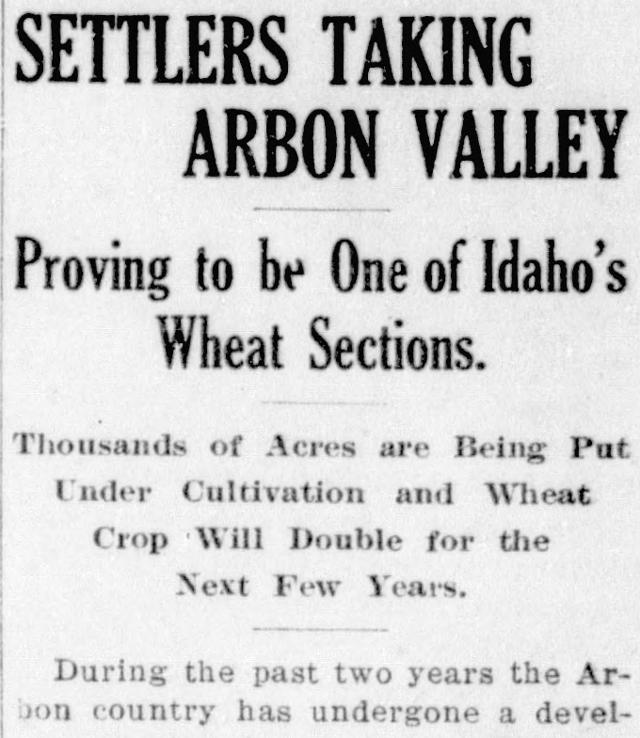 View photograph ↗
Newcomers outnumber the old settlers of Arbon Valley two to one
In September 1910 the American Falls Press found Arbon Valley's newcomers outnumbering its old settlers two to one and looked for a wheat crop twice the size of two years earlier.
From: Newcomers outnumber the old settlers of Arbon Valley two to one ↗ View photograph ↗
Mrs. Jennie Price of Arbon carries the Republican nomination for county treasurer
In 1910 a homesteading woman from Arbon won the Republican primary for Oneida County treasurer, in a year when only women sought that office, and lost the fall race to Cora Dudley of Malad.
From: Mrs. Jennie Price of Arbon carries the Republican nomination for county treasurer ↗ View photograph ↗
On a stormy night, Arbon votes to join Power County
Arbon Valley voted three times between 1908 and 1911 to leave Oneida County for a new county around American Falls, and saw two bills fail before Power County was finally made in 1913.
From: On a stormy night, Arbon votes to join Power County ↗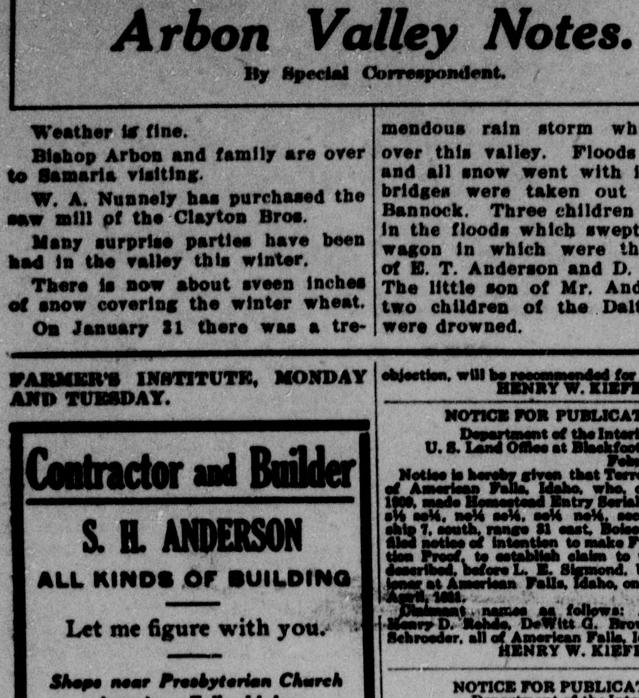 View photograph ↗
Winter flood drowns three Arbon children and takes the Bannock bridges
A January rainstorm in 1911 drowned three Arbon children and took the bridges on Bannock Creek; that spring Oneida County put new bridges to a bond vote.
From: Winter flood drowns three Arbon children and takes the Bannock bridges ↗ View photograph ↗
Arbon talks of a townsite, with the village already taking shape
In 1911 Arbon had no town, but its newspaper columns told of a hotel, a store, a dance hall, a village blacksmith and butcher, and talk of laying out a townsite.
From: Arbon talks of a townsite, with the village already taking shape ↗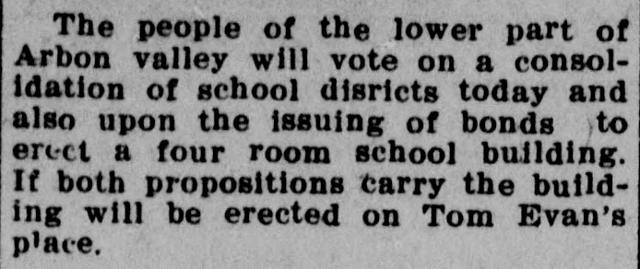 View photograph ↗
Lower Arbon votes on one district and a school on Tom Evans' place
In June 1911 the lower Arbon valley voted on merging its school districts and building on Tom Evans' place, and by 1913 a Central school stood on Evans land as both schoolhouse and community hall.
From: Lower Arbon votes on one district and a school on Tom Evans' place ↗ View photograph ↗
Over the Moonshine divide, a shorter road for Arbon wheat
In 1911 the county surveyed a road from American Falls over the Moonshine divide to Arbon, and in 1912 American Falls cash and Arbon labor built a short cut, probably on that line, that drew the valley's wheat away from Pocatello.
From: Over the Moonshine divide, a shorter road for Arbon wheat ↗ View photograph ↗
Four men from American Falls drive around Bannock Peak in a day
On a Sunday in July 1911, four American Falls men put 127 miles on an automobile circling Bannock Peak, lunching off a well trough and calling on Arbon's pioneers as they came home through the valley.
From: Four men from American Falls drive around Bannock Peak in a day ↗ View photograph ↗
State land selector finds Rattlesnake Creek land already ceded
In July 1911 Idaho's land selector looked over the Moonshine and Rattlesnake country for land for the state, and found that most of the good land on Rattlesnake Creek was ceded Fort Hall land.
From: State land selector finds Rattlesnake Creek land already ceded ↗ View photograph ↗
Nine threshers follow forty headers through the Arbon wheat of 1911
In 1911 the American Falls Press watched Arbon's wheat go from July guesses to steam threshers to wagon trains at the railroad, and an editor saw in six lines how far the valley had come.
From: Nine threshers follow forty headers through the Arbon wheat of 1911 ↗ View photograph ↗
Arbon's dry-land alfalfa wins the paper's blue ribbon
In September 1911 the *American Falls Press* awarded Arbon's dry-land alfalfa a blue ribbon in print, the high point of the valley's part in Farmers' Day, the farm show American Falls held each fall from 1908.
From: Arbon's dry-land alfalfa wins the paper's blue ribbon ↗ View photograph ↗
Lightning misses Charles Orison, and the papers follow his family for eighty years
A near miss by lightning at Summit in 1911 is the first the valley papers say of Charles and Jean Ann Orison, whose family they followed between Arbon Valley and Logan until 1990.
From: Lightning misses Charles Orison, and the papers follow his family for eighty years ↗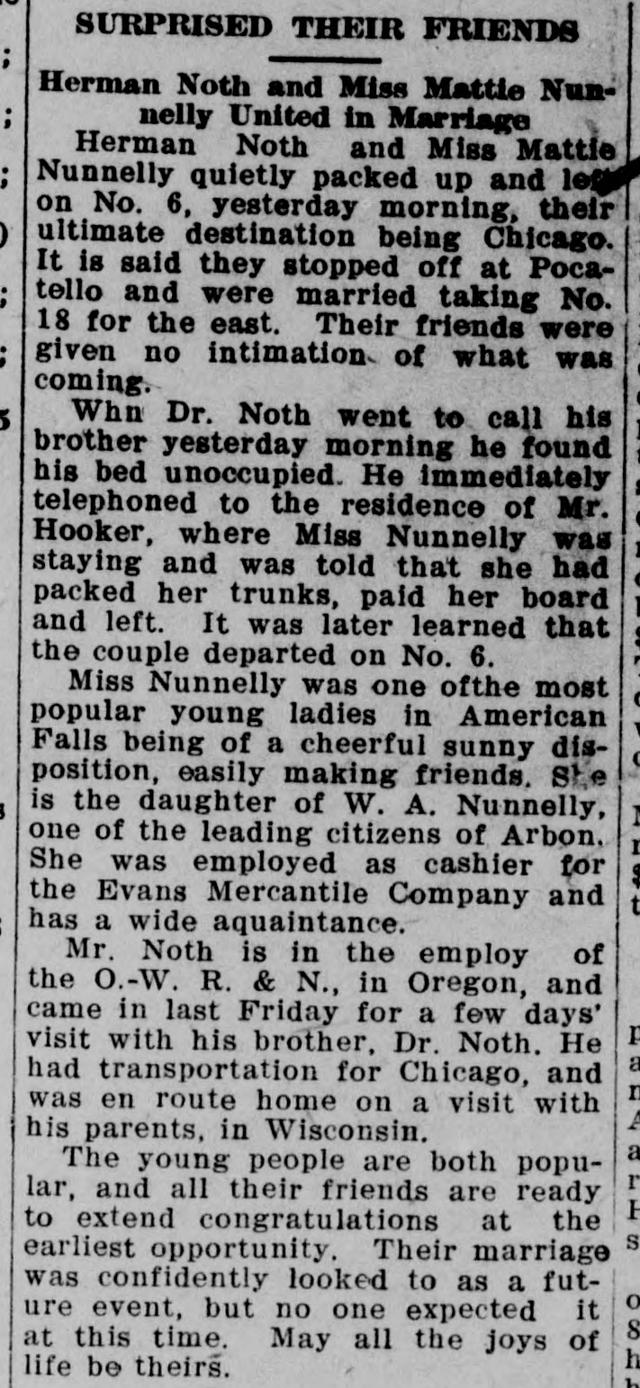 View photograph ↗
An Arbon homesteader's daughter and a doctor's brother slip away on No. 6
In September 1911 Mattie Nunnelley left American Falls on the morning train with Herman Noth, and over the next eight years the Press followed the couple to a ranch at Arbon and to her early death.
From: An Arbon homesteader's daughter and a doctor's brother slip away on No. 6 ↗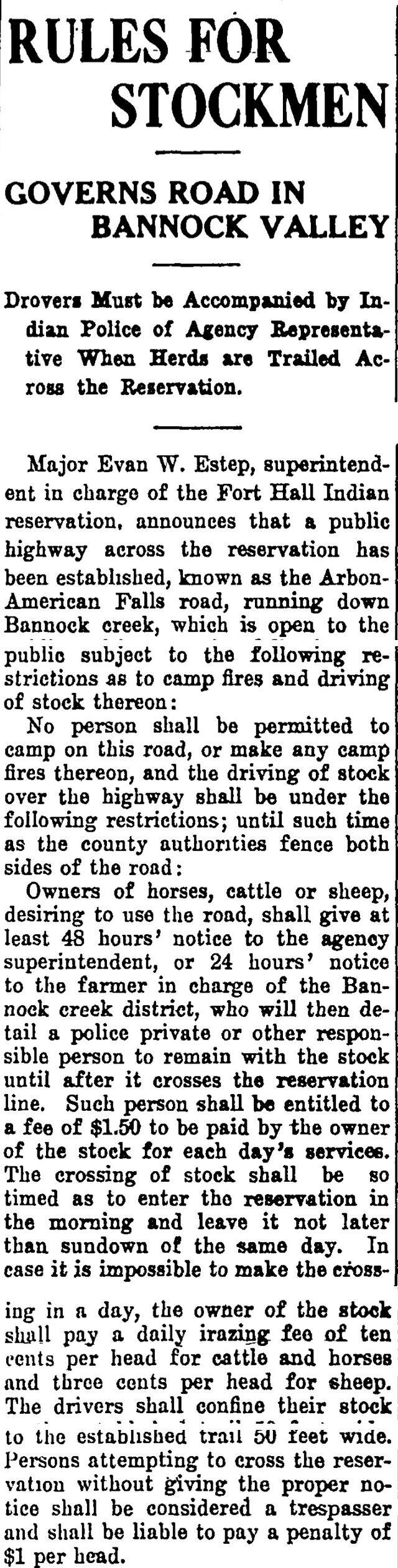 View photograph ↗
Fort Hall opens the Bannock Creek road, with rules for drovers
In October 1911 the Fort Hall superintendent opened the Arbon–American Falls road down Bannock Creek to the public, with no camping or fires and escorts for driven stock.
From: Fort Hall opens the Bannock Creek road, with rules for drovers ↗ View photograph ↗
Four children of a Bannock Creek farmer come home to Fort Hall
In November 1911 four children whose father, known in Nevada as "Indian Mike," had once farmed on Bannock Creek as Jim Taggert were brought from a Nevada school to Fort Hall after the fight that killed most of their family.
From: Four children of a Bannock Creek farmer come home to Fort Hall ↗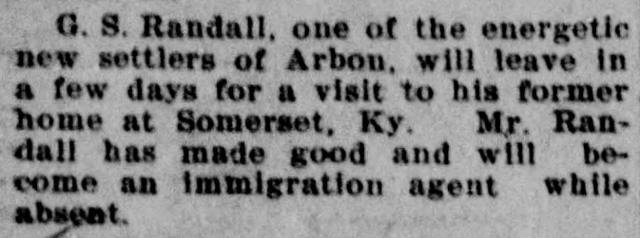 View photograph ↗
Arbon settler heads home to Kentucky as an immigration agent
When G. S. Randall of Arbon went home to Somerset, Kentucky, in December 1911, he went as a man who had made good, and the papers then follow the Kentucky families who came to the valley, stayed and left.
From: Arbon settler heads home to Kentucky as an immigration agent ↗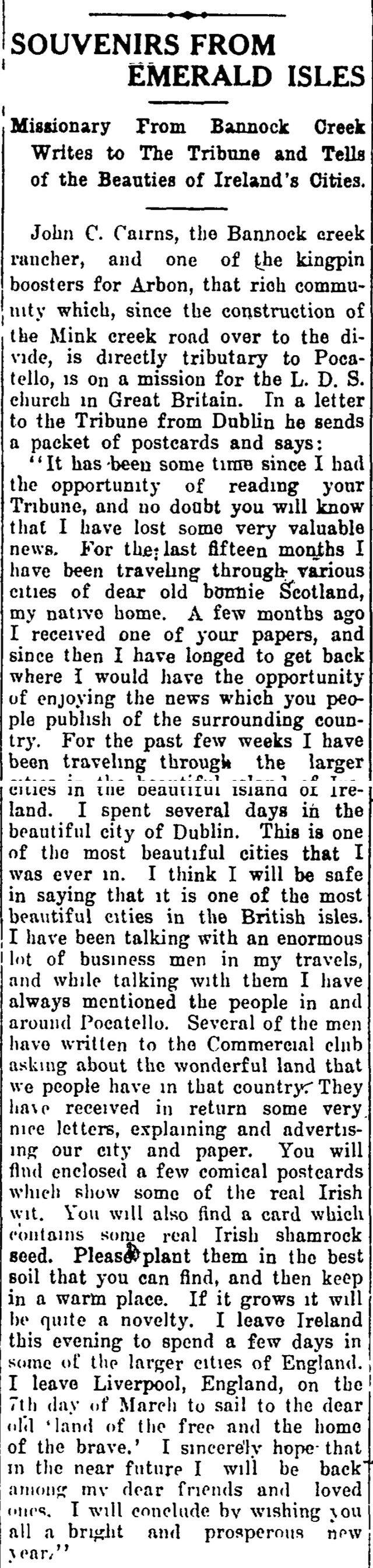 View photograph ↗
An Arbon rancher writes home from his mission and comes back to a dance
In the spring of 1912 the *Pocatello Tribune* followed Arbon rancher John C. Cairns from Dublin to Halifax and home again, where the valley met him with a supper and dance.
From: An Arbon rancher writes home from his mission and comes back to a dance ↗ View photograph ↗
Valley women prove up claims of their own
Between 1911 and 1919 the land notices and valley columns of the American Falls Press followed Arbon and Crystal women as they proved up land in their own names, from wives' desert claims to a mother and her daughters on Cherry Creek.
From: Valley women prove up claims of their own ↗ View photograph ↗
A doubting father from Kansas comes around on Arbon vegetables
Told by the old-timers that nothing would ripen at his altitude, Arbon homesteader G. S. Butler ended up supplying them with potatoes and won over the Kansas father who had predicted his failure.
From: A doubting father from Kansas comes around on Arbon vegetables ↗ View photograph ↗
Two Whiting brothers of Crystal wed the same morning, each unaware of the other
On a December morning in 1912 two Whiting brothers from Crystal took out marriage licenses in Pocatello minutes apart, neither knowing the other was marrying.
From: Two Whiting brothers of Crystal wed the same morning, each unaware of the other ↗ View photograph ↗
Pocatello and American Falls vie for Arbon Valley's wheat
When American Falls cut a new road into Arbon Valley in 1912 and drew off its grain, Pocatello's paper raised the alarm and an Arbon farmer came to town asking for a road over Trail Creek.
From: Pocatello and American Falls vie for Arbon Valley's wheat ↗ View photograph ↗
Pocatello merchants press for a Trail Creek road to win Arbon's wheat
In 1912 and 1913 Pocatello's businessmen and the Arbon farmers pledged money for a road over the Trail Creek divide, until a reservation right of way and a shortfall of cash stopped it.
From: Pocatello merchants press for a Trail Creek road to win Arbon's wheat ↗ View photograph ↗
New county's commissioners spend four days on Arbon Valley roads
In May 1913 the commissioners of the new Power County spent four days looking over roads at Crystal and Arbon, opening a season of petitions, a rival offer from Pocatello and a change of road overseer.
From: New county's commissioners spend four days on Arbon Valley roads ↗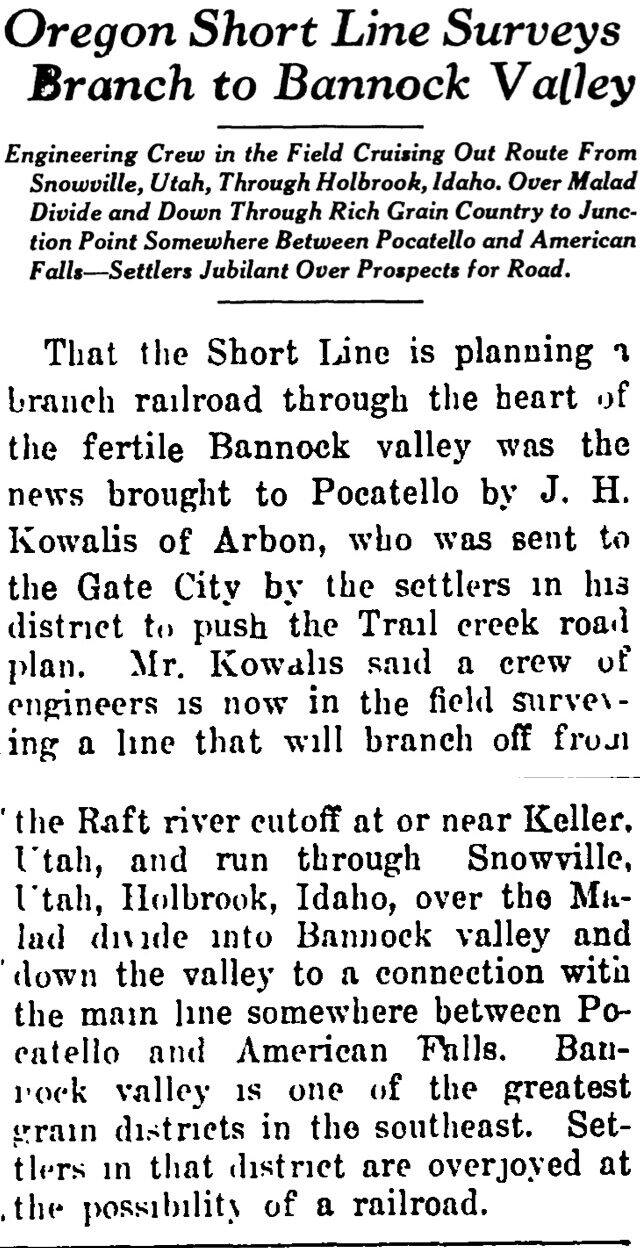 View photograph ↗
Arbon hears the Short Line is surveying a branch down Bannock Valley
In June 1913 a man from Arbon brought word to Pocatello that Short Line engineers were surveying a branch railroad over the Malad divide and down Bannock Valley.
From: Arbon hears the Short Line is surveying a branch down Bannock Valley ↗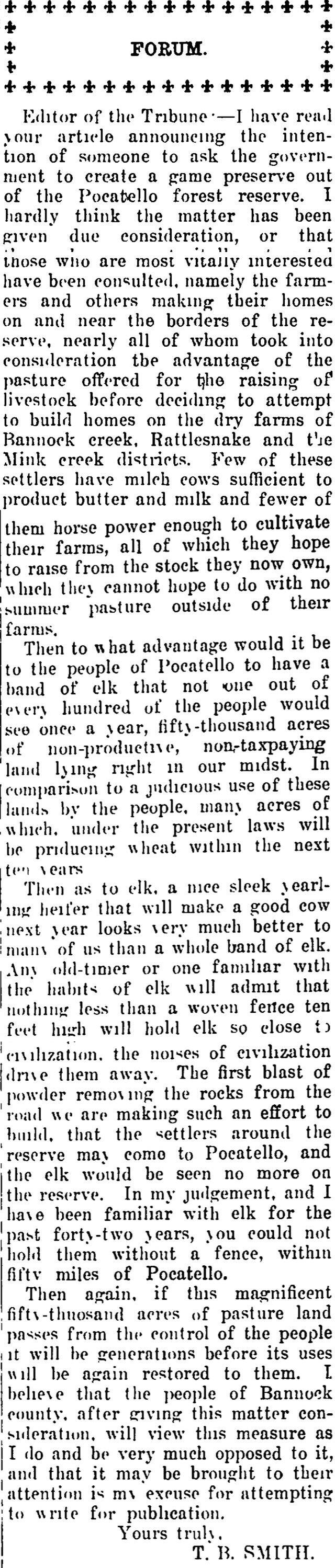 View photograph ↗
Settlers over the Mink Creek divide want pasture, not elk
In June 1913 homesteaders south of the Mink Creek divide fought sheep permits on the Pocatello forest reserve, and when someone proposed turning it into an elk refuge, T. B. Smith wrote to the paper that the settlers needed summer grass, not game.
From: Settlers over the Mink Creek divide want pasture, not elk ↗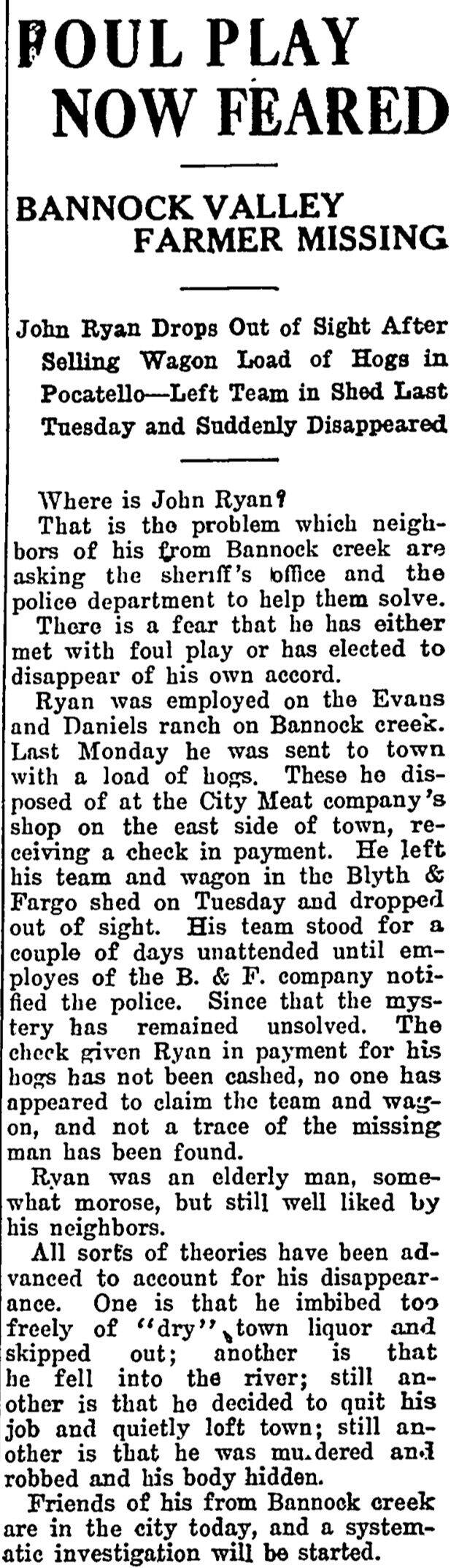 View photograph ↗
Bannock Creek ranch hand vanishes after selling hogs in Pocatello
In June 1913 John Ryan, a hand on the Evans and Daniels ranch on Bannock Creek, sold a load of hogs in Pocatello, left his team in a shed and dropped out of sight.
From: Bannock Creek ranch hand vanishes after selling hogs in Pocatello ↗ View photograph ↗
From Arbon, B. W. Rice counts the grain and the farmers who grow it
Writing from Arbon the day after a divided Fourth of July in 1913, B. W. Rice sized up the valley's grain and named its farmers one by one, and within days two Congregational churches were organized there.
From: From Arbon, B. W. Rice counts the grain and the farmers who grow it ↗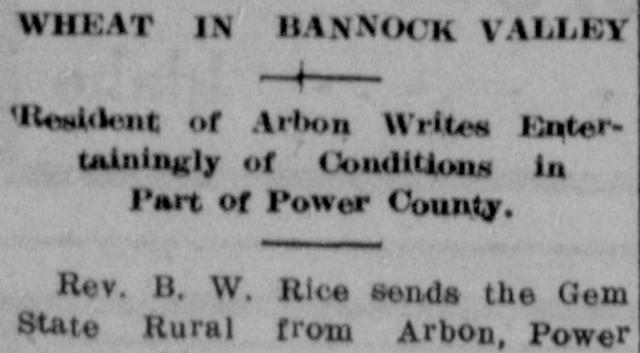 View photograph ↗
A minister sends a hill of wheat and a report from Bannock Valley
In the summer of 1913 a Congregational minister mailed a hill of dry-farmed wheat from Arbon with a report on the valley's crops, land and people, while he set about starting its first two Protestant churches.
From: A minister sends a hill of wheat and a report from Bannock Valley ↗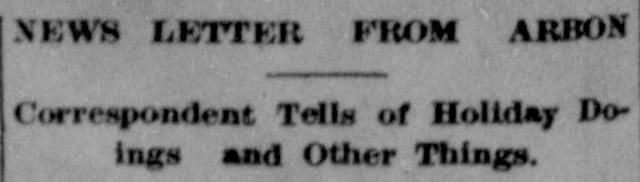 View photograph ↗
Santa comes to the Central school with gifts for 125 Arbon children
On Christmas Eve 1913 Santa Claus brought presents, candy, nuts and oranges to 125 children at Arbon's Central school, and dances and sleighing parties filled the holiday week.
From: Santa comes to the Central school with gifts for 125 Arbon children ↗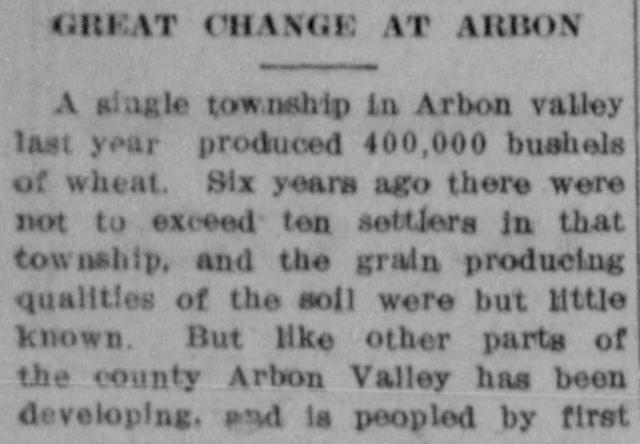 View photograph ↗
Arbon Valley wheat fills the road to the railroad in 1913
In the valley's first harvest under Power County, the papers followed Arbon's wheat from the threshers to the railroad, through a farmers' co-operative, a call to Tulsa and three crop counts that never agreed.
From: Arbon Valley wheat fills the road to the railroad in 1913 ↗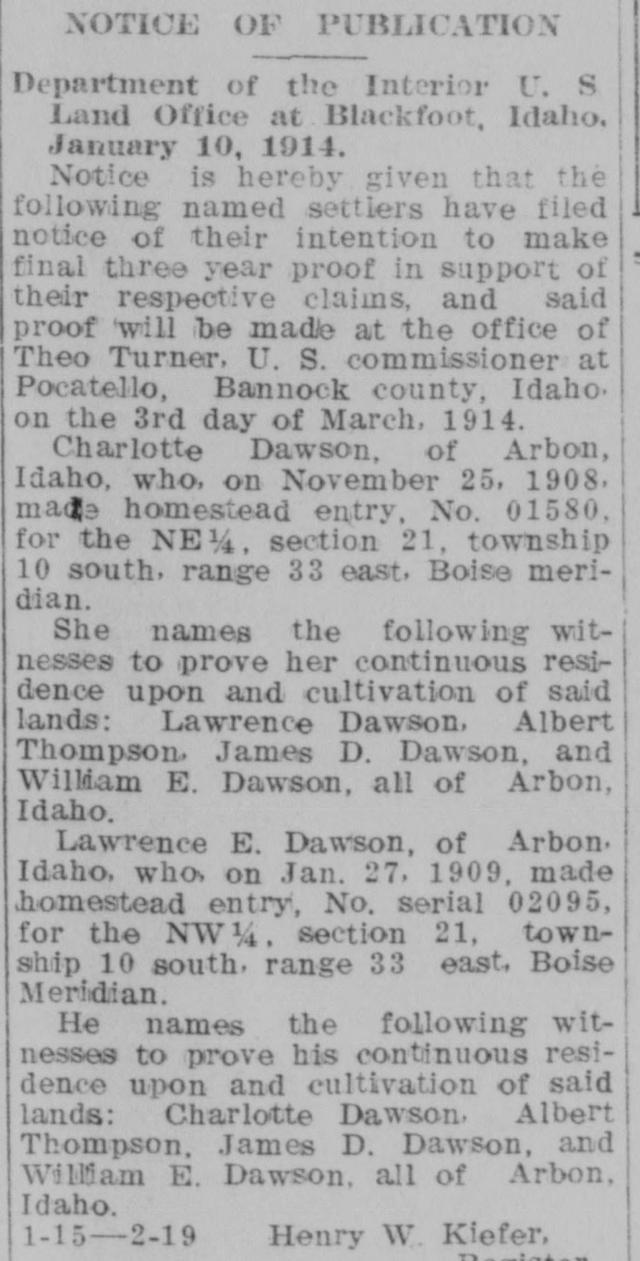 View photograph ↗
Arbon homesteaders prove up, and neighbours vouch for neighbours
From 1909 to 1914 the land-office notices in the American Falls Press tracked Arbon Valley homesteaders turning claims into titles, with neighbours standing witness and contests over claims nobody lived on.
From: Arbon homesteaders prove up, and neighbours vouch for neighbours ↗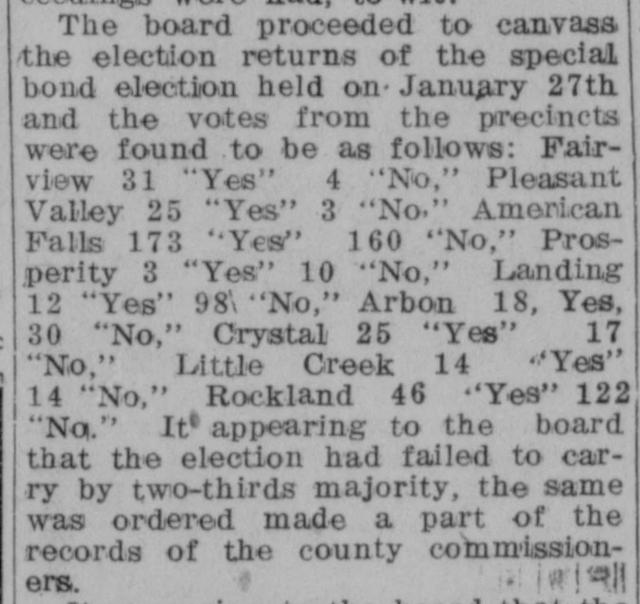 View photograph ↗
Arbon votes down the county road bonds
In January 1914 the new Power County asked its voters for $125,000 in road bonds, with a trunk road promised from Arbon, and the valley turned them down.
From: Arbon votes down the county road bonds ↗ View photograph ↗
Skis, surprise parties and barbed-wire telephones in Arbon, 1914
At the end of a snowy winter in 1914, an American Falls store's monthly paper carried the Arbon news, almost certainly from Mrs. E. A. Logan, and the American Falls Press reprinted it.
From: Skis, surprise parties and barbed-wire telephones in Arbon, 1914 ↗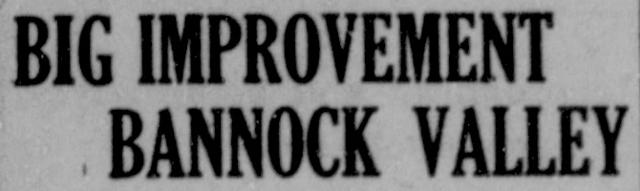 View photograph ↗
Arbon boosters vote a right of way for a railroad on posts
In the spring of 1914 Arbon farmers offered a right of way and $1,000 a mile in bonds to a promoter whose grain cars would hang from a single rail on posts, but no line was ever reported built.
From: Arbon boosters vote a right of way for a railroad on posts ↗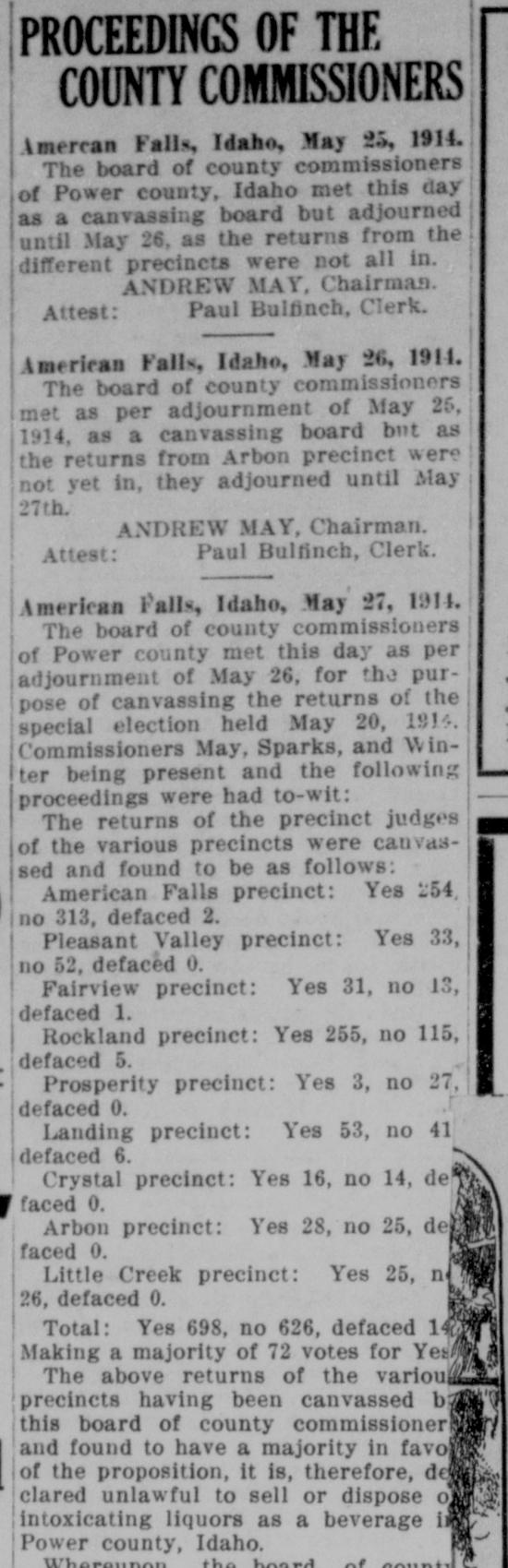 View photograph ↗
Power County goes dry, and the count waits on Arbon
Power County voted to forbid the sale of liquor on May 20, 1914, 698 to 626, with Arbon going dry by three votes and Crystal by two, and the official count held up a week waiting for Arbon's returns.
From: Power County goes dry, and the count waits on Arbon ↗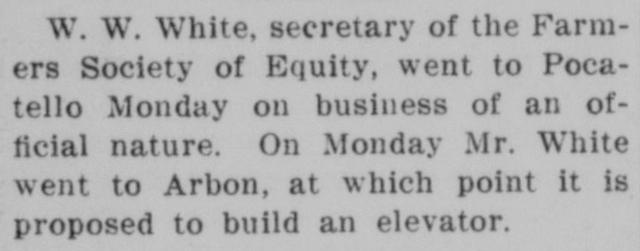 View photograph ↗
Arbon farmers join the Equity and hope for an elevator of their own
Arbon Valley dry farmers joined the Farmers' Society of Equity in 1913, and for four years the cooperative talked of a grain elevator for the valley that the papers never show being built.
From: Arbon farmers join the Equity and hope for an elevator of their own ↗ View photograph ↗
Frost takes the Bannock Valley wheat after a spring of high hopes
A June frost in 1914 cut down the Bannock Valley wheat after the best spring anyone remembered, yet by winter the valley had still shipped its grain by the carload.
From: Frost takes the Bannock Valley wheat after a spring of high hopes ↗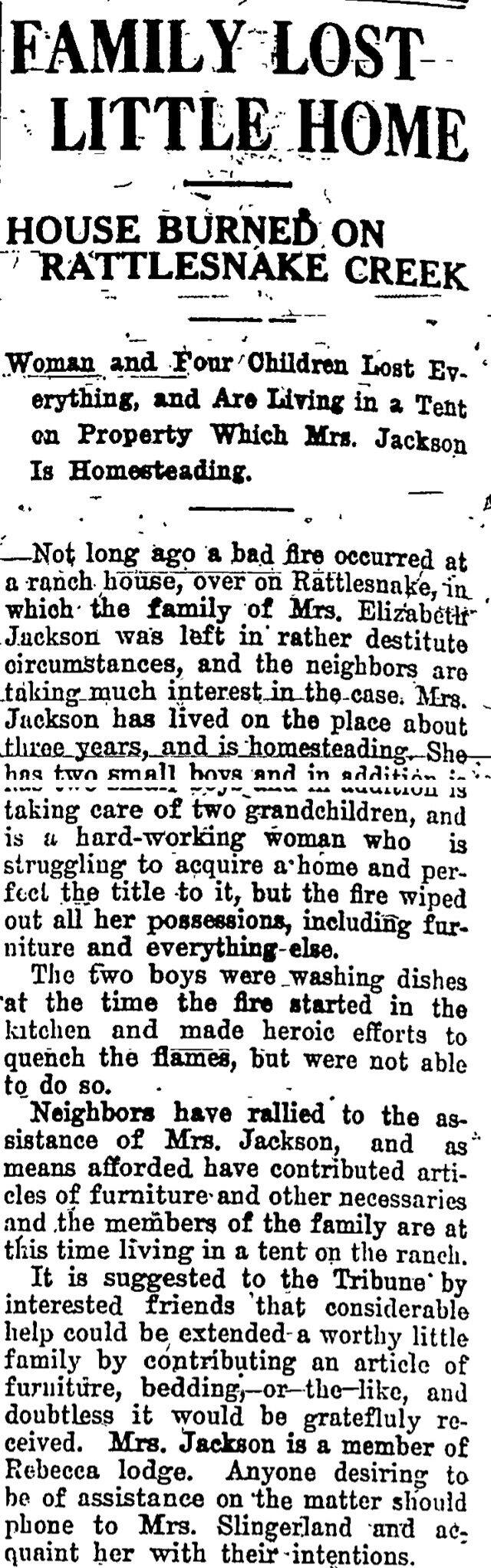 View photograph ↗
Kitchen fire leaves a Rattlesnake Creek homesteader living in a tent
In July 1914 the Pocatello Tribune asked readers to help Mrs. Elizabeth Jackson, homesteading on Rattlesnake Creek, whose house had burned with everything in it.
From: Kitchen fire leaves a Rattlesnake Creek homesteader living in a tent ↗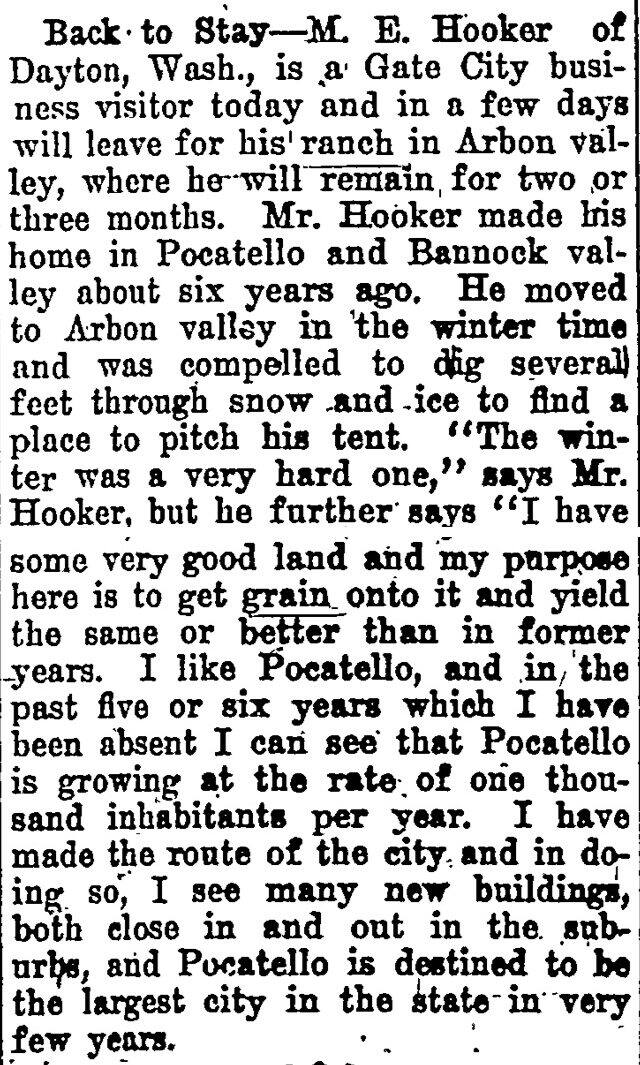 View photograph ↗
Arbon homesteader recalls digging through the snow to pitch his tent
In 1914 Ed Hooker told the Pocatello Tribune how he had shoveled down through several feet of snow and ice for a tent site when he came to Arbon Valley, where he homesteaded until 1917.
From: Arbon homesteader recalls digging through the snow to pitch his tent ↗ View photograph ↗
By way of Brigham, the valley's mail took weeks to reach Crystal
In 1914 a letter from American Falls to Crystal rode 239 miles of rail through Brigham City and Malad, and the valley kept petitioning until a Pocatello route came in 1916.
From: By way of Brigham, the valley's mail took weeks to reach Crystal ↗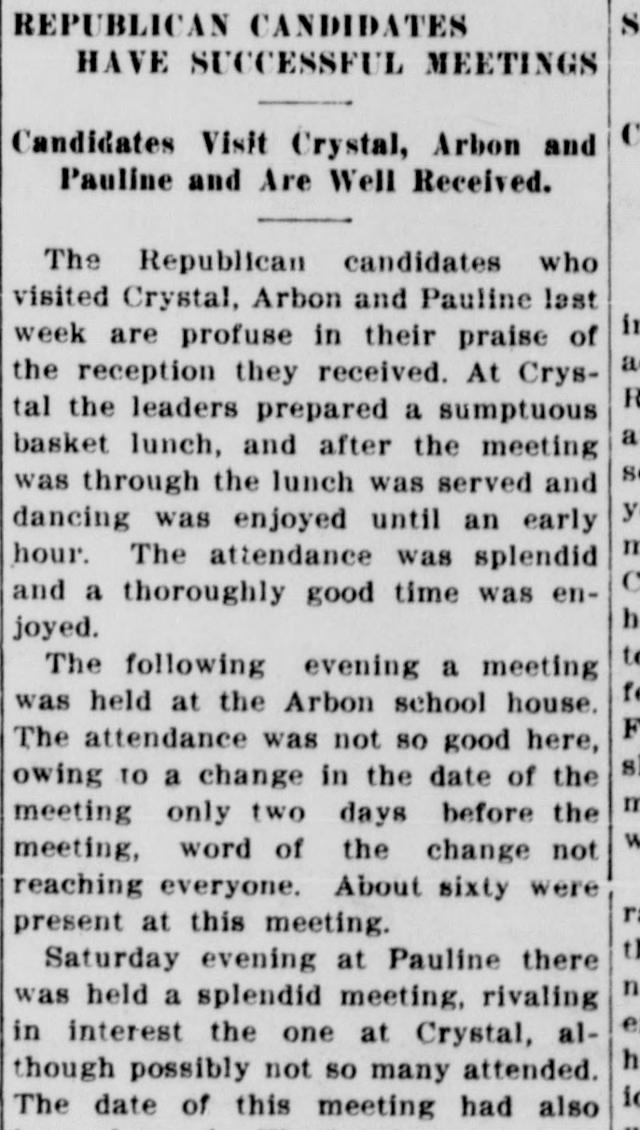 View photograph ↗
An Arbon homesteader becomes Power County's first legislator
In 1914 William Allard, a homesteader from Arbon, won the Republican primary and the November election to become the first man Power County sent to the Idaho House.
From: An Arbon homesteader becomes Power County's first legislator ↗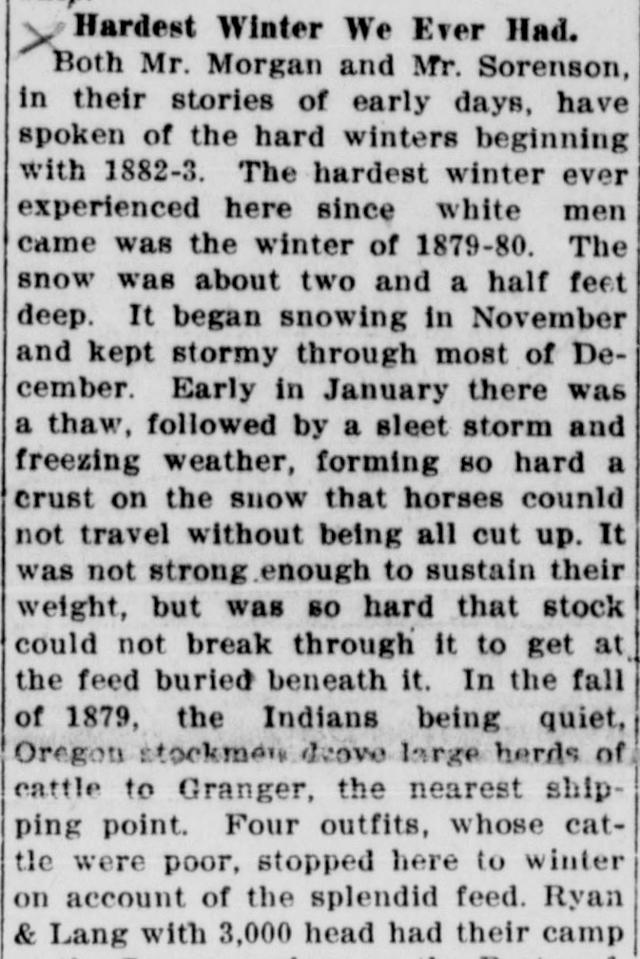 View photograph ↗
The winter the herds died, and the years Bannock Valley was cattle range
An old settler's 1915 memory of the winter that froze the Oregon herds opens three decades of glimpses of Bannock Valley as range for cattle and sheep, before wheat took it over.
From: The winter the herds died, and the years Bannock Valley was cattle range ↗ View photograph ↗
Logs piled at the mill promise a building year in Arbon
A pile of logs at John Payne's sawmill in the spring of 1915 told Arbon's correspondent a building year was coming, and the paper's columns followed the canyon mills and the new houses through the season.
From: Logs piled at the mill promise a building year in Arbon ↗ View photograph ↗
Pauline takes the field in red, and Sunday baseball comes to Arbon Valley
In the spring of 1915 the Pauline nine wore new red suits, bought with help from a dance, as the valley's neighborhood teams met each other on Sunday afternoons.
From: Pauline takes the field in red, and Sunday baseball comes to Arbon Valley ↗ View photograph ↗
A New York seminary student spends a summer preaching in Arbon Valley
In 1915 Robert W. Sturges, a New York seminary student, spent four months as pastor of the Congregational churches at Arbon and Highland, then wrote about the valley.
From: A New York seminary student spends a summer preaching in Arbon Valley ↗ View photograph ↗
Even the mountain ranges are being homesteaded
Through 1915 the *American Falls Press* followed Arbon Valley homesteaders as they filed in Knox Canyon and on the ranges, drilled for water, built houses and sold out.
From: Even the mountain ranges are being homesteaded ↗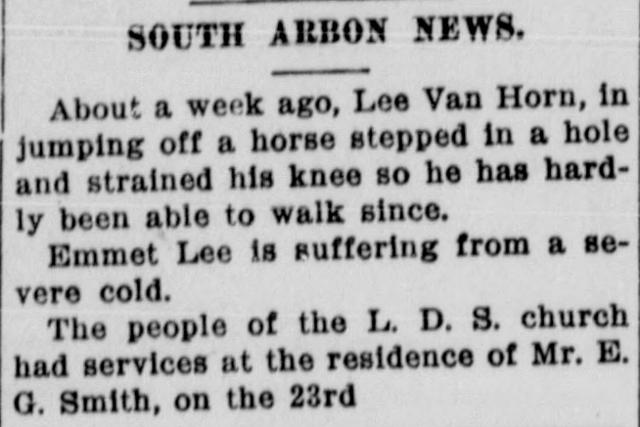 View photograph ↗
Two Smith sisters pass through the South Arbon news of 1915
Elmira and Delone Smith, daughters of the Summit homesteader E. G. Smith, turn up again and again in the South Arbon column of 1915, and their obituaries carry the story on for seventy years.
From: Two Smith sisters pass through the South Arbon news of 1915 ↗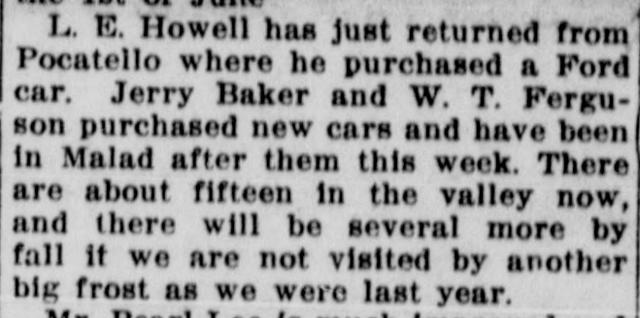 View photograph ↗
Arbon Valley farmers catch a spring malady and buy cars
A year after frost took most of its wheat, Arbon Valley came down with what one correspondent called a spring malady, and by June 1915 about fifteen cars were running in the valley.
From: Arbon Valley farmers catch a spring malady and buy cars ↗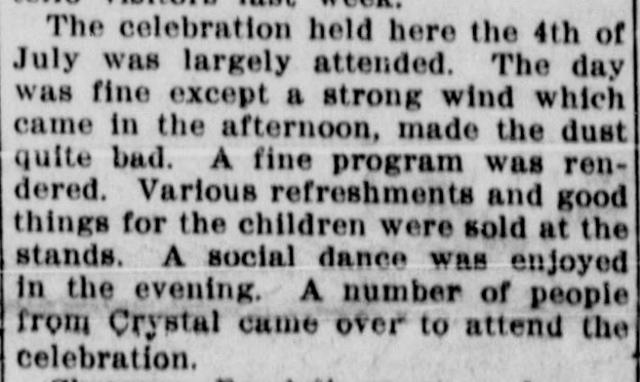 View photograph ↗
A windy Fourth at the Central school and a crowded 24th at Pauline
In the summer of 1915 Arbon Valley decorated its graves, held a big Fourth of July picnic at the Central school on July 3 and crowded the Pauline L.D.S. grounds for Pioneer Day.
From: A windy Fourth at the Central school and a crowded 24th at Pauline ↗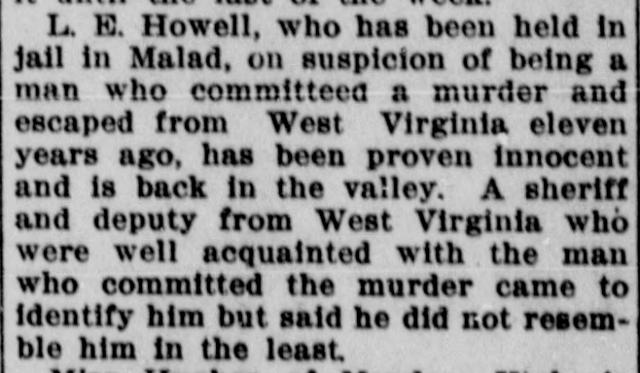 View photograph ↗
South Arbon man held at Malad is cleared of a West Virginia murder
Jailed at Malad in 1915 on a forgery charge, L. E. Howell of South Arbon was suspected of an old West Virginia killing until two officers from that state came west and said he looked nothing like their man.
From: South Arbon man held at Malad is cleared of a West Virginia murder ↗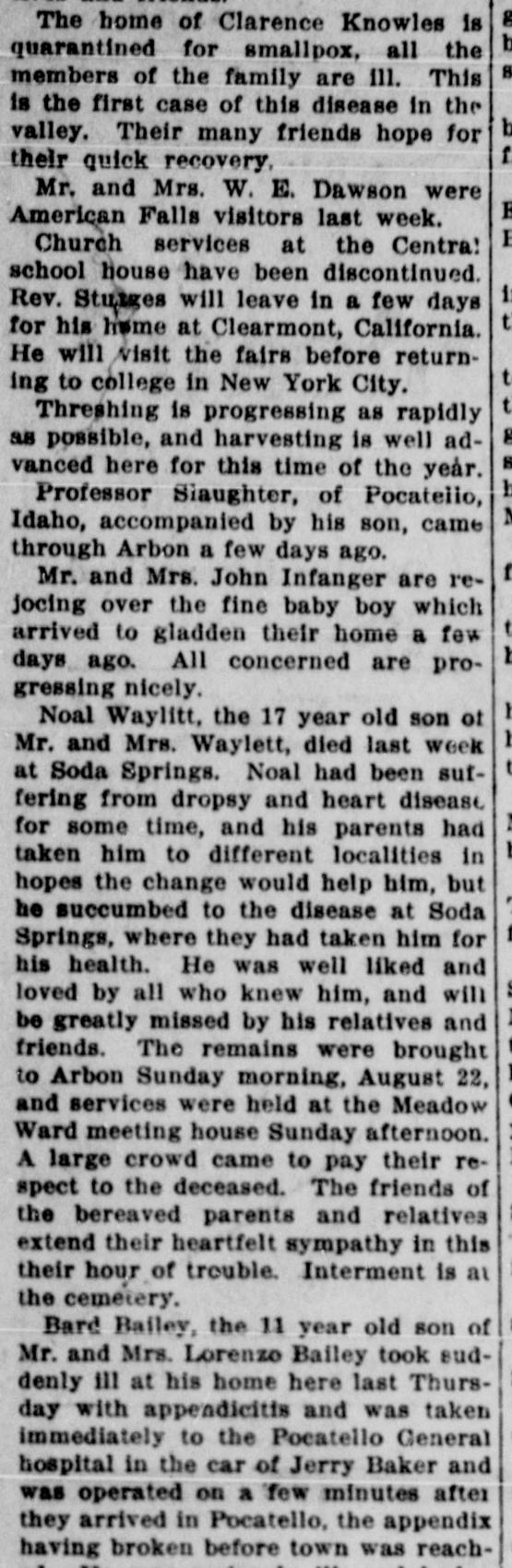 View photograph ↗
For Arbon Valley's sick in 1915, the doctor was a long ride away
Through 1915 Arbon Valley carried its sick and hurt over the mountain to Malad, across the reservation to Pocatello or down to Ogden, until a long-distance telephone line reached the valley in December.
From: For Arbon Valley's sick in 1915, the doctor was a long ride away ↗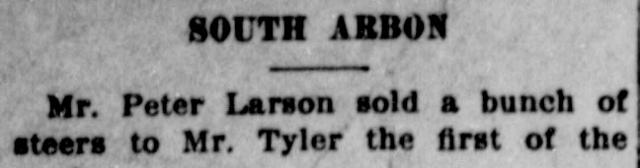 View photograph ↗
For the south end in 1915, the road to market ran over the mountain to Malad
Through the summer and fall of 1915 the South Arbon news column followed hogs, grain, machinery and patients over the mountain road to Malad, the town the valley's south end relied on.
From: For the south end in 1915, the road to market ran over the mountain to Malad ↗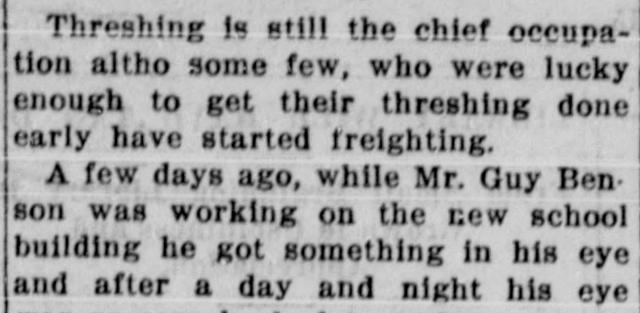 View photograph ↗
Arbon Valley's biggest wheat year brings its first combines
In 1915 Arbon Valley sowed more wheat than ever, cut some of it with its first combines and threshed the rest with short-handed crews through a dry, fire-prone fall.
From: Arbon Valley's biggest wheat year brings its first combines ↗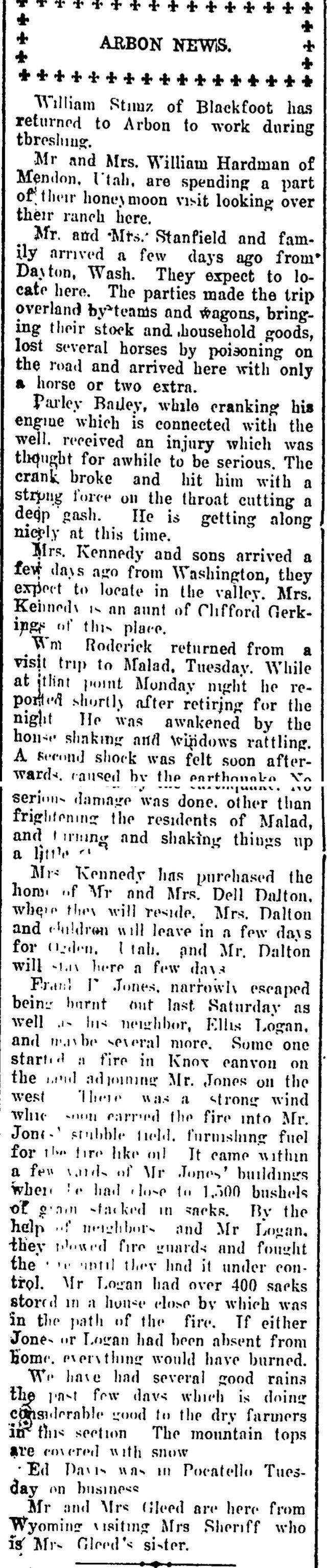 View photograph ↗
Dayton family reaches Arbon by wagon, and neighbors stop a fire at Knox Canyon
A family from Dayton, Washington, came into Arbon by wagon after losing horses to poison on the road, in the same week that neighbors plowed fire guards to save 1,500 bushels of sacked grain near Knox Canyon.
From: Dayton family reaches Arbon by wagon, and neighbors stop a fire at Knox Canyon ↗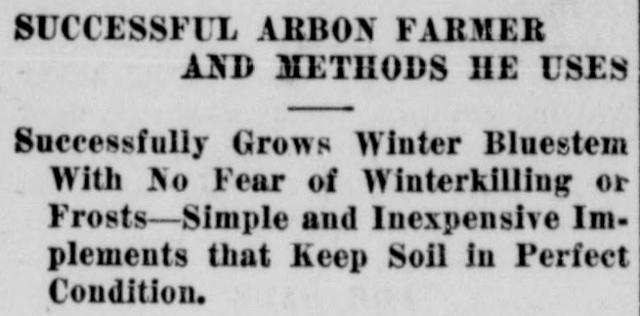 View photograph ↗
An Arbon farmer's wheat comes in clean in a smutty year
In the fall of 1915, while smut ran through Arbon Valley wheat, Power County's new agent found none in Henry Shandrew's grain, and that same year a plant taken from a field near Arbon became a wheat immune to bunt.
From: An Arbon farmer's wheat comes in clean in a smutty year ↗ View photograph ↗
A new road across the reservation, and a county quarrel over the bill
In 1915 Power County hurried a road for Bannock Valley north across the Fort Hall Reservation before allotment could shut the way, then fell to quarreling over who should pay for it.
From: A new road across the reservation, and a county quarrel over the bill ↗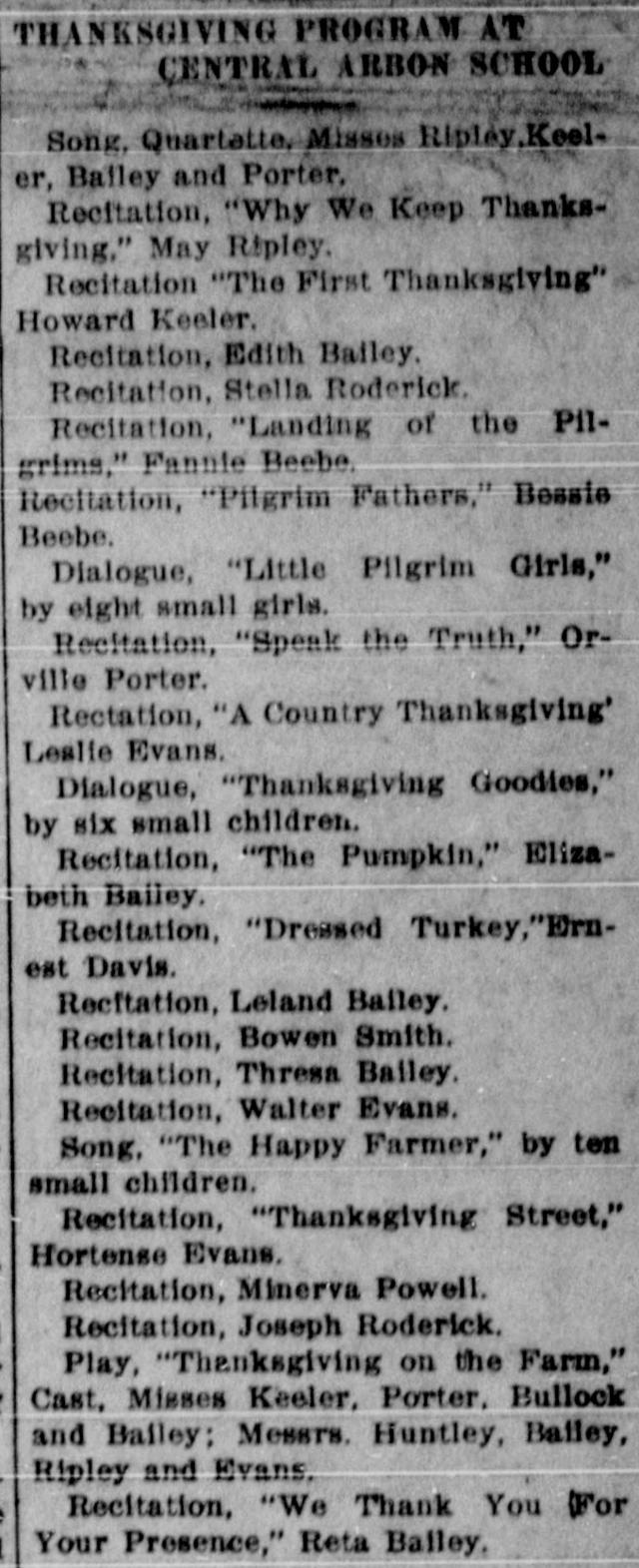 View photograph ↗
Storm or no storm, Central school children take the stage for Thanksgiving and Christmas
In the stormy late fall of 1915 the pupils of Arbon's Central school gave a Thanksgiving program and a Christmas Eve cantata, and the *Press* printed every part and nearly every child's name.
From: Storm or no storm, Central school children take the stage for Thanksgiving and Christmas ↗ View photograph ↗
After years of waiting, Arbon Valley is connected to the world
Arbon Valley formed its own telephone company in 1913 and talked over barbed wire for two years until the long-distance line from American Falls finally reached it in December 1915.
From: After years of waiting, Arbon Valley is connected to the world ↗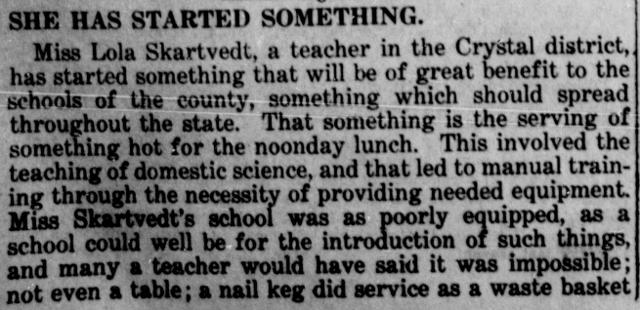 View photograph ↗
A Crystal teacher starts something with a hot lunch on Clifton Creek
In 1915 Lola Skartvedt began cooking hot noon lunches with her pupils in a bare shack school on Clifton Creek near Crystal, and the county paper said the idea should spread statewide.
From: A Crystal teacher starts something with a hot lunch on Clifton Creek ↗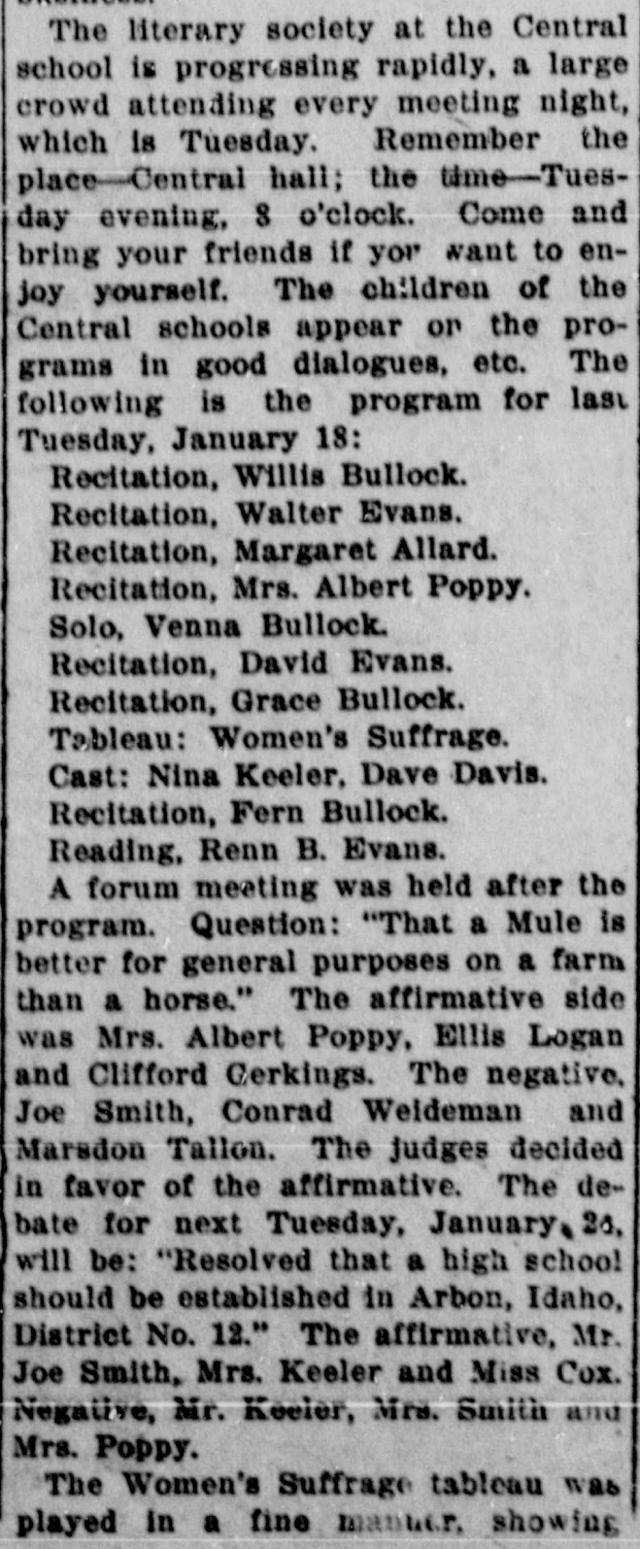 View photograph ↗
A washboard, a mule and a high school: Arbon's literary society takes the stage
Through the stormy winter of 1915–16, neighbors at the north end of Arbon Valley crowded into the Central school on Tuesday nights to recite, read, play music and debate everything from mules to a high school for Arbon.
From: A washboard, a mule and a high school: Arbon's literary society takes the stage ↗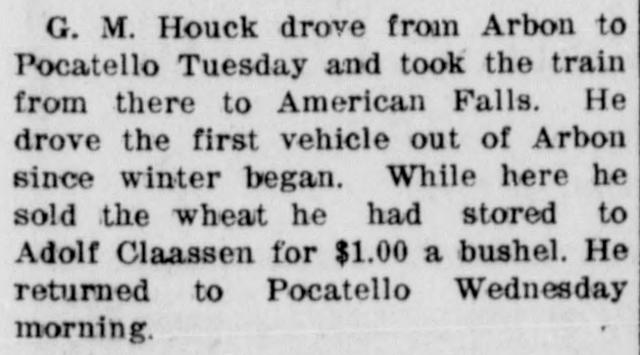 View photograph ↗
First vehicle out of Arbon after a winter of three-foot snow
Storms buried Arbon Valley in about three feet of snow in early 1916 and cut its new telephone line; in February the paper reported the first vehicle out since winter began.
From: First vehicle out of Arbon after a winter of three-foot snow ↗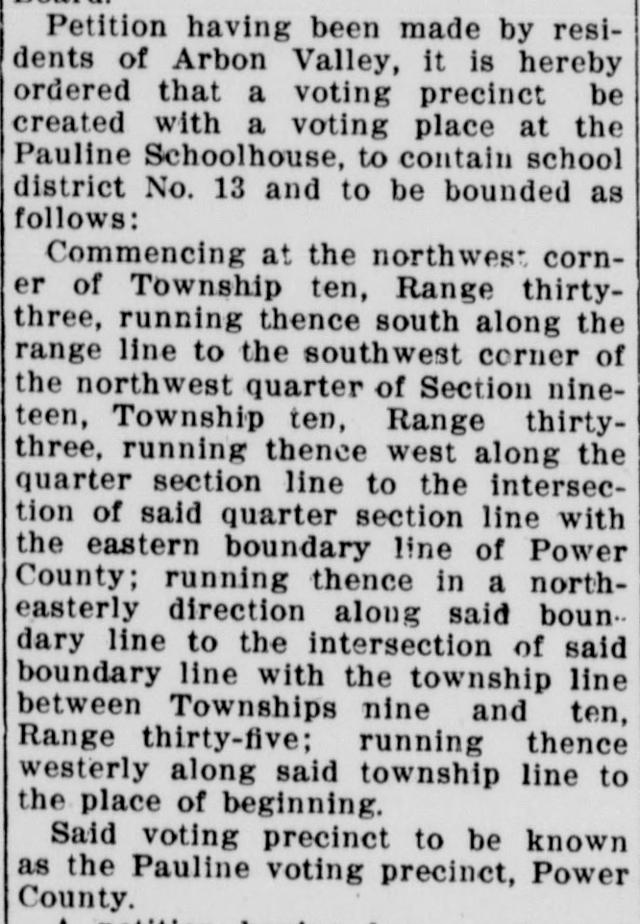 View photograph ↗
Pauline gets its own polling place, and a valley man goes to the county board
In the spring of 1916 the Pauline schoolhouse became a polling place, and that fall two valley men, Gus Brahmstadt and John Noble, ran for the valley's seat on the Power County board.
From: Pauline gets its own polling place, and a valley man goes to the county board ↗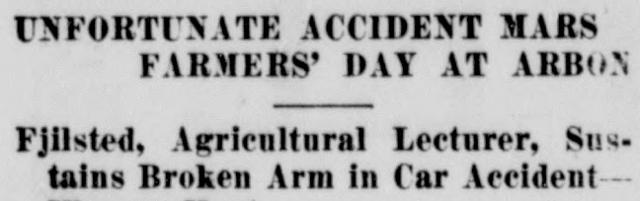 View photograph ↗
A wreck mars Arbon's first fair, and Allard answers a critic
Arbon's first community fair, held at the Central school on May 10, 1916, had a band, exhibits and speeches until a borrowed car overturned, and a few weeks later William Allard answered an unsigned critic of the day.
From: A wreck mars Arbon's first fair, and Allard answers a critic ↗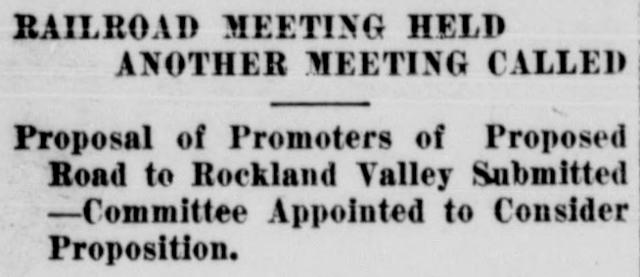 View photograph ↗
Arbon Valley farmers pledge a dollar an acre for a railroad that never came
For eight years Arbon Valley farmers petitioned, met, signed notes at a dollar an acre and backed one railroad scheme after another, and in May 1916 the promoters carried the plan to American Falls, but no line was ever built.
From: Arbon Valley farmers pledge a dollar an acre for a railroad that never came ↗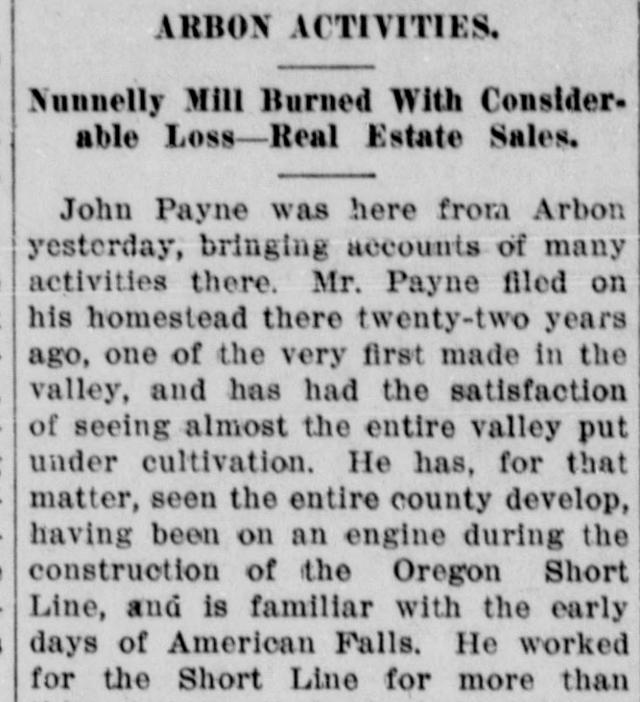 View photograph ↗
John Payne, the mayor of Arbon that no one elected
An American Falls paper made pioneer John Payne the mayor of Arbon in fun, and over the next two years its columns showed a retired Short Line engineer at work as dry farmer, sawmill owner, justice and would-be county commissioner.
From: John Payne, the mayor of Arbon that no one elected ↗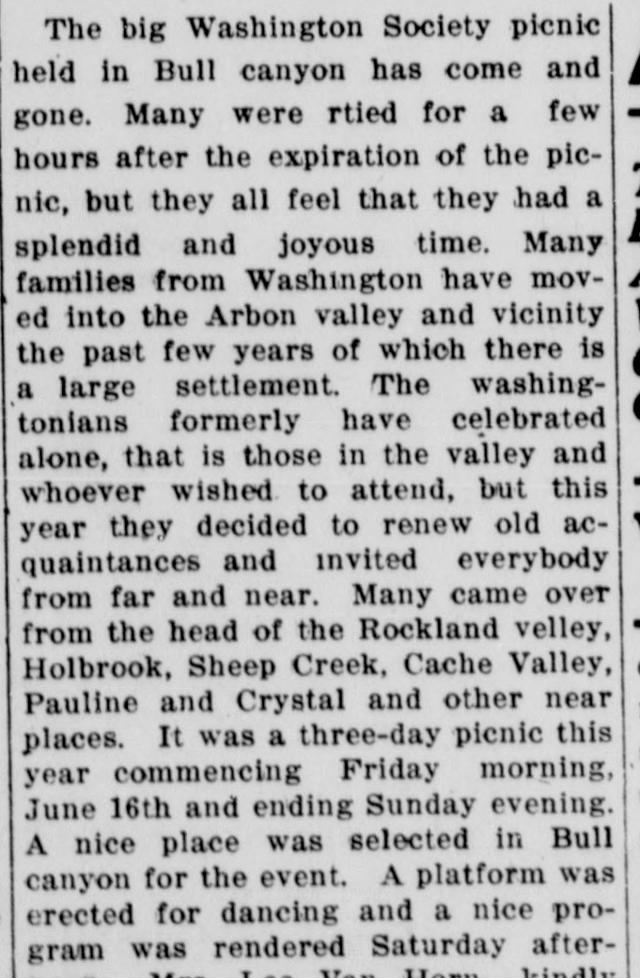 View photograph ↗
Washington settlers throw open their Bull Canyon picnic to the whole county
Seven years after one newspaper mailed to Dayton drew the first Washington homesteaders to Arbon Valley, their settlement held a three-day picnic in Bull Canyon in June 1916 and invited everyone.
From: Washington settlers throw open their Bull Canyon picnic to the whole county ↗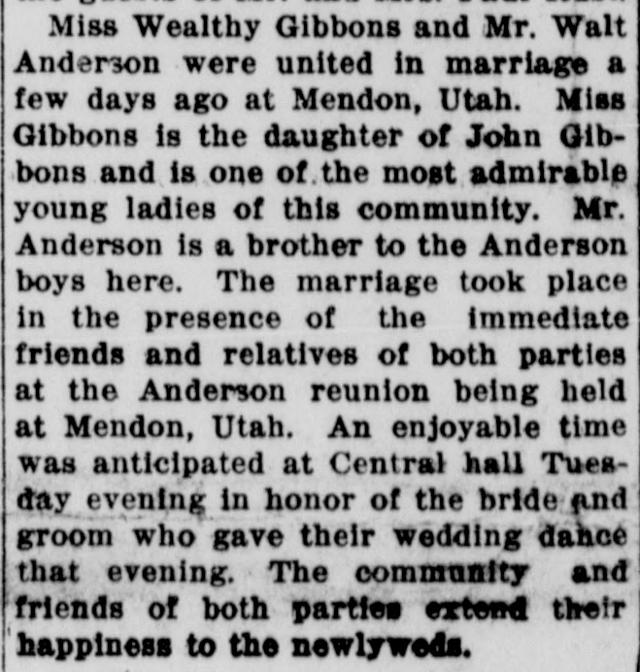 View photograph ↗
Walt Andersen and Wealthy Gibbons marry at the family reunion in Mendon
Walt Andersen and Wealthy Gibbons of Arbon were married at the Andersen reunion in Mendon in June 1916, and by Christmas her father had taken out a licence to marry Walt's sister Catherine.
From: Walt Andersen and Wealthy Gibbons marry at the family reunion in Mendon ↗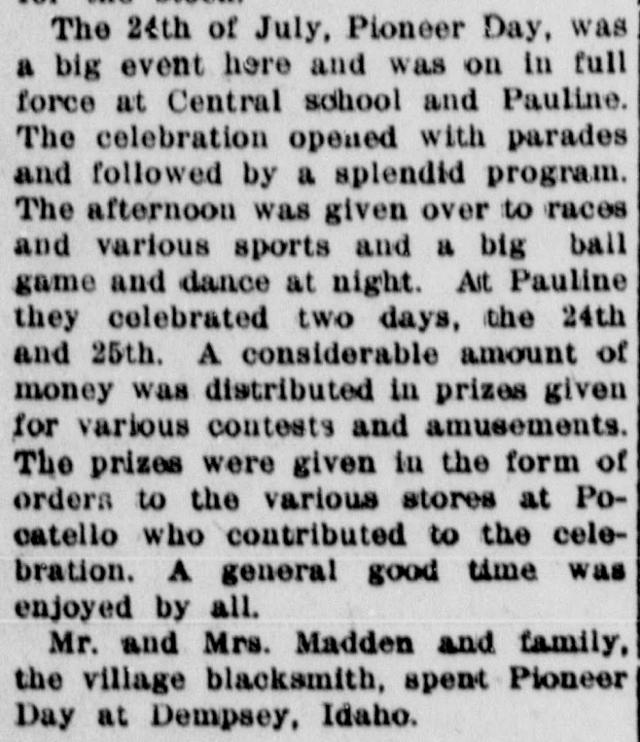 View photograph ↗
Arbon Valley keeps Pioneer Day with parades, races and dances
From a 1916 parade to the Central school to the opening of Arbon's new hall in 1929, the valley kept every July 24 with programs, races, bucking contests and dances that ran late.
From: Arbon Valley keeps Pioneer Day with parades, races and dances ↗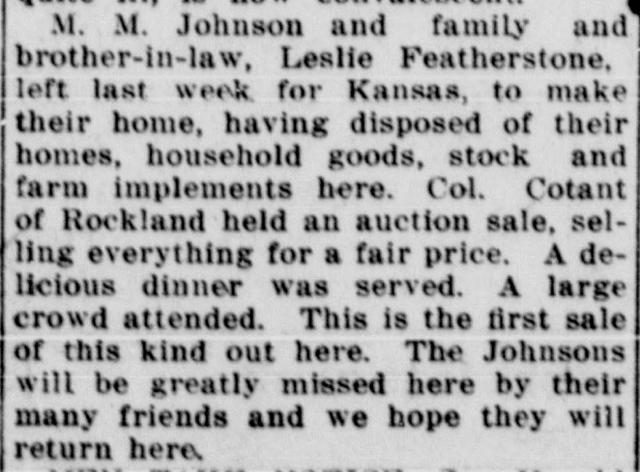 View photograph ↗
A Kansas bride at Arbon, and the sale that took her husband home
Married at Pocatello in the spring of 1915, Ida Featherston likely played the organ for a new Arbon Sunday school, died at her valley home in May 1916 and was sent home to Kansas for burial, and that fall her husband sold out at the valley's first farm auction.
From: A Kansas bride at Arbon, and the sale that took her husband home ↗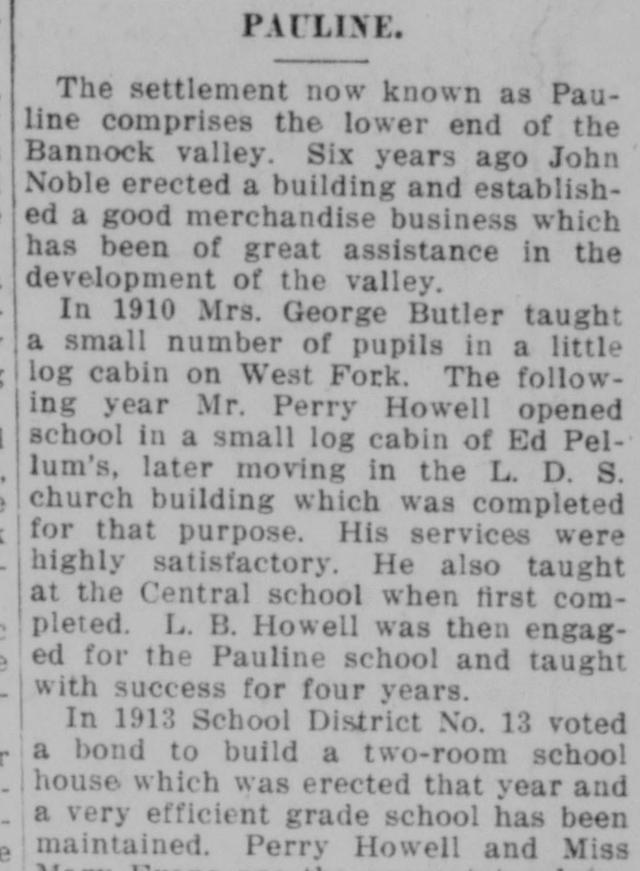 View photograph ↗
Pauline grows up around a store, a log-cabin school and the Meadow Ward
How Pauline got its store, school and post office, and how its Meadow Ward fared under its first bishop, Wilhelm F. Kowallis, from 1911 to his farewell in 1918.
From: Pauline grows up around a store, a log-cabin school and the Meadow Ward ↗ View photograph ↗
Crystal, hidden up Rattlesnake Creek, is a valley strangers cannot find
Six years after it was a new settlement wanting a school, Crystal had about 150 families in a basin so well hidden that the American Falls Press said strangers could not find the road in.
From: Crystal, hidden up Rattlesnake Creek, is a valley strangers cannot find ↗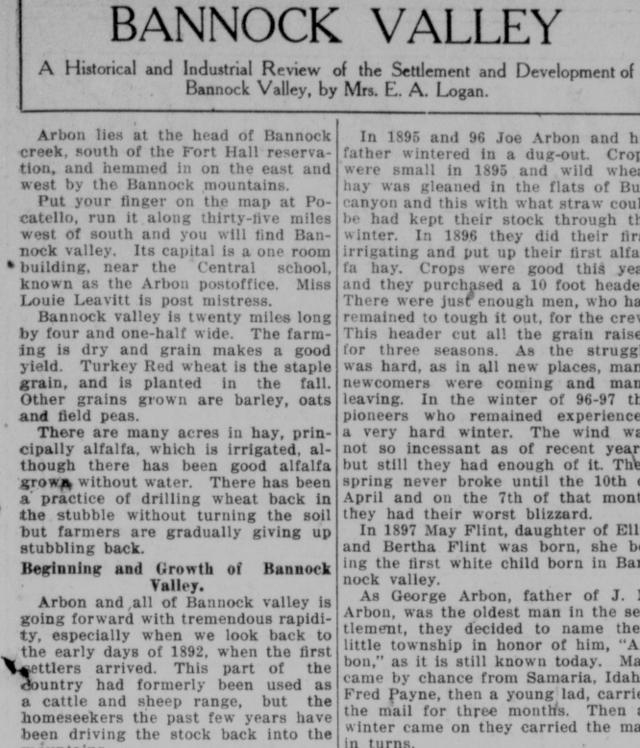 View photograph ↗
Mrs. Logan tells how the squatters took up Bannock Valley
In 1917 Mrs. E. A. Logan wrote down how a handful of squatters settled Bannock Valley in the 1890s, and in 1920 she told it again as a birthday tribute to George Arbon.
From: Mrs. Logan tells how the squatters took up Bannock Valley ↗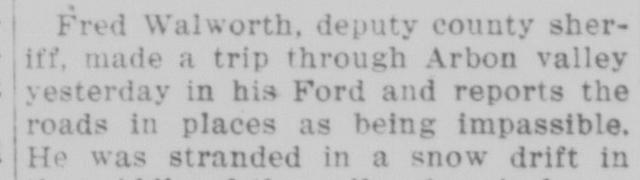 View photograph ↗
A June snowdrift and a broken bridge: the roads to town in 1917
In 1917 a deputy sheriff was stranded six hours in a June snowdrift, a mail carrier forded floodwater and a Portneuf bridge broke under a load of Crystal grain.
From: A June snowdrift and a broken bridge: the roads to town in 1917 ↗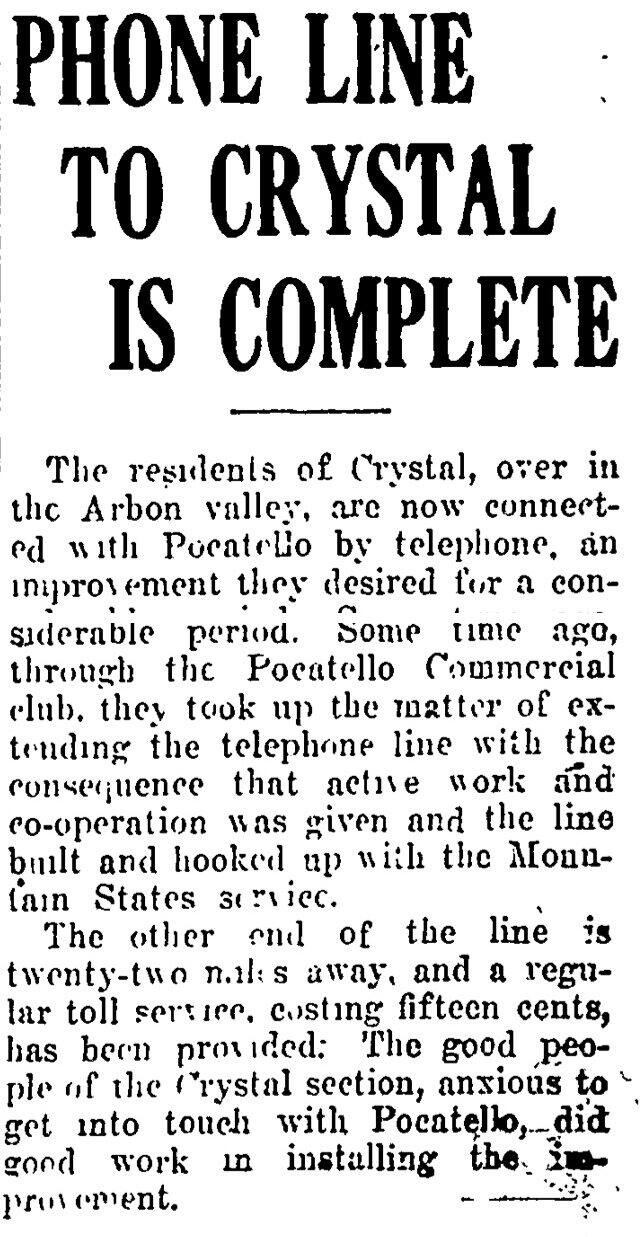 View photograph ↗
Crystal settlers finish their own telephone line to Pocatello
Crystal settlers set light poles toward Pocatello in the winter of 1917 with Commercial Club money, and by July the line was joined to Mountain States at a fifteen-cent toll.
From: Crystal settlers finish their own telephone line to Pocatello ↗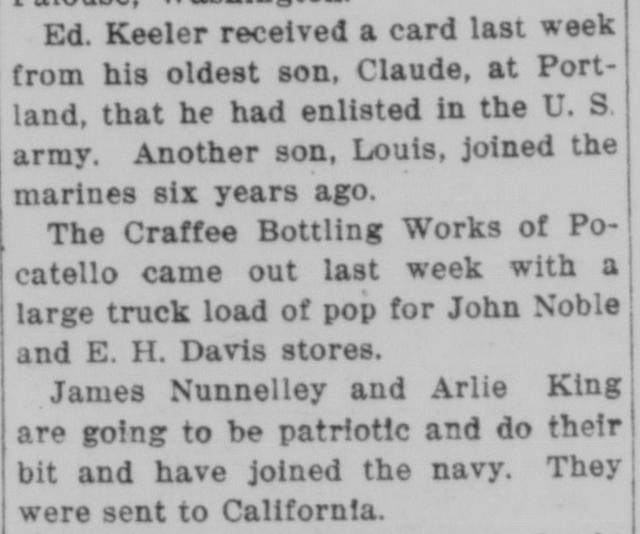 View photograph ↗
Before the draft called them, valley men were already enlisting
Through 1917, while the new draft was still being drawn, young men of Arbon and Crystal walked into recruiting offices at Pocatello, Salt Lake City and Portland, and the papers set down their names a few at a time.
From: Before the draft called them, valley men were already enlisting ↗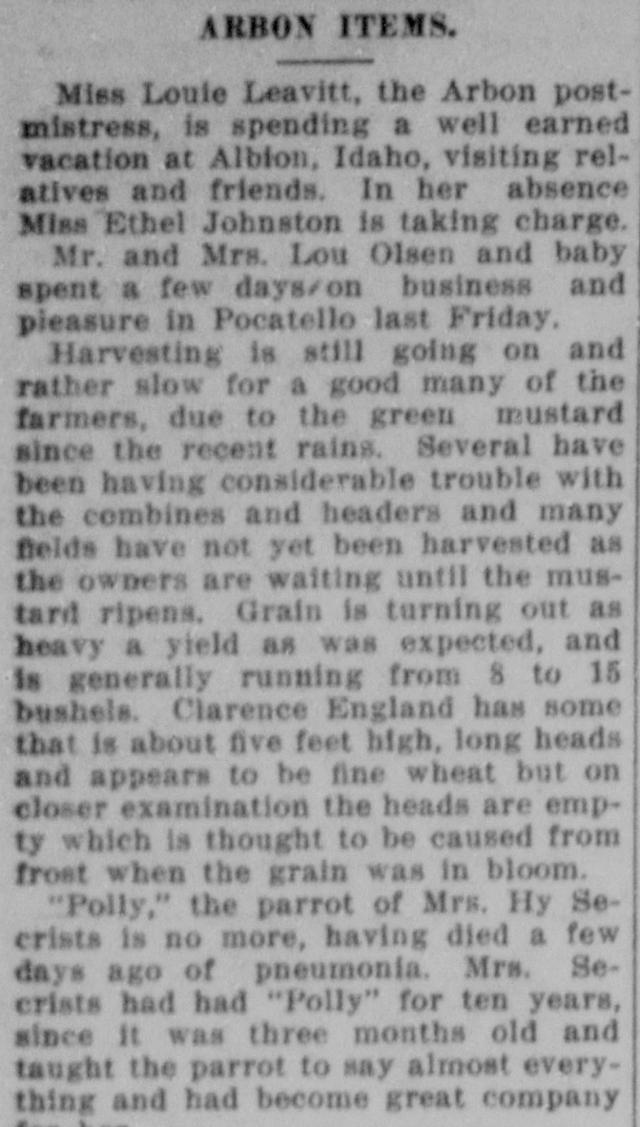 View photograph ↗
Arbon neighbors hear a car at the gate, and it turns out to be an aeroplane
In the first week of September 1917 the Arbon correspondent of the American Falls Press told of an aeroplane that neighbors saw or heard crossing the valley after dark, a dozen years before any flight over Arbon was put on record.
From: Arbon neighbors hear a car at the gate, and it turns out to be an aeroplane ↗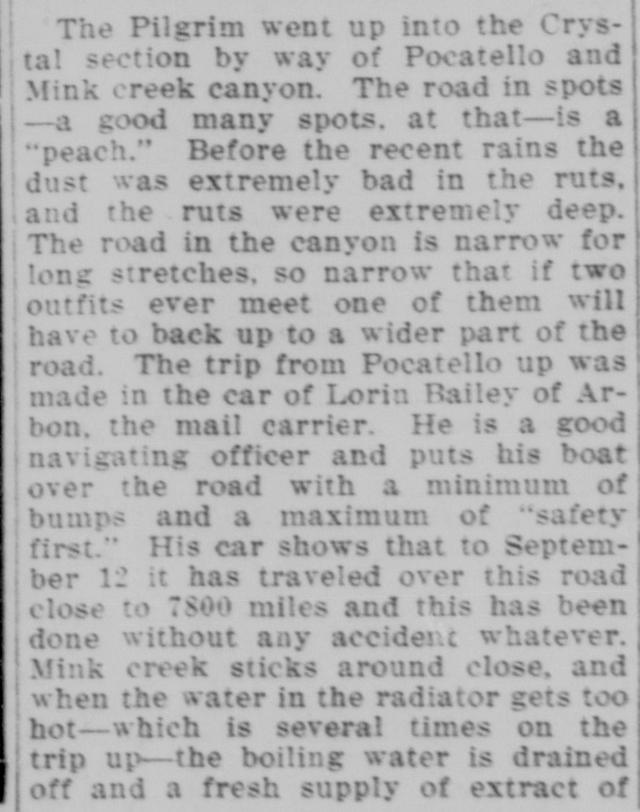 View photograph ↗
A roving farm writer called the Pilgrim walks the Arbon Valley roads
In the fall of 1917 the American Falls Press sent a farm writer who signed himself the Pilgrim over the roads of Crystal, Pauline and Arbon, mostly on foot, and he wrote down what he met along the way.
From: A roving farm writer called the Pilgrim walks the Arbon Valley roads ↗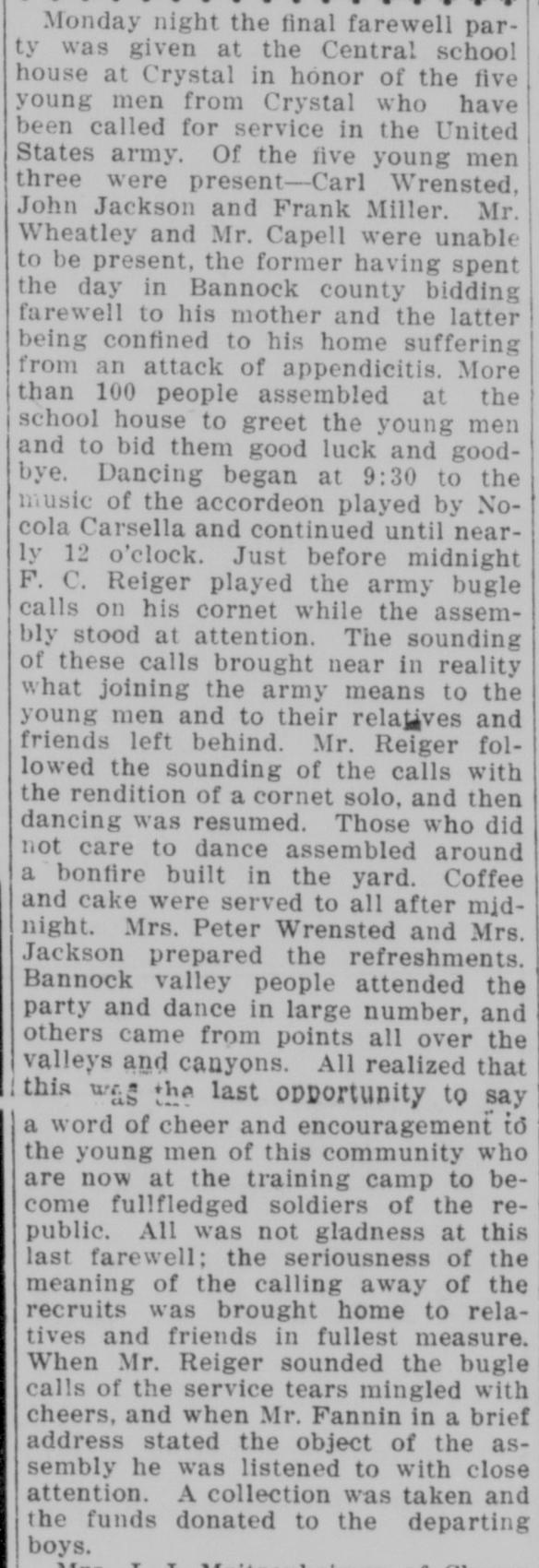 View photograph ↗
Bugle calls at midnight as the valley sends off its draft men
In the fall of 1917 Arbon and Crystal danced, built bonfires and stood for a cornetist's bugle calls to send the valley's first draft men off to Camp Lewis.
From: Bugle calls at midnight as the valley sends off its draft men ↗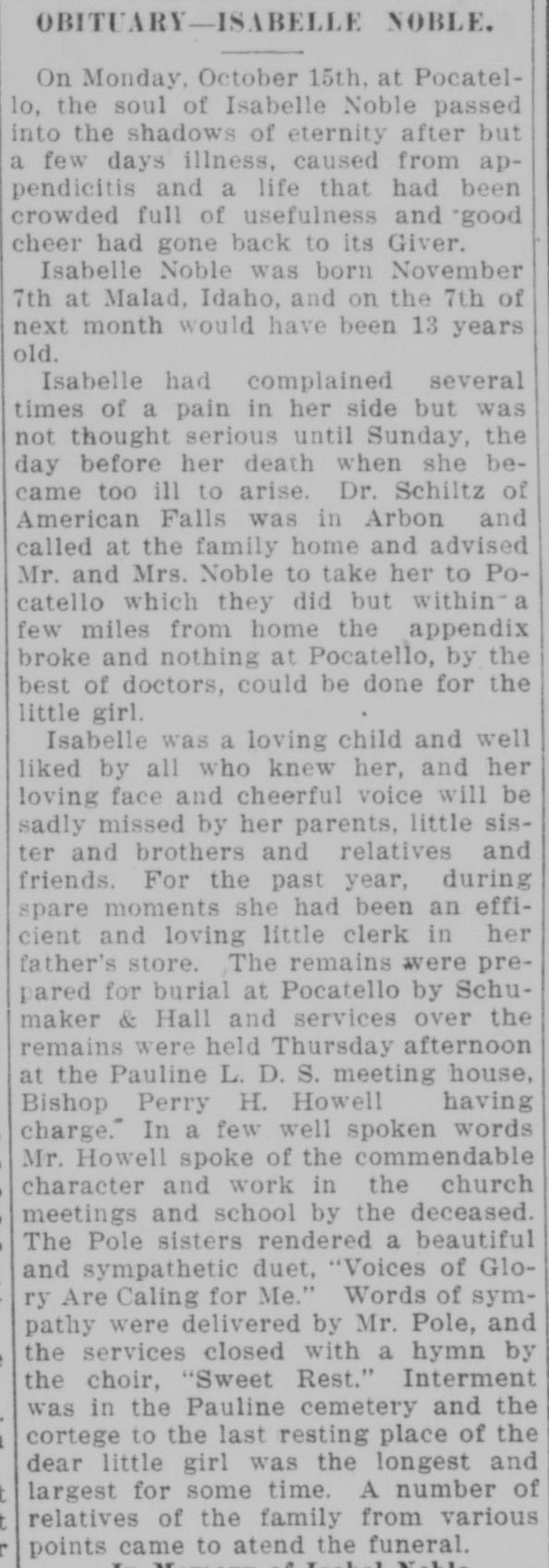 View photograph ↗
Isabelle Noble, little clerk of the Pauline store, dies at 12
Isabelle Noble, 12, who helped behind the counter of her father's store at Pauline, died of a burst appendix in 1917, one of four children John and Fanny Noble buried between 1915 and 1921.
From: Isabelle Noble, little clerk of the Pauline store, dies at 12 ↗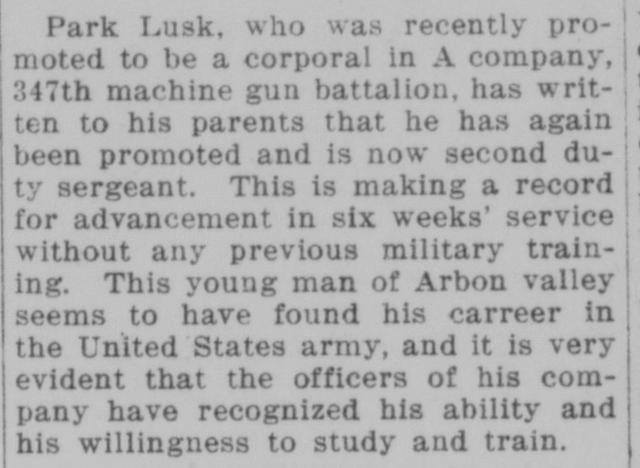 View photograph ↗
Two Lusk brothers of Pauline marry two Bailey sisters of Arbon
Six weeks after he was drafted in 1917, Park Lusk of Pauline had been promoted twice, and the papers went on to follow him, his brother Dave and the Bailey sisters they married through war, a young wife's death and the obituaries of the 1950s.
From: Two Lusk brothers of Pauline marry two Bailey sisters of Arbon ↗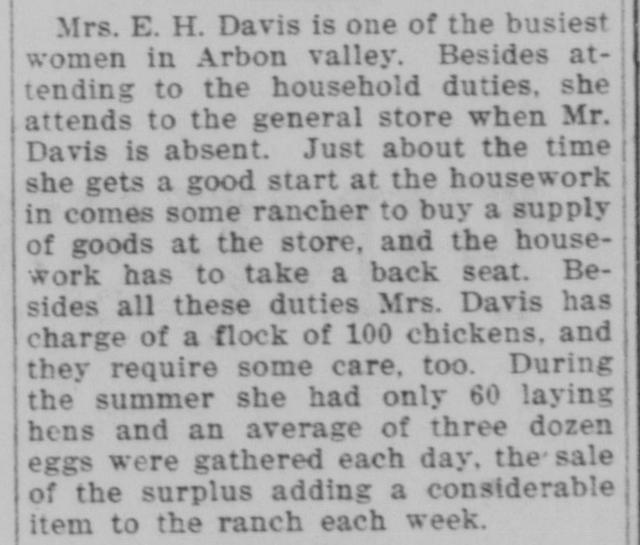 View photograph ↗
At the Davis store, the housework takes a back seat
Esther Davis kept house, kept chickens and kept the counter of the general store she and Ed Davis ran at Arbon, a valley landmark until 1931.
From: At the Davis store, the housework takes a back seat ↗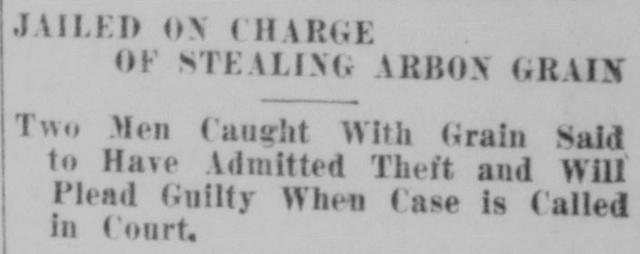 View photograph ↗
A deputy behind a telephone pole catches the Pauline wheat thieves
In November 1917 a Pauline wheat buyer followed a stolen load by lantern, and Deputy Sheriff Hy Secrist waited for the thieves behind a telephone pole.
From: A deputy behind a telephone pole catches the Pauline wheat thieves ↗ View photograph ↗
With the coal bins empty, Arbon Valley goes back to the canyons for wood
In the fall of 1917, with coal scarce, an American Falls Press farm writer found Arbon Valley ranchers hauling fuel from the same canyons that had given them the logs for their cabins.
From: With the coal bins empty, Arbon Valley goes back to the canyons for wood ↗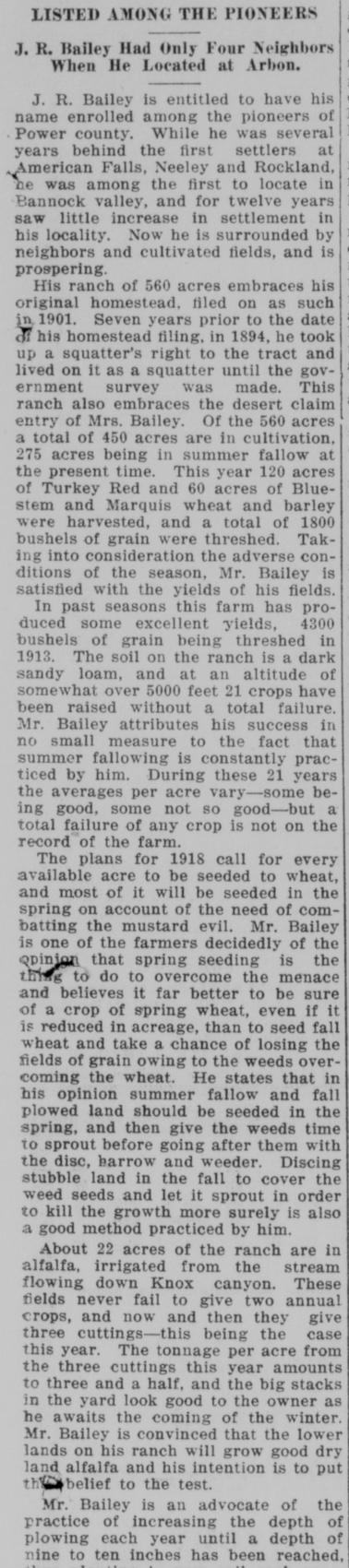 View photograph ↗
Ten cents, two cows and a greased pig built the Bailey ranch at Arbon
J. R. and Annie Bailey reached Arbon with ten cents, two cows and some debts, and by 1917 a farm writer found them on 560 acres, with a greased pig still part of the family lore at their golden wedding in 1940.
From: Ten cents, two cows and a greased pig built the Bailey ranch at Arbon ↗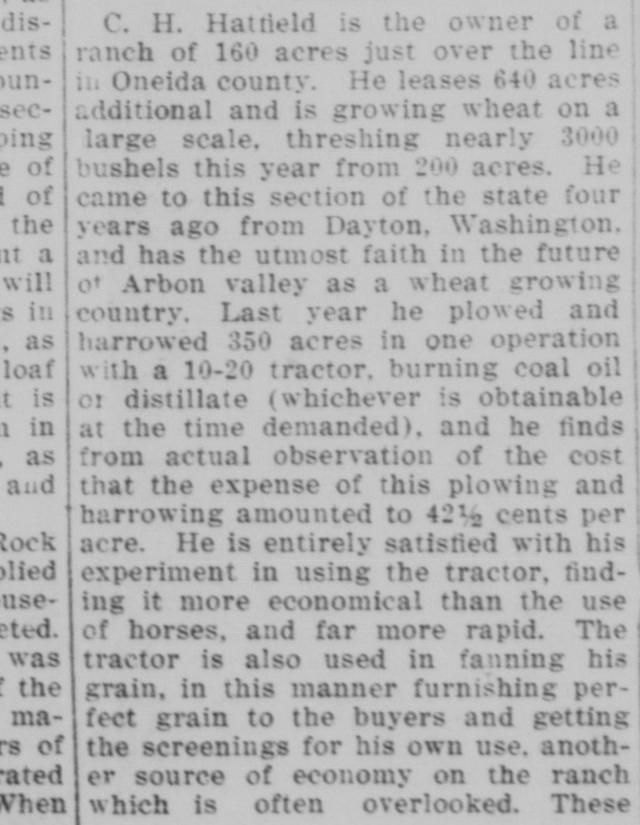 View photograph ↗
Hatfield's tractor plows 350 acres in a valley of horse teams
From a 10-20 tractor plowing 350 acres in 1916 to a Fordson on a 1921 sale bill, the papers show the first tractors at work beside Arbon Valley's big horse teams.
From: Hatfield's tractor plows 350 acres in a valley of horse teams ↗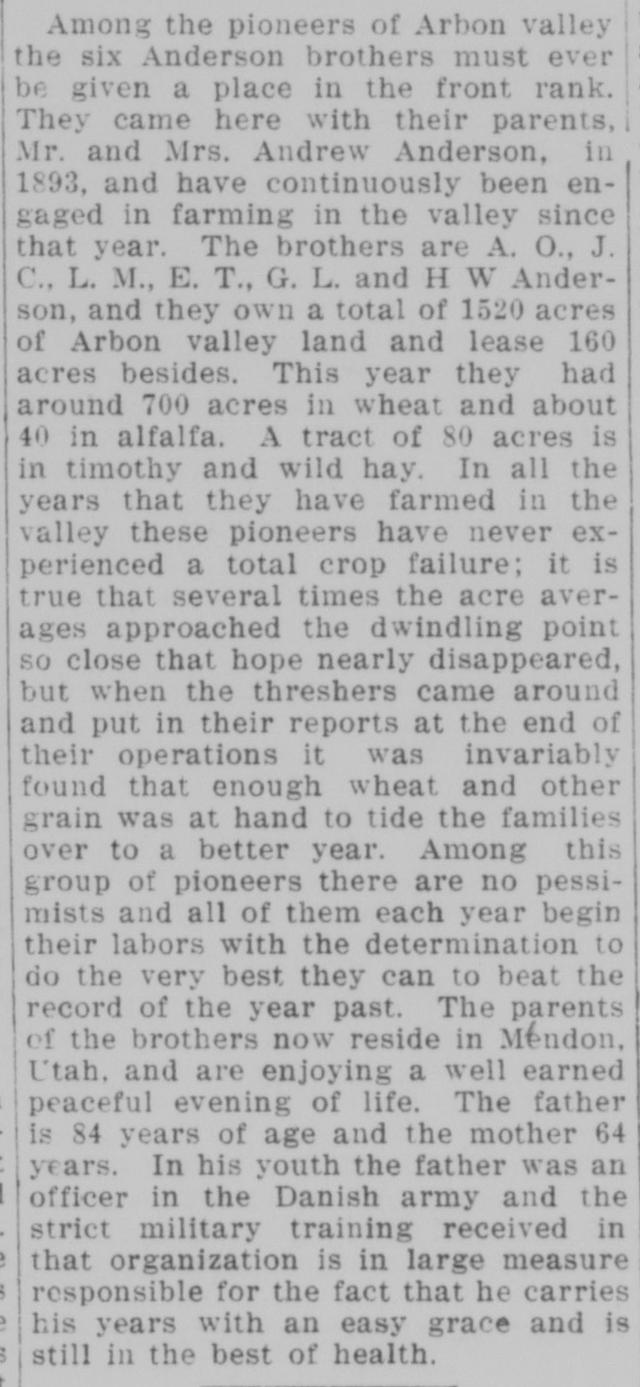 View photograph ↗
In Mendon, the Arbon Andersens kept coming home to their mother
Sophia Andersen never lived in Arbon Valley, yet from 1917 to her death in 1939 the papers show her Arbon sons, daughters and grandchildren making their way back to her house in Mendon, Utah.
From: In Mendon, the Arbon Andersens kept coming home to their mother ↗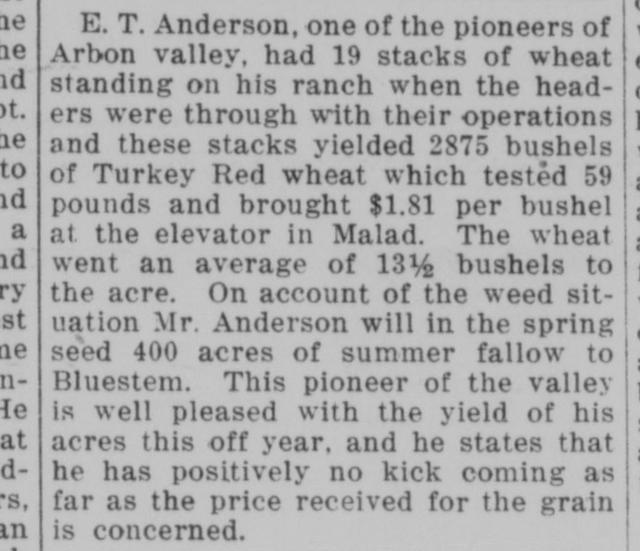 View photograph ↗
Through hail and mustard, Arbon Valley's 1917 wheat brings wartime prices
In the first year of America's war, Arbon Valley's dry-farm wheat came through hail, heat and Jim Hill mustard to a thin harvest that sold for as much as $1.95 a bushel.
From: Through hail and mustard, Arbon Valley's 1917 wheat brings wartime prices ↗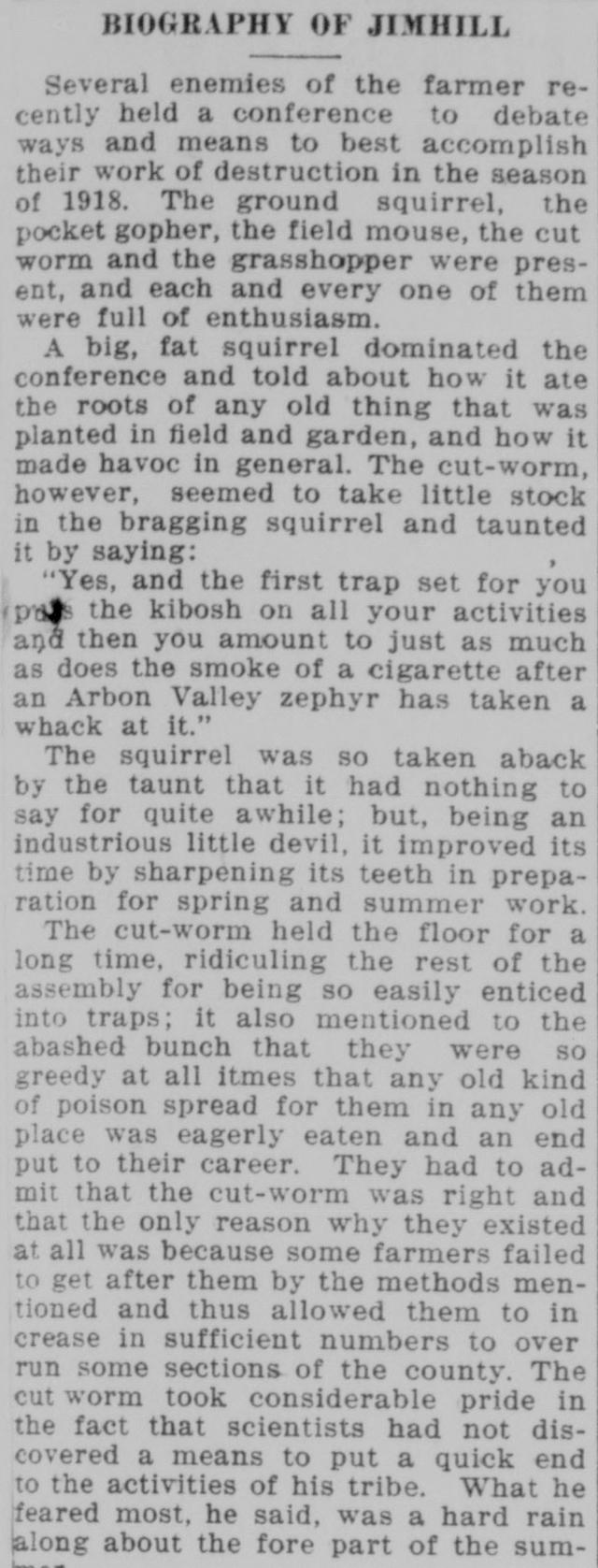 View photograph ↗
Arbon Valley goes to war on Old Jim Hill, and the weed talks back
In 1917 and 1918 Arbon Valley's wheat farmers fought Jim Hill mustard, a weed that rolled across the country as a tumbleweed, and the Press's roving farm writer gave the weed a chance to boast.
From: Arbon Valley goes to war on Old Jim Hill, and the weed talks back ↗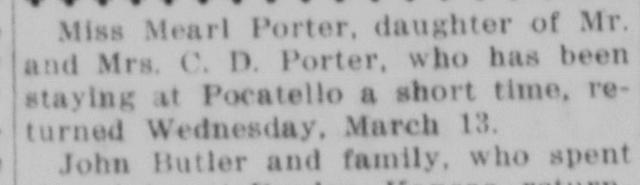 View photograph ↗
Arbon Valley families winter away and the spring columns count them home
In the fall of 1917 many Arbon Valley families left their farms for the winter, a few stayed by choice, and in March 1918 the valley columns counted them home.
From: Arbon Valley families winter away and the spring columns count them home ↗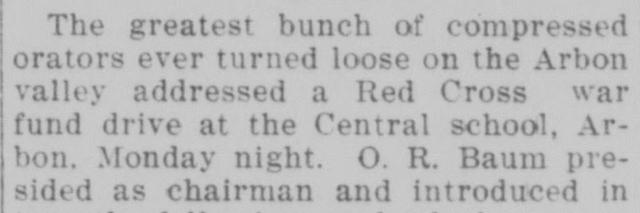 View photograph ↗
Arbon bids up a cake as the valley opens the Red Cross drive
On one May night in 1918, Arbon outbid the speakers from American Falls for a Red Cross cake while Pauline heard four speakers and Crystal raised its whole quota before going home.
From: Arbon bids up a cake as the valley opens the Red Cross drive ↗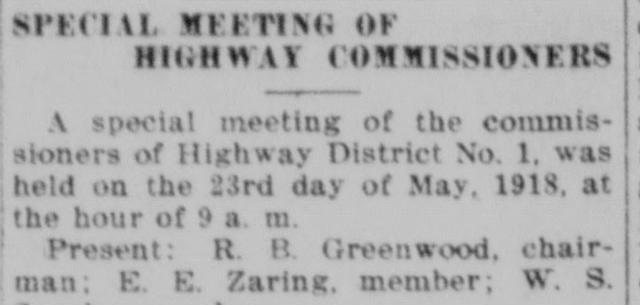 View photograph ↗
The road to Michaud must follow the allotment lines
When the Fort Hall lands on lower Bannock Creek were divided into allotments, the valley's road to Michaud had to move, Pauline farmers leased allotted ground, and by 1922 the land of allottees who had died was up for sale.
From: The road to Michaud must follow the allotment lines ↗ View photograph ↗
Pocatello paper calls the spoiled Pauline wheat "rank fiction"
In June 1918 the Pocatello Tribune called the Nonpartisan League's charge that Pauline wheat had rotted "rank fiction," a month after its own report that some of it had spoiled.
From: Pocatello paper calls the spoiled Pauline wheat "rank fiction" ↗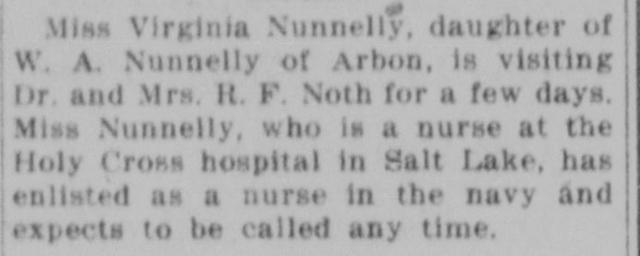 View photograph ↗
Four sisters from Summit answer the call as nurses
One after another, four daughters of W. A. Nunnelley of Summit trained as nurses, and the papers traced them through a Navy enlistment, the influenza of 1918–19 and a Logan diploma in 1920.
From: Four sisters from Summit answer the call as nurses ↗ View photograph ↗
Half a million bushels of wheat and no railroad to haul it
In 1918 Arbon Valley expected nearly half a million bushels of wheat with the railroad 25 to 35 miles away, and its call for motor trucks reached the national trade press.
From: Half a million bushels of wheat and no railroad to haul it ↗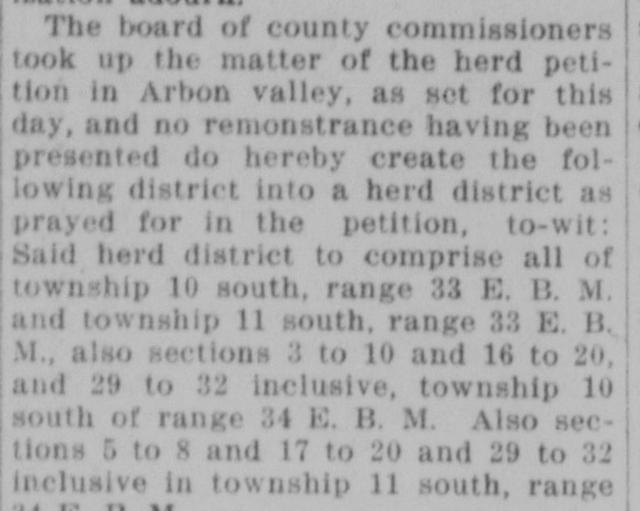 View photograph ↗
Arbon Valley gets its herd district, and no one objects
In July 1918 the Power County commissioners heard a petition from Arbon Valley residents for a herd district and, with no one standing against it, created the district on July 27.
From: Arbon Valley gets its herd district, and no one objects ↗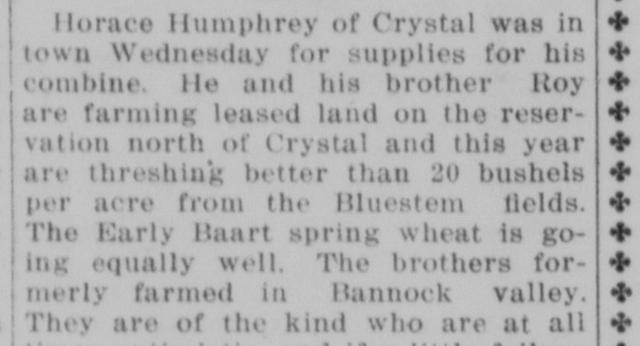 View photograph ↗
Smiling through the lean years, the Humphrey brothers thresh twenty bushels at Crystal
Brothers Horace and Roy Humphrey kept smiling through good years and bad on the dry farms of Arbon and Crystal, and two of Horace's Arbon-born sons later made their way to Barrow, Alaska, and Promontory, Utah.
From: Smiling through the lean years, the Humphrey brothers thresh twenty bushels at Crystal ↗ View photograph ↗
Influenza sweeps Arbon Valley with no doctor within forty miles
In the fall of 1918 the Spanish influenza reached Arbon Valley a few weeks after its one doctor had gone back to Pocatello, and whole families fell ill together.
From: Influenza sweeps Arbon Valley with no doctor within forty miles ↗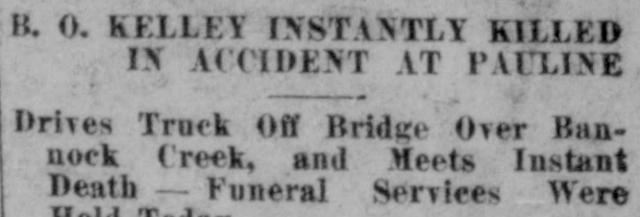 View photograph ↗
Wheat hauler B. O. Kelley killed in the dark at the Pauline bridge
Before daylight on December 23, 1918, B. O. Kelley, hauling Pauline wheat for the Zaring Grain Company, drove his truck off the Bannock Creek bridge at Pauline and was killed, two days before Christmas.
From: Wheat hauler B. O. Kelley killed in the dark at the Pauline bridge ↗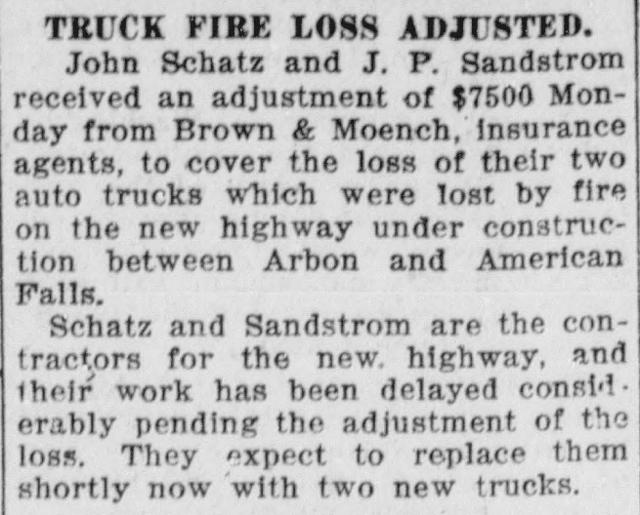 View photograph ↗
Arbon Valley builds its new road in a summer without rain
In 1919 Arbon Valley's new highway district started grading and graveling the Bannock Creek road, lost two contractors' trucks to fire, and by August was counting on the road work to carry farmers through a drought.
From: Arbon Valley builds its new road in a summer without rain ↗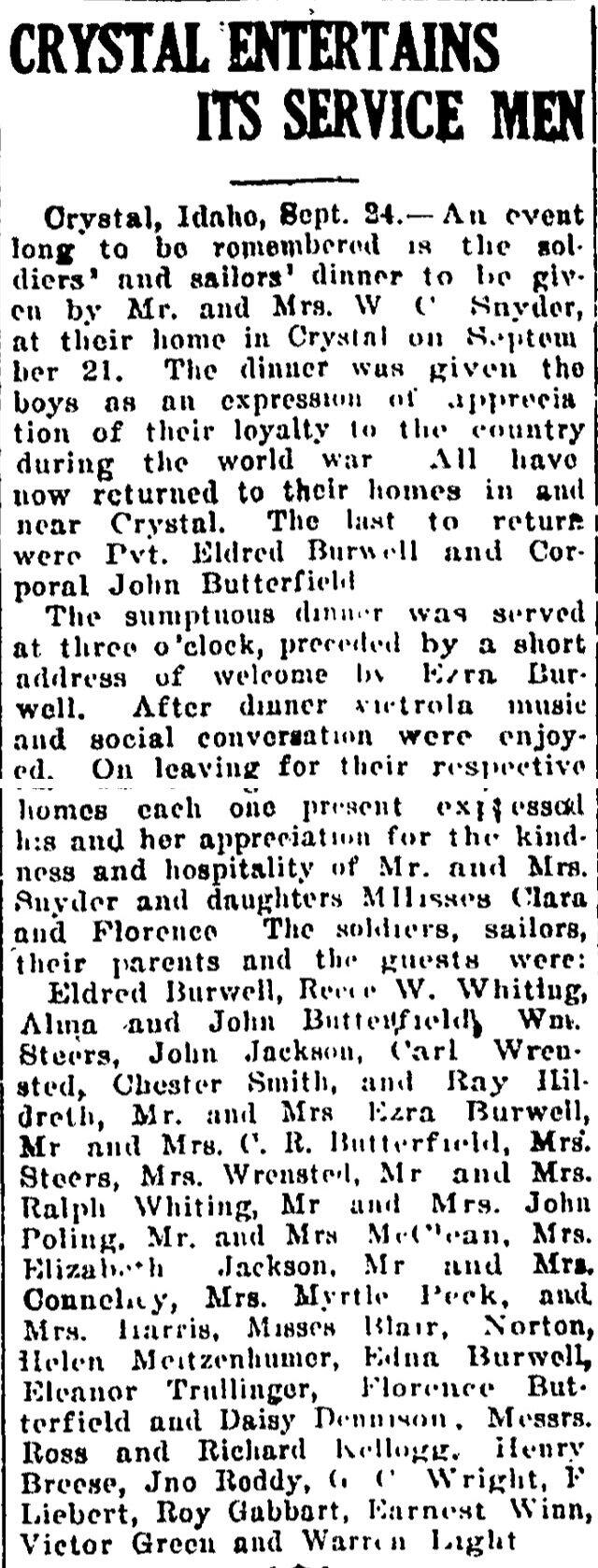 View photograph ↗
Crystal sits its returned soldiers down to dinner
With the last of Crystal's soldiers home from the war, W. C. and Cora Snyder gave the men, their families and their friends a Sunday dinner at their home in September 1919.
From: Crystal sits its returned soldiers down to dinner ↗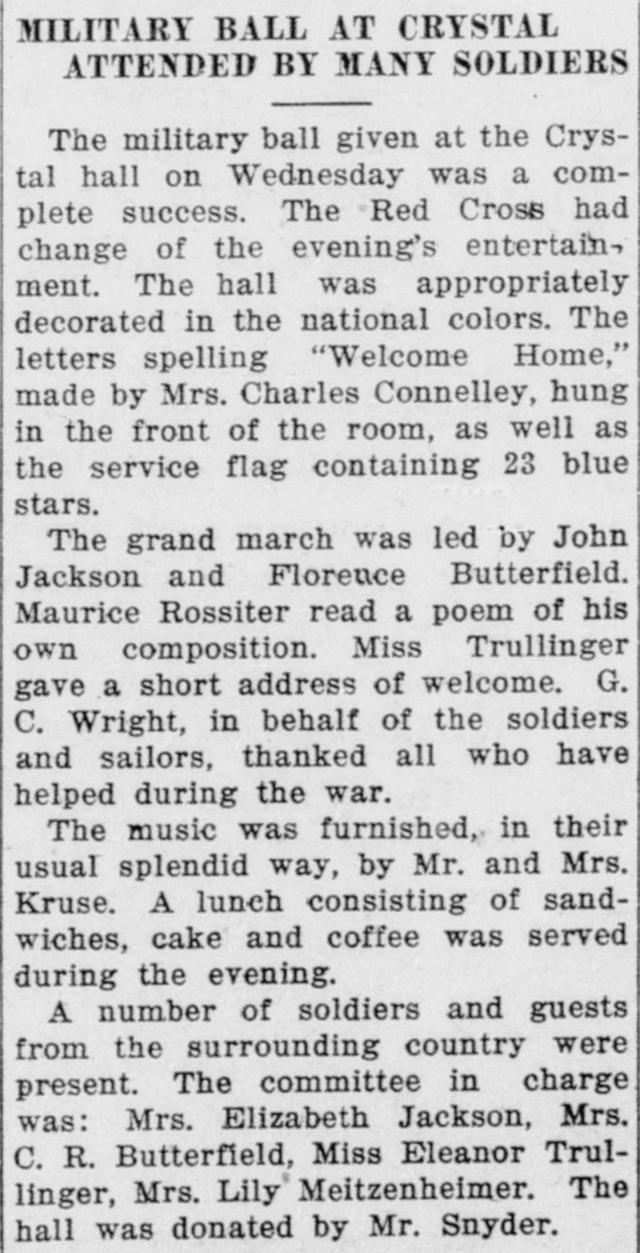 View photograph ↗
Valley women knit, sew and dance for the Red Cross, then welcome the soldiers home
Through two years of war the Red Cross women of Arbon, Crystal and Pauline sewed, knitted and held suppers for the soldiers, and in October 1919 they gave the returning men a ball at the Crystal hall.
From: Valley women knit, sew and dance for the Red Cross, then welcome the soldiers home ↗ View photograph ↗
Charles Bailey filed first on the Arbon floor, and stayed four years
Charles A. Bailey of Wellsville made the first homestead entry on the Arbon floor in 1901, proved up three years later and died in 1905, and his widow Grace took their children home to Cache Valley.
From: Charles Bailey filed first on the Arbon floor, and stayed four years ↗The 1920s
 View photograph ↗
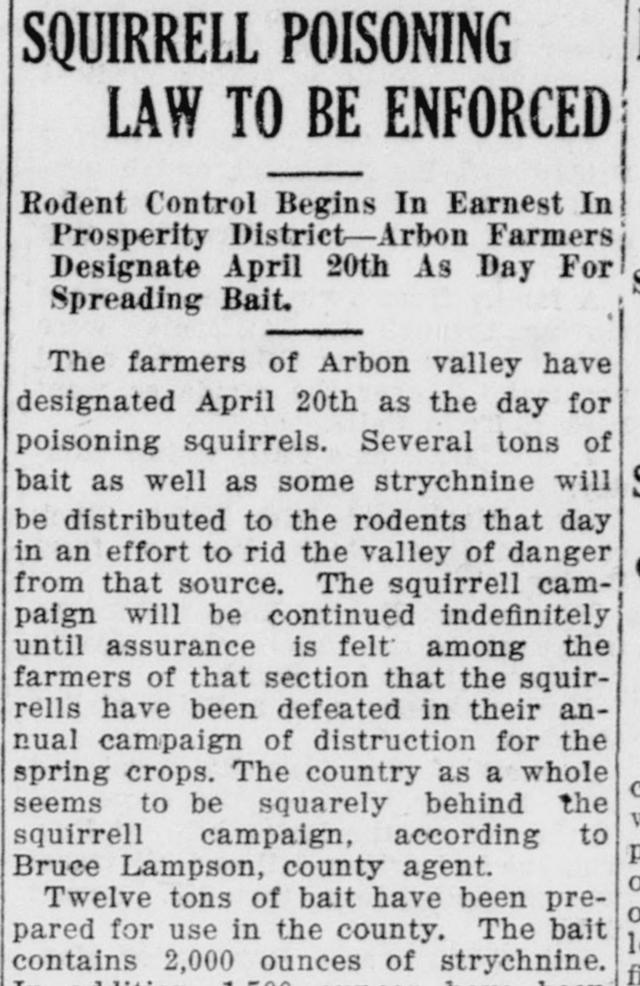
Arbon Valley sets a day to poison its squirrels
In the spring of 1920 Arbon Valley's farmers chose a day to spread strychnine bait against the ground squirrels eating their wheat, part of a Power County campaign that ran for years and cost Ed Davis four of his best horses.
From: Arbon Valley sets a day to poison its squirrels ↗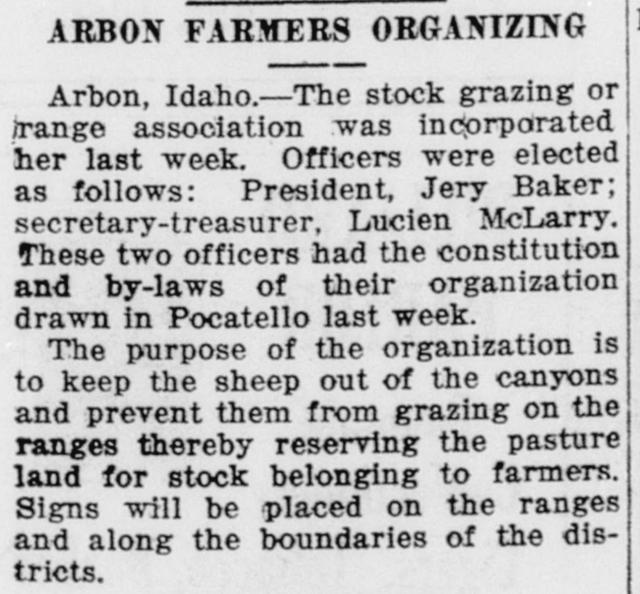 View photograph ↗
Arbon farmers organize to keep the sheep out of their canyons
In the spring of 1920 Arbon's farmers incorporated a range association to keep the migrating sheep bands off their canyons and hills, and by midsummer a deputy was riding the ranges and sheepmen were standing trial at Pauline.
From: Arbon farmers organize to keep the sheep out of their canyons ↗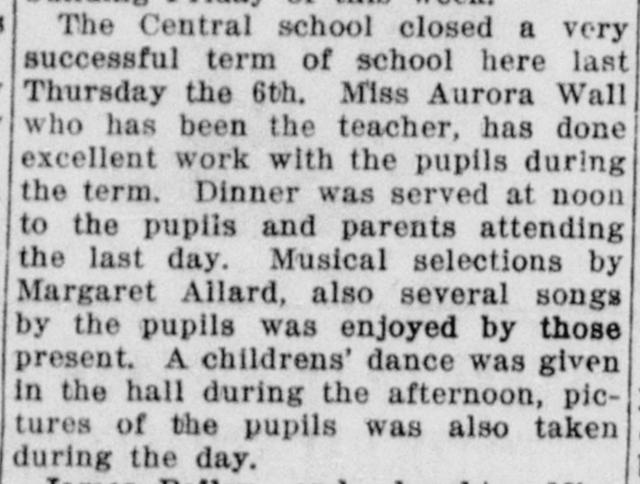 View photograph ↗
Miss Wall closes a good year at the Central school
Through the 1919–20 school year the Arbon columns followed a lone teacher and her Central school pupils from basketry and thrift verses to debates, a smoking stove and four eighth-grade graduates.
From: Miss Wall closes a good year at the Central school ↗ View photograph ↗
Newlywed Elmer and Susan Ward move out to their Arbon farm
Two months after their Malad wedding, Elmer and Susan Ward moved out to their Arbon farm in May 1920, starting a life split between town and valley that the papers followed until all three of their surviving children called Arbon home.
From: Newlywed Elmer and Susan Ward move out to their Arbon farm ↗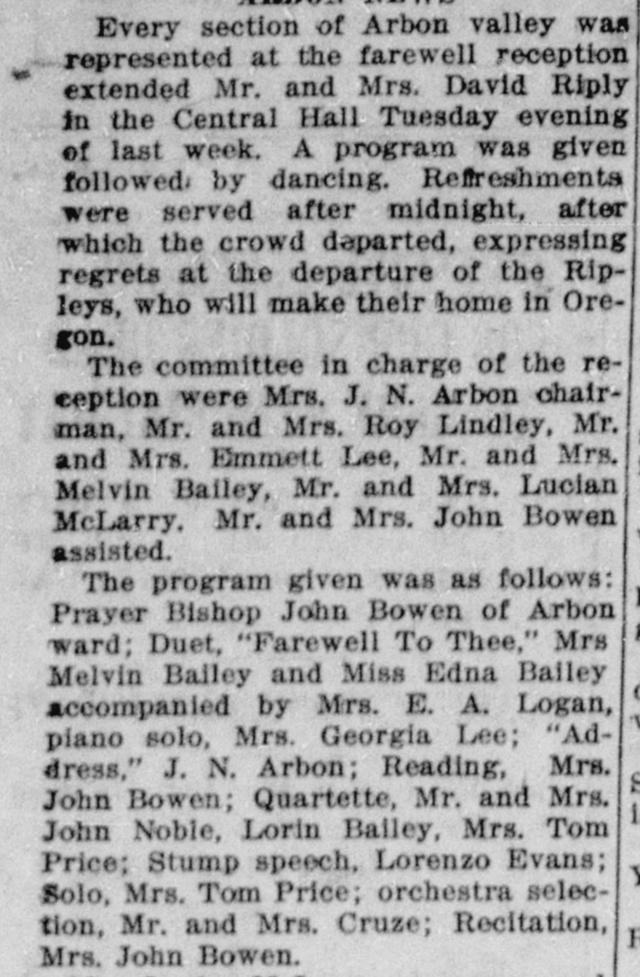 View photograph ↗
Arbon Valley says goodbye to the Ripleys, bound for Oregon
In May 1920 the whole valley crowded into Central Hall to send off David B. Ripley and his wife, who had sold their east-side ranch and were moving to Oregon.
From: Arbon Valley says goodbye to the Ripleys, bound for Oregon ↗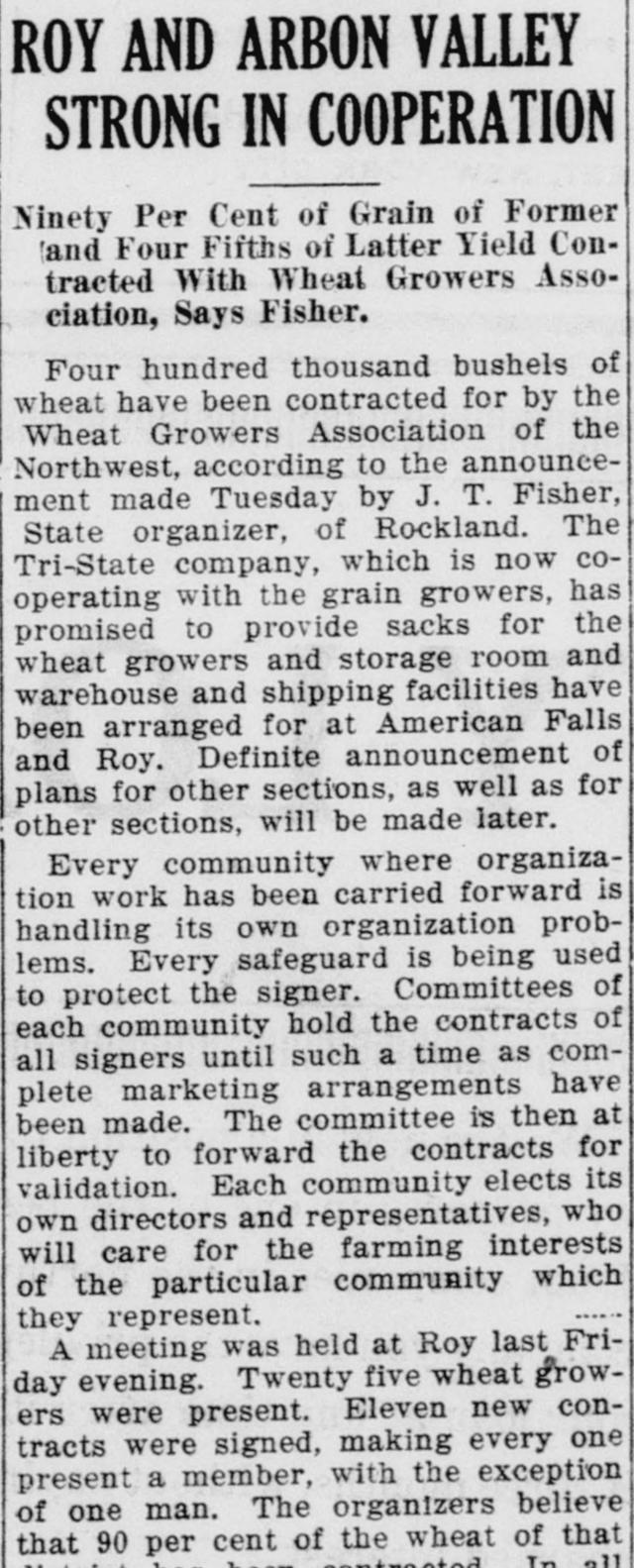 View photograph ↗
Arbon Valley pledges four-fifths of its wheat to the pool
In the wet spring of 1920 Arbon Valley farmers signed about 80 per cent of a promising crop over to the new Wheat Growers Association, then watched wheat prices slide through a long, hard winter.
From: Arbon Valley pledges four-fifths of its wheat to the pool ↗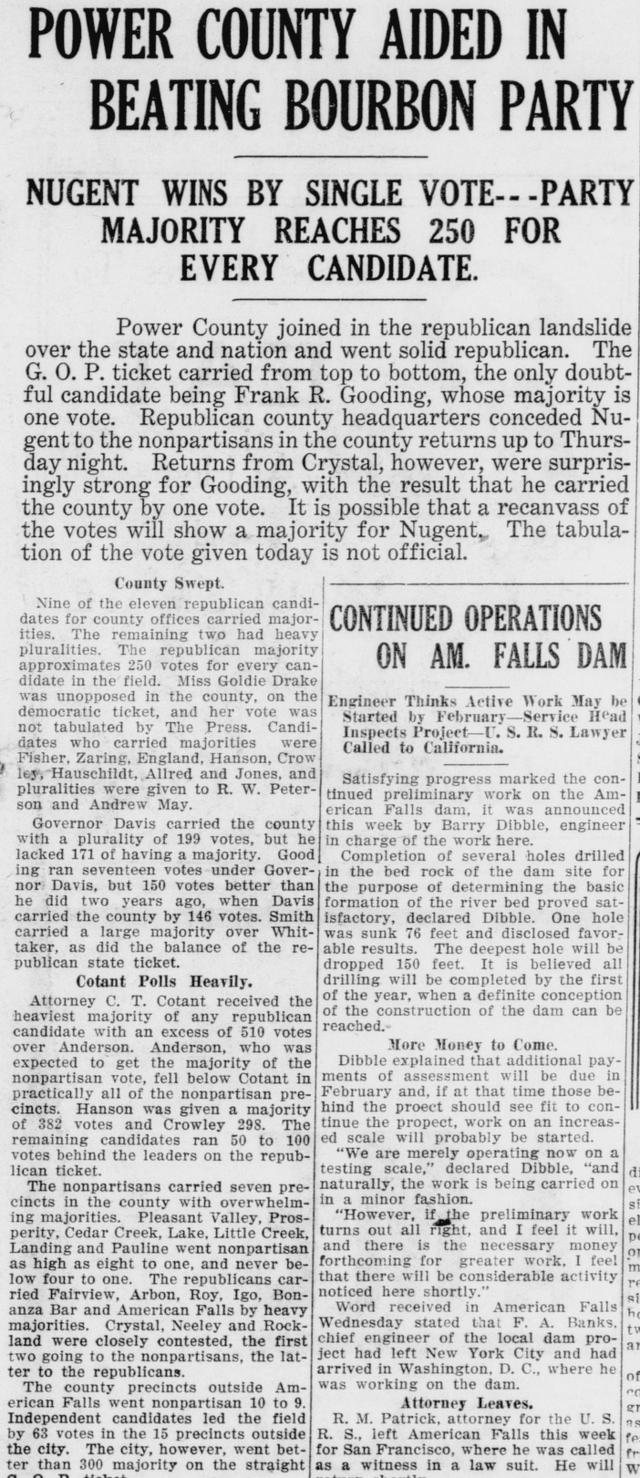 View photograph ↗
Pauline votes the League ticket as Arbon stays Republican
Under a foot of snow in November 1920, Pauline voted the Nonpartisan League ticket that ran its own Jack McCool for county commissioner, Arbon held to the Republicans, and Crystal's returns tipped the county's Senate count by a single vote.
From: Pauline votes the League ticket as Arbon stays Republican ↗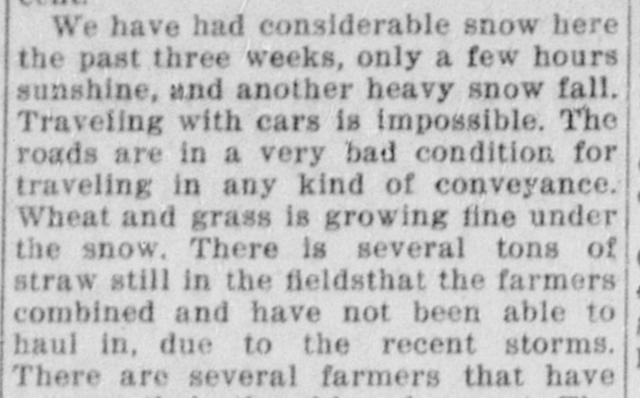 View photograph ↗
Snow buries Arbon's harvest, and the valley waits out a long winter
Snow fell on Arbon Valley before the 1920 threshing was done, and through a long winter the Arbon column of the American Falls Press kept track of the stranded grain, the families who left for town, the dances of those who stayed and a spring that kept turning back to snow.
From: Snow buries Arbon's harvest, and the valley waits out a long winter ↗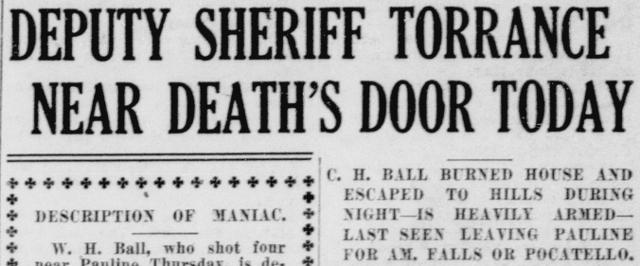 View photograph ↗
A shooting on the Pauline road, a deputy killed and two acquittals
On St. Patrick's Day 1921 W. H. Ball shot a neighbor on the road near Pauline and a deputy sheriff at his cabin, and before the year was out two Power County juries had let him go.
From: A shooting on the Pauline road, a deputy killed and two acquittals ↗ View photograph ↗
Grandpa Arbon, the man the valley was named for, dies at Malad at 81
George Arbon, oldest of the valley's first settlers and the man Arbon was named for, died at his son's Malad home in March 1921, after decades of lost crops elsewhere.
From: Grandpa Arbon, the man the valley was named for, dies at Malad at 81 ↗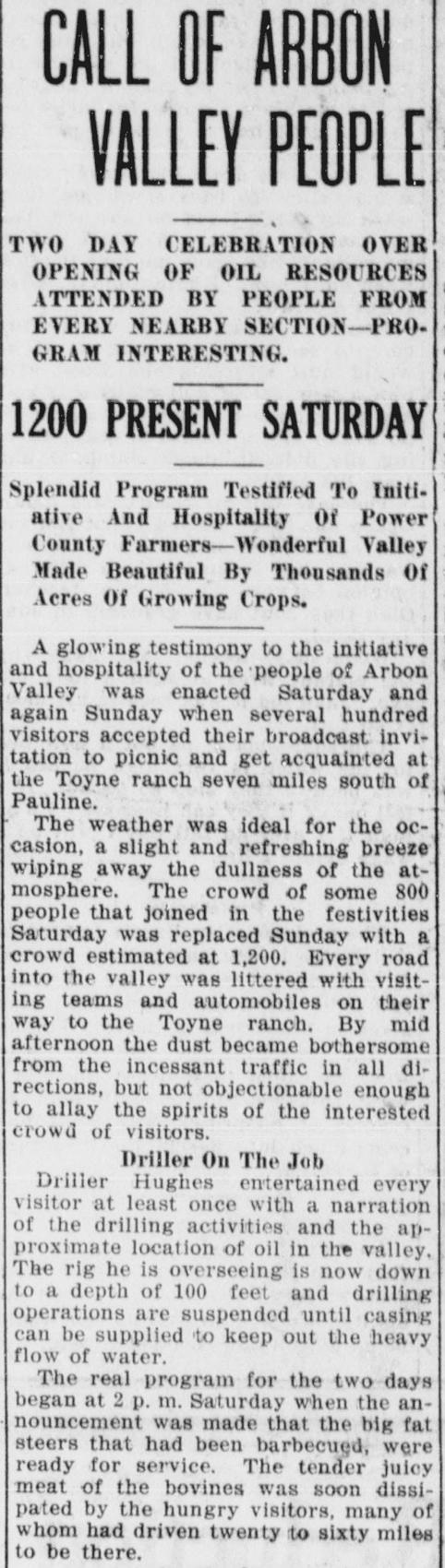 View photograph ↗
Arbon Valley throws a two-day party for its first oil well
In June 1921 some 2,000 visitors came to the Toyn ranch for barbecue, ball games and a look at Arbon Valley's first oil well, which the papers then followed through sixteen months of shows and promises.
From: Arbon Valley throws a two-day party for its first oil well ↗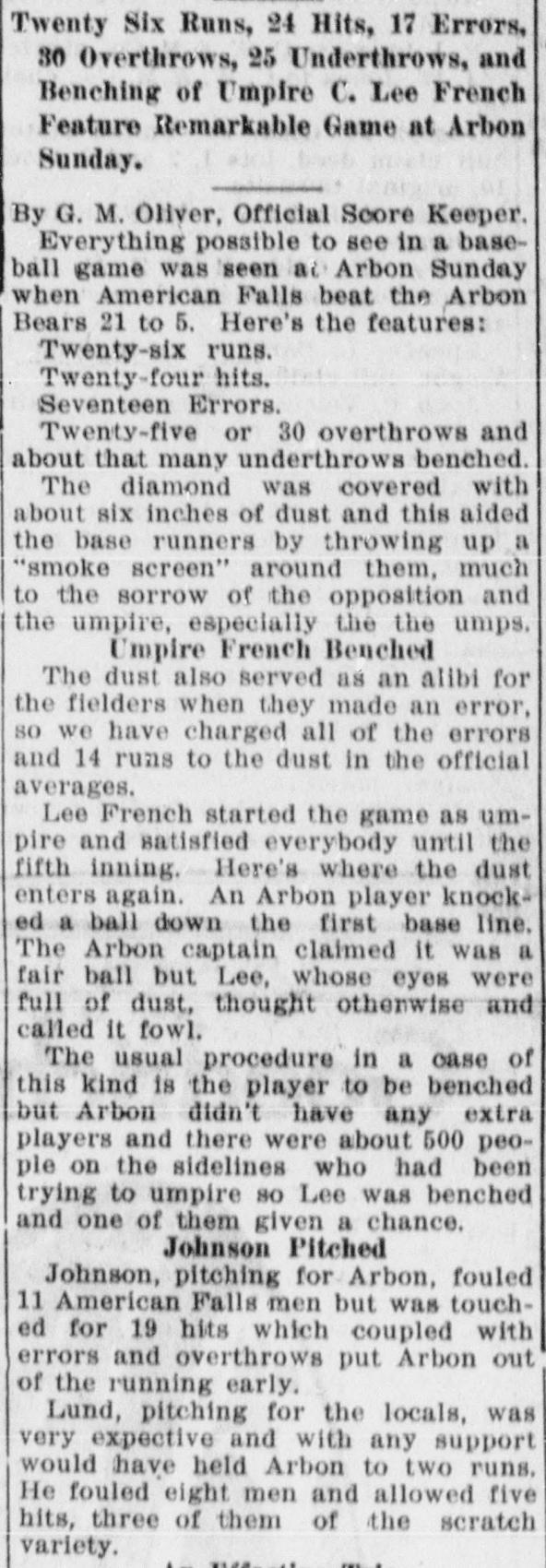 View photograph ↗
In six inches of dust, American Falls beats the Arbon Bears
For a few summers in the early 1920s Pauline, the Arbon Bears and the South Arbon Cubs played ball against each other and against American Falls, most memorably on a dust-deep diamond at the 1921 oil celebration.
From: In six inches of dust, American Falls beats the Arbon Bears ↗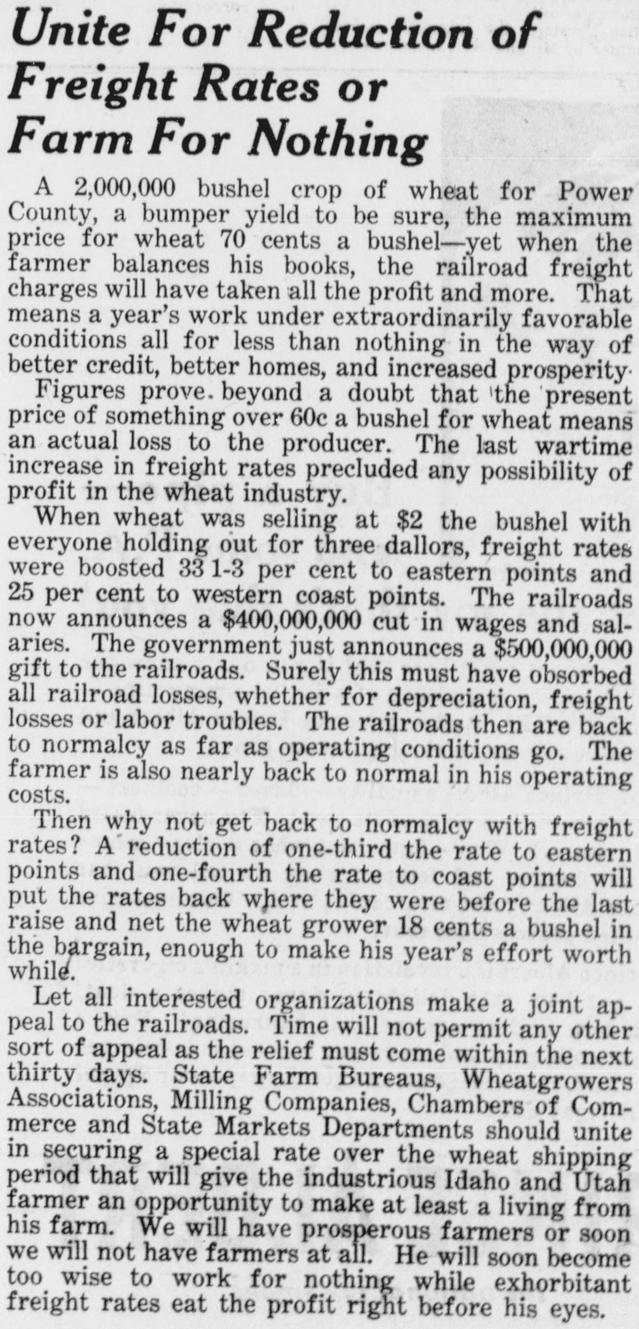 View photograph ↗
A bumper wheat crop for nothing: the Arbon valley's hard years, 1920–1925
Between 1920 and 1925 the Arbon valley's dry farmers raised good wheat and still lost ground to falling prices, high freight, scarce credit, failed banks and tax deeds, until two-dollar wheat came back.
From: A bumper wheat crop for nothing: the Arbon valley's hard years, 1920–1925 ↗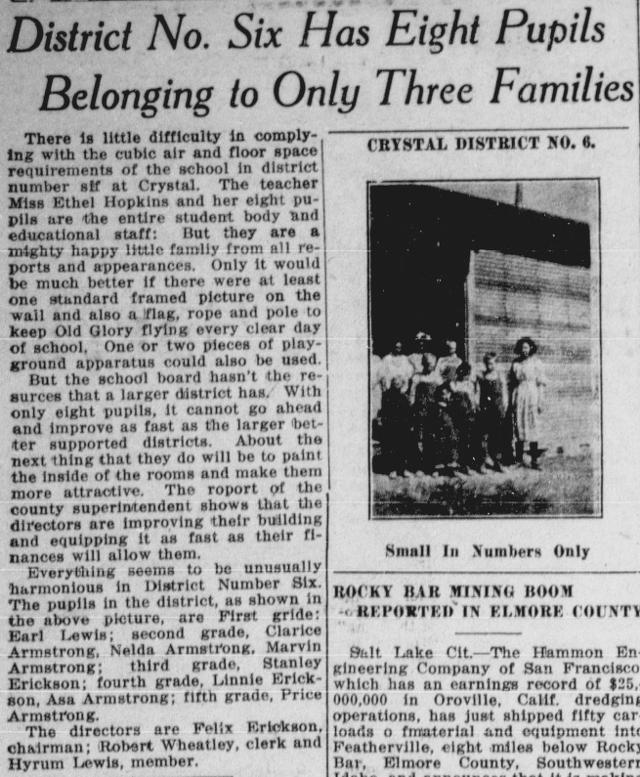 View photograph ↗
Eight pupils from three families fill a one-room school near Crystal
In December 1921 the Press printed a picture of District No. 6, a one-teacher school between Pauline and Crystal whose eight pupils came from three families and soon wrote their own news.
From: Eight pupils from three families fill a one-room school near Crystal ↗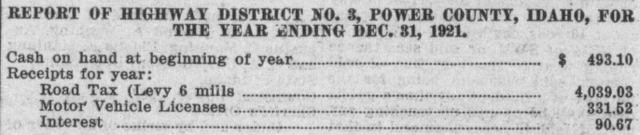 View photograph ↗
Arbon road district loses its cash in a bank failure as the big wheat crop rolls
In 1921 Arbon Valley's own highway district lost its cash in a Pocatello bank failure, just as a big wheat crop had to be hauled to the railroad over bad roads.
From: Arbon road district loses its cash in a bank failure as the big wheat crop rolls ↗ View photograph ↗
Lost in a blizzard, Frank Kulock dies within sight of home
Coming home from Pauline with the mail on February 11, 1922, Frank Kulock lost his way in a blizzard and froze to death in his own field, where his wife found him three days later.
From: Lost in a blizzard, Frank Kulock dies within sight of home ↗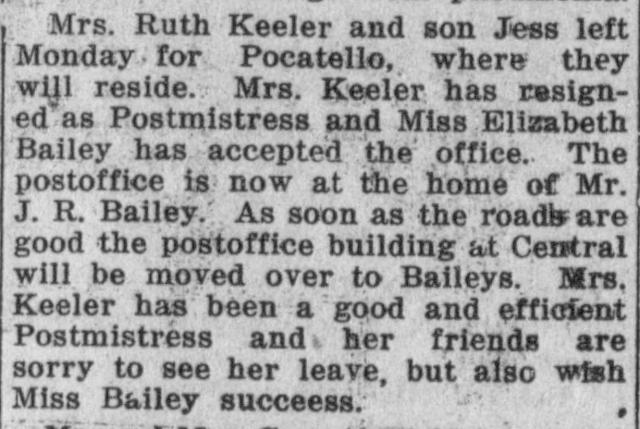 View photograph ↗
Arbon post office moves to the Bailey farm, and nearly closes
In 1922 the Arbon post office left its building by the Central school for J. R. Bailey's home and came within weeks of closing, the latest turn for an office that had followed its keepers since 1898.
From: Arbon post office moves to the Bailey farm, and nearly closes ↗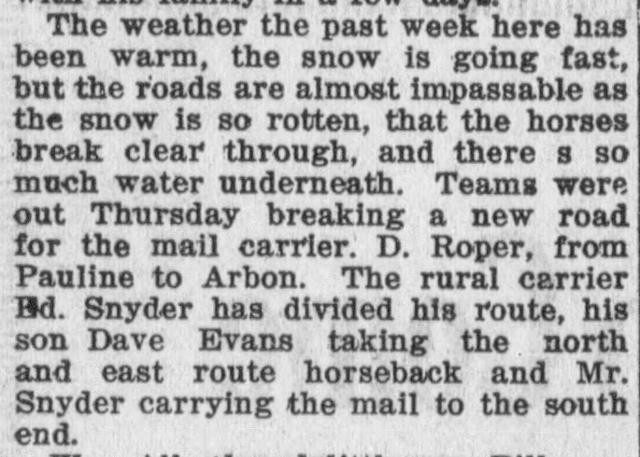 View photograph ↗
In the 1922 thaw, Ed Snyder splits the Arbon mail route
When the spring thaw of 1922 left Arbon's roads too rotten for a team, rural carrier Ed Snyder split his route with his stepson, part of more than twenty years the Snyders gave to the valley's mail.
From: In the 1922 thaw, Ed Snyder splits the Arbon mail route ↗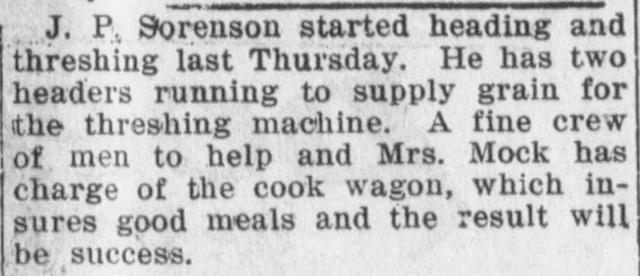 View photograph ↗
A Summit homestead harvest, and a farm that lasted a century
In 1922 J. Parley Sorensen ran two headers on the Summit homestead he had proved up in 1914, land his descendants the Thompsons still farm and that Idaho named a Century Farm in 2024.
From: A Summit homestead harvest, and a farm that lasted a century ↗ View photograph ↗
A lantern in a pothole gives away a still at Sunbeam
Days before the 1922 Roundup, a lantern led two Power County officers to a copper still hidden at Sunbeam, where a young Kentuckian was caught at work and charged with his uncle, a Pauline farmer.
From: A lantern in a pothole gives away a still at Sunbeam ↗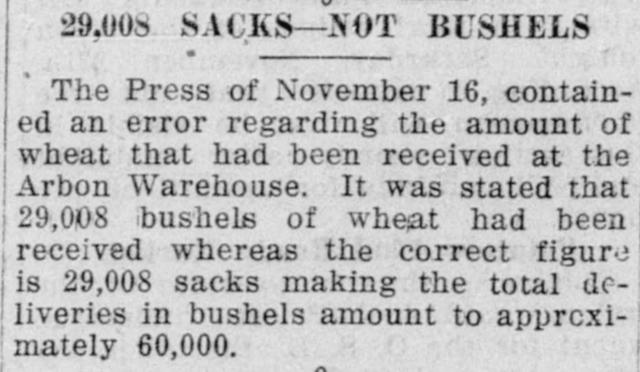 View photograph ↗
Sacks, not bushels: Arbon Valley's wet, weedy wheat harvest of 1922
After a season of spotty fields, daily rains, weeds above the grain and town men who lost their nerve, Arbon Valley's warehouse took in 29,008 sacks of wheat, a figure the paper first printed as bushels.
From: Sacks, not bushels: Arbon Valley's wet, weedy wheat harvest of 1922 ↗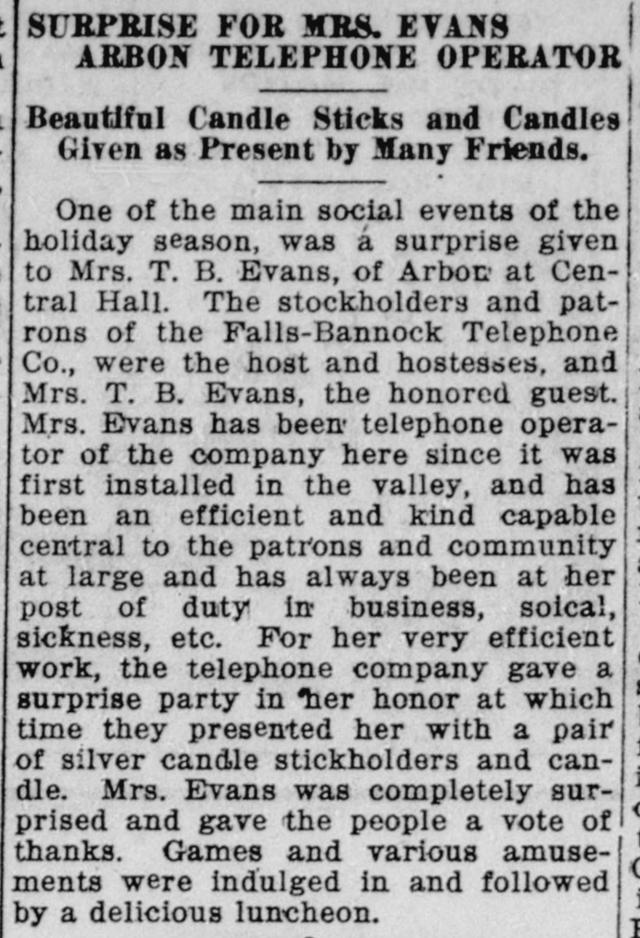 View photograph ↗
Arbon surprises Mrs. T. B. Evans, its telephone central since the start
In 1923 Arbon's telephone patrons threw a surprise party for Susannah Smith Evans, who had kept the valley's post office, store and switchboard, led its Red Cross and registered its voters.
From: Arbon surprises Mrs. T. B. Evans, its telephone central since the start ↗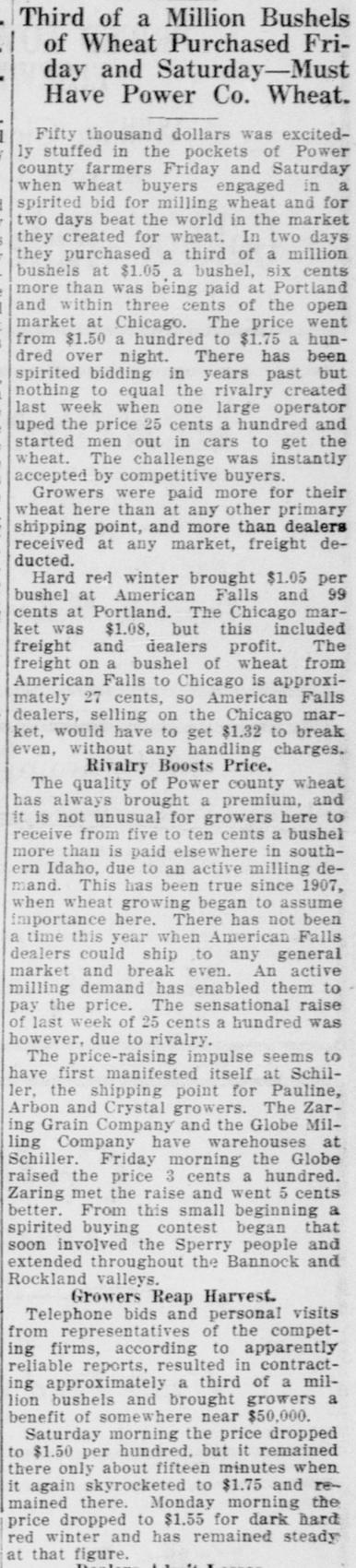 View photograph ↗
Rival buyers bid up the valley's wheat at Schiller
In October 1923 rival buyers bid up wheat at Schiller, the valley's railroad siding, and into the spring teams and trucks hauled the crop there, 26 miles from Pauline.
From: Rival buyers bid up the valley's wheat at Schiller ↗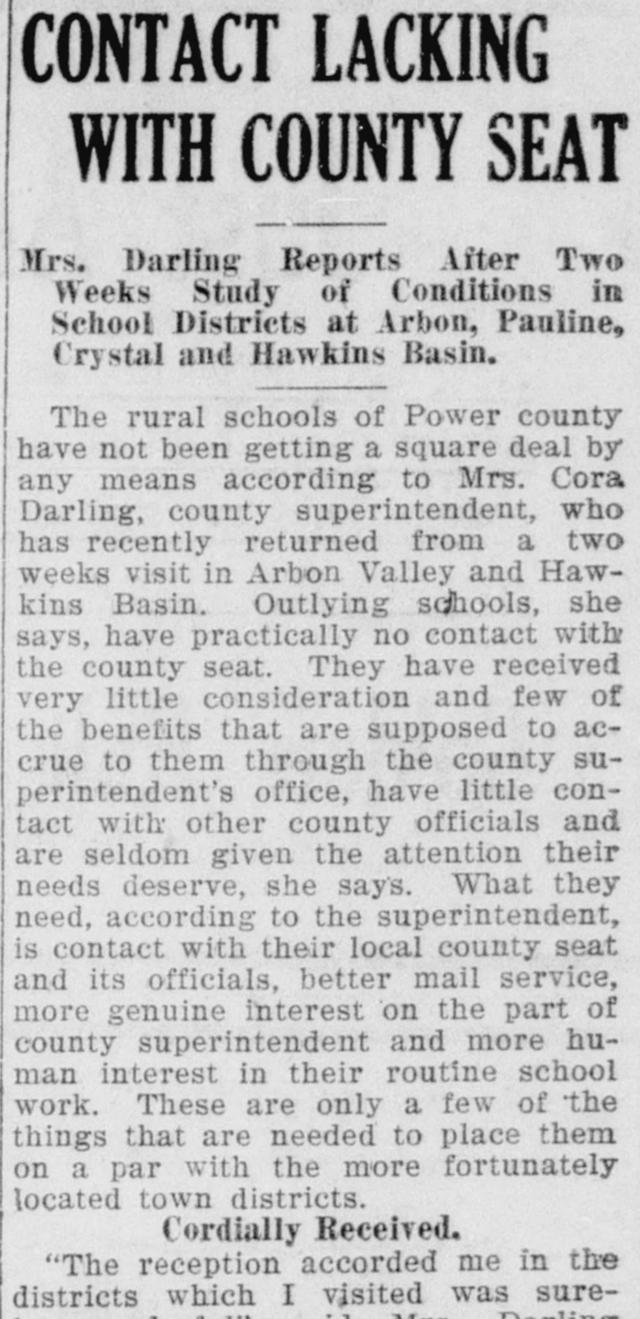 View photograph ↗
The county superintendent comes to the valley's schools by grain rack and on foot
In October 1923 Power County's school superintendent, Mrs. Cora Darling, lived for two weeks among the country schools of Arbon Valley and Hawkins Basin, getting from one to the next by stage, grain rack, borrowed car and her own two feet.
From: The county superintendent comes to the valley's schools by grain rack and on foot ↗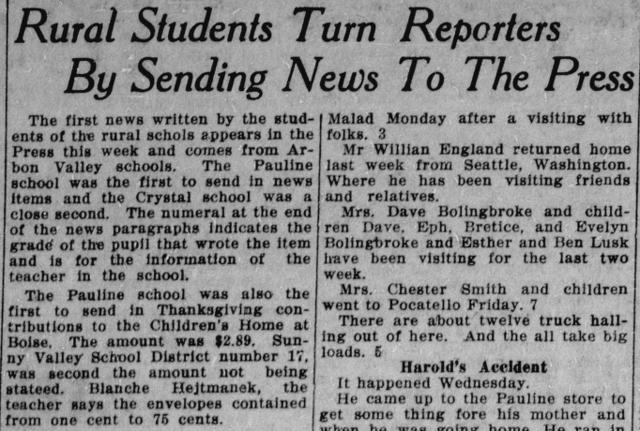 View photograph ↗
Arbon Valley schoolchildren turn reporters for the Press, 1923–24
For one school year the American Falls Press ran weekly news written by the pupils of Arbon Valley's country schools, misspellings included, and the first of it came from Pauline.
From: Arbon Valley schoolchildren turn reporters for the Press, 1923–24 ↗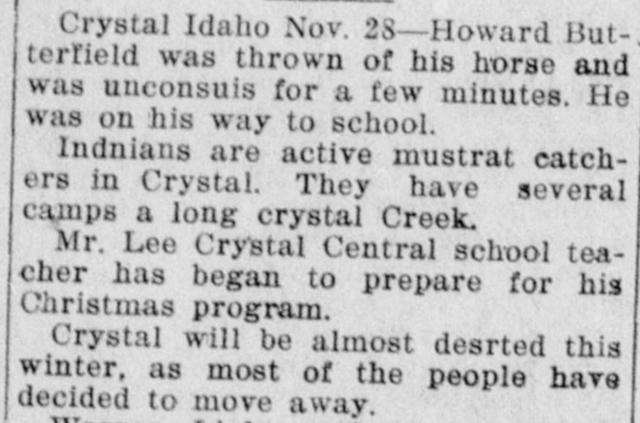 View photograph ↗
Crystal's schoolchildren report a settlement packing up
Writing for the American Falls Press in the winter of 1923–24, Crystal's pupils predicted their settlement would be "almost deserted" and then reported, week by week, who left and who stayed.
From: Crystal's schoolchildren report a settlement packing up ↗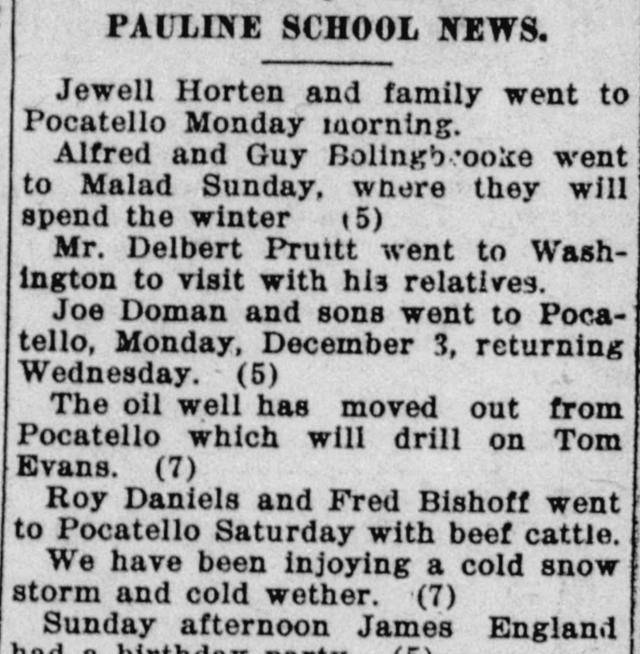 View photograph ↗
Pauline City, the crossroads that hoped to be a town
A doctor's office, two stores and a grain warehouse gave Pauline hopes of becoming a town, and by 1923 its schoolchildren were cheering for "Pauline City."
From: Pauline City, the crossroads that hoped to be a town ↗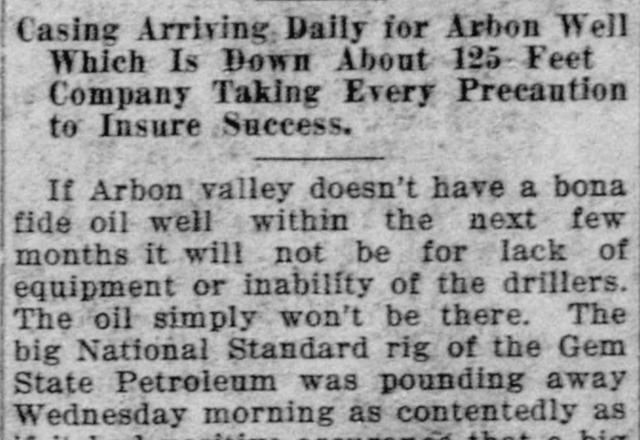 View photograph ↗
Oil rig beside the Arbon school draws crowds, then drills on for five years
In 1924 the Gem State Petroleum Co. set what was billed as Idaho's biggest oil rig beside Arbon's Central school, and for five years the valley watched it bore toward oil that never came.
From: Oil rig beside the Arbon school draws crowds, then drills on for five years ↗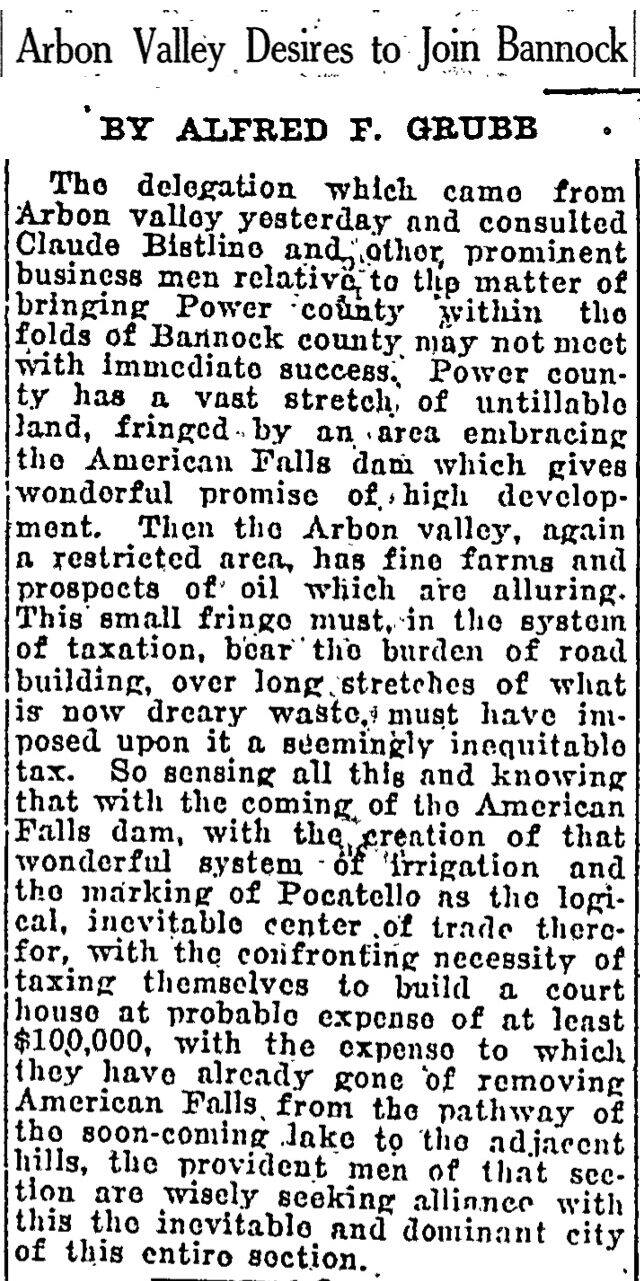 View photograph ↗
Arbon Valley men come to Pocatello to talk of joining Bannock County
Eleven years after Arbon Valley voted itself into Power County, a delegation came to Pocatello in March 1924 to talk of joining Bannock instead, and in 1939 the idea surfaced once more.
From: Arbon Valley men come to Pocatello to talk of joining Bannock County ↗ View photograph ↗
Arbon Valley signs up 213 cows for a cheese factory
In the spring of 1924 Ren Evans signed up 23 Arbon Valley farmers and 213 cows for a cheese factory backed by Ernest Brog of Driggs, but whether it ever made cheese is unknown.
From: Arbon Valley signs up 213 cows for a cheese factory ↗ View photograph ↗
Crystal taxpayers fault their road district as mail and grain wear down the Mink Creek road
In 1924 Crystal's taxpayers complained of the highest road and school tax in Power County and poor mail service, while the valley's mail and wheat kept wearing down the mountain road to Pocatello.
From: Crystal taxpayers fault their road district as mail and grain wear down the Mink Creek road ↗ View photograph ↗
Lusk steps aside, and an Arbon pioneer runs for the county board
Perry Lusk of Pauline took the Arbon Valley's seat on the Power County board in the Democratic sweep of 1922, then declined to run again in 1924, leaving the pioneer T. B. Evans to contest it.
From: Lusk steps aside, and an Arbon pioneer runs for the county board ↗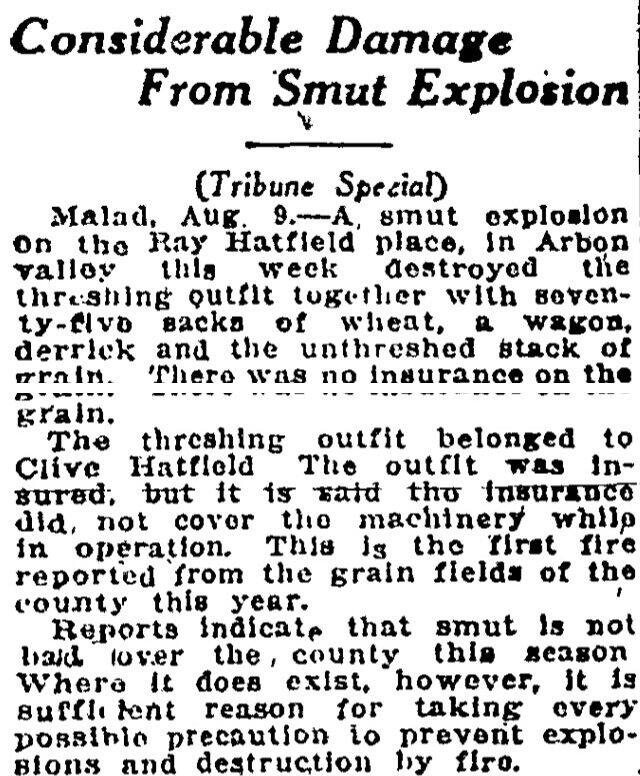 View photograph ↗
Smut blast burns the Hatfield threshing outfit in Arbon Valley
In August 1924 a smut explosion on the Ray Hatfield place in Arbon Valley burned Clive Hatfield's threshing outfit, 75 sacks of wheat, a wagon, a derrick and a stack.
From: Smut blast burns the Hatfield threshing outfit in Arbon Valley ↗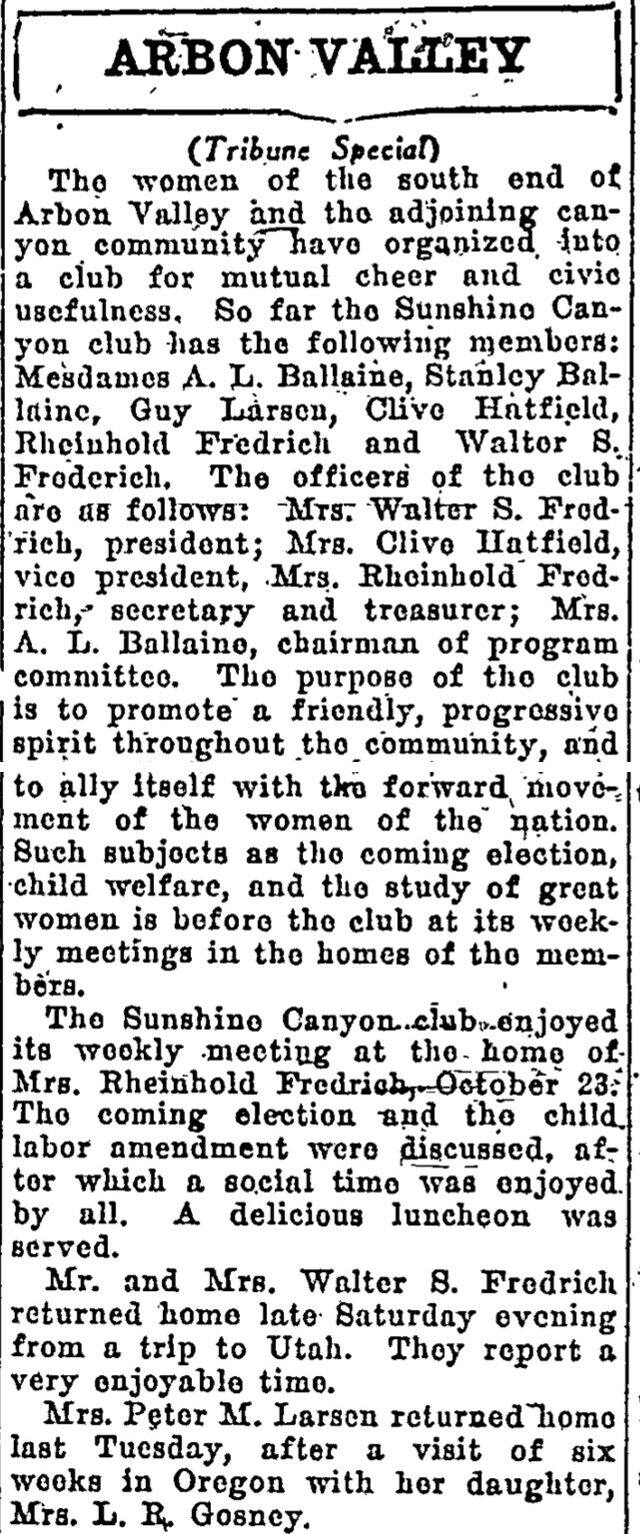 View photograph ↗
Six women at the south end form the Sunshine Canyon club
In the last days before the 1924 election, six women at the south end of Arbon Valley formed the Sunshine Canyon club and met each week to talk over the vote, child welfare and the lives of great women.
From: Six women at the south end form the Sunshine Canyon club ↗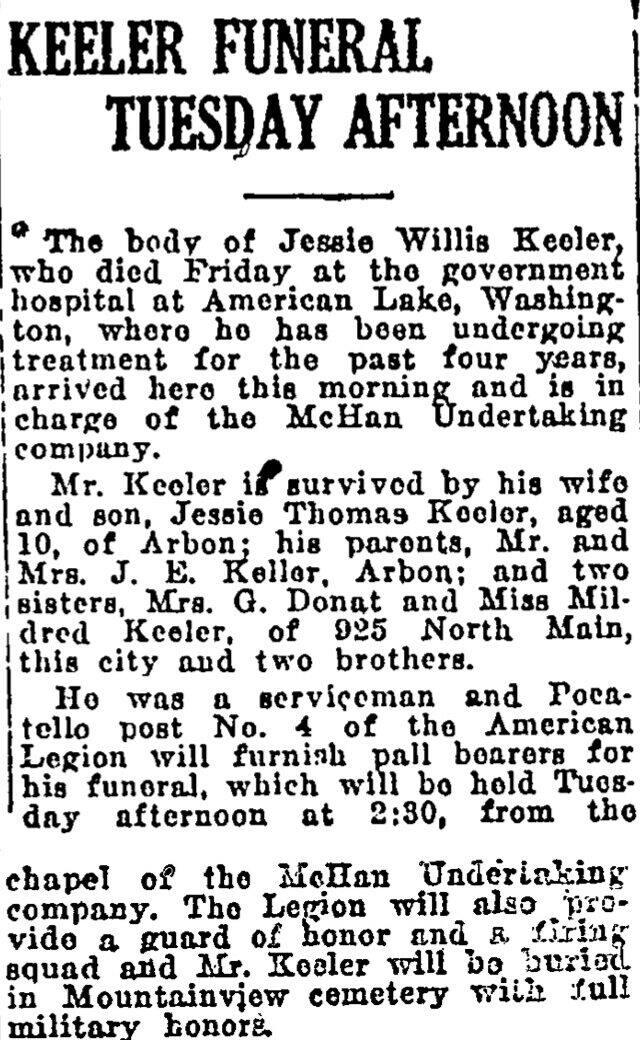 View photograph ↗
Arbon Navy man Jesse Keeler buried at Pocatello with Legion honors
Four years after he went into a veterans' hospital in Washington, Arbon homesteader and Navy volunteer Jesse Keeler came home to Pocatello for a funeral with taps and a Legion salute.
From: Arbon Navy man Jesse Keeler buried at Pocatello with Legion honors ↗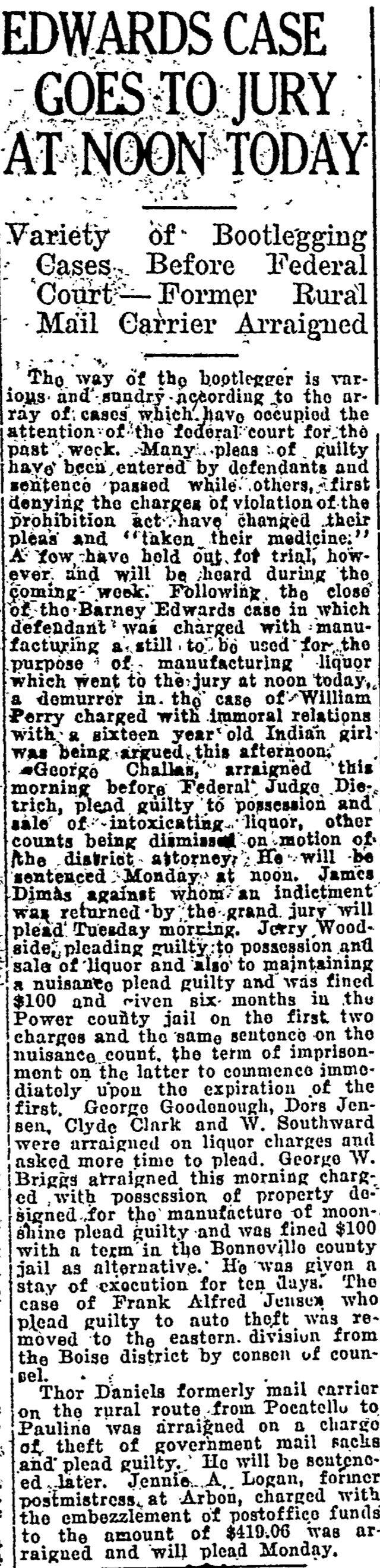 View photograph ↗
Arbon's former postmistress and mail carrier answer in federal court
In October 1925 the woman who had kept the Arbon post office was arraigned at Pocatello over $419.06 in missing funds, and the man who had carried the valley's mail was fined $100 for turning mail sacks into grain bags and saddle blankets.
From: Arbon's former postmistress and mail carrier answer in federal court ↗ View photograph ↗
A Horse Island girl takes the school beside the Arbon oil well
In the fall of 1925 Lila M. Wade of Horse Island had charge of District 12's school at Arbon Center, beside the oil well, and nearly seventy years later her obituary remembered her in Arbon's one-room schools.
From: A Horse Island girl takes the school beside the Arbon oil well ↗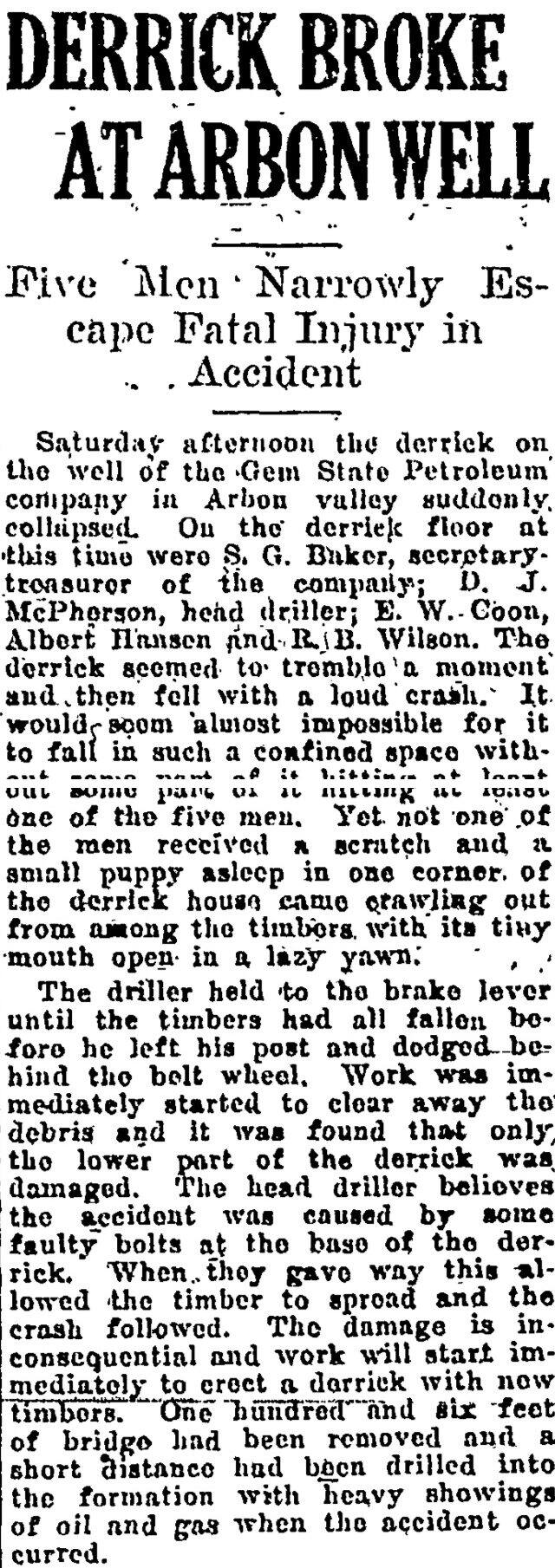 View photograph ↗
Derrick falls at the Arbon well, and five men walk away
In 1926 the Gem State well at Arbon drew crowds, blew gas through its plug, was said to carry helium and lost its derrick; by autumn the company was in receivership.
From: Derrick falls at the Arbon well, and five men walk away ↗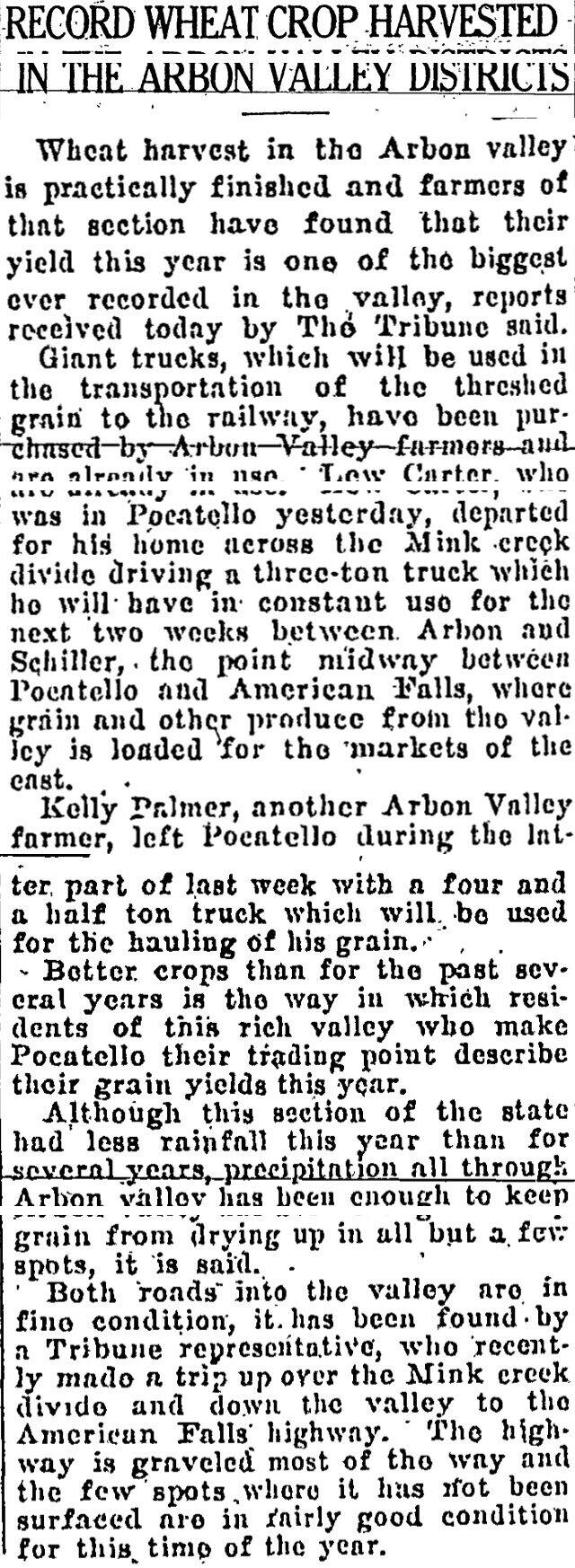 View photograph ↗
Arbon Valley farmers bring in a big wheat crop and haul it out in giant trucks
In the dry summer of 1926 Arbon Valley harvested one of the biggest wheat crops in its memory, early, and its farmers bought big new trucks to haul it to the railroad at Schiller.
From: Arbon Valley farmers bring in a big wheat crop and haul it out in giant trucks ↗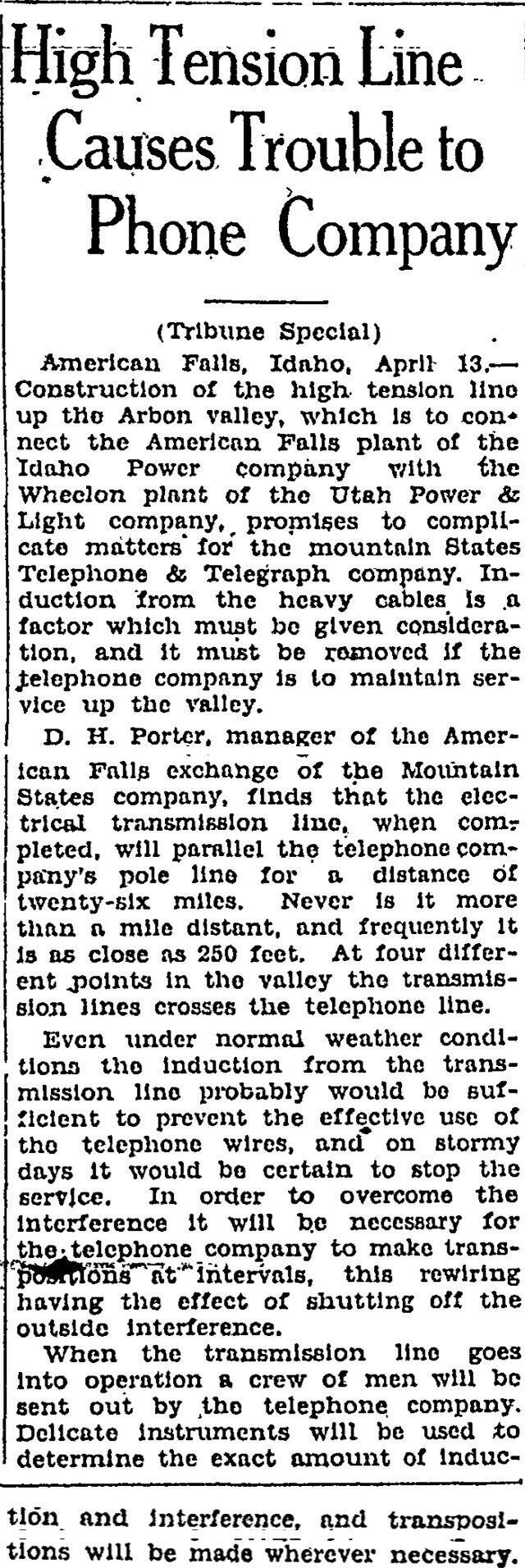 View photograph ↗
A power line up Arbon Valley worries the telephone company
In spring 1927 crews hauled poles through Arbon Valley mud for a power line from American Falls to Utah, and the telephone men braced for what it would do to their wires.
From: A power line up Arbon Valley worries the telephone company ↗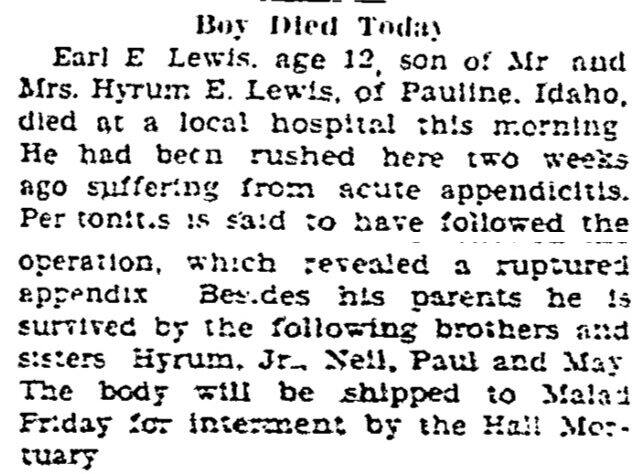 View photograph ↗
Pauline boy, 12, dies weeks after a ruptured appendix
Brought into Pocatello at 3:30 on New Year's morning 1928 with a ruptured appendix, twelve-year-old Earl Lewis of Pauline lived eighteen more days.
From: Pauline boy, 12, dies weeks after a ruptured appendix ↗ View photograph ↗
An old cattleman remembers Tom Sparks's herds and a sheepman shot near Sunbeam
In 1928 J. R. Munn recalled Tom Sparks's cattle on the Arbon and Crystal range, the Fleming sheep that crowded them, and the sheepman found shot near Sunbeam creek, a killing other papers place in 1894.
From: An old cattleman remembers Tom Sparks's herds and a sheepman shot near Sunbeam ↗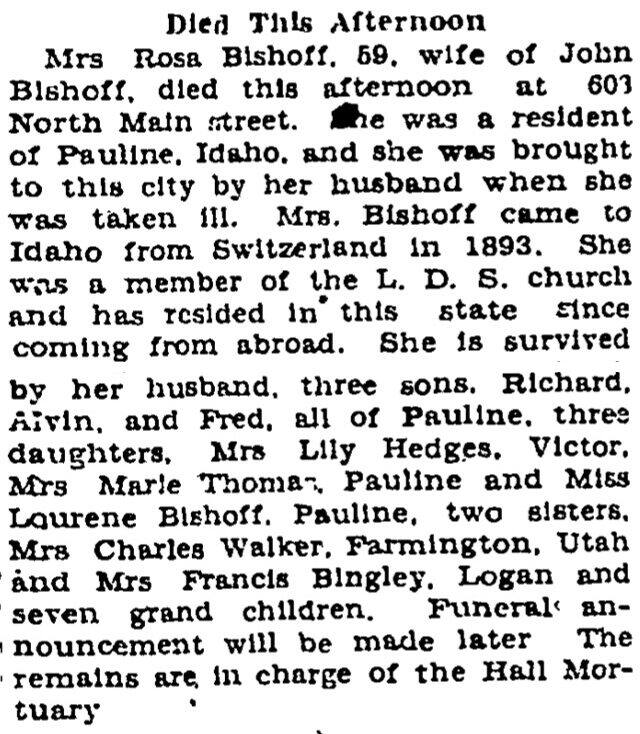 View photograph ↗
Rosa Bishoff, who came from Switzerland to Pauline, dies at 59
Rosa Bishoff, a Swiss immigrant of 1893 who raised her family at Pauline, died in Pocatello on December 6, 1928, at 59.
From: Rosa Bishoff, who came from Switzerland to Pauline, dies at 59 ↗ View photograph ↗
Jerry Hatch packs the Arbon mail through the winter of 1928–29
When snow closed the reservation road in the winter of 1928–29, carrier Jerry B. Hatch carried the Arbon mail on his back, and a Crystal woman rode the last miles home beside it on a mail horse.
From: Jerry Hatch packs the Arbon mail through the winter of 1928–29 ↗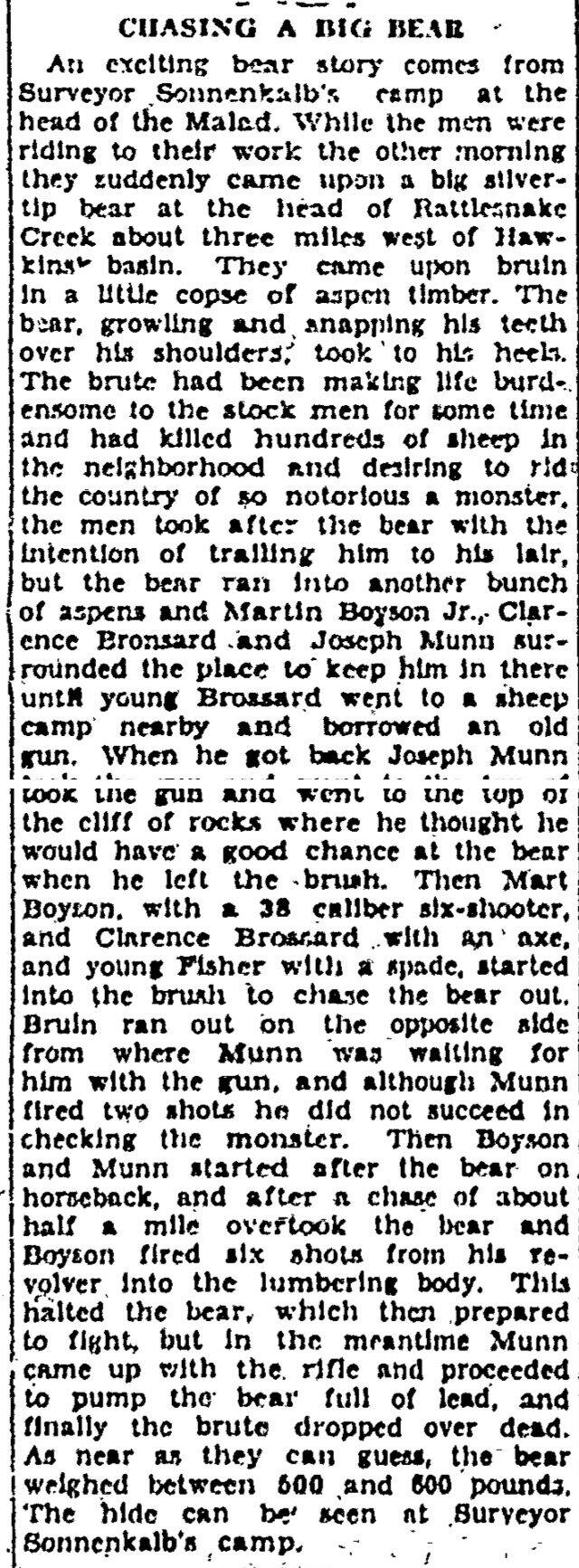 View photograph ↗
Survey crew runs down a sheep-killing bear at the head of Rattlesnake Creek
In June 1899 men from Surveyor Sonnenkalb's camp cornered a silver-tip blamed for hundreds of dead sheep in an aspen thicket at the head of Rattlesnake Creek and killed it with a borrowed gun and a six-shooter.
From: Survey crew runs down a sheep-killing bear at the head of Rattlesnake Creek ↗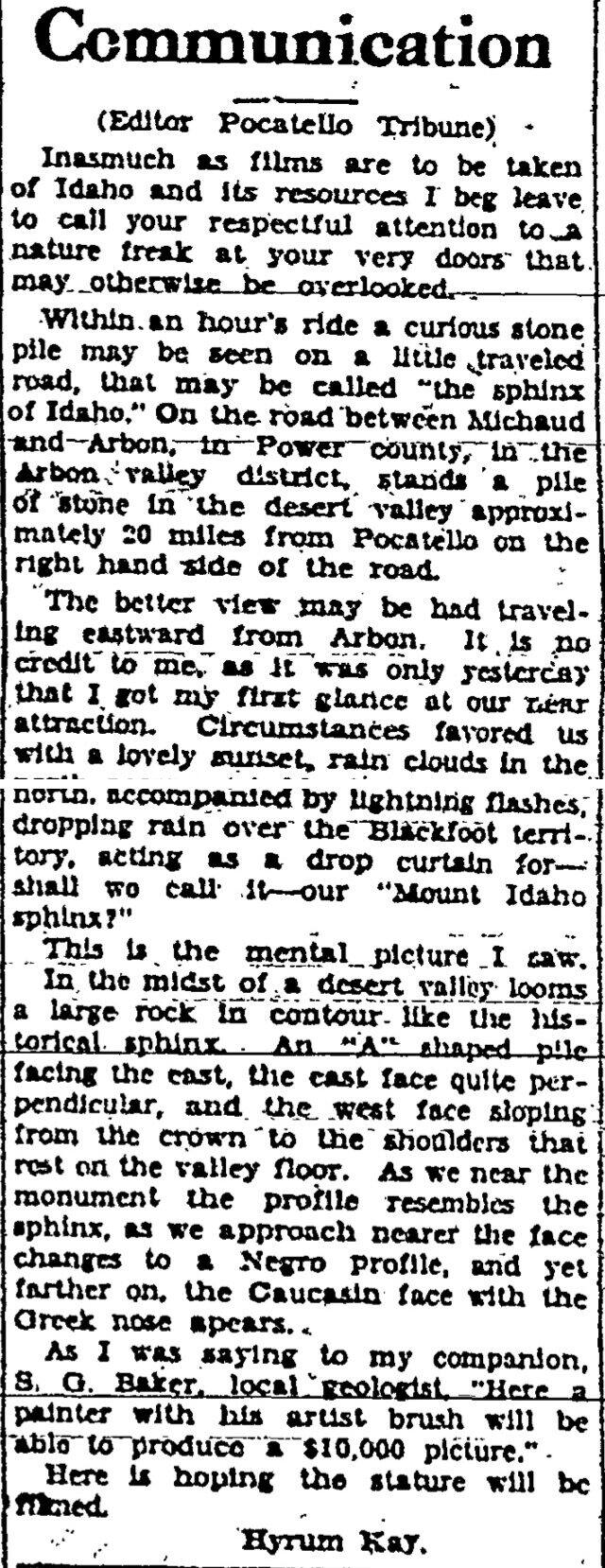 View photograph ↗
A Pocatello man finds the Sphinx of Idaho in Arbon Valley
From 1929 to 1934 Hyrum Kay of Pocatello kept writing the Tribune about a lone rock in Arbon Valley that showed the face of the Sphinx at sunset, a landmark he said valley settlers knew as the Old Man of the Valley.
From: A Pocatello man finds the Sphinx of Idaho in Arbon Valley ↗The 1930s
 View photograph ↗
Elk in the haystacks, and a herd cut in half by poachers
When Arbon Valley farmers complained that elk from the Pocatello game preserve were raiding their haystacks, two committees went to count the herd, found it shrinking rather than swelling, and advised against a hunt both times.
From: Elk in the haystacks, and a herd cut in half by poachers ↗Help put names to these pictures.
Many of these photographs still need names, places and dates. If you know who is in one, open it and choose “Help identify this photograph”. If your family keeps photographs of the valley, the archive would love to see them.