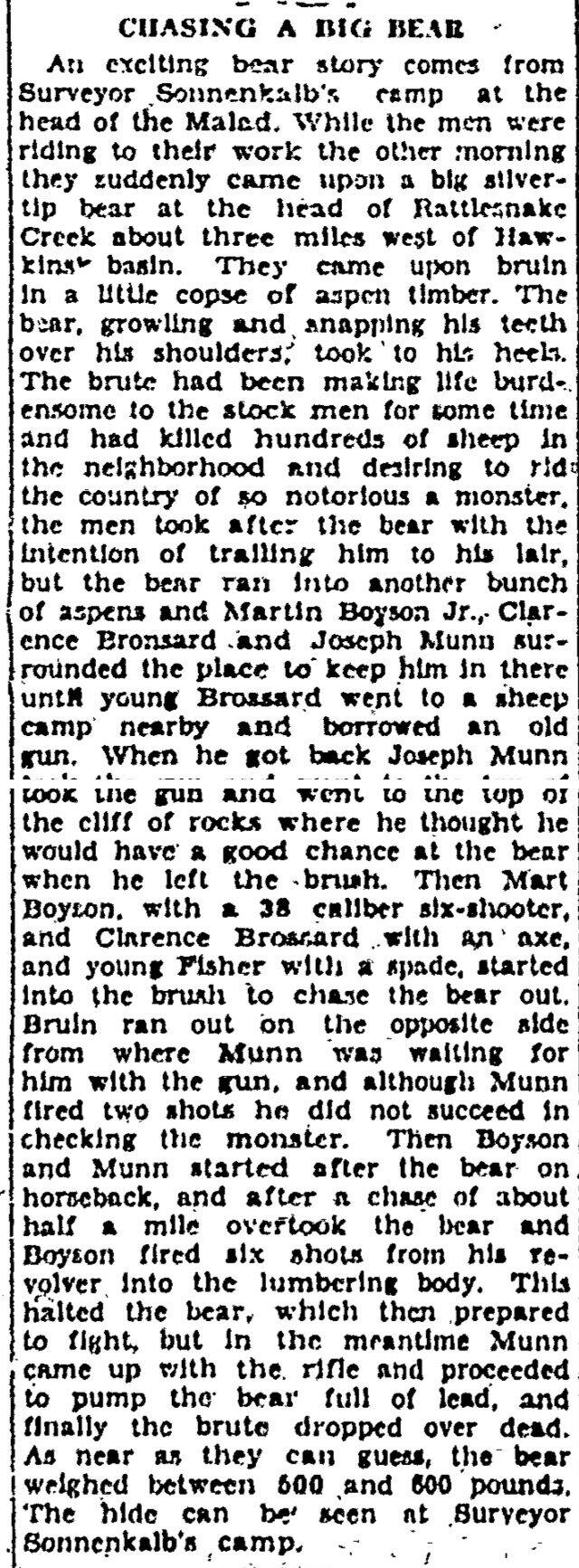
The men of Surveyor Sonnenkalb’s camp were riding out to the day’s work one June morning in 1899 when they came on a big bear in a little stand of aspen at the head of Rattlesnake Creek. Before they were through they had gone after it with a borrowed rifle, a six-shooter, an axe and a spade, and its hide was on show back at camp.
The Pocatello Tribune told the story that June, and thirty years later, on Sunday, June 23, 1929, it ran the item again in “In Olden Times: What Happened in Pocatello Thirty Years Ago,” a column of reprints, under the date June 24, 1899. The 1899 issue itself has not turned up in the archive, so the reprint is all that survives, and it may have been cut or retyped along the way.
A survey camp in sheep country
The item placed the camp “at the head of the Malad.” Its surveyor was very probably Oscar Sonnenkalb, a civil engineer from Pocatello who was advertising himself as Bannock County surveyor by 1913. What his crew was surveying that summer, the paper did not say.
The bear turned up about three miles west of Hawkins Basin. Rattlesnake Creek rises from springs in the basin that would later be called Crystal and runs down to Bannock Creek, and Hawkins Basin sits some twelve miles southeast of Crystal, so a spot three miles west of it fits the high ground where the creek begins. There was no Crystal yet. That basin belonged to the Fort Hall land ceded under an agreement signed in 1898 and ratified in 1900, explained in The reservation next door, and it was not opened to homesteaders until 1902. Nobody knows whether the place where the bear was found lay inside the reservation line in 1899. The Bradley family says George Willard Bradley put up a cabin in the upper Rattlesnake drainage in 1899–1900, though the first record of him there is a water right dated 1902.
In 1899 that high country was sheep range, with a sheep camp near enough for a man to ride over and borrow a gun. Down in the valley it was a stockmen’s world in the same years, as When Bannock Valley was cattle range tells.
Chased from one thicket to the next
The paper called the animal a “silver-tip,” a name Westerners commonly gave the grizzly, and described it no further. It ran off growling. The Tribune said it had long been a plague to the stockmen and had killed “hundreds of sheep” in the neighborhood. That figure was the paper’s, and nothing has been found to check it. The riders decided to trail it.
The bear holed up in a second patch of aspens. Martin Boyson Jr., Clarence Bronsard and Joseph Munn ringed the thicket to hold it there while “young Brossard” fetched an old gun from the nearby sheep camp. The item spells the name both ways, and it does not say plainly whether the young Brossard who went for the gun was Clarence.
Munn took the gun up a cliff of rocks to wait for the bear to break cover. Then three men went into the brush to flush it out: Boyson with a .38 six-shooter, Clarence Brossard with an axe and a man named only as “young Fisher” with a spade.
The bear came out on the side away from Munn. He got off two shots, and neither stopped it. Boyson and Munn went after it on horseback, and about half a mile on, Boyson caught up and emptied his revolver into it, six shots. The bear stopped and turned to fight. By then Munn had come up with the rifle, and he kept firing until it fell dead.
The men put its weight at 500 to 600 pounds. The hide went on display at the survey camp.
The paper said nothing more about the four men. None of them is known to have settled in the valley, and the site has no family page for any of their surnames; most likely they belonged to the survey crew. When did it all happen? The item says only “the other morning,” which puts it a few days before June 24.
The settlement that grew up below the creek’s head is followed in Crystal, the hidden settlement up Rattlesnake Creek, and the same hills made wildlife news again nearly thirty years later, in the State’s elk at Crystal. In 1899, the country at the head of Rattlesnake Creek had one bear fewer.
The original article
Pocatello Tribune, June 23, 1929, page 10, in the column “In Olden Times: What Happened in Pocatello Thirty Years Ago,” under the date June 24, 1899. Transcribed from the page scan.
CHASING A BIG BEAR
An exciting bear story comes from Surveyor Sonnenkalb’s camp at the head of the Malad. While the men were riding to their work the other morning they suddenly came upon a big silver-tip bear at the head of Rattlesnake Creek about three miles west of Hawkins’ basin. They came upon bruin in a little copse of aspen timber. The bear, growling and snapping his teeth over his shoulders, took to his heels. The brute had been making life burdensome to the stock men for some time and had killed hundreds of sheep in the neighborhood and desiring to rid the country of so notorious a monster, the men took after the bear with the intention of trailing him to his lair, but the bear ran into another bunch of aspens and Martin Boyson Jr., Clarence Bronsard and Joseph Munn surrounded the place to keep him in there until young Brossard went to a sheep camp nearby and borrowed an old gun. When he got back Joseph Munn took the gun and went to the top of the cliff of rocks where he thought he would have a good chance at the bear when he left the brush. Then Mart Boyson, with a 38 caliber six-shooter, and Clarence Brossard with an axe, and young Fisher with a spade, started into the brush to chase the bear out. Bruin ran out on the opposite side from where Munn was waiting for him with the gun, and although Munn fired two shots he did not succeed in checking the monster. Then Boyson and Munn started after the bear on horseback, and after a chase of about half a mile overtook the bear and Boyson fired six shots from his revolver into the lumbering body. This halted the bear, which then prepared to fight, but in the meantime Munn came up with the rifle and proceeded to pump the bear full of lead, and finally the brute dropped over dead. As near as they can guess, the bear weighed between 500 and 600 pounds. The hide can be seen at Surveyor Sonnenkalb’s camp.