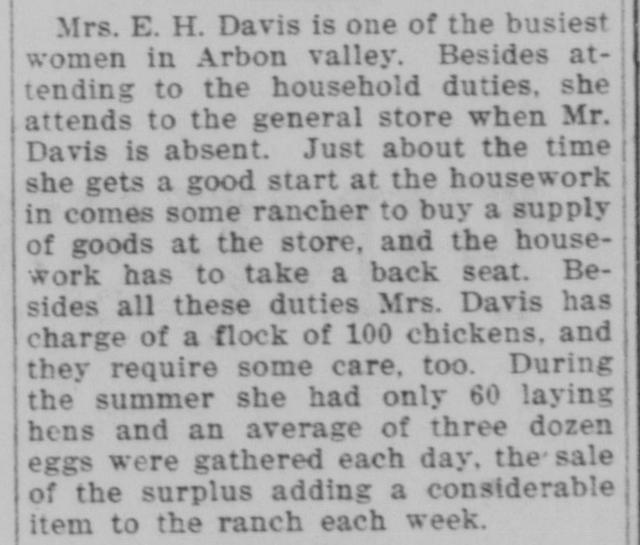
Whenever Ed Davis was off on the road with a freight wagon, his wife ran the store. Esther Davis would no sooner get going on the housework, the American Falls Press reported in November 1917, than “in comes some rancher to buy a supply of goods at the store, and the housework has to take a back seat.”
The paper’s roving farm writer, who signed himself the Pilgrim, called her “one of the busiest women in Arbon valley.” Besides the house and the counter she had charge of 100 chickens. Over the summer only 60 of them were laying, yet they gave about three dozen eggs a day, and the eggs the family did not need brought in “a considerable item to the ranch each week.” Two weeks before, the same writer had named her husband “the rancher-merchant of Arbon valley.” The couple raised crops and livestock alongside the trade, and the store was a family business.
For close to twenty years many families in the valley bought their groceries, flour and gasoline from the Davises. The Press mentions the store from 1914 to 1921, and Esther’s obituary says they kept it until 1931.
Among the first families
Edward H. Davis married Esther Arbon, a daughter of George Arbon, in 1892, and two years later they came to the valley, one of its earliest households. Their family history puts the Davis ranch a mile west on Church Road, at its corner with Bailey Road, and the store just across the road to the west. A family memory has Ed Davis carrying groceries to the snowbound Nunnelleys in the winter of 1909–10. Arbon lay in Oneida County until 1913, then in the new Power County, whose seat at American Falls was home to the Press.
Just when the store opened is unsettled. The family puts it at 1910. The site’s account of the first stores finds Ed Davis selling groceries out of his house by 1912–13 and starting the general store around 1915. Mrs. E. A. Logan’s history of the valley, printed in March 1917, described “a fine general, up-to-date merchandise store, which he opened up about two years ago.” But the Arbon items in the Press of April 2, 1914, three years earlier, were already calling it new:
Mr. Ed. Davis, proprietor of the new store opened lately, is progressing well and is busy freighting out supplies to his many customers. Davis’ store and the Noble Kowallis store have in a fine stock of supplies and keep busy handling most of the trade of the valley.
The other store was John Noble’s at Pauline, at the valley’s north end, which still went by the name of the old partnership.
Two four-horse outfits
Everything on the shelves came over the roads from Malad or Pocatello. At harvest in August 1915, with everyone in the fields and groceries in heavy demand, Davis was busy hauling supplies out to the store. By the end of November he had “a fine display of Christmas goods.”
In June 1916 the Arbon column tracked the trade almost week by week. Eddie Davis, probably the eldest son, returned from Malad with flour and other goods, and the column offered a tip for motorists: anyone crossing the valley who ran low on gas could buy more “at E. H. Davis’ the Arbon merchant.” Two weeks on, “our live merchant” was in Pocatello for “another big load of merchandise,” and the following week he set out once more “with two four-horse outfits.” In July 1917 a Pocatello bottling works trucked a load of pop out to the Noble and Davis stores.
Half a mile west of the store
Before long people gave directions by the store. Mrs. Logan’s history put the Valley View school “about three miles south of the Central school, near E. Davis’ store,” and the Pilgrim, making his rounds that November, found D. V. Roberts’s quarter section and Sam Roderick’s ranch by counting the distance west of it. Roberts offered his own place for sale in the spring of 1918 as a “160-acre dry farm, half mile west of E. H. Davis’ store.” When Mrs. Ballaine gave up teaching at Valley View in April 1921, the column still described the school as “near the E. H. Davis store.” That June a number of farmers gathered at the store and at the Arbon farm to poison squirrels, but the poison never came.
Only once in the papers read for this story did the doors close. Influenza reached the valley in the fall of 1918, and on November 1 the Arbon column noted:
The Davis store is closed until the family of E. H. Davis recover from their seige of sickness.
The Davises were “all taking turns with the ‘flu’,” two or three of them in bed at once, while Ed was away in Wyoming hunting big game. Other families in the valley were down with it too. The column never said when the store reopened.
Until 1931
After 1921 the Press pages read here fall silent about the store. Esther’s obituary in the Deseret News of April 6, 1954, supplies the rest: the couple made their home at Arbon and kept a store there until 1931, then lived at Tyhee, north of Pocatello. Ed died in 1945, and Esther died in a Pocatello hospital on April 5, 1954, after a long illness. No report of the closing has turned up, so how the store came to an end is not known.
Years later another store served the valley’s travelers at the Mink Creek crossroads, kept by the Daniels and Evans families. More on the family is in the Davis family pages, with the Arbon area and the valley’s schools. But for the better part of two decades, the place to buy flour, pop, Christmas goods or a tank of gas in the middle of Arbon Valley was the Davis store, and as often as not it was Esther behind the counter.
The original article
American Falls Press, November 6, 1917, page 3. Transcribed from the page scan.
ALONG THE HIGHWAYS
Gleanings by the Pilgrim In His Wanderings Here and There.
Well up against the eastern foothills of Arbon valley, about [illegible] miles southeast of Arbon postoffice, Harry Van Horn is farming a ranch of 320 acres. This year he had 120 acres in Turkey Red which has given a yield per acre above the average of the valley and the quality of the wheat has been pronounced by the threshers to be of the best handled by them. At this writing threshing was in progress and the yield could not be ascertained. Up to the time of heading this year this ranch has been free of mustard, but since the grain was cut a growth of the pest has made its appearance and Mr. Van Horn intends to eradicate [illegible] resorting to spring seeding. On this ranch, which lies at an altitude of 5250 feet an orchard of 20 trees, containing apple, pear, plum and cherry trees, was set out three years ago last spring and some cherries were picked this year. The sweet corn planted in the garden gave plenty of roasting ears. A dairy herd is being established and the production of cream and butter will be an important feature on this ranch when fully developed. The flock of Brown Leghorn and Rhode Island Red chickens is another revenue produced on this ranch. Van Horn believes in diversification as the best way of successfully conducting farming operations.
J. N. Arbon this year threshed 4696 bushels of winter and spring wheat, the yield being fully up to his expectations for an adverse year. He plans to put in a large acreage of spring wheat next year, fall seeding having been curtailed owing to the prevalence of mustard and other weeds and the urgent need for their elimination. Mr. Arbon has been a farmer in this valley ever since he came here with his father, George Arbon, in 1892, and combines livestock raising with his farming. However, the growing of cereals and alfalfa hay is the main endeavor of this pioneer of the valley.
Mrs. E. H. Davis is one of the busiest women in Arbon valley. Besides attending to the household duties, she attends to the general store when Mr. Davis is absent. Just about the time she gets a good start at the housework in comes some rancher to buy a supply of goods at the store, and the housework has to take a back seat. Besides all these duties Mrs. Davis has charge of a flock of 100 chickens, and they require some care, too. During the summer she had only 60 laying hens and an average of three dozen eggs were gathered each day, the sale of the surplus adding a considerable item to the ranch each week.
Over the Mink creek divide stands a lone pine tree, visible from any point of Arbon valley north of Pauline. On a clear day it looms up quite plainly from the foothills on the west edge of the valley and points the way to the Mink creek pass. When in the years to come the airship service is established and automobiles and Fords have been relegated to the rear the lone pine tree on the divide will be the pilot’s guide. Did any one say that airship service is a long way off? Well, most of us will remember when we used to scoff at all who talked of horseless carriages. We do not scoff at them now. This old world keeps a-moving and progress is the order of the day.
L. M. Anderson, one of the group of Anderson brothers who are pioneer farmers of Arbon valley, enlisted as a volunteer in the United States army six months ago is now stationed at San Diego, California, a member of [illegible] Co., 21st U. S. infantry. He likes the service and the training he is receiving, and report has it that his regiment is about ready to sail for France. When the last letter was received from Mr. Anderson about the middle of October, he stated that he was in charge of a bunch of mules belonging to the machine gun battalion.
E. T. Anderson, whose ranch is located five miles south of Arbon postoffice, has nineteen stacks of wheat ready for the thresher, and expects to reap a yield fully up to the average of the valley this year. At the end of October quite considerable amount of threshing remains to be done and hauling of grain to the platforms and to the railroad will continue well into the winter.
It has been noticed that every school house in Arbon valley is provided with a flag pole in the yard, but so far Old Glory has not been seen flying at the top of the pole in any school yard. This is not due to neglect of the teachers, however. The atmosphere is of a very emotional nature up Arbon valley way and with little provocation begins to surge and surge, until the gentle zephyrs have grown into a formidable blast which will whip to pieces anything made of cloth. The only way to keep a flag flying here is to get one of the kind made of steel netting.
Farley Van Horn, who has a homestead just across the Oneida county line, will leave on November 5 for American Lake, Washington, to join the national army. The young man was called to go earlier, but was given time to get in his crops. He is eager to go into the army and to do his bit in the service of Uncle Sam. The young man is a son of Mrs. Kate Van Horn of Arbon valley.
Sources
- American Falls Press, April 2, 1914, page 11
- American Falls Press, August 12, 1915, page 4
- American Falls Press, December 2, 1915, page 3
- American Falls Press, June 8, 1916, page 8
- American Falls Press, June 22, 1916, page 8
- American Falls Press, June 29, 1916, page 6
- American Falls Press, March 29, 1917, page 7
- American Falls Press, July 27, 1917, page 5
- American Falls Press, October 23, 1917, page 3
- American Falls Press, November 6, 1917, page 3
- American Falls Press, November 16, 1917, page 3
- American Falls Press, April 26, 1918, page 4
- American Falls Press, November 1, 1918, page 5
- American Falls Press, April 8, 1921, page 2
- American Falls Press, June 17, 1921, page 2
- Deseret News, April 6, 1954, page 32
- Edward Henry Davis & Esther Rebecca Arbon, family history, on this site
- The first store, Stories, on this site