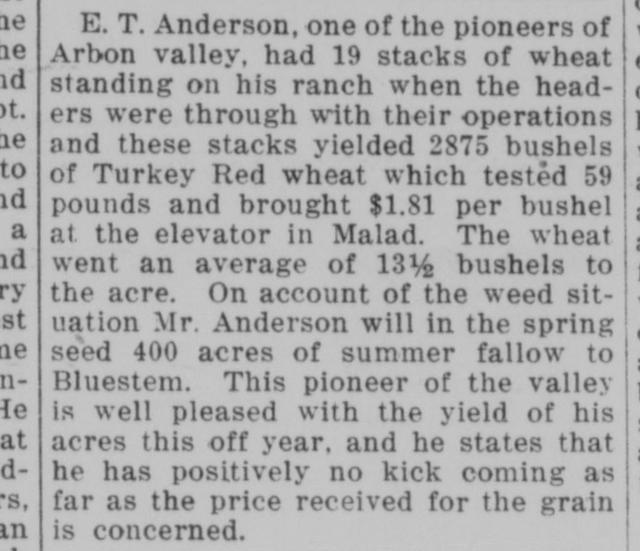
When the headers were done on E. T. Anderson’s ranch in 1917, nineteen stacks of wheat stood waiting for the thresher. They made 2,875 bushels of Turkey Red, about 13½ bushels to the acre, and the elevator at Malad paid him $1.81 a bushel for it. The American Falls Press reported on January 8, 1918, that he had “positively no kick coming as far as the price received for the grain is concerned.” He was probably Ezra Taft Andersen of the Andersen family. He was well pleased with his yield in what the paper called an off year. For Arbon Valley it had been a year of hail, heat, weeds and war.
The paper had followed that wheat since spring. Most of it was Turkey Red, a hard winter wheat, with some Bluestem sown in the spring. The valley had belonged to Oneida County until 1913, when Power County was formed.
A hopeful June
June began well. On June 5 the valley column said more than a week of rain, falling every day, had “made a great change in the looks of the crops.” A week later County Agent Kjosness came back from the valley, and the Press wrote that “Grain prospects in the Arbon valley excell those in any part of the county.” A Crystal man named Butterfield said he had seen in the Arbon country “some of the finest wheat he has ever seen.” Agents selling hail insurance went from farm to farm. No one was looking for hail, the column admitted on June 29, but “most of the grain around here is very good and we believe in preparedness.”
Hail on a Friday afternoon
The storm came on Friday, July 6, at about two in the afternoon. For several minutes it cut grain and alfalfa to the ground, in the column’s words, “like a mower would do it.” Some farms were hit hard and others only lightly. The storm crossed nearly the whole valley near the Central school, three miles wide in places.
Will Allard lost three-fourths of his crop. Wm. Kramer was left with about 15 of his 80 acres of fall wheat, and Con Weidermann’s losses were heavy too. John Bullock lost 120 acres. He was probably the J. H. Bullock whose Turkey Red had won a world’s-fair medal, as the Press noted in March. One report called his the only crop without insurance; another said Kramer’s had none either. Lorin Bailey had 60 acres that looked as good as any in the valley in June, and they threshed out at only 360 bushels. That evening Frank Swim telephoned to say the hailstones still lay heaped around his buildings. In October the Press wrote that in all of D. J. Bowen’s years on his ranch, no storm had come close to this one “in severity and destructiveness.”
Then the heat set in. On July 10 a report from Pocatello to the Salt Lake Tribune said hot weather was “burning up the crops” across some 300,000 acres of dry farms in the Arbon and Rockland valleys. Unless rain fell within three days, many fields would hardly pay to harvest. Even so, the Press reckoned on July 24 that the county’s wheat would bring at least $1.1 million at the government’s price, more than double what the bumper crop of 1914 had returned.
Harvest in wartime
The same issue printed the county’s draft numbers as they were drawn, with Arbon and Crystal names among them, and farm help began to run short. In late August Ben Davis put down his law books to help his brother Jim, who was laid up, get the harvest in at Crystal, “doing his bit in the nation’s crisis,” as the Press put it.
By August 21 the grain was ripe across the valley:
The grain is all ready to harvest and everywhere the combines and headers are to be seen at work. Palmers started up their thresher last week. The wheat is running around eight and twelve bushels to the acre. There is considerable grain ready to be hauled to the new platform when it is completed.
The new platform was probably one of those E. E. Zaring was putting up that month at Pauline, where a platform later grew into the valley’s only grain warehouse. September brought more rain and more hail. The wet weather kept the Jim Hill mustard green, and many owners left their fields standing until the weed ripened.
On September 12 Central Hall gave a send-off for “our boys who are soon going to leave,” among them Park Lusk, Charles Hassenpflug, Thomas A. Gibbons, John A. McCool, Thomas Wheatley and Ernest Poppie. In October a rancher who went to Pocatello to hire a man came home without one; the first he found asked $5 a day and board. Even Roy Porter’s four mules were called up. “Their Arbon valley days are over now, as Mr. Porter has sold them to the government,” wrote the paper’s roving farm correspondent, who signed himself “the Pilgrim.” By December Robert Wheatley was running his brother Thomas’s ranch while Thomas was in the service.
That October, wheat stacked up on the platforms faster than motor trucks could carry it to the railroad at Michaud. By November the roads were too bad for the trucks to run at all.
Bushels and dollars
J. N. Arbon threshed 4,696 bushels, “fully up to his expectations for an adverse year.” J. R. Bailey got 1,800 bushels of wheat and barley, where in 1913 he had threshed 4,300 bushels of grain. T. B. Evans, who had sold his first threshed wheat for 50 cents a bushel in 1895, lost about 30 acres to the hail and averaged about 11 bushels on what was left.
The prices made up for a good deal. Turkey Red was fetching $1.68 to $1.72 a bushel, and more at Malad, over Jenson Pass in Oneida County. Joseph Abler sold there for $1.83, and the Malad mill paid D. J. Bowen $1.95, “the highest price paid for wheat from Arbon valley this year.” The Pilgrim wrote on November 16:
Malad wheat buyers are eager to get hold of Arbon valley winter wheat. Whenever a load of this wheat gets to the Oneida county metropolis the owner of it has no trouble at all in disposing of it at top prices.
An elevator at American Falls advertised that the wheat price was fixed for 1917 and 1918. Still, the Pilgrim figured that “more than enough wheat to fatten 10,000 hogs has gone to waste this year in Arbon valley,” some of it left uncut on account of the mustard. Straw itself had become “an article of commerce,” and after the winter of 1916–17 that starved so much stock, ranchers were paying cash for it.
Spring wheat for 1918
The weed set the plans for the next year. “The Jim Hill mustard menace is the most difficult problem confronting the farmers,” the Pilgrim wrote, and the growers were close to agreed on sowing only in the spring for two or three years, even at a few bushels less to the acre. Andersen meant to put 400 acres of summer fallow into Bluestem. J. R. Bailey would plant wheat on every acre he could, most of it spring-sown, and so would W. E. Dawson of Pauline, the Press reported, “in compliance with the government’s request.”
The original article
American Falls Press, January 8, 1918, page 3. Transcribed from the page scan.
Gleanings by the Pilgrim In His Wanderings Here and There
E. T. Anderson, one of the pioneers of Arbon valley, had 19 stacks of wheat standing on his ranch when the headers were through with their operations and these stacks yielded 2875 bushels of Turkey Red wheat which tested 59 pounds and brought $1.81 per bushel at the elevator in Malad. The wheat went an average of 13½ bushels to the acre. On account of the weed situation Mr. Anderson will in the spring seed 400 acres of summer fallow to Bluestem. This pioneer of the valley is well pleased with the yield of his acres this off year, and he states that he has positively no kick coming as far as the price received for the grain is concerned.
Sources
- American Falls Press, March 29, 1917, page 1
- American Falls Press, June 5, 1917, page 2
- American Falls Press, June 12, 1917, page 4
- American Falls Press, June 12, 1917, page 5
- American Falls Press, June 19, 1917, page 5
- American Falls Press, June 29, 1917, page 5
- American Falls Press, July 10, 1917, page 5
- Salt Lake Tribune, July 11, 1917, page 13
- American Falls Press, July 24, 1917, page 1
- American Falls Press, August 10, 1917, page 5
- American Falls Press, August 21, 1917, page 3
- American Falls Press, August 28, 1917, page 3
- American Falls Press, September 7, 1917, page 8
- American Falls Press, September 18, 1917, page 4
- American Falls Press, October 9, 1917, page 3
- American Falls Press, October 26, 1917, page 3
- American Falls Press, October 30, 1917, page 3
- American Falls Press, November 2, 1917, page 3
- American Falls Press, November 6, 1917, page 3
- American Falls Press, November 9, 1917, page 3
- American Falls Press, November 9, 1917, page 8
- American Falls Press, November 13, 1917, page 3
- American Falls Press, November 16, 1917, page 3
- American Falls Press, November 20, 1917, page 3
- American Falls Press, November 23, 1917, page 3
- American Falls Press, December 14, 1917, page 3
- American Falls Press, January 8, 1918, page 3