In the summer of 1910 an Arbon rancher came into Pocatello and could hardly say enough about the road that had brought him there. It was, J. C. Cairns told the Pocatello Tribune, “one of the finest mountain roads I ever traveled.” Four years earlier the way up Mink Creek had been little more than a fresh grade, and the settlers beyond the divide had since lent their own labor to building its replacement.
A rancher’s grade
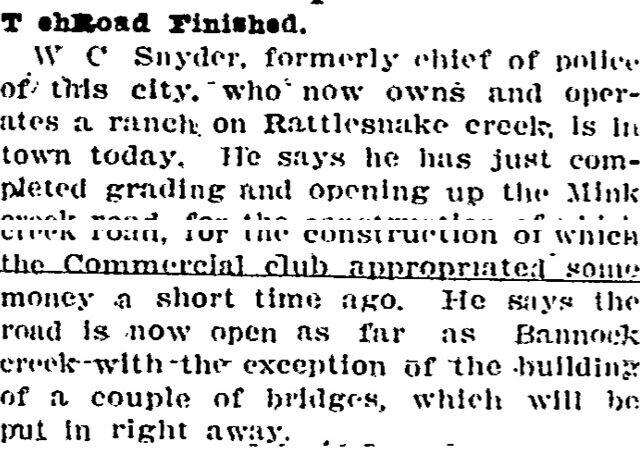
The first word came on Monday, June 25, 1906. W. C. Snyder, “formerly chief of police of this city,” was in town from the ranch he now owned and worked on Rattlesnake Creek. He told the Tribune he had just finished grading and opening the Mink Creek road, a project the Commercial Club had put money toward not long before. The road now ran through as far as Bannock Creek, in Bannock Valley, as Arbon Valley was then often called. Only a couple of bridges remained, and those would go in right away. The item did not say how much the club, most likely Pocatello’s, had given, who worked alongside Snyder or exactly where the road ran.
Snyder was almost certainly William Clinton Snyder, who took up one of the first homesteads at Crystal, on Rattlesnake Creek, in October 1902, and whom the American Falls Press later named as Crystal’s first settler. Name, creek and Pocatello tie all line up, though the 1906 item never mentions Crystal and no other source consulted here speaks of his police work. The Crystal area page and Crystal, the hidden settlement up Rattlesnake Creek tell more of the settlement he helped begin.
“A dugway all the way to the divide”
Four years on, the road still was not good enough. On Friday evening, April 8, 1910, the Bannock County Good Roads Association gathered to hear from its road committees. The opening of the Tribune’s account, on its front page, could not be found for this post. The continuation on page 8 picks up partway through a committee report, evidently from the Mink Creek committee. Above some point named in the lost opening, it said, the road was “a dugway all the way to the divide,” a track cut into the hillside, and “material changes in the route” would be needed before it made a passable highway. The committee planned to look the road over and send a written report to the county commissioners.
Then came word from the settlers on the far side:
A petition, signed by T. L. Reddy and 22 other residents and settlers along Rattlesnake creek, over the Mink creek divide, was submitted to the association, asking that efforts be made to bring about a change in route and grade to the end that the highway might be made passable. The petition was referred to the Mink creek committee.
Whether this T. L. Reddy was the “Mr. Reddy” with good fields at Crystal in 1911, no source read here says. The association heard as well that the county road and bridge fund held nearly $7,000, and it set a meeting with the commissioners for the following week.
Built by volunteers
By midsummer the new road was in use. On July 15, 1910, the Tribune gave Arbon a front-page piece, placing it 27 miles southwest of Pocatello. Cairns, in the city on business, gave the credit where he thought it belonged:
Mr. Cairns paid a high compliment to Road Supervisor Tom Reynolds, under whose supervision the new road up Mink creek and over the Rattlesnake creek divide was recently built. “This is one of the best pieces of road building I ever saw,” says Mr. Cairns.
The settlers along Rattlesnake creek and in Bannock valley volunteered their services in building this road, and thereby exhibited an enterprising and boosting spirit that augurs well for the progress of that community.
The mountain road was the short way in, though not the easiest for freight. John Payne, the Arbon merchant, was in town at the same time. He had come around by Michaud and Swanson’s ranch, some six miles farther but “better adapted to heavy loads,” and he headed home with a big wagonload of groceries.
On Tuesday, August 16, Mr. and Mrs. T. B. Evans came in from Arbon “over the fine, new Bannock county road built over the Mink Creek divide,” the paper reported the next day. They were almost certainly Thomas Bowen Evans and his wife Susannah, who served for a time as Arbon’s postmistress.
The road also made a point about county lines. Arbon belonged to Oneida County, governed from Malad, but the road over the divide was Bannock County’s work. When Cairns came to Pocatello again on September 30, he reported fully 75,000 bushels of wheat raised in the valley. The new road, he said, would be a credit to any county, and if Oneida County did as well as Bannock had, “the farmers would have no kick coming.”
The road that held the trade
None of the 1910 reports says whether the new road followed the route the settlers had asked for, how much of Snyder’s 1906 grade it reused, what it cost or when the crews did the work. Two years later its worth was plain. In 1912, with American Falls bidding for the valley’s wheat, the Tribune, as reprinted in the American Falls Press, put Pocatello’s hold on that trade down to “a splendid road over the Mink creek divide” that the county had built a few years earlier, as told in American Falls and Pocatello court the Arbon wheat trade, 1912. The road’s later story, through the 1920s, is in Mail, grain and the Mink Creek road to Pocatello, 1924–1929.
The settlers who petitioned for a better road, and then helped build it, had pulled their valley’s harvest over the divide toward Pocatello.
The original article
Pocatello Tribune, June 25, 1906, page 4. Transcribed from the page scan.
The Road Finished.
W C Snyder, formerly chief of police of this city, who now owns and operates a ranch on Rattlesnake creek, is in town today. He says he has just completed grading and opening up the Mink creek road, for the construction of which the Commercial club appropriated some money a short time ago. He says the road is now open as far as Bannock creek—with the exception of the building of a couple of bridges, which will be put in right away.
Sources
- Pocatello Tribune, June 25, 1906, page 4
- Pocatello Tribune, April 9, 1910, page 8
- Pocatello Tribune, July 15, 1910, page 1
- Pocatello Tribune, August 17, 1910, page 5
- Pocatello Tribune, September 30, 1910, page 2
- American Falls Press, June 22, 1911, page 1
- American Falls Press, August 22, 1912, page 1
- American Falls Press, February 4, 1921, page 5