Power County looked for the biggest wheat crop in its history in 1921, and every bushel Arbon Valley raised would have to go out by wagon and truck, over rough miles, to a railroad siding. That was the summer the valley’s own road district found its money locked inside a closed Pocatello bank.
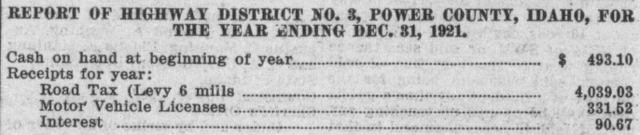
The district’s books for the year, printed in the American Falls Press on February 3, 1922, show what it was left with when the hauling was done: $3.60 in the bank.
A road district of its own
Arbon belonged to Oneida County until 1913, when it was taken into the new Power County, governed from American Falls. On June 12, 1918, voters unanimously created Highway District No. 3 to cover the Arbon and Pauline precincts, and that fall they approved $50,000 in bonds.
The commissioners, with J. E. Keeler as chairman and William Allard of Arbon as secretary, advertised in April 1919 for bids to gravel fifteen miles of road running south along Bannock Creek. Beyond their northern line, the road down the creek toward the railroad was in the hands of Highway District No. 1, the American Falls district. A Salt Lake paper noted that August that in this wheat country “long hauls over poor roads have been the rule.” By the close of 1920 the valley district counted fourteen miles of road graded and graveled.
Courting the valley’s trade
American Falls wanted that traffic. In February 1921 its newly revived Chamber of Commerce took up the question of a shorter Arbon–American Falls highway “so that the farmers of that district could reach this city more easily.” Irvin Allred, the county engineer, told the board the road could be graveled to carry heavy loads for roughly $1,000 a mile, and that a “Shiller cut” would take off about three miles. A cut-off beginning some seven miles west of Starlight would save ten, but it would cost at least $3,000 a mile. The board leaned toward the cheaper plan and had its secretary write to leading men in Arbon. Its reasoning was plain:
With a newly graveled highway, it was felt by members of the board, and the proper trade inducements offered by local merchants, a bulk of the Arbon Valley trade would be diverted to this city.
Neither cut appears in the papers as built.
Money in a closed bank
E. E. Zaring, the American Falls grain buyer, toured every district that spring and told the Press on June 3 that the county would harvest two million bushels, more than ever before. He was especially taken with the valley:
Arbon Valley shows now in its prime. From Pauline to Crystal, there is little choice for special comment. There is a universally excellent stand of grain, the acreage is larger than ever before and the yield is bound to be enormous.
By then the Bannock National Bank of Pocatello had already failed, closing in May. On July 11 the Salt Lake Telegram reported that the Arbon Valley highway district’s available cash had gone down with it. The commissioners had been counting on about $2,000 to maintain their roads that year and did not know how they would keep them up through the wheat haul. On the same page the Telegram said the frost of July 3 had struck hardest in the Arbon Valley, though most of the wheat was too far along to be badly hurt.
The haul to Schiller
The grain went to Schiller, a siding on the Oregon Short Line roughly a mile west of today’s Bannock Peak Truck Stop on I-86, as the Pauline and West Fork history places it. A 1924 report put it twenty-six miles from the Pauline warehouse; the site’s Stories pages trace the first grain warehouse and the first trucks in the valley.
Late in August the Arbon column complained that the harvest was short of men to gather straw and sacks:
Oliver Foutz, the U. S. mail carrier brings several out a day, but they work from half a day to three or four days and quit, which is quite discouraging, when help is needed so bad. Grain is going from 15 bushels to thirty-five. Several acres were found to be frozen when they commenced cutting the grain.
A Mr. Keeler had bought an International truck and was running it to Schiller twice a day; the Wheatgrowers Association’s grain was handled there that fall. The column printed his initials as “J. K.”, which may be a slip for J. E. In September the Press found more trucks on the road than ever. Zaring rated the wheat excellent and the price about 84 cents a bushel. Between August 1920 and New Year’s Day 1921 his company had paid anywhere from $1.34 to $2.22, as the market moved. The late frost, he said, had done real damage in Arbon Valley after all.
By the middle of October the lower stretch of the highway was “in a very bad condition, especially for travel with touring cars,” with trucks still running to Schiller siding and teams starting to freight.
Receiver’s certificates
The year-end report told the rest. Counting the $493.10 it started with, the district took in $4,954.32, most of it from a six-mill road tax. It paid out $1,000 for new road, $735.67 for upkeep and $902.50 in bond interest. Another $1,937.66, very likely the money caught in the failure, was carried as “Bannock National Bank (Receiver’s Certficates held),” the misspelling the report’s own: a claim on whatever the receiver might someday recover from the bank. That left $3.60 in cash against $2,410.24 in unpaid bills and interest. The report was signed by Keeler, George M. Houk and Roy Lindley as commissioners, with Allard as secretary and treasurer.
The road showed it. In October 1922 Allred, now county surveyor, said the county’s roads were much better than a year earlier, but “The Arbon valley road is our worst one at this time. The bed is too loose to be held in any shape.” The district’s election on November 7 offered five names for three seats: the three sitting commissioners and two newcomers, Dave Lusk, probably David Thomas Lusk of Pauline, and L. B. Evans, probably Ren Evans of Arbon. How the vote went has not turned up.
That December Allred, acting as engineer for the American Falls district, announced that twenty or twenty-one four-horse teams supplied by the district’s residents would gravel three and a half miles of the Arbon Valley road north and west from Rocky Ford. “The Arbon road cuts up badly every year during the wheat hauling season,” he said. The Stories pages carry the road forward to the first state highway, and set these years beside the foreclosures of 1920–1925 on the valley’s farms.
The papers read so far do not say whether the district ever got its money back. In January 1929 the Salt Lake Tribune reported that a federal court had issued its final decree holding the Bannock National Bank’s directors responsible for the losses, in a case followed closely “as many local people were financially involved.”
The original article
American Falls Press, February 3, 1922, page 4. Transcribed from the page’s digitized text, with the heading and the first lines checked against the page scan. The report is printed as a table, with the figures in a column at the right and dot leaders between; here each figure follows its line.
REPORT OF HIGHWAY DISTRICT NO. 3, POWER COUNTY, IDAHO, FOR THE YEAR ENDING DEC. 31, 1921.
Cash on hand at beginning of year $ 493.10
Receipts for year:
Road Tax (Levy 6 mills 4,039.03
Motor Vehicle Licenses 331.52
Interest 90.67
Total 4,954.32
Expenditures for year:
Road Construction 1,000.00
Road Maintenance 735.67
Bridge Maintenance 300.00
Administrative Expense 76.00
Interest on Bonds 902.50
Bannock National Bank (Receiver’s Certficates held) 1,937.66
Total 4,950.72
Cash in Bank 3.60
Bills Payable 304.99
Unpaid Interest and handling 2,105.25
Total 2,410.24
Assessed Valuation $692,788.00
Approximate mileage of all roads 109 miles
Approximate mileage of graded roads 23 miles
Approximate mileage of surfaced roads 15 miles
Approximate miles surfaced past year 1 mile
Commissioners
J. E. KEELER,
GEO. M. HOUK,
ROY LINDLEY,
WM. ALLARD, Sec’y. and Treas.
Sources
- American Falls Press, June 25, 1918, page 3
- American Falls Press, November 15, 1918, page 3
- American Falls Press, April 18, 1919, page 4
- Salt Lake Herald-Republican, August 25, 1919, page 2
- American Falls Press, November 19, 1920, page 7
- American Falls Press, February 11, 1921, page 1
- American Falls Press, February 18, 1921, page 1
- American Falls Press, June 3, 1921, page 1
- Salt Lake Telegram, July 11, 1921, page 14: the highway district
- Salt Lake Telegram, July 11, 1921, page 14: the frost
- American Falls Press, July 29, 1921, page 8
- American Falls Press, August 26, 1921, page 4
- American Falls Press, September 9, 1921, page 1
- American Falls Press, October 14, 1921, page 4
- American Falls Press, February 3, 1922, page 4
- American Falls Press, October 12, 1922, page 8
- American Falls Press, October 26, 1922, page 1
- American Falls Press, November 2, 1922, page 1
- American Falls Press, December 28, 1922, page 1
- American Falls Press, March 13, 1924, page 2
- Salt Lake Tribune, January 4, 1929, page 11