Rain came down on the snow of Arbon Valley in the last days of January 1911, and kept coming. When it stopped, the snow had melted off with it, Bannock Creek had torn out its bridges, and three children were dead.
The valley was still in Oneida County then, its business done at the county seat in Malad, and many people still called it Bannock Valley. Its news reached the outside world in short letters to the papers. One from Malad, printed in the Deseret Evening News on February 4, carried the first word: three children had drowned at Arbon.
A sleigh in the water
The families of Del Dalton and Ezra Anderson, the Malad letter said, had been on their way home from a neighbor’s in a sleigh when it tipped over and threw them all into the flood. Everyone was pulled out except “two children belonging to Mr. Dalton and one belonging to Mr Anderson.”
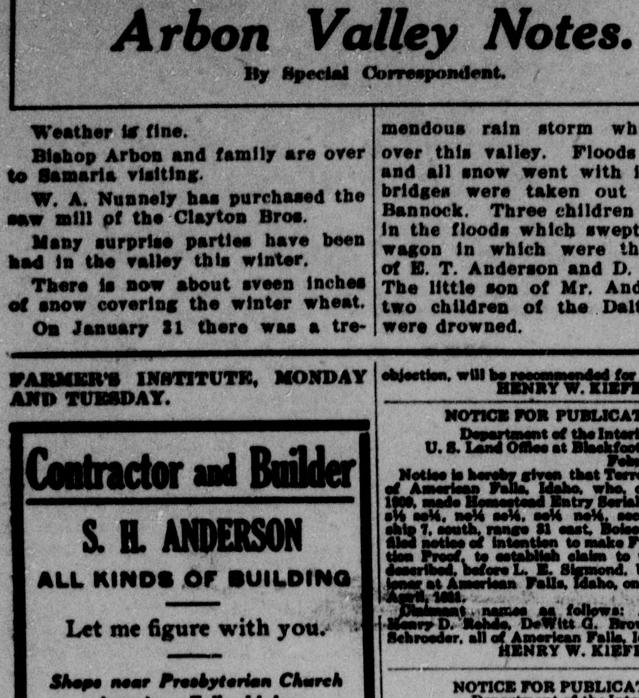
The valley’s own correspondent wrote it up for the American Falls Press two weeks later, in “Arbon Valley Notes” for February 18. The column began with the small things of a winter: Bishop Arbon’s family off visiting in Samaria, W. A. Nunnely (Walter A. Nunnelley) taking over the Clayton brothers’ sawmill, around seven inches of snow lying on the winter wheat, and “many surprise parties” since fall. Then it came to the storm. The floods had been bad, the snow had gone off with the rain, and the creek had carried away bridges up and down the Bannock. In the correspondent’s account the families were riding in a wagon, not a sleigh, and the dead were “the little son of Mr. Anderson and two children of the Dalton family.”
The papers spelled the fathers’ names their own way. E. T. Anderson was Ezra Taft Andersen, as the family writes it, and D. C. Dalton was Dell C. Dalton. Neither paper named the children. They were Nicholas Andersen, and George and the baby Dora Dalton, as the Stories entry on the drowning records. The family’s side is told in the history of Ezra Taft Andersen and Eva Arbon Andersen, and the loss is among Melinda Campbell’s Valley Tragedies.
Just when it happened is still uncertain. The day is hard to make out on the digitized Press page; the transcription below reads it as January 31. The site’s timeline gives January 18, and Find a Grave gives January 30. The Stories entry weighs those dates against the family accounts of that night.
Floods across the county
Arbon was not alone. The same Malad letter called the downpour of the past few days one of the worst floods the Malad Valley had ever seen, with bridges gone all through that end of the valley. Other letters from Malad told of streams out of their banks and travel at a standstill. A party headed for Samaria drove into Devil Creek, not knowing its bridge had washed out, and lost a horse. Near Rockland, the Press said, the creek had spread over the low meadows and swept off the private bridges.
On March 18 Marshal Johnson, in town from Arbon early that week, gave the Press the plain count: “every bridge on Bannock creek went out last month during the floods.” Speaking in March, he would have meant February, and the county commissioners had already blamed “the unusual storms of the past two months.” The valley wanted “three bridges across the Bannock and one across Rattlesnake,” he said. The snow was off now, and farm work would soon start.
The Rockland correspondent in that issue found the roads gullied and the bridges washed out: “It has been many seasons since such a condition of roads has confronted any one.” Commissioner May said he had so many miles of bad road in his district that he would have to go out to the Arbon and Rattlesnake country, among others, for plans and estimates before he let any repair contracts.
Bonds for bridges
The county’s answer was a bond issue. On March 11 the Press reported that the commissioners would put bonds to the voters, both to pay off outstanding county warrants, the IOUs written for bills the treasury could not yet cover, and to rebuild bridges lost in the storms. Many were gone in Cache and Malad valleys, the paper said, and some around Arbon and Rockland.
The commissioners’ list of work, printed April 1, came to roughly $60,000, about half of it for the warrants. Most of the new spans were to be steel or concrete. Arbon’s share was a wooden bridge over Bannock Creek near the place of Perry Lusk, who had been ranching on the West Fork since 1906.
When the formal notice of election ran on April 29, dated April 20 and signed by John J. Evans as clerk of the commissioners, the figures had changed. It sought a little under $24,000 in road and bridge bonds and left the warrants to a separate issue. For the valley it named a wooden bridge across the Bannock near a place the digitized text renders “Aobles,” likely the Noble homestead at what became Pauline; whether that was the same bridge first listed near Lusk’s is unknown. It also named “one wooden bridge across Rattlesnake creek in Bannock valley, $300,” and $500 for “completing grade of Malad Arbon road,” part of the story of the first engineered road out of the valley. The commissioners, meanwhile, were already awarding bridge contracts elsewhere in the county, each “on condition that the bond election carries.”
Some voters balked. On May 6 the Press told of a man who meant to vote no because the plan called for so many iron bridges, when in his view wooden ones would do the job for far less. The paper admitted it was no judge of bridges, but it backed the bonds anyway: “It is iron and concrete bridges or none.”
No record of the election day or the vote count has turned up. The bonds passed all the same. On May 25 the Press reported that the commissioners would meet June 17 “to sell the bond issue recently voted.” Whether the new bridges ever went in over the Bannock and the Rattlesnake, and when, the papers of that spring do not say.
The original article
American Falls Press, February 18, 1911, page 4. Transcribed from the page scan.
Arbon Valley Notes.
By Special Correspondent.
Weather is fine.
Bishop Arbon and family are over to Samaria visiting.
W. A. Nunnely has purchased the saw mill of the Clayton Bros.
Many surprise parties have been had in the valley this winter.
There is now about sveen inches of snow covering the winter wheat.
On January 31 there was a tremendous rain storm which sweep over this valley. Floods were bad and all snow went with it. Many bridges were taken out along the Bannock. Three children met death in the floods which swept away the wagon in which were the families of E. T. Anderson and D. C. Dalton. The little son of Mr. Anderson and two children of the Dalton family were drowned.
Sources
- American Falls Press, February 4, 1911, page 3
- Deseret Evening News, February 4, 1911, page 11
- American Falls Press, February 18, 1911, page 4
- American Falls Press, March 11, 1911, page 1
- American Falls Press, March 18, 1911, page 3
- American Falls Press, March 18, 1911, page 6
- American Falls Press, April 1, 1911, page 1
- American Falls Press, April 29, 1911, page 4
- American Falls Press, April 29, 1911, page 7
- American Falls Press, May 6, 1911, page 1
- American Falls Press, May 25, 1911, page 4