By the night of St. Patrick’s Day, 1921, the men of Arbon Valley were out in the hills with rifles. “Arbon Valley is in arms,” the American Falls Press told its readers the next morning. That Thursday, March 17, W. H. Ball, a farmer near Pauline at the north end of the valley, had shot his neighbor Ed Brandt on the road. Late in the afternoon he fired on a posse at his own cabin and mortally wounded Deputy Sheriff Charles H. Torrance of American Falls. Before the year was over, two Power County juries had found him not guilty.
A quarrel at the store
The trouble began that morning at the Davis store in Pauline, where, the Press said, Ball quarreled with Dick Steed. About a mile out of town Ball met Brandt bringing his team in. Brandt’s account, as he gave it to Deputy Sheriff Hyrum Secrist, was that Ball pulled a pistol, fired twice, hit him in the forearm and went on home.
Torrance drove out from American Falls. At Pauline he swore in John Kowallis, Herbert Swim and Eric Young as deputies, and with them and Secrist he went out to Ball’s place. As they later told the court, they kept watch for two hours and went in while Ball was away with his gun. He came back about half past five and was told to put his hands up. By their account he started shooting. One shot knocked the cap off Secrist’s head. Kowallis took a bullet in the arm, Swim came away with a broken leg, and Torrance was hit with buckshot from close range. The Press said Ball set fire to his house and slipped off into the hills.
Every crossroad watched
The paper’s next-morning story gave the scene in full:
Arbon Valley is in arms. Every male citizen has shouldered a gun and is searching the hills for the mad man who escaped under cover of darkness. Pocatello and American Falls police forces are uniting in the search. Every crossroad has been picketed.
Ball, wounded in the arm, made it to the ranch of J. E. Pauling, whom the Press called Polling. According to the Ogden Standard-Examiner, Pauling carried him over the divide in a wagon. The Press said only that two boys delivered him to St. Anthony’s hospital in Pocatello at three in the morning and were gone before anyone in authority got their names. Doctors took off the arm. The Bannock County officers who spoke with him did not believe he was insane, the Standard-Examiner reported.
Torrance died on Sunday, March 20, at the Bethany Deaconess hospital in American Falls. He was born in Oregon in 1867, had made his home in American Falls since 1908, and at the Baptist church he taught a big Sunday school class of boys. Over 600 people filled the Auditorium for his funeral, and Rev. A. J. Ford called him “a martyr to duty.” The site’s Stories pages tell it as the St. Patrick’s Day shootings near Pauline, and it is counted among the Valley Tragedies.
Self-defense at American Falls
The state charged Ball with first-degree murder and three assaults, and Brandt filed a $20,000 suit against him. On June 20 the murder trial opened at American Falls before Judge Ralph W. Adair of Blackfoot, and the courtroom was packed.
Secrist swore he had told Ball he was under arrest; Kowallis swore Torrance had told Ball he was an officer. The defense pointed out that at the preliminary hearing neither man had said Ball was told officers were there to arrest him. Two defense witnesses described a mob of some fifteen men apart from the posse, until one of them, Verne Munn, placed those men at the Pauline store, better than two miles off. At that point, in the Press’s phrase, “a small bomb burst in the defense testimony.”
Ball himself, by the paper’s account, “told a simple and colorless story.” He said he had gone hunting on the reservation, though he thought an officer might come for him. When told to halt he rested his gun butt on the ground and asked if any officers were in the crowd. He “was answered by a shot,” he testified, and only then did he shoot. He pleaded self-defense: he had seen Eric Young, Brandt’s brother-in-law, among the men, and fired because he believed “it was a mob come to take his life.” The jury was out overnight and on the morning of June 24 returned a verdict of not guilty. Officers arrested Ball again on the spot for shooting Brandt.
The papers themselves had come under suspicion. Four men called for the jury told Ball’s lawyer, Judge J. M. Stevens, that they believed nothing they read in a newspaper. When it printed the verdict, the Press explained that its first story had come by telephone from Pauline two hours after the shooting, while “the people were excited,” and it went on:
The Press carried the story in detail, forty eight hours after the shooting occurred and was still not in accord with the exact facts in the case. Indeed a story of the true facts will probably never be written. Human intelligence and human senses are not dependable under conditions of excitement. An eye witness to a tragedy may be the most inaccurate in his report of what occurred.
Twice tried for Brandt
The assault case, on a charge of intent to murder Brandt, came to trial on October 6. Brandt and two eyewitnesses had testified by the second day, when Judge O. R. Baum dismissed it because the charge Prosecuting Attorney C. T. Cotant had filed did not state a crime against the state.
The case was tried again starting December 19. Fred Bishoff and Kenneth Waylett of Pauline told the court, as the Salt Lake Telegram reported it, that Ball drove past Brandt, tied his team some hundred yards farther on, came back on foot and fired twice. Ball’s version was that Brandt called out, and when he turned he saw a rifle aimed at him, so he walked back and shot Brandt in the arm. As the Press gave his testimony, Brandt “drew a rifle on him but did not fire a shot.” The defense argued that the eyewitnesses had been too excited to be trusted. The jury deliberated three and a half hours and at eleven that night, December 20, again found Ball not guilty. In the Press’s view, “a carefully planned theoretical plea of self defense” had beaten “the strongest direct convincing evidence heard in a recent criminal case in Power County.” The Stories pages record it as two juries acquit W. H. Ball.
Unsettled accounts
One of the posse was still waiting on the state the next spring. In May 1922 the state industrial accident board turned down Kowallis’s claim for compensation as a man the law had required to serve as a deputy. Swim, whose leg was broken that day, has his place in the site’s history of the Swim family. How Brandt’s suit came out, and what happened to Ball, the papers searched do not say.
Nor does the valley’s own memory match the newspapers. Melinda Campbell’s history of Pauline and West Fork, written much later, has Brandt shooting first on the road, one of the men around the cabin hitting Ball before he fired, and the posse setting the cabin alight. No 1921 paper read for this post has Brandt firing, and the Press said Ball burned his own house. Only Ball’s sworn word that he “was answered by a shot” comes partway to her telling. The Press had said it plainly in June: a story of the true facts would probably never be written.
The original article
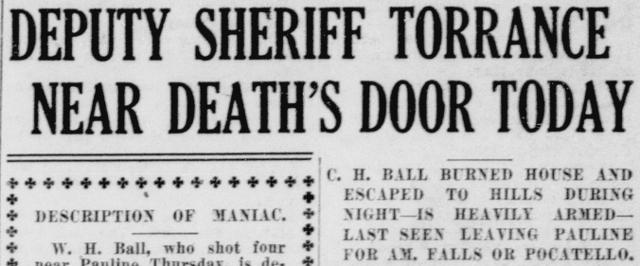
American Falls Press, March 18, 1921, pages 1 and 8. Transcribed from the page scans.
BARRICADED MANIAC SHOOTS FOUR
DEPUTY SHERIFF TORRANCE NEAR DEATH’S DOOR TODAY
C. H. BALL BURNED HOUSE AND ESCAPED TO HILLS DURING NIGHT—IS HEAVILY ARMED—LAST SEEN LEAVING PAULINE FOR AM. FALLS OR POCATELLO.
DESCRIPTION OF MANIAC.
W. H. Ball, who shot four near Pauline Thursday, is described as being about six feet tall; [illegible] years old and wore a [illegible] beard about a week old and a moustache. He is described as a two gun man, using two revolvers which he fires with his arms crossed. He also has a shot gun, a rifle and plenty of ammunition.
POSSES ARE SEARCHING
Deputy Torrance Is in Bethany Deaconess Hospital With Seven Bullet Wounds in His Body—Maniac Fired Double Load of Buckshot into Peace Officers’s Body. Condition Critical.
[illegible]
W. H. Ball, the maniac who shot Deputy Sheriff C. H. Torrance and three other men Thursday, was brought into St. Anthony’s hospital at Pocatello, at 3 a. m. Friday, by two young boys, who left the hospital before the authorities could learn their names.
Hospital authorities declared today that Ball had been shot in the arm between the elbow and the shoulder, the main artery being severed. The arm was amputated above the elbow. Ball’s condition is serious. He lost considerable blood. Nurses declared he appeared normal and rational, but refused to discuss his shooting.
Police officers have taken him in charge and placed a guard over [illegible]
Deputy Sheriff C. H. Torrance lies at deaths door and three other deputies [illegible] the hospital following the [illegible] shooting of W. H. Ball, Pauline rancher who ran amuck yesterday, killing wherever the opportunity offered. Only a few smoldering embers remain to designate the place where Ball lived, and Ball himself has gone over the ridge into the high hills between his home and Pocatello pursued by an angry posse bent on vengance.
Arbon Valley is in arms. Every male citizen has shouldered a gun and is searching the hills for the mad man who escaped under cover of darkness. Pocatello and American Falls police forces are uniting in the search. Every crossroad has been picketed. Every town in southern Idaho has been notified to watch for the murderer. It is believed that he will not be taken, alive.
Deputy Sheriff Torrance was brought to the Bethany Deaconess hospital at three o’clock this morning riddled with buck shot. His assaillant beaded him point blank at not more than thirty yards and discharged two loads into his body. He then approached him and asked if he was a officer.
Torrance said he was. “Your a d— liar and I’ll not help you an inch,” said Ball.
Walked Half Mile.
[illegible] about half a mile when he fell in a faint. [illegible] placed in a buggy and driven to Dawson garage where temporary aid was given until Dr. C. F. Schütz arrived from American Falls. A major operation was performed on the abdomen and stomach at four [illegible] taken to insure correct [illegible] of the wound. Torrance’s body was pierced in seven places, one shot passing through his shoulder and penetrating the liver. His condition is critical but hopeful.
Frank Swim is in the hospital with flesh wounds in the leg. John Kawalis has a fractured left forearm and Ed. Brandt is in Lind Brothers hospital with a fractured arm, all the inflictions from the gun of Ball who is regarded as a second Harry Tracey.
Brandt First Victim
[illegible] the call from Pauline at 11 o’clock [illegible] morning. The report was to the effect that W. H. Ball had shot Ed. Brandt in the arm while passing him in the road. This report proved true.
[illegible] other business of Sheriff Hanson and Deputy [illegible] Oliver. When he arrived at Pauline he deputized John [illegible] Herbert Swim and Eric [illegible]. These with deputy sheriff Secrist undertook the capture [illegible] ranch. When he returned to his house he found the sheriffs party in possession. He was given the command to raise his hands but instead opened fire with his rifle. He fired as he advanced and finally gained the shelter of his house without injury [illegible] the posse. He appeared alternately then on either side of the house and [illegible] shots at his would be captors. His first shot removed the cap from the head of Hyrum Secrist following which Secrist emptied his pistol. His second volley crippeld Kawallis in the hand and he surrendered [illegible] to Herbert Swim.
The third volley from the maniac [illegible] Swim to the [illegible] with a broken leg and he was carried away by Kawalis. Young and Torrance were [illegible] facing bullets alone. Ball rounded the corner of his house under the [illegible] of Torrance who thought he had his man. He hesitated and before he pulled the trigger Ball discharged a load of buckshot into him point blank. Torrance turned to run and second volley caught him in the shoulder and right arm. Swim had exhausted his amunition and left the field of battle. It was then that the conversation between Sheriff Torrance and Ball took place. “I didn’t want to shoot point blank,” said Torrance [illegible]
Swim Wounded.
The shooting occured about 5:30 p. m. Secrist watched developments until darkness obscured his vision. He was joined then by three armed farmers who did sentry duty until the sheriffs party arived from American Falls. Twenty armed men were gathered at the Dawson garage but the scene of the shooting was two miles away.
First Posse Arrives.
Upon the arrival of the Sheriff’s party about [illegible] p. m. the posse was strengthened. McCann’s ambulance and an additional doctor was called from Pocatello. The Pocatello peace officers were advised to assit in the man hunt. The Pocatello assistance arrived about midnight. Torrance was placed in the ambulance and brought home. The posse was led by Sheriff George Hanson and included Pete Hanson, Will Oliver, Dr. C. F. Schütz, Tom Oliver, C. Lee French, Kirby Torrance, W. P. Lund, and W. O. Griswold.
They left American Falls in high powered automobiles and grim determination marked their faces.
Before leaving the city a thoro canvass was made for heavy fire arms and ammunition. Several hundred rounds [illegible] McKown’s store. The fire arms were all rifles. [illegible] composed of about [illegible] armed men [illegible] American Falls [illegible] are scouring the [illegible] back of [illegible]. [illegible] last report from Pauline indicated that Ball was on his way [illegible] American Falls or Pocatello and was being driven by Ed. Polling, a Pauline farmer.
Deputy Sheriff [illegible] in describing the first shooting in the forenoon as it was told him by Brandt, said that it occurred about 10:30 a. m. after Ball had left Pauline on his way home.
Had Quarreled.
Ball had had a quarrel with Dick Steed, a farmer, earlier in the morning at the Davis store in Pauline. The quarrel, Secrist declared, was started by Ball without provocation. He then left the store and as he neared a lonely spot on the highway a mile out of town he [illegible] Brandt and his team driving into Pauline. Just as Ball’s rig pulled up alongside Brandt’s the former whipped out a pistol and opened fire. The first shot went wild and the second took effect in Brandt’s forearm, the bullet passing up the arm and out at the elbow. It was then that Brandt dropped to his wagon bed. Ball proceeded home, it is said.
Ball, according to Deputy Sheriff Secrist, has lived near Pauline for about 10 years and has always been known as a peculiar character. He is said to have had a quarrelsome disposition and has never allowed a person on his ranch since living there. On several occasions he is known to have driven off persons. He is also said to have always appeared well armed.
Believed Insane.
It is partially because of his past actions and his shooting of Brandt Thursday morning that the authorities are inclined to believe him insane. Brandt is and always has been known as a peaceful law abiding citizen and has according to his own statements, never had anything to do with Ball.
Ball will be arrested and placed in [illegible] county jail and possible attempted murder charges will be filed against him.
Sources
- American Falls Press, March 18, 1921, page 1
- American Falls Press, March 18, 1921, page 8
- Ogden Standard-Examiner, March 19, 1921, page 4
- American Falls Press, March 25, 1921, page 1
- American Falls Press, March 25, 1921, page 8
- American Falls Press, June 10, 1921, page 1
- American Falls Press, June 24, 1921, page 1
- American Falls Press, June 24, 1921, page 4
- American Falls Press, June 24, 1921, page 8
- American Falls Press, October 14, 1921, page 1
- Salt Lake Telegram, December 21, 1921, page 2
- American Falls Press, December 23, 1921, page 1
- Deseret News, May 31, 1922, page 18
- Melinda Campbell, Pauline and West Fork, on ArbonValley.com