Lew Carter left Pocatello on Monday, August 30, 1926, at the wheel of a three-ton truck and headed home across the Mink Creek divide. He planned to keep it rolling for two weeks straight, back and forth between Arbon and Schiller, because the valley had a lot of wheat to move.
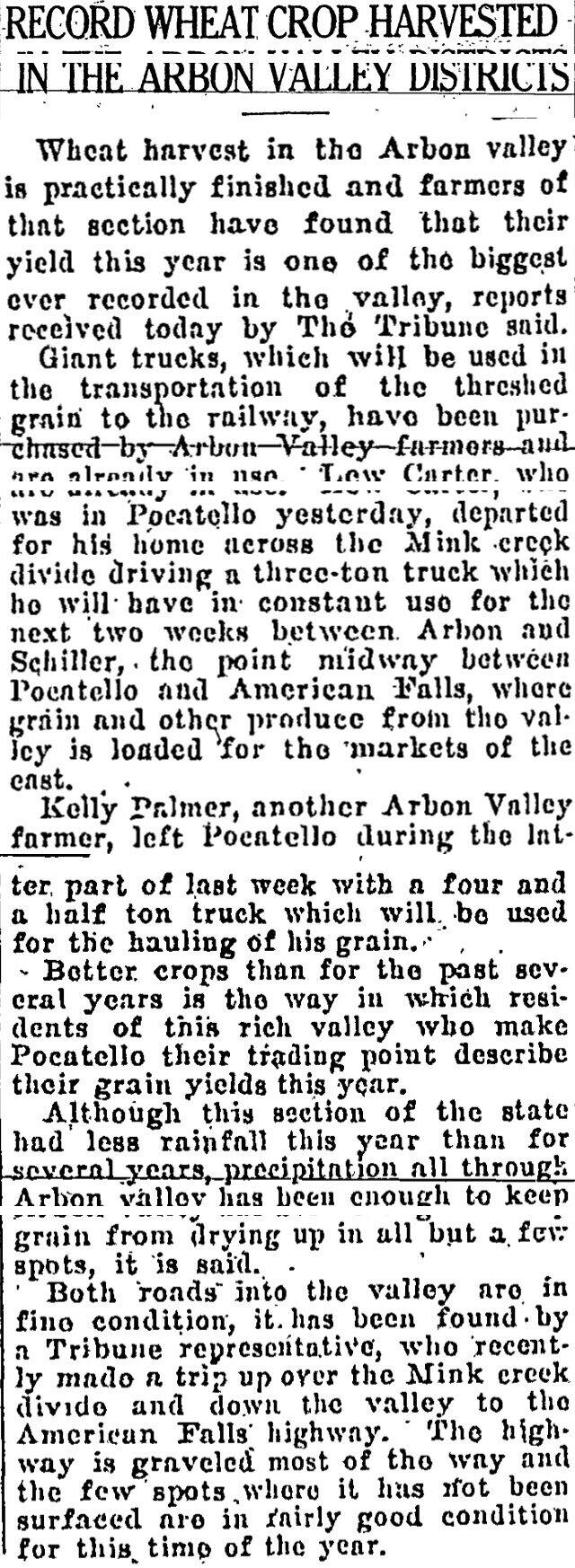
The next day the Pocatello Tribune gave the news. Harvest in Arbon Valley was all but done, and the yield ranked, in the paper’s words, as “one of the biggest ever recorded in the valley.” Farmers there had bought what the Tribune called giant trucks to carry the threshed grain to the railroad, and the trucks were already at work. Kelly Palmer, another valley farmer, had driven out of Pocatello late the week before in a truck of four and a half tons to haul his own crop. Valley people who did their trading in Pocatello said the grain was better than any they had raised in several years.
The headline over the story called it a “record” crop, which went further than the story itself. The paper printed no bushel figures, no prices and no count of the trucks.
After the lean years
The valley had waited a while for a season like this. From 1920 through 1925, as an earlier post tells, its farmers grew good crops and sold them at falling prices, while credit dried up and banks closed. The 1925 harvest was an improvement. On September 2 of that year the Tribune promised “a wonderful crop of grain this season, mostly wheat,” with dry-farm wheat three feet tall and more going down before combined harvesters and sackers. The same writer saw the houses standing empty:
It seems, however, that there are many vacant homes throughout the district, but those who have remained and held their faith in the wonderful soil of the area are being compensated in very substantial manner.
A dry year and an early harvest
In late April 1926 a Tribune writer drove into the valley over roads in excellent shape and found the young wheat green against the uncleared sagebrush. New casing was on its way out to the oil well at Arbon, and the paper still spoke of the valley as the place where southeastern Idaho kept its oil hopes.
Then the rain held off through the early summer. Even so, by July 8 the grain was coming in, roughly two weeks ahead of the usual time, and it was being hauled to American Falls for shipment. The Tribune reported that “in spite of the dry weather of the earlier part of the summer indications are that there will be a bountiful crop.” Six days later Pocatello’s mayor, C. Ben Ross, explained to the chamber of commerce forum why the gloomy forecasts of a few weeks before had been wrong. The experts had overlooked the moisture still in the ground from 1925, he said, and the latest rains had turned things around. As for Arbon valley, “he said the yield would be good.”
Some fields did not escape. A Malad dispatch printed on August 14 described a hailstorm on the Sunday before, probably August 8, that ran across Oneida County just south of the valley and stripped the grain from the Pleasant View district clear to Elkhorn. One line covered Arbon: “In the Arbon valley severe losses were felt from the same storm.” The paper named no farms and gave no acreage, and how much the hail cut from the valley’s total is not known.
By the end of August the dry year had worked out well enough. Less rain had fallen than in several seasons, but across the valley there had been enough to keep the wheat alive in all but a few places.
Down to Schiller
Schiller, the siding on the railroad halfway between Pocatello and American Falls, had served as the valley’s loading point for some years. In 1923, as the post on the Schiller buying war tells, teams and trucks hauled the crop there, 26 miles from Pauline. The July report had the 1926 grain going to American Falls and the August one named Schiller, and the papers do not say how the haul was split between them. The paper called the new trucks giants. The Ward family bought their first one in 1926, as the site’s entry on the first trucks records.
The roads were ready for them. A Tribune man who drove up over the Mink Creek divide and down the length of the valley to the American Falls highway found both routes in fine shape, with gravel on most of the highway. The way over the divide had its own history, told in the Mink Creek road to Pocatello.
The truck driver of that Monday was very probably Lew C. Carter of Arbon. In March 1921 the stockholders of the Falls-Bannock Telephone Company chose him as their president, and in the fall of 1925 he served as clerk of the Arbon school district, as the post on Lila Wade’s years in Arbon’s schools tells. Kelly Palmer turns up nowhere else in the papers searched for this post, and who he was is not known. More on the farms around them is in the histories of Arbon and of Pauline and West Fork.
The good harvests did not last. Within a few years drought and debt began to drain the outlying settlements, as the Stories entry on Crystal and Buist tells. In the late summer of 1926, though, the trucks ran full.
The original article
Pocatello Tribune, August 31, 1926, page 10. Transcribed from the page scan.
RECORD WHEAT CROP HARVESTED IN THE ARBON VALLEY DISTRICTS
Wheat harvest in the Arbon valley is practically finished and farmers of that section have found that their yield this year is one of the biggest ever recorded in the valley, reports received today by The Tribune said.
Giant trucks, which will be used in the transportation of the threshed grain to the railway, have been purchased by Arbon Valley farmers and are already in use. Lew Carter, who was in Pocatello yesterday, departed for his home across the Mink creek divide driving a three-ton truck which he will have in constant use for the next two weeks between Arbon and Schiller, the point midway between Pocatello and American Falls, where grain and other produce from the valley is loaded for the markets of the east.
Kelly Palmer, another Arbon Valley farmer, left Pocatello during the latter part of last week with a four and a half ton truck which will be used for the hauling of his grain.
Better crops than for the past several years is the way in which residents of this rich valley who make Pocatello their trading point describe their grain yields this year.
Although this section of the state had less rainfall this year than for several years, precipitation all through Arbon valley has been enough to keep grain from drying up in all but a few spots, it is said.
Both roads into the valley are in fine condition, it has been found by a Tribune representative, who recently made a trip up over the Mink creek divide and down the valley to the American Falls highway. The highway is graveled most of the way and the few spots where it has not been surfaced are in fairly good condition for this time of the year.
Sources
- Pocatello Tribune, August 31, 1926, page 10
- Pocatello Tribune, September 2, 1925, page 6
- Pocatello Tribune, April 26, 1926, page 3
- Pocatello Tribune, July 8, 1926, page 12
- Pocatello Tribune, July 14, 1926, page 14
- Pocatello Tribune, August 14, 1926, page 2
- American Falls Press, March 18, 1921, page 2
- American Falls Press, October 29, 1925, page 1