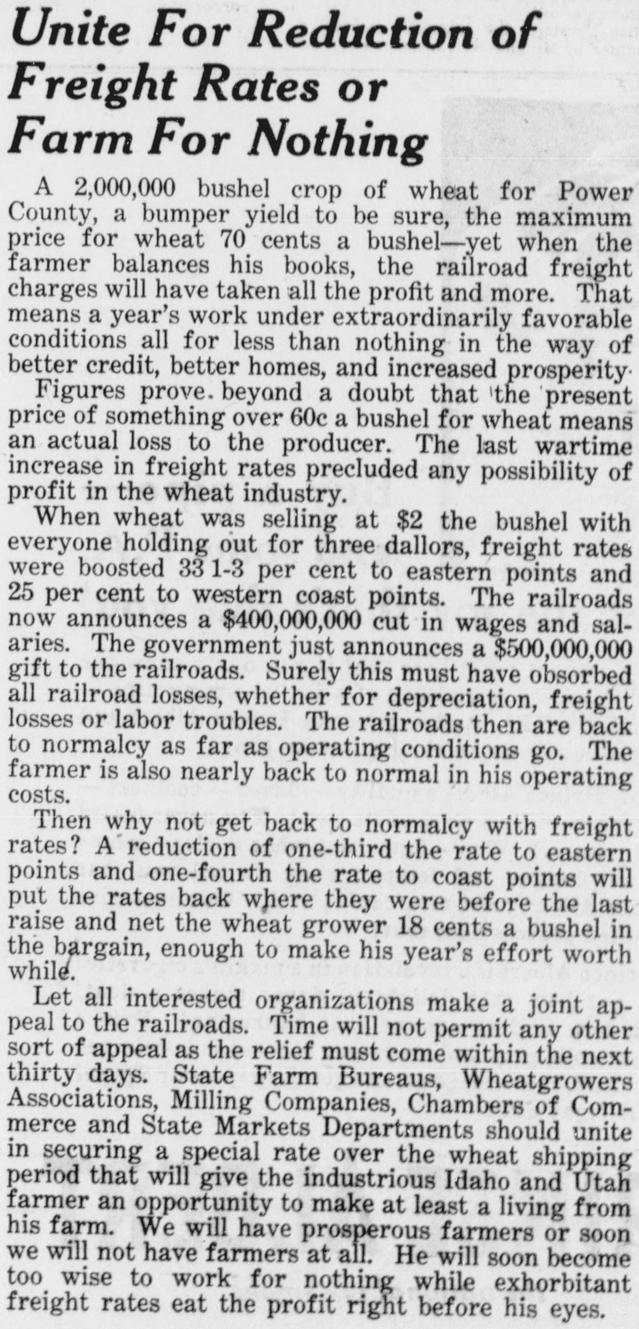
In July 1921 the wheat in the Arbon valley stood as well as any in Idaho, and the American Falls Press did the arithmetic on its front page. If Power County harvested 2,000,000 bushels, “a bumper yield to be sure,” and sold it for 70 cents at the very most, the railroad would carry off every cent of profit and more. “We will have prosperous farmers or soon we will not have farmers at all,” the paper warned.
That was the bind the valley’s dry farmers lived in through the first half of the 1920s. The valley had been part of Oneida County until 1913 and of Power County since, and the county paper followed its farmers as prices fell, credit dried up and banks closed. The site’s Stories tell of the foreclosures of those years; the Press was trying to explain them as they came.
Rain, then a landslide
The drought of 1919 had cut the valley’s crop short, but 1920 started well. A heavy rain in late May left the Arbon and Rockland valleys “beautiful beyond description,” the Press wrote, and the talk had turned: “General conversation now centers on the price of grain rather than the prospects entertained for a crop failure.” By June the paper rated the Arbon valley’s prospects probably the best in the county, with 25 bushels to the acre expected.
Price was the trouble. Wheat had brought $2 a bushel when the railroads last raised freight rates during the war, as the paper recalled a year later. Farmers had formed the Wheat Growers Association to sell their grain together, and in August 1920 it said it would put up platforms at Arbon and Roy; by December William Allard of Arbon sat as one of its local directors. Prices kept sliding all the same. In November the Press described a general decline that had “already assumed proportions of a landslide.” The Arbon column of December 3 told of Bernie Burge, who shipped a carload of mules to St. Louis and found the market there had dropped.
No money for seed
By the spring of 1921 many of the county’s dry farmers could not afford seed. Congress set aside $2,000,000 for seed loans to farmers hurt by drought, and County Agent T. H. Morrell explained why Power County needed them:
Much of the land was prepared for sowing last fall, but no wheat was planted for the simple reason that the farmers couldn’t buy their seed. They had no money.
Power County drew $22,500, the largest share in Idaho by the paper’s account. Only a farmer whose 1920 crop had failed could apply. He might borrow $2 an acre, up to $200, signing a note backed by a mortgage on the coming crop that ranked ahead of all his other mortgages. Committeemen handled the loans in each community: Fred Fanning at Crystal, T. B. Evans and Ed. Davis at Arbon, and John Kowallis and C. England at Pauline. How many valley farmers borrowed, the papers do not say.
Federal land loans promised little more. As the Federal Farm Loan Board got ready to lend again that spring, G. S. Butler told the Press in April, and again in May, that few Power County farmers stood to gain. He was almost certainly the George S. Butler who had homesteaded in the Arbon valley before buying a dry farm west of American Falls; the page on the Swim family tells of the Butlers. The farms “were already over mortgaged,” he said, and land had lost so much value that a federal loan could not clear the old mortgages, which the board required it to do.
Seventy-cent wheat
Then the 1921 crop came up green. After the June celebration at the oil well on the Toyn ranch, the Press wrote that “No where in the state is there better looking wheat crops, and green valleys are no where greener than at Arbon.” Two weeks later came the front-page sums under the headline “Unite For Reduction of Freight Rates or Farm For Nothing.” With wheat just above 60 cents, the paper said, the grower was losing money on every bushel. It urged farm bureaus, wheat growers, millers and chambers of commerce to press the railroads together for a cut that would put 18 cents a bushel back in the farmer’s hands. By September wheat stood at 83 cents a bushel at American Falls.
Farms for the back taxes
By March 1922 the lenders were looking for new farmers. W. G. Kerr’s firm represented loan companies holding about $1,000,000 in loans on 30,000 acres of improved land in the county, and he said 150 families could take up cultivated farms by paying what was owed in taxes and interest and assuming a small debt. He described the county this way:
It is new, has been deserted in large part by the original homesteader as all new countries have, has in many instances been poorly farmed and is now getting its second start, a start that will be based on careful farm management and intelligent work, not overburdened by excessive credit, extravagant methods and high interest rates.
A second article on that page laid the heavy debts on many of the first farmers and on careless dry farming. Land once worth fifty dollars an acre now brought twenty, it said, and as far as the damaged print can be read, much of what was for sale lay in the Rockland and Arbon valleys.
Banks fail, and the county takes deeds
Then the banks went. In 1923 both the First National Bank of American Falls and the First State Bank of Rockland failed. “Every common school district had money in the bank,” the Press wrote that October. Every highway district had taken losses too, and the county stood to lose more than $100,000. By that account the valley’s schools lost money with the rest.
In September 1924 the county treasurer gave notice that Power County held certificates for unpaid 1920 taxes on tracts around Crystal, Arbon and Pauline, among many others, and would take a tax deed to any left unredeemed by January 4, 1925. Henry D. Wall’s land was on the list. Which tracts were redeemed, the notices do not say.
Two-dollar wheat again
Relief came with the 1925 harvest. The Mountain Home Republican, passing along a Press report, said hard red milling wheat had opened near $2.00 a bushel and that yields would more than double the year before: “Many farmers who had 500 or 600 sacks of wheat last year will have 3,000 or better this year.” The Arbon valley and Roy would be the last to harvest.
That October the Press held up the Power County Bank as proof of how fast the county was coming back. Opened some fourteen months earlier on what many had considered “a hopeless banking situation,” it now carried about 900 accounts, and roughly three-quarters of the 1925 wheat crop sat in warehouses, held for $2.50 a hundred pounds.
How many valley families held on, and how many lost their land or moved away, the papers never told; the notices record suits and sales, not what became of the people. At Crystal and Buist, drought and debt came back before the decade was out.
The original article
American Falls Press, July 15, 1921, page 1. Transcribed from the page scan.
Unite For Reduction of Freight Rates or Farm For Nothing
A 2,000,000 bushel crop of wheat for Power County, a bumper yield to be sure, the maximum price for wheat 70 cents a bushel—yet when the farmer balances his books, the railroad freight charges will have taken all the profit and more. That means a year’s work under extraordinarily favorable conditions all for less than nothing in the way of better credit, better homes, and increased prosperity.
Figures prove, beyond a doubt that the present price of something over 60c a bushel for wheat means an actual loss to the producer. The last wartime increase in freight rates precluded any possibility of profit in the wheat industry.
When wheat was selling at $2 the bushel with everyone holding out for three dallors, freight rates were boosted 33 1-3 per cent to eastern points and 25 per cent to western coast points. The railroads now announces a $400,000,000 cut in wages and salaries. The government just announces a $500,000,000 gift to the railroads. Surely this must have obsorbed all railroad losses, whether for depreciation, freight losses or labor troubles. The railroads then are back to normalcy as far as operating conditions go. The farmer is also nearly back to normal in his operating costs.
Then why not get back to normalcy with freight rates? A reduction of one-third the rate to eastern points and one-fourth the rate to coast points will put the rates back where they were before the last raise and net the wheat grower 18 cents a bushel in the bargain, enough to make his year’s effort worth while.
Let all interested organizations make a joint appeal to the railroads. Time will not permit any other sort of appeal as the relief must come within the next thirty days. State Farm Bureaus, Wheatgrowers Associations, Milling Companies, Chambers of Commerce and State Markets Departments should unite in securing a special rate over the wheat shipping period that will give the industrious Idaho and Utah farmer an opportunity to make at least a living from his farm. We will have prosperous farmers or soon we will not have farmers at all. He will soon become too wise to work for nothing while exhorbitant freight rates eat the profit right before his eyes.
Sources
- American Falls Press, August 16, 1918, page 4
- American Falls Press, May 28, 1920, page 4
- American Falls Press, June 18, 1920, page 1
- American Falls Press, August 6, 1920, page 1
- American Falls Press, November 26, 1920, page 4
- American Falls Press, December 3, 1920, page 1
- American Falls Press, December 3, 1920, page 2
- American Falls Press, March 18, 1921, page 1
- American Falls Press, March 25, 1921, page 1
- American Falls Press, March 25, 1921, page 8
- American Falls Press, April 8, 1921, page 1
- American Falls Press, May 6, 1921, page 1
- American Falls Press, July 1, 1921, page 6
- American Falls Press, July 15, 1921, page 1
- American Falls Press, September 9, 1921, page 1
- American Falls Press, March 24, 1922, page 1
- American Falls Press, October 18, 1923, page 1
- American Falls Press, June 26, 1924, page 1
- American Falls Press, September 18, 1924, page 6
- American Falls Press, September 18, 1924, page 7
- Mountain Home Republican, August 7, 1925, page 4
- American Falls Press, October 29, 1925, page 1