Arbon Valley went into 1915 with more wheat in the ground than it had ever planted, and by the middle of September nearly every household had a crew of men to feed. When Edd Hooker butchered a two-year-old steer that month, he had no trouble finding takers among the neighbors.
The valley’s farmers, south of Pocatello and American Falls, grew their grain without irrigation. That year they brought in a good crop of fall wheat and cut part of it with the valley’s first combine harvesters. The American Falls Press, published at the seat of Power County, followed the season through its Arbon and South Arbon columns and its news from Crystal. Arbon had belonged to Oneida County until 1913.
Two solid townships
The forecast came from G. S. Randall of Arbon. On November 26, 1914, he told the Press that Arbon and Crystal farmers would grow “at least two solid townships of wheat” the next year. A survey township is six miles on a side, about 23,000 acres, and Randall counted no fewer than 46,000 acres already seeded or ready for spring planting. At about 25 bushels an acre, that came to more than a million bushels. The paper pointed out how fast things had changed: six or seven years earlier hardly any grain had been grown there, and the few settlers had kept stock.
The weather did not help at first. The fall of 1914 was dry, and in December Henry Shandrew of Arbon said “fear is felt for fall wheat.” The spring stayed dry as well, until the Press reported on April 22, 1915, that farmers were rejoicing over several days of “splendid rains.” Only twice in fifteen years, in 1900 and 1910, had a spring been as dry, and now Arbon and Crystal had “a thorough soaking.” By mid-May Randall said “crop prospects never were so good.” On June 3 the South Arbon correspondent wrote that the rains were still coming and the crops stood a month ahead of the usual season.
The first combines
Until then the valley’s grain had been cut with headers, which clipped off the heads to be stacked and threshed later. A combine did the cutting and the threshing in a single pass. By July 1915 the Press counted about 150 of them in Power County.
The earliest one the papers place in Arbon belonged to G. M. Houk and W. E. Fisher. On May 20, 1915, the Press noted that the two had come in on Monday “after a header for their combine.” When they got the machine is not recorded.
On June 24 the North and Central Arbon column reported that F. J. Lewis, a salesman for the North Western Harvester Co. of Spokane, had spent several weeks in Arbon selling combines. Humphries, E. A. Logan, Hill and Messenger had gone in together on one, and the Stotts and Lees of South Arbon had bought another. Headers alone, the column said, could hardly save all the grain. That report is the basis for the site’s entry on the first combines, though the Houk and Fisher item puts a combine in Arbon hands five weeks earlier.
Harvest
The same June 24 paper carried a less cheerful note. Two men who had driven through the Rockland and Arbon valleys found the spring grain in bad need of rain, though the fall grain had come through with little harm.
Harvest around Arbon started at the end of July. Marshall Johnson drove through and saw “several fields of grain that will yield forty-five bushels to the acre,” and on August 5 the Press said Arbon and Crystal had some splendid fields and a very high average to look for. A week later the Blewett combines were doing fine work, several more machines had been bought, and E. H. Davis was kept busy freighting supplies to his store, “as every one is busy harvesting.”
Elsewhere in the county the paper judged most of the spring-sown grain a failure. At the south end, around Summit, frost had done considerable damage, though not nearly as much as in 1914, the year of the June frost that killed George Andersen’s wheat. Some people there were cutting their spring grain for hay, but most of the fall grain was good.
Hands were short. “Men have been scarce this season,” the South Arbon column reported in September, and several crews had gone to work short-handed. The new combines had their troubles too. The Lee brothers and Tom Stott broke down the first day they ran theirs and had all kinds of bad luck after that. The next week Stott caught his overalls on a set screw on the machine and badly bruised his leg, then went back to work. The partners finished their crop with the combine by mid-September.
By September 9 most of the heading was done and threshing was “in full blast,” with crops turning out well. Thomas King and his sons brought a new threshing machine home from Malad, and Mr. Nunnelley finished his sawing and moved his engine down to thresh. The week before, J. W. Phillips of Crystal had reported “one small field giving 65 bushels per acre.” How threshing first came to the south end is told in the first threshing machine at the south end.
Fire and freight
Early September brought several fires, which burned a good deal of fence but little grain. On September 16 the correspondent told of the closest call. Someone had set a fire on the west side of the valley that nearly took Fred Larsen’s crop and buildings. In a strong wind, Larsen and Homer Young fought it for almost half a day to save the place. The grass and sagebrush were so dry, the column said, that a fire once started was almost impossible to stop.
Then the grain had to be hauled out, over the mountain to Malad or across the Fort Hall Reservation, where ruts and broken bridges left the roads “nearly impassable for those freighting grain.”
Late in September hard rains halted all farm work at the south end. On October 7 the South Arbon column reported that the Sorenson brothers’ threshing machine (the family spelled the name Sorensen) had had “an explosion one day last week, caused by smut,” one of the smut explosions at threshing time. They were back at work within hours.
A million bushels a year
No count of the 1915 crop has turned up to test Randall’s forecast. On January 2, 1916, the Salt Lake Tribune described the Arbon valley as 100,000 fertile acres, half of them in wheat, producing about a million bushels a year, most of it marketed through Pocatello. That was a figure for an ordinary year, not a tally of 1915. More of the valley’s story is told in the history of Arbon.
In February 1916 G. M. Houck drove “the first vehicle out of Arbon since winter began” and sold the wheat he had stored to Adolf Claassen at American Falls for $1.00 a bushel. The Press spelled the name Houck, but he was probably the same G. M. Houk who, the May before, had come in looking for a header for his combine.
The original article
American Falls Press, September 16, 1915, page 2. Transcribed from the page scan.
SOUTH ARBON
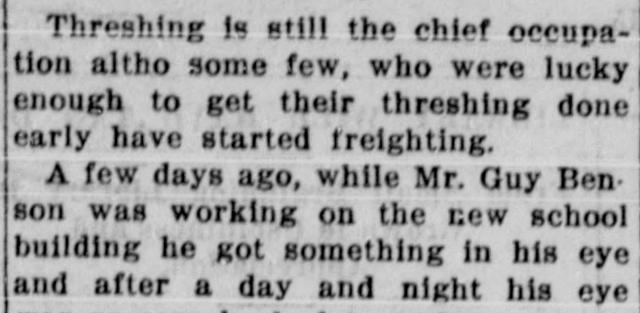
Threshing is still the chief occupation altho some few, who were lucky enough to get their threshing done early have started freighting.
A few days ago, while Mr. Guy Benson was working on the new school building he got something in his eye and after a day and night his eye was so sore he had to make a trip to Malad to a doctor. He is now able to be back at work again.
Mr. Jack Folsom had the misfortune to loose four good work horses about a week ago, and while he was in the south end of the valley looking for them his wife got a letter from some of their friends near Pocatello saying they had found two of them but he has not been able to locate the others.
Messrs. Charles Higgins and Georgenson, each had a work horse to die last week.
Mr. E. O. Smith and daughter [illegible] have returned from a two weeks’ visit to relatives in Logan, Utah.
Born to Mr. and Mrs. Lee Hatfield, on the 3rd of Sept, a daughter and to Mr. and Mrs. Alex Izatt a son on the same day.
Among recent visitors were Mrs. Jack Folsom, Mrs. Lee Van Horn and Miss Irene Nunnelley at Mrs. Mina Johnson’s, Misses Mamie and Thelma Nunnelley at Mrs. Tracy Lee’s and Mrs. Joe Benson and children at Mrs. Edd Smith’s.
Bishop Holbrook of Holbrook, was through here Wednesday in his new Studebaker Car.
Mr. A. C. Baker and family were called to Logan, Utah on account of the serious illness of his mother who only lived a few days after their arrival.
Mrs. Jennie Smith returned to her home in Dayton, Wash., last week, after spending the summer here with her son Roy.
Mr. Orville Mikkelson has just completed a new residence on his homestead.
Mr. and Mrs. Harry Chapman went Pocatello the latter part of last week.
Last Thursday while Mr. Nunnelley’s outfit was threshing at J. A. Gardner’s there was two different fires started in the cylinder from some unknown cause, but there was no smut in the grain and they found the fire in time and put it out before any damage was done.
Miss Olive Sorenson left last Saturday for her home in Mendon, Utah. Miss Sorenson is quite a popular young lady and the young people of the community hate to see her leave.
Mr. Pett, of Brigham, brought a wagon load of peaches, tomatoes and melons into the valley on day last week which was quite a treat to people living so far from market.
Mr. Lett Robinson was requested to contribute $50.00 to the county fund a few days ago. He was caught bootlegging and was arrested and had to pay a fine of $50.00. There are several more in the valley thought to be conducting the same sort of business, but so far have been lucky enough to keep out of sight of the officers.
Mr. W. H. Smith had to make a trip to Malad Saturday evening after a new cylinder for his well.
Mrs. E. A. Logan and mother Mrs. Paul Rust, have gone to Garland, Utah, after fruit.
Clarence Barrett has sold his homestead to Mr. Harve Fletcher.
Harve Fletcher arrived here from Dayton, Wash., and is very much pleased with the country.
[illegible] Howell and Walter Frederick went to Sheep creek last Sunday.
Robert and Tom Stott and families have gone to Brigham after a load of fruit.
Miss Leslie Potter was the guest of Mrs. Herman Noth last week.
Oneida Milling and Elevator company has a car of new oats to sell or will take in wheat and give you oats. Better see them if you need oats.
Mr. Mont. Mellon is here visiting a few days.
Mrs. Paul Rust of Pocatello, is here visiting her daughter Mrs. E. A. Logan.
Elias Horton recently returned from Moreland, Idaho, where his son resides. They visited the fair at Mackay and greatly enjoyed themselves.
[illegible] McGown returned to Pocatello a few days ago after working here during harvest.
Threshing is progressing rapidly, [illegible] loads of grain have been freighted out. The roads on the reservation are nearly impassable for those freighting grain on account of bad ruts, and bridges, [illegible] broke down.
Mr. Lorenso Bailey left here Friday for Pocatello, with one of his daughters, who fell a few days ago injuring her arm. It appears to be a badly broken arm. Mr. Bailey’s son, who was operated on at the Pocatello general hospital three weeks ago has contracted typhoid fever. As to last report he is progressing nicely.
Fred Dalton and Miss Winnie Dalton, of Salt Lake City, Utah, are visiting their brother Mr. Dell Dalton and family.
Miss Gena and Thelma Rust returned to Pocatello Monday after visiting here for several days.
Lorin Bailey and John Bullock were Pocatello visitors Monday.
Mr. John Bryant and family went to American Falls last week on business.
Mrs. Rust and Mrs. Logan went down to Tremonton, Utah, Monday on business.
Arbon had a light shower this last week.
We see by The Press that supplies are arriving at the Falls for the Bannock Valley Telephone line. We hope it means us, as we would like to be connected up with the outside.
Mr. Gooch and family left the past week for Blackfoot, Idaho, where they will spend the winter.
The Lee Bros. and Tom Stott finished harvesting their crop with their combine last week.
Some one set a fire on the west side of the valley about a week ago that came near burning Mr. Fred Larsen’s crop and buildings. There was quite a strong wind and Mr. Larsen and Mr. Homer Young had to fight fire for almost half a day to save his place. The grass and sage brush are so dry that it is almost impossible to stop a fire when it once gets started.
Mr. George Bollinger is erecting a house on the homestead belonging to his wife and they intend to make that their home Mr. Bollinger having proved up on his homestead some time ago.
Miss Virginia Nunnelly returned to Salt Lake the first of last week. Mr. and Mrs. Herman Noth accompanied her to Malad.
Mrs. J. A. Gardner and Miss Olive Sorenson were the guests of Mrs. Chance Payne the first of last week.
Mr. E. O. Smith and daughter Miss Elmira and Miss Lulu Benson have gone to Logan, Utah for a two weeks’ visit.
Miss Hilvie Swenson, who has been visiting relatives here for some time has returned to her home in Logan.
Mrs. Tracy Lee has been the guest of Emmett Lee and family for the past week.
Mr. Zeal Smith and wife have been visiting relatives in Daniels for the past week.
Mr. and Mrs. Chas. Gastineau, of near Pauline, were here on business the first of the week.
Mrs. Joe Benson gave a party Tuesday evening in honor of Miss Hilvie Swenson and Miss Dorothea Neilson. There were several young people present and the evening was spent in various kinds of games after which delicious refreshments were served. They each declared they had had an ideal time.
Mr. and Mrs. Jack Folsom entertained a few of their friends Sunday evening. Those present being Messrs. James Nunnelley and Clyde Johnson, and Misses Irene Nunnelley and Amy Johnson.
Mr. H. E. Chapman is somewhat improved and has been able to do a little work in his blacksmith shop this week. Max Hatfield has been helping him.
Mr. W. H. Smith and Elinor McCauley, each took a load of wheat to Malad the latter part of the week for Mr. Nunnelley.
Mr. Walter Frederick made a business trip to Landing last week.
Mrs. Harve Fletcher of Dayton, Wash., arrived last week and will remain with her parents Mr. and Mrs. Phil Hatfield. Mrs. Fletcher has been in very poor health for some time and thinks probably that the climate here will help her.
Mr. Edd Hooker butchered a two year old steer the first of last week but had no trouble in disposing of it around in the neighborhood as most every family has a crew of men to cook for.
Mrs. Lee Hatfield and mother Mrs. Reed have gone to Malad where they will remain a few weeks.
Mrs. J. A. Gardner was the guest of Mrs. Ammon Sorenson several days last week.
The people from this end of the valley were so busy that but few of them were out to the R. R. meeting held at the Central school house on August 29.
Mrs. Alex Izatt has gone to Hyrum, Utah, for a few weeks visit with her parents.
The infant daughter of Mr. and Mrs. Frank Turner has been quite sick for the past week.
Miss Nellie Matthews has just returned from Logan, Utah where she has been visiting for some time.
Miss Olive Sorenson entertained about a dozen of her friends with a candy party, last Friday evening where a very enjoyable time was had.
Mr. W. H. Smith and family were Sunday visitors at the home of W. A. Nunnelley.
E. O. Lee and wife were in American Falls the first of the week.
Mr. and Mrs. Gus Brahmstadt, Mr. and Mrs. George Bollinger were the guests of Mr. and Mrs. L. Hall Sunday.
Mr. Robert W. Sturges left last Monday for California where he and his parents will visit the Panama Exposition before he goes back to New York to enter school. Mr. Sturges has had charge of the Arbon and Highland congregational churches for the past four months and while here has made many friends who hate to see him leave.
Sources
- American Falls Press, November 26, 1914, page 1
- American Falls Press, December 3, 1914, page 5
- American Falls Press, April 22, 1915, page 1
- American Falls Press, May 20, 1915, page 5
- American Falls Press, June 3, 1915, page 4
- American Falls Press, June 24, 1915, page 1
- American Falls Press, June 24, 1915, page 8
- American Falls Press, July 29, 1915, page 1
- American Falls Press, July 29, 1915, page 5
- American Falls Press, August 5, 1915, page 1
- American Falls Press, August 12, 1915, page 4
- American Falls Press, September 2, 1915, page 5
- American Falls Press, September 2, 1915, page 8
- American Falls Press, September 9, 1915, page 2
- American Falls Press, September 16, 1915, page 2
- American Falls Press, September 30, 1915, page 6
- American Falls Press, October 7, 1915, page 1
- Salt Lake Tribune, January 2, 1916, page 57
- American Falls Press, February 10, 1916, page 5