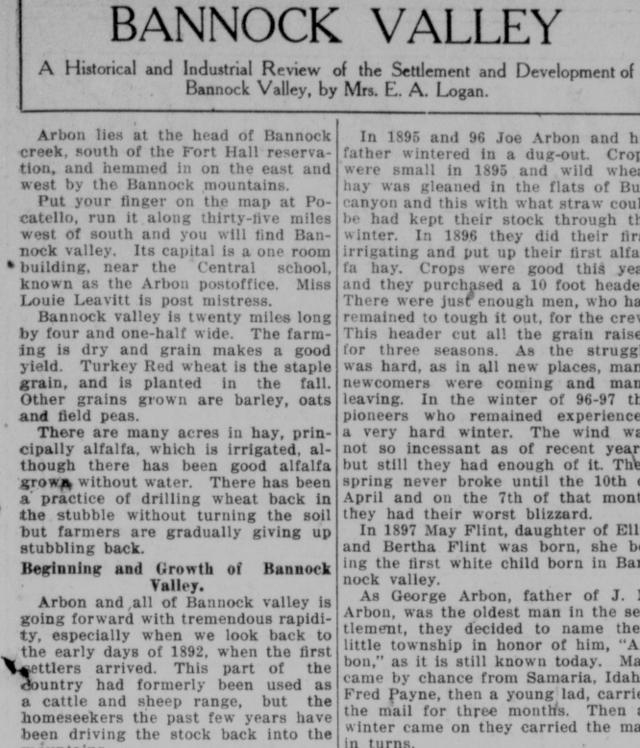
On March 29, 1917, the American Falls Press printed a special "Industrial Edition," and its page 7 carried "Bannock Valley: A Historical and Industrial Review," by Mrs. E. A. Logan of Arbon. It tells how a few squatters took up the valley in the 1890s. The site counts it as the valley's first written history, and many of the Stories' "firsts" come from it.
Mrs. Logan, whom the site identifies as Jennie Logan, was a newer settler; her husband, she wrote, had quit firing locomotives seven years earlier to take up 160 acres.
Snow in Knox Canyon
She began with directions: "Put your finger on the map at Pocatello, run it along thirty-five miles west of south and you will find Bannock valley." When the first settlers came, the valley was in Oneida County; Power County was created from it in 1913.
The first settlers came in 1892, into what had been cattle and sheep range. The digitized text of the page is too garbled to show who made up the first party, but not their first difficulty: there was still so much snow in Knox Canyon that they could not tell whether a creek ran there. Later that summer they found a good stream and started a canal to bring it down to the valley. Her lists of the original pioneers name D. J. Bowen, E. J. Wright, George Arbon and his son J. N. (Joe) Arbon, E. H. Davis, L. B. Evans, W. T. Hawkins and Hy. E. Davis.
In 1893 J. N. Arbon, H. Davis, E. H. Davis and D. J. Bowen staked out their land. Because it was unsurveyed, they held it by squatters' rights, by living on and working it. In 1920 she wrote: "The land in the valley had not been surveyed when they arrived so all took advantage of 'squatters rights' and settled on the land that most of them now own."
The canal reached the mouth of the canyon, and the first spring they raised enough vegetables and small fruits for the winter. Then she came to the first cabin:
D. J. Bowen was the proud possessor of the first cabin. It was made of hewn logs with a dirt roof and he had to haul the lumber for the floor from Elkhorn, near Malad City.
"Many of the pioneers moved into town for the winter but a few stuck it out." The Anderson brothers, probably the brothers of this site's Andersen family, "camped in a wagon box," in a year the digitized text has garbled.
The first harvest
In 1894 a group that included Bowen, the Arbons and Bailey "bought wire to fence each a small proportion of land and put in grain." Bowen bought an Osborne dropper, a reaping machine, and because the grain was too short to bind into sheaves it was hauled in wagons. A thresher came from Samaria, near Malad. Bowen's crop came to 63 bushels and Arbon's to 100. Cold weather had set in by the time the late threshing reached the Anderson boys' place, so the crew left the machine "between the stacks" and finished the next spring.
In 1895 and 1896, she wrote, Joe Arbon and his father wintered in a dugout. Joe's own memory of their first winter, which he recalled as spent in a cabin and which may have been an earlier year, is in Smoke and snow in the Arbons' first winter. She went on:
Crops were small in 1895 and wild wheat hay was gleaned in the flats of Bull canyon and this with what straw could be had kept their stock through the winter. In 1896 they did their first irrigating and put up their first alfalfa hay. Crops were good this year and they purchased a 10 foot header. There were just enough men, who had remained to tough it out, for the crew.
"This header cut all the grain raised for three seasons." Newcomers came and went, and the winter of 1896–97 was very hard for those who stayed: "The spring never broke until the 10th of April and on the 7th of that month they had their worst blizzard."
The name
She then told how the settlement got its name: "As George Arbon, father of J. N. Arbon, was the oldest man in the settlement, they decided to name their little township in honor of him, 'Arbon,' as it is still known today." Bowen became postmaster in 1898, and in the fall of 1900 George Arbon, Bowen and a Daniels were judges at the first election.
Her history runs on to the homestead rush of 1908 and to a valley that hoped one day to "hear the brakeman call 'next station, Arbon.'" Of the first pioneers, J. N. Arbon, D. J. Bowen, J. R. Bailey, E. H. Davis, L. B. Evans "and the Anderson boys" were still there.
Grandpa Arbon's birthday
Mrs. Logan told the story again on the Press's front page of January 9, 1920, as "Arbon Pioneers Were Resourceful Farmers," this time around George Arbon. She closed:
Joe Arbon has a splendid farm, his pioneer squatter's claim, and has prospered. His father now resides in Malad. He is still quite hale and hearty considering his age. His many friends here extend to "Grandpa" Arbon their best wishes for a happy birthday and hope that he will enjoy many more of them.
The Arbon column in the same issue reported that Mr. and Mrs. Jerry Baker had gone to Malad for the 80th birthday of her father, George Arbon, a family reunion at the Malad home where Joe was wintering. The life story printed at his death counts the guests as "forty-five in all." George Arbon died at Joe's home in Malad on March 22, 1921, after a stroke; his body was to be taken to Willard, Utah, for burial beside his wife.
Where the accounts differ
Her versions differ: the hard winter is 1896–97 in 1917 and 1895 in 1920, and in 1920 the town had borne Arbon's name "since 1895," though the first post office, named Arbon, was applied for in 1898. The 1920 piece brings George Arbon in with the party of 1892, as a Press profile of Joe did in November 1917, and the 1917 history counts him among the original pioneers; his biography says 1893, and the Arbon family page finds no record made at the time that places an Arbon in the valley before 1898. The Andersen accounts give the first house to Otto Andersen.
The article as printed
American Falls Press, March 29, 1917, page 7. Transcribed from the page scan.
BANNOCK VALLEY
A Historical and Industrial Review of the Settlement and Development of Bannock Valley, by Mrs. E. A. Logan.
Arbon lies at the head of Bannock creek, south of the Fort Hall reservation, and hemmed in on the east and west by the Bannock mountains.
Put your finger on the map at Pocatello, run it along thirty-five miles west of south and you will find Bannock valley. Its capital is a one room building, near the Central school, known as the Arbon postoffice. Miss Louie Leavitt is post mistress.
Bannock valley is twenty miles long by four and one-half wide. The farming is dry and grain makes a good yield. Turkey Red wheat is the staple grain, and is planted in the fall. Other grains grown are barley, oats and field peas.
There are many acres in hay, principally alfalfa, which is irrigated, although there has been good alfalfa grown without water. There has been a practice of drilling wheat back in the stubble without turning the soil but farmers are gradually giving up stubbling back.
Beginning and Growth of Bannock Valley.
Arbon and all of Bannock valley is going forward with tremendous rapidity, especially when we look back to the early days of 1892, when the first settlers arrived. This part of the country had formerly been used as a cattle and sheep range, but the homeseekers the past few years have been driving the stock back into the mountains.
Arbon is about 5250 feet above sea level. From a line through the center of the valley lengthwise there is ample wood and good timber within four miles. Two saw mills are doing good business. Railroad talk breaks out once in a while and the ranchers blow themselves for new wind mills, combine harvesters cars buildings etc on the strength of it. The building of a road is being given serious consideration.
The high foothills are also being brought under the plow. There is little fruit grown. Quite a few farmers raise their own small fruit, and some apples, pears and plums are grown, but not a large quantity of the latter.
Pocatello, American Falls and Malad vie each other for the Bannock trade, and it is split between these three places. The Indian reservation is in between the valley and the Oregon Short Line railroad. Lately a good county road has been built through the reservation which makes travel considerably easier.
The tendency is in the direction of larger farms. The soil is rich, light weight, dark colored volcanic ash.
[illegible] First Settlers
[illegible] J. R. Bailey, John [illegible] Bowen, S. D. [illegible] came into the valley to seek a new home. There was still a considerable amount of snow in Knox canyon and the party could not tell whether there was a creek there or not. Later in the summer they found a good stream of water in the canyon and soon commenced to work on a canal where the saw mill is now [illegible] down in the valley for irrigation. The original pioneers were D. J. Bowen, E. J. Wright, [illegible], Geo. Arbon, E. H. Davis, L. B. Evans, W. T. Hawkins and Hy. E. Davis.
In 1893 J. N. Arbon, H. Davis, E. H. Davis and D. J. Bowen staked out their land which is at the present location. As the land had not yet been surveyed, they took it under squatters rights. The work on the canal was completed and the water carried to the mouth of the canyon. The first spring they raised enough vegetables and small fruits for their winter use and had some left for their stock. The year before S. D. Davis plowed a small patch of land and put it in wheat for a trial. This was watered from a spring. The grain turned out fair for new breaking.
D. J. Bowen was the proud possessor of the first cabin. It was made of hewn logs with a dirt roof and he had to haul the lumber for the floor from Elkhorn, near Malad City. Many of the pioneers moved into town for the winter but a few stuck it out [illegible] in dug-outs. In 1893 [illegible] Anderson brothers [illegible] here and camped in a wagon box. [illegible] 1894 [illegible] Bowen, the Arbons, Bailey and [illegible] together and bought wire to fence each a small proportion of land and put in grain. D. J. Bowen purchased an Osborne dropper with which the grain was cut and hauled in wagons, as the grain was too short to bind. They secured [illegible] thresher from Samaria and Mr. Bowen received from his crop 63 bushels and Arbon 100 bushels. They were late in the fall threshing and cold weather set in by the time the Anderson boys' place was reached and the thresher crew left their machine "between the stacks and finished threshing late in the next spring.
In 1895 and 96 Joe Arbon and his father wintered in a dug-out. Crops were small in 1895 and wild wheat hay was gleaned in the flats of Bull canyon and this with what straw could be had kept their stock through the winter. In 1896 they did their first irrigating and put up their first alfalfa hay. Crops were good this year and they purchased a 10 foot header. There were just enough men, who had remained to tough it out, for the crew. This header cut all the grain raised for three seasons. As the struggle was hard, as in all new places, many newcomers were coming and many leaving. In the winter of 96-97 the pioneers who remained experienced a very hard winter. The wind was not so incessant as of recent years, but still they had enough of it. The spring never broke until the 10th of April and on the 7th of that month they had their worst blizzard.
In 1897 May Flint, daughter of Ellis and Bertha Flint was born, she being the first white child born in Bannock valley.
As George Arbon, father of J. N. Arbon, was the oldest man in the settlement, they decided to name their little township in honor of him, "Arbon," as it is still known today. Mail came by chance from Samaria, Idaho. Fred Payne, then a young lad, carried the mail for three months. Then as winter came on they carried the mail in turns.
The first thresher was bought in 1897 and grain was hauled to Kelton, Utah, a distance of seventy miles, Corrine, Utah 75 miles, Collinston, [illegible] miles, and McCammon, Idaho, taking four and five days to make a trip. In 1898 D. J. Bowen was appointed postmaster [illegible] pay $1.32, which was all the mail that had [illegible] Settlers had to pay a carrier for six months after the office was established. J. R. Bailey then had the postoffice for three or four years, then Mrs. T. B. Evans for one year. It was finally given back to Mr. Bailey, who served altogether about sixteen years, resigning in June, 1916.
The first election was held in the fall of 1900. George Arbon, D. J. Bowen and Donam Daniels were the judges. In this year the L. D. S. church was organized on August 19th with ten families, besides a few single men. D. J. Bowen was first presiding elder. At first the meetings were held in the different homes in turns. The first Sunday school superintendent was J. R. Bailey and his assistants were E. H. Davis and Joe Arbon. The latter was the first bishop. In 1901 the church building was completed and was an all purpose house such as for dances, amusements and school. [illegible] school was held in this building with Maude Evans (now Mrs. A. Affleck) as teacher in 1901. [illegible] White operated the first saw [illegible] canyon in 1900. This lumber could [illegible] T. B. Evans established a small store where merchandise could [illegible] Bailey [illegible] John, J. R. and Will, conducted a fine little store where Lorenzo [illegible]
Development Was Slow for Eight [illegible]
In 1908 John L. McKown and O. H. Barber, editor of the American Falls Press, visited Arbon. They were surprised to find so large an acreage of lands open to homestead entry. They were appealed to by the settlers to aid in bringing in people to settle these lands and readily consented. The settlers, for their part, agreed to answer all leters of inquiry that came. [illegible] campaign for setlers was begun through the American Falls Press. Pictures of farming scenes in the valley were printed, yields and the names of farmers given to substantiate them. Within a few months this work became productive of unexpected results and new setlers began to flock in. Within two years practically all of the vacant lands were homesteaded, the development being among the most rapid of any section of the county. The cultivated lands were as infrequent then as uncultivated tracts are [illegible] Many former railroad men [illegible] during the rush or earlier, are now making good as grain growers [illegible] big country. A few of these are.
T. B. Evans, an old timer, came here many years ago when the country was rough and nearly uncivilized, after [illegible] a short rail on the O. S. L., and now owns a splendid farm, well stocked with cattle, has a fine bungalow, and has regained his health as well as becoming prosperous and one of the leading citizens of the valley.
E. A. Logan, a locomotive fireman, quit his job seven years ago and took up 160 acres. He doubtless works harder than a fireman but then he [illegible] now is his own master.
John Payne, an old engineer, has made good here, owning a good farm and a good saw mill in Knox canyon.
John Bowen is to be remembered as one of the first settlers. He now [illegible] has a fine grove of poplar trees, several years old. He has vegetables, fruit trees and several sorts of berries which bear nicely. He nearly always has his own apples for winter use.
Bishop Arbon has a fine place in splendid shape and is one of the leading farmers of the valley.
Donnam Daniels who lives near the reservation line north of here, on West Fork has a fine hay ranch and is making money. His residence is near a big mountain stream. Here as nowhere else in the valley the splendid sunsets behind the western mountains are only equalled in inspiration by the inspiring hour of a sunrise over the eastern hills.
Wm. Allard, a newcomer, has a good [illegible]
J. R. Bailey now owns a large [illegible] a barn and other good buildings, cattle, horses and a good farm. This is his reward for the hardships endured in the early days of this country.
E. H. Davis, one of the pioneers, owns good land and stock and also has a fine general, up-to-date merchandise store, which he opened up about two years ago.
J. E. Keeler is one of the progressive newer settlers. He homesteaded 160 acres a few years ago. Now he has a fine large home, labor saving machinery and also purchased 200 more of improved land.
L. B. Evans has made good fighting his way through sweat and toil and now is the possessor of a splendid ranch and has gone into the cattle business the past few years. He was appointed probate judge of Power county when the county was created, but refused to qualify.
Prosperity has reigned so well here with the farmers that they are in good standing with the banks and business houses in various cities. We are all earnestly looking forward to a railroad and hope to ride through here on the train in the near future and point out old land marks and scenery, and hear the brakeman call "next station, Arbon."
There are many others who have fine houses and all the necessities of life.
The oldest settlers who toiled so incessantly with very little conveniences to do with and from 65 to 70 miles to freight their grain, who have "stuck" it out and made good, are to be congratulated. Those of the first pioneers, still located and living here are J. N. Arbon, D. J. Bowen, J. R. Bailey, E. H. Davis, L. B. Evans and the Anderson boys.
A graded school was built in the center of the district, known as Central school. The building has two large rooms and large basement used for community purposes. There is now another school about three miles south of the Central school, near E. Davis' store, known as Valley View school, and still further south there has been erected a large beautiful [illegible] congregational church was also organized July 13, 1913 at the Central school where meetings are held. This is the only church in the valley besides the L. D. S. church.
A telephone system was installed here about four years ago, known as the party line and about a year ago we were connected up through American Falls with long distance to the outside world. The telephone office was installed at the home of T. B. Evans where it is at present, with Evans an efficient operator.
The people here are honest and moral.
The first Protestant Sunday school was organized in Arbon at the home of Mr. and Mrs. G. S. Butler on April [illegible], 1911, which was called the Bannock [illegible] school. The following officers were elected: Superintendent, William Allard; assistant superintendent, Mrs. G. S. Butler; secretary, Mrs. E. A. Logan; treasurer, Mrs. G. S. Randall; musician, Mrs. E. A. Logan. This Sunday school met for two years in the homes of the various members until the completion of the Central school, since which time meetings have been held there.
Harold Leavitt conducts a barber shop near the Arbon postoffice.
Hyrum Secrist and his son, Jesse, are among those who have recently added new buildings. Mr. Secrist has built a fine bungalow on his splendid farm and Jesse has completed a fine dwelling on his homestead.
Harry Chapman, who conducts a blacksmithing business near the Highland school saves the farmers many long trips for repairs. He is doing an excellent business.
Miss Leavitt is conducting a small store in connection with the postoffice, which is proving quite a convenience to the public. She has a small stock of staple groceries, stationery and notions.
T. B. Evans, one of our most public-spirited citizens, gave the land for the Central school building and has offered land for a townsite.
Our mail facilities are much better since the route to Pocatello was established. This route supplies Crystal, Pauline and Arbon. All those south of the Arbon postoffice have their mail delivered by a rural carrier three times a week. Brigham Bowen. This service gives the valley the best mail service in the county.
Several new combined harvesters have found their way into the valley during the past two years and the old threshing outfits are gradually being laid aside.
Bannock valley has been treated very well in an official way. We have one of the present board of county commissioners, Mr. G. A. Brahmstadt, an enterprising and public spirited farmer who is doing his full share toward the development of the valley. He is a very capable man and will render good service.
William Allard was elected a member of the lower house of the legislature two years ago. He made an excellent member and is very highly esteemed as a citizen.
When the county was created L. B. Evans, one of the pioneers of the valley, was appointed probate judge, but did not qualify, so that we have had, or could have had, a representative [illegible] the official family all the time.
On this site: the Arbon area history and the first harvesting machines.
Sources
- American Falls Press, March 29, 1917, page 7
- American Falls Press, March 29, 1917, page 1
- American Falls Press, November 6, 1917, page 3
- American Falls Press, January 9, 1920, page 1
- American Falls Press, January 9, 1920, page 4
- American Falls Press, March 25, 1921, page 2
- American Falls Press, April 1, 1921, page 1
- American Falls Press, April 1, 1921, page 8