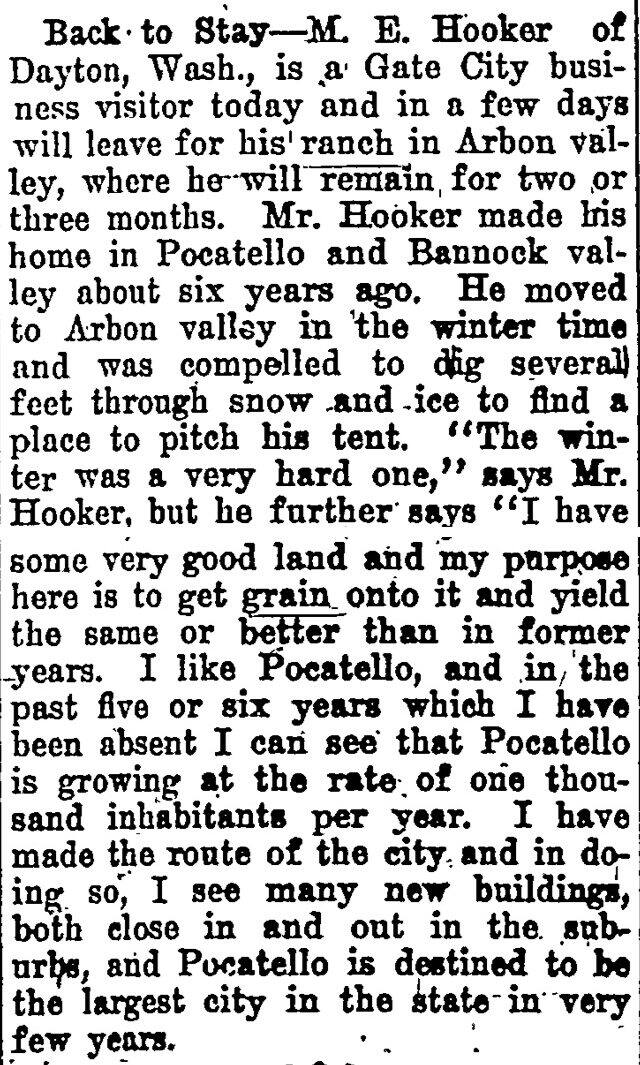
When M. E. Hooker first came into Arbon Valley it was the dead of winter, and before he could put up a tent he had to shovel down through several feet of snow and ice to reach the ground. “The winter was a very hard one,” he told the Pocatello Tribune years afterward.
He told it in July 1914, while he was in Pocatello on business. He had come from Dayton, Washington, and was headed back to his Arbon ranch in a few days to stay two or three months and put in a crop. The paper gave him a paragraph among its local items on July 24 under the heading “Back to Stay,” and the Semi-Weekly Pocatello Tribune ran it again on July 29. He had good land, he said, and he expected it to grow as much grain as before, or more. He had also toured the town, counted new buildings both near the center and out in the suburbs, and reckoned that Pocatello was gaining a thousand people a year and would soon be the biggest city in Idaho.
Marcus Edwin Hooker
The initials stood for Marcus Edwin Hooker, called Ed. His obituaries of January 1941 use both names, and the one of January 6 says he and his wife, Ella, took up a homestead in Arbon Valley in 1910. The American Falls Press, which ran a column of Arbon news from at least 1911, called him M. E. Hooker in its news from the county seat and Ed or Edd Hooker in its South Arbon column. No single Press item ties the two forms together, but the homestead, the dates and the obituaries leave little room to doubt they were one man.
He was probably not the H. E. Hooker who advertised at American Falls as a contractor and builder. That man was likely the “Contractor Hooker” putting up a schoolhouse in Arbon Valley in 1912, as told in District 46 and Arbon’s Central School, and nothing found so far links the two families.
The winter of the tent
The paragraph never named the winter. Hooker said only that he had come “about six years ago.” But when the census was taken in the Arbon precinct in the spring of 1910, it found Marcus E. Hooker, 54, and Ella, 48, living beside Henry and Anna Shandrew, so the hard winter was most likely 1909–10. Where in the valley the tent stood, how long he lived in it and whether Ella spent that first winter there with him, the papers do not say.
His claim was 160 acres, filed on in 1910, four miles south of the Arbon post office, as the Press described it in 1917. Federal land records show the patent for those 160 acres going to Marcus E. Hooker by cash entry on March 4, 1912.
He did not always farm it himself. In September 1911 the Arbon column noted that “Henry Shandrew Sr has leased the Hooker ranch for two years,” part of the story told in Henry Shandrew’s clean wheat. That lease explains why the 1914 item found Hooker coming back from Washington to work his own ground again. Dayton, a wheat town near Walla Walla, sent a whole company of settlers to the south end of the valley from 1909 on, as told in The Washington people’s three-day picnic. Whether Hooker came with them or alone is not known, and neither is what he meant by the “five or six years” he said he had been “absent.”
Logs, grain and a steer
By 1915 the South Arbon column was following him through the seasons. In June two men, probably Ed Hooker and Gus Brahmstadt, though the digitized text mangles both names, were cutting logs in Bull Canyon so they could finish their building before harvest (Logs at the mill). On September 9 the column reported that he and Roy Smith had each hauled a load of grain over the mountain to Malad (Over the mountain to Malad), and that he had lost a fine cow. The next week it ran an item that shows what harvest meant in the valley (The Arbon harvest of 1915):
Mr. Edd Hooker butchered a two year old steer the first of last week but had no trouble in disposing of it around in the neighborhood as most every family has a crew of men to cook for.
In July 1916 the Press counted Benjamin D. Lindley, M. E. Hooker and John Payne among the “prominent farmers from Arbon Valley” in town at the county seat. Hooker was bound for Washington to see to “his farming interests in that state.” That same month the Arbon column recorded that he and Ellis Logan had lost valuable mares.
North to Tyhee
The Press reported on July 10, 1917, that M. V. Talion had bought the M. E. Hooker homestead, “which has on it over 100 acres of fine grain.” This site reads the buyer as Marsden Tallon, whose own farming is told in Old Jim Hill.
The Hookers moved to Tyhee, north of Pocatello. One 1941 notice dates that move five years after the homestead and another says only several years later, but the Arbon items keep him in the valley through the summer of 1916 and record the sale in 1917. At Tyhee the couple owned and worked more than one farm in the last twenty years of his life.
He died at home late on December 31, 1940, at 84. The Pocatello Tribune said he was born on a farm near Albion, New York, on March 5, 1856. A later notice printed the year as 1865, but his age and the 1910 census both agree with 1856. The obituary of January 2 dates his marriage to Ella Rosenberg to 1909 and his coming to Idaho to soon after. He had voted in every election since he came of age, it said, and his many friends knew him as a man who kept to the “Golden Rule.” His widow survived him, with a daughter in New York, five grandchildren and five great-grandchildren. Services were held on Sunday, January 5, 1941, at the McHan funeral home in Pocatello, and he was buried in Mountain View cemetery.
Three decades before, he had started his Arbon years with a shovel in his hands, clearing a patch of frozen ground big enough for a tent.
The original article
Pocatello Tribune, July 24, 1914, page 5. Transcribed from the page scan. The Semi-Weekly Pocatello Tribune reprinted it on July 29.
Back to Stay—M. E. Hooker of Dayton, Wash., is a Gate City business visitor today and in a few days will leave for his ranch in Arbon valley, where he will remain for two or three months. Mr. Hooker made his home in Pocatello and Bannock valley about six years ago. He moved to Arbon valley in the winter time and was compelled to dig several feet through snow and ice to find a place to pitch his tent. “The winter was a very hard one,” says Mr. Hooker, but he further says “I have some very good land and my purpose here is to get grain onto it and yield the same or better than in former years. I like Pocatello, and in the past five or six years which I have been absent I can see that Pocatello is growing at the rate of one thousand inhabitants per year. I have made the route of the city and in doing so, I see many new buildings, both close in and out in the suburbs, and Pocatello is destined to be the largest city in the state in very few years.
Sources
- Pocatello Tribune, July 24, 1914, page 5
- Semi-Weekly Pocatello Tribune, July 29, 1914, page 3
- American Falls Press, September 14, 1911, page 1
- American Falls Press, June 3, 1915, page 4
- American Falls Press, September 9, 1915, page 2
- American Falls Press, September 16, 1915, page 2
- American Falls Press, July 13, 1916, page 1
- American Falls Press, July 20, 1916, page 1
- American Falls Press, July 10, 1917, page 5
- American Falls Press, November 27, 1917, page 3
- Pocatello Tribune, January 2, 1941, page 10
- Sunday Tribune-Journal, January 5, 1941, page 10
- Pocatello Tribune, January 6, 1941, page 1
- 1910 U.S. census, Oneida County, Idaho, Arbon Precinct
- Land patent IDBL 0007026, Marcus E. Hooker, March 4, 1912