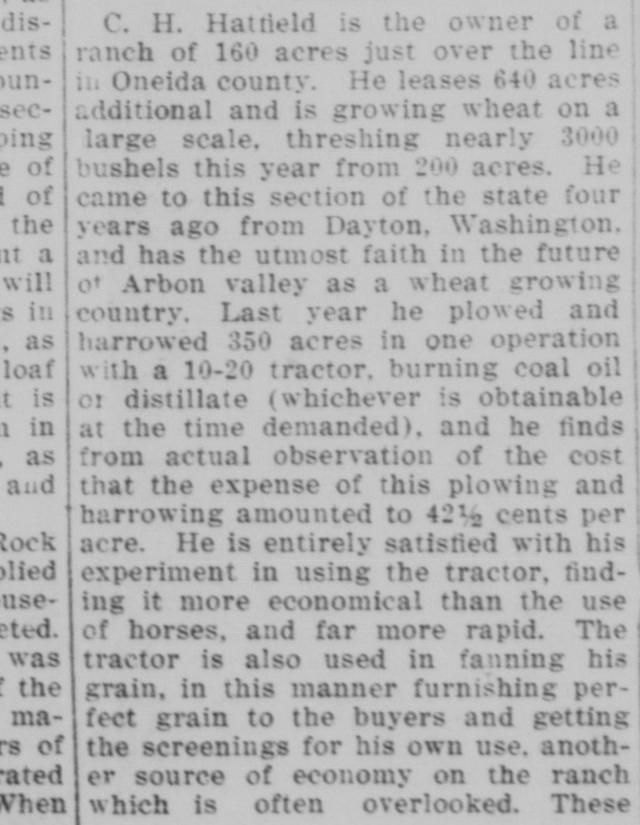
In 1916, on a wheat ranch at the south end of Arbon Valley, C. H. Hatfield hitched a plow and a harrow behind a 10-20 tractor and worked 350 acres at a single pass. He kept track of what it cost him, and it came to 42½ cents an acre. All around him, his neighbors were still farming with horses.
The machines that valley families remember arrived in the late 1920s and later, and this site’s record of the first tractors had started with the newspapers of 1920. The American Falls Press turned up a handful sooner on the dry farms: Hatfield’s 10-20, a Case at Arbon in 1917, and J. E. Keeler’s “iron horse” in 1918. Each one worked alongside the big teams the same paper found on ranch after ranch.
The Pilgrim counts the horses
That fall of 1917 the Press carried a farm department called “With Power County’s Farms and Farmers,” written by someone who signed only as “The Pilgrim.” Arbon had belonged to Oneida County until Power County was carved out in 1913, while the Summit end of the valley stayed in Oneida. The Pilgrim went from ranch to ranch, noting crops and methods, and almost never left without tallying the “work bunch” of horses.
F. C. Reiger, near Crystal, had four work horses and put all four on his twelve-foot weeder. Elmer Beuten and G. C. Wright, partners on 640 acres in the same neighborhood, owned fourteen. They ran a pair of gang plows, each dragging a harrow, and “seven horses are hitched to each gang plow.” Close to Pauline the Pilgrim met E. J. Kilgore, newly come from Umatilla County, Oregon, “the land of big wheat farms,” who had 860 acres under lease. A “skinner,” in the talk of the day, was a teamster, and the Pilgrim called Kilgore one of the best “ten-horse skinners” in the west. He hauled his wheat with eight horses, and somewhere along the route across the reservation the wagon had to swing through a sharp double turn to cross a narrow bridge over Bannock Creek. He managed it with no whip and no thrown stone. “Mr. Kilgore talks to his horses in language they understand,” the Pilgrim wrote.
Kerosene and distillate
The column of November 23, 1917, reached Hatfield. He owned 160 acres “just over the line” in Oneida County, leased another 640, and had threshed close to 3,000 bushels off 200 acres that season. He had arrived from Dayton, Washington, four years earlier. He was probably the Clive H. Hatfield whose filing on 160 acres in Bannock Valley appeared in the Press in October 1913, and the Hatfields were among the Dayton families who made their homes at Summit.
His tractor burned “coal oil or distillate,” whichever he could get when he needed it. Coal oil meant kerosene, and 10-20 was the machine’s horsepower rating. Hatfield told the Pilgrim he was “entirely satisfied” with the experiment, finding the tractor cheaper than horses “and far more rapid.” He ran his fanning mill with it too, sending clean grain to the buyers and keeping the screenings at home as feed. On that same page W. E. Dawson of Pauline, who had nine Percheron-grade work horses, did the double job the old way: he “drags the harrow behind the plow, thus getting two workings of the soil with one operation.”
Hatfield’s 10-20 is the earliest gasoline or kerosene tractor yet found in the valley’s papers. A steam outfit had plowed there in 1911, as told in the first steam engine and steam thresher, and the first combines came in 1915.
A Case, a gasoline engine and an iron horse
The next machines turn up in one-line items from the valley correspondents. “C. W. and John Hughes bought a Case tractor a few days ago,” the Arbon column said on July 27, 1917. On January 15, 1918, the Crystal column told of three gang plows working the Whiting ranch the week before, “one attached to a gasoline engine, the other two drawn by horses.”
In May 1918 the Arbon column had Mr. Keeler with a new tractor and a three-bottom plow, ready to plow through the summer. The make looks like a Russell, though the digitized text garbles the name. The machine had given him some trouble but was by then doing good work. A fortnight later J. E. Keeler “went to Pocatello Saturday to get feed for his iron horse,” and “Mr. Keeler’s tractor is running along in good style now.”
Fordsons and sale bills
In August 1920 two men on a crop-inspection trip through southeastern Idaho, the Pocatello Auto Company’s manager and a representative of the Ford Motor Company’s Salt Lake branch, thought so well of Arbon Valley’s fields that they planned a Fordson demonstration there before long, showing plowing, harrowing, disc plowing and harvesting. Whether it ever took place, no report has been found. In September, as the site’s entry on the first tractors records, a Salt Lake dealer sold a tractor to Frank Reiger of Crystal, very likely the F. C. Reiger the Pilgrim had watched behind four horses three years before.
T. S. Toyn of Arbon put his 1919 Cleveland 12-20 up for sale in April 1921, two-bottom plows included, in good shape and “only plowed about 800 acres,” or he would trade it for a good car. In July a public sale on a farm two miles west of the Pauline store, and an unknown distance north (the digitized page has lost the figure), listed “20 head Mares, 3 to 10 years old,” milk cows, Deere gang plows, a Ford touring car and “Harness for 18 head of horses.” By private sale the same farm offered a “Fordson Tractor and Gang Plow, Complete,” a double disc and a Blewett combine. The owner’s name has been lost too. Toyn ran his Cleveland notice again from October into December 1922, this time with two 14-inch gang plows, “used very little.”
Neither notice says why. Both appeared in the hard years that followed the wartime boom, the years of the foreclosures of 1920–1925.
The horses give way
For most families the change was still years off. The first-tractors entry has the Arbons buying a gasoline Caterpillar in 1928 and the Bolingbrokes a Caterpillar early in the 1930s. The Lusks traded their horses for a crawler in 1937, and Mark Andersen‘s family got its first tractor around 1941. More of the places the Pilgrim visited are told in the histories of Crystal and of Pauline and West Fork.
In 1917, though, a man who could turn eight horses across a narrow bridge by voice alone was the one the paper ranked among the best teamsters in the west.
The original article
American Falls Press, November 23, 1917, page 3, the “Along the Highways” items in the farm department “With Power County’s Farms and Farmers,” by “The Pilgrim.” Transcribed from the scanned text of the page, with the opening of the Hatfield item checked against the page scan. The scanned text runs this column together with its neighbours, so the order of the items follows the page as best it can be read, and words lost in the scan are marked [illegible].
ALONG THE HIGHWAYS
Gleanings by the Pilgrim [illegible] Wanderings Here and There.
George M. Williams of Samaria, Idaho, last spring purchased a half section of farm land, located a few miles west of the Davis store in Arbon valley, and this fall has been busy plowing a part of the land to [illegible] ready for a good crop next year. This farmer is an experienced dry farm wheat grower and will do his very best to add to the total yield of wheat the coming season. On his farm a great deal [illegible] development is still required before the entire area will be in shape to grow [illegible] but since Mr. Williams is fond of the labor which creates productive farms from sagebrush flats and hills the work is entered upon with pleasure. Mr. and Mrs. Williams will remain on the farm this winter and all other winters, realizing that a [illegible] can not be kept up to the proper standard by the owner being absent from it part of the year.
Homer Lindley is completing a new frame farm dwelling on his ranch three and a half miles southeast [illegible] the Davis store in Arbon valley. The house rests on a concrete foundation [illegible] concrete basement. Mr. Lindley homesteaded a quarter section [illegible] two ago and this year had nearly all of it in wheat. His Turkey Red tested 61 pounds and brought [illegible] bushel at the elevator in [illegible] Mr. and Mrs. Lindley [illegible] the winter in California, [illegible]
The sheltering of machinery and farm implements during the winter months is coming into vogue more and more as farmers learn that it is cheaper to buy lumber than to pay repair bills. There was a time throughout the west when farm implements were left standing through the winter wherever work was left off in the summer or fall, and in the following spring the enormous repair bills exacted by blacksmiths and machinists consumed far too much of the profits of the grain fields, [illegible]
C. H. Hatfield is the owner of a ranch of 160 acres just over the line in Oneida county. He leases 640 acres additional and is growing wheat on a large scale, threshing nearly 3000 bushels this year from 200 acres. He came to this section of the state four years ago from Dayton, Washington, and has the utmost faith in the future of Arbon valley as a wheat growing country. Last year he plowed and harrowed 350 acres in one operation with a 10-20 tractor, burning coal oil or distillate (whichever is obtainable at the time demanded), and he finds from actual observation of the cost that the expense of this plowing and harrowing amounted to 42½ cents per acre. He is entirely satisfied with his experiment in using the tractor, finding it more economical than the use of horses, and far more rapid. The tractor is also used in fanning his grain, in this manner furnishing perfect grain to the buyers and getting the screenings for his own use, another source of economy on the ranch which is often overlooked. These screenings [illegible] excellent feed for [illegible] and hogs and obviate the [illegible] of going down into the pocket-book to supply them. Mr. Hatfield will practice nearly [illegible] wheat seeding for several seasons, being an adherent of the theory that this [illegible] the quickest and most efficient [illegible] to get rid of the mustard.
H. W. Anderson, whose ranch home [illegible] three and a half miles [illegible] of the Davis store in Arbon valley, is one of the group of Anderson brothers who have been farming in the valley since [illegible]. This year he had 175 acres of winter and spring wheat and the yield went above the average of [illegible] When this was written threshing had not been completed. Next spring 200 acres will be seeded in wheat, no fall [illegible] conditions. The old pioneer [illegible] built in 1893 by Andrew Anderson, father of the Anderson brothers, stands on the ranch of H. W. Anderson and is now used as an ice house [illegible] the brothers, supplying all the [illegible]
The growing and feeding of alfalfa to all kinds of livestock is steadily on the increase in this county. Experiments in other states where this excellent forage plant has been grown for many years have proven that there are two ways of feeding the hay, and one of these ways practically does away with all waste. On many ranches the hay is chopped fine and blown or [illegible] into a structure built on the lines of a granary. When the chopped alfalfa is blown into the structure it packs down like bran and it is surprising how large a [illegible] can be packed away into a small space. This finely chopped alfalfa is fed to hogs in a trough and to horses and cattle in a manger. Experiments made with two tons of loose hay, followed by two tons of chopped alfalfa, have shown that three cows were fed on the chopped more than ten days longer than on the loose hay, and it is within the bounds of reason to assume that the waste resulting from the method of feeding loose hay represents 70 per cent of the shortage [illegible]
The dweller in town and city may have some fancy drinks at his bidding that the rancher has not, but the best drink of all—summer or winter—is at the rancher’s command who has a dairy cow or two and makes butter. Good butter and better buttermilk go together—one a revenue-maker and the other a health-maker. On ranches of this county where butter is made quantities of this refreshing drink are poured away each churning day because no market is close at hand for it; and, on the other hand, in the towns and cities quantities of [illegible] It would be eagerly bought during the summer months if it could be readily obtained. [illegible]
Sources
- American Falls Press, October 16, 1913, page 8
- American Falls Press, July 27, 1917, page 5
- American Falls Press, October 9, 1917, page 3
- American Falls Press, October 19, 1917, page 7
- American Falls Press, November 23, 1917, page 3
- American Falls Press, January 15, 1918, page 3
- American Falls Press, May 10, 1918, page 8
- American Falls Press, May 24, 1918, page 4
- American Falls Press, August 6, 1920, page 2
- American Falls Press, April 8, 1921, page 5
- American Falls Press, July 15, 1921, page 5
- American Falls Press, October 12, 1922, page 5
- American Falls Press, December 7, 1922, page 5