In September and October 1917 the first Arbon Valley men called under the selective draft left for Camp Lewis, at American Lake in Washington, and their neighbors sent them off with dances; at Crystal there were bonfires and bugle calls as well. The valley's correspondents wrote up the farewells for the Power County paper, the American Falls Press.
Called in the draft
By September the Press was printing the names of men certified for service. Some were given time for the harvest: Ernest Poppie of Arbon, Thomas O. Wheatley of Pauline and Erastus T. Capell of Crystal were excused until October 1, and Carl T. Wrensted of Crystal until September 15, "to finish harvesting."
"One of our young men slipped one over on his friends by getting married a few days ago at American Falls," the Arbon column reported on September 18. Jack McCool of Pauline, John A. McCool on the draft lists, had married Mabel Geesey of Fairview early that month. After a wedding trip to Missouri they settled on their homestead near Pauline to wait for his call, and Mabel took a teaching post at Crystal.
Central Hall, September 12
The same column reported Arbon's farewell:
One of the most enjoyable social events in some time was given at Central Hall Wednesday evening, September 12th, being in honor of our boys who are soon going to leave having been called in the recent draft.
The seven named were Park Lusk, Charles Hassenpflug, Thomas A. Gibbons, John A. McCool, Torrey Woodruff, Thomas Wheatley and Ernest Poppie, most of them men of Arbon and Pauline. Central Hall stood by Arbon's Central school and held regular Saturday night dances. A four-piece orchestra played: Mrs. John Fuller at the piano, her son Emerson on the violin, and probably Elmer and Charles Bailey of the Bailey family on trombone and clarinet. (The digitized text garbles the surnames; the Baileys are a likely reading.) The correspondent called the music "quite a treat and something new for us."
Three of the seven were called first. Woodruff, Lusk and Gibbons were on the list of men to leave American Falls on Wednesday, September 19, with Power County's 40 per cent quota. American Falls gave the departing men an evening at the Odeon, with the band, short talks and a dance, and a special train carried the contingent away.
Two farewells at Crystal
The next contingent was called for Wednesday, October 3, and "Crystal has the heaviest representation," the Press noted. Erastus Capell, Charles Hassenpflug, John Jackson, Carl Wrensted and Frank H. Miller were listed from Crystal, with Ernest Poppie of Arbon and Thomas Wheatley of Pauline.
Crystal said goodbye twice. On Saturday night, September 29, Mrs. Peter Wrensted and Mrs. Jackson, "both of whom have a son in the contingent," gave a farewell dance at the Gabbert school house. Fully ninety neighbors came, and the Crystal correspondent wrote:
Of course, the little school house near the divide was far too small to accommodate the big crowd, but that little matter was easily remedied by building a big bonfire of sagebrush.
The accordion player, Mr. Carsella, "located a level and smooth piece of Power county real estate" and had the dancers stepping to a quadrille "by the light of the bonfire." Coffee was boiled over the fire, and the last goodbyes were said "when dawn of a new day was not far away."
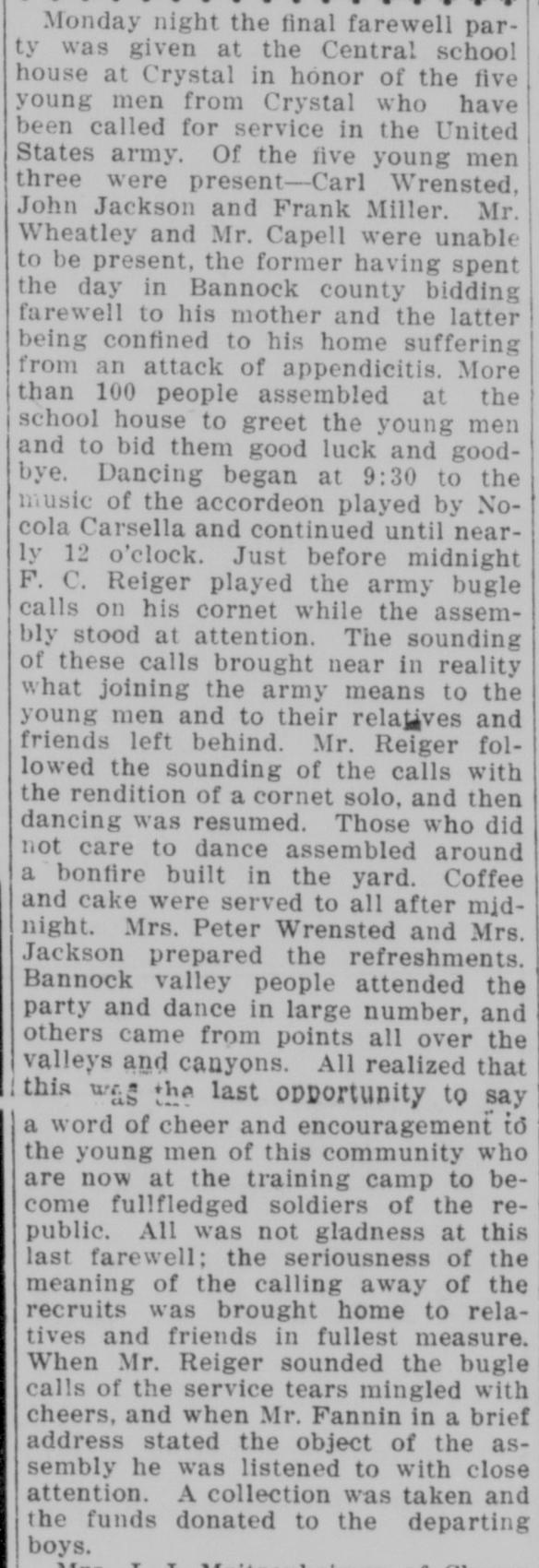
On Monday, October 1, came what the paper called the final farewell, at the Central school house at Crystal. More than 100 people came, Bannock Valley people "in large number" among them. Of the five Crystal men the correspondent counted, three were there. Thomas Wheatley had gone to Bannock County to say goodbye to his mother, and Capell was at home with appendicitis. (His five were not quite the county's: he counted Wheatley of Pauline in place of Hassenpflug.)
Carsella played for dancing from 9:30, and those who did not dance gathered around a bonfire in the yard. Just before midnight F. C. Reiger played the army bugle calls on his cornet while everyone stood at attention. Reiger, who ranched on Clifton Creek about a mile from Crystal, had served in the Philippine insurrection and often acted as bugler in the islands. The correspondent wrote:
All was not gladness at this last farewell; the seriousness of the meaning of the calling away of the recruits was brought home to relatives and friends in fullest measure. When Mr. Reiger sounded the bugle calls of the service tears mingled with cheers, and when Mr. Kannin in a brief address stated the object of the assembly he was listened to with close attention.
A collection was taken for the departing men, and the two mothers had coffee and cake ready after midnight. On Tuesday morning Carl Wrensted's parents took him to American Falls, where the departing men were given a reception and dance that evening. Newell Leishman went down from Arbon to see off "the boy from here," probably Ernest Poppie, and came home praising the dance, the banquet and the Red Cross comfort bags.
Letters from Camp Lewis
The Press reported that Ernest Poppie was in Company 44 of the 166th Depot Brigade and that it rained almost steadily. Park Lusk wrote to his sister, Mrs. Joe Evans, that he had been made a corporal in the 347th Machine Gun Battalion, and soon afterwards wrote to his parents that he was second duty sergeant, which the Press called "a record for advancement in six weeks' service without any previous military training."
Jack McCool was to leave with the final 15 per cent of the county's quota on November 7 but came down with tonsillitis. A few days later he was on his way to American Lake, and Mabel went back to Crystal, where she taught the Gabbert school. On Saturday, November 10, Thomas Wheatley and Jack Jackson, probably John Jackson of Crystal, passed through McCammon among soldiers bound from Camp Lewis for New York, and chatted with friends who met them, thinking it was "the last glimpse of Idaho they will have for some time." Mabel McCool visited her husband at Camp Lewis and came home in January saying "the boys get the best of everything."
When the Red Cross printed Power County's honor roll in August 1918, all eleven of these valley men were on it. The Press does not say whether Capell, sick two days before, left with the others on October 3. Park Lusk and Ernest Poppie were later reported wounded in France, as the Stories entry Wounded in France tells.
The article as printed
American Falls Press, October 5, 1917, page 3. Transcribed from the page scan.
CRYSTAL LOCALS.
Monday night the final farewell party was given at the Central school house at Crystal in honor of the five young men from Crystal who have been called for service in the United States army. Of the five young men three were present—Carl Wrensted, John Jackson and Frank Miller. Mr. Wheatley and Mr. Capell were unable to be present, the former having spent the day in Bannock county bidding farewell to his mother and the latter being confined to his home suffering from an attack of appendicitis. More than 100 people assembled at the school house to greet the young men and to bid them good luck and goodbye. Dancing began at 9:30 to the music of the accordeon played by Nocola Carsella and continued until nearly 12 o'clock. Just before midnight F. C. Reiger played the army bugle calls on his cornet while the assembly stood at attention. The sounding of these calls brought near in reality what joining the army means to the young men and to their relatives and friends left behind. Mr. Reiger followed the sounding of the calls with the rendition of a cornet solo, and then dancing was resumed. Those who did not care to dance assembled around a bonfire built in the yard. Coffee and cake were served to all after midnight. Mrs. Peter Wrensted and Mrs. Jackson prepared the refreshments. Bannock valley people attended the party and dance in large number, and others came from points all over the valleys and canyons. All realized that this was the last opportunity to say a word of cheer and encouragement to the young men of this community who are now at the training camp to become fullfledged soldiers of the republic. All was not gladness at this last farewell; the seriousness of the meaning of the calling away of the recruits was brought home to relatives and friends in fullest measure. When Mr. Reiger sounded the bugle calls of the service tears mingled with cheers, and when Mr. Fannin in a brief address stated the object of the assembly he was listened to with close attention. A collection was taken and the funds donated to the departing boys.
Mrs. J. J. Meitzenheimer of Cherry creek spent part of the week in Pocatello, making arrangements for her younger children to attend school there the coming winter.
Miss Luella Crump of Robin is visiting her aunt, Mrs. Merion Crump, at the ranch home south of Crystal.
Miss Elsie Brandt is visiting her sister, Mrs. Eric Young, and her brother, Ed. Brandt, at the former's ranch home south of Crystal. Miss Brandt is employed in Malad and will return to that town next week.
Mr. and Mrs. Peter Wrensted accompanied their son, Carl, to American Falls on Tuesday morning, from whence the young man will go to American Lake, Wash., to become a member of the national army.
Mrs. Annie Torgensen of Grace, Idaho, is visiting her daughter, Mrs. John Haydn, at the ranch home north of town. Mrs. J. H. Ward of Joplin, Missouri, a sister of Mrs. Haydn, is also a visitor at the ranch home.
Mrs. M. J. Howells, mother of Mrs. Martin Haydn, who was recently taken ill at her homestead adjoining her daughter's ranch, has been taken to Pocatello and is recuperating at the home of Mrs. N. O. Mant, another daughter.
The Gabbert school opened Monday with Mrs. Mabel McCool as teacher. The enrollment of pupils totals 10, with an opening attendance of 8. This is Mrs. McCool's first term as a teacher. She is a graduate of the American Falls high school and the Albion normal.
Wheat delivery continues at the local platforms, but trucking to railroad points has not yet commenced.
[illegible] has been drawn for jury service and instructed to appear for duty October [illegible].
[illegible] went to American Falls Wednesday [illegible] a witness in a trespass case.
[illegible] in American Falls attending district court as a witness in a grazing trespass case.
Sources
- American Falls Press, June 12, 1917, page 4
- American Falls Press, August 28, 1917, page 3
- American Falls Press, September 11, 1917, page 1
- American Falls Press, September 11, 1917, page 5
- American Falls Press, September 18, 1917, page 1
- American Falls Press, September 18, 1917, page 4
- American Falls Press, September 28, 1917, page 1
- American Falls Press, September 28, 1917, page 4
- American Falls Press, October 2, 1917, page 1
- American Falls Press, October 2, 1917, page 2
- American Falls Press, October 5, 1917, page 3
- American Falls Press, October 9, 1917, page 3
- American Falls Press, October 9, 1917, page 4
- American Falls Press, October 23, 1917, page 3
- American Falls Press, October 26, 1917, page 3
- American Falls Press, October 30, 1917, page 3
- American Falls Press, November 9, 1917, page 1
- American Falls Press, November 13, 1917, page 2
- American Falls Press, November 16, 1917, page 4
- American Falls Press, January 22, 1918, page 4
- American Falls Press, August 23, 1918, page 3