In the winter of 1914 some of Arbon Valley’s farmers were hauling their grain twenty-two miles to market. So when the secretary of the Farmers’ Society of Equity paid the valley a visit that June, the American Falls Press gave the news a single line: Arbon was where the society proposed to build an elevator.
The valley’s dry farmers had been joining the cooperative since the fall before. The Equity bought sacks, wire and machinery for its members by the carload and meant to sell their grain together. For four years the papers followed the hope of an elevator in the valley, and for four years it stayed a hope.
A local at Arbon
The society came in with the harvest of 1913, the first after Arbon, Pauline and Crystal were cut out of Oneida County and made part of the new Power County. On September 6 the county’s five Equity locals gathered at American Falls to organize countywide, with delegates from Arbon, Crystal and Fairview. T. O. Phillips of Crystal was made vice-president, and the Press reported that “the company will handle grain and potatoes this coming fall.” In October the county board voted to set up an agency at the Michaud siding on the railroad, reached by a road across the Fort Hall Reservation, where it would buy grain and sell hay and coal. Phillips was put in charge.
One Arbon woman caught the spirit of it on paper. Mrs. Frank Fisher wrote to the women’s page of Up-to-Date Farming, a farm paper published in Indianapolis, and her letter ran on February 15, 1914. Her husband was probably the Frank Fisher whom the Press had counted among “the new settlers of Arbon” in 1912. She said she read nearly every word of the paper, and then she wrote about the Equity:
I am much interested in its work for better marketing, which will mean more comforts and conveniences for our farm homes. I love farm life, run as it is, but when A. Y. Satterfield, the national organizer of the Farmers’ Society of Equity, organized a local union here last fall, I became enthused with the visions of farm life as it might be and can be.
She closed with a recipe for cranberry sauce made with raisins and a way to keep beets, turnips and carrots through the winter packed in sand in the cellar.
That same January, Bishop W. F. Kowallis of the Meadow Ward at Pauline traveled to Logan on Equity business. He was the one who told the Logan Republican about the twenty-two-mile haul.
Carloads of sacks and wire
When the society’s Pocatello meeting broke up on the evening of February 16, 1914, it had voted to support a farm paper for southeastern Idaho and had sent its secretary off to buy ten cars of grain bags and several more of woven wire fence, barbed wire and nails. Ten cars of machinery, most of it spoken for, were already rolling, and two cars of lumber had been ordered. Directors were named by county or district. Among Bingham, Bannock, Cache and the rest, the Salt Lake Tribune listed “T. O. Phillips of Arbon district,” almost surely the Crystal man. The Shoshone Journal, reprinting the Pocatello Tribune, added: “Representatives of the society will be placed at the marketing places for grain and produce.”
The valley held its own meetings too. That February Mr. and Mrs. W. Snyder of Crystal, probably W. C. Snyder and his wife, crossed to Arbon for the Equity meeting and stayed over with the Secrists. On Saturday, March 14, the society “held a rousing meeting,” the Arbon correspondent wrote, and “the meaning of Equity was explained to those present.”
By early March W. W. White had taken over from A. W. Davis as county secretary. He and Satterfield, by then state president, started new locals at Neeley, near American Falls, and at Rockland, in the next valley west of Arbon. White went back to Rockland to sign up members and sell shares in the corporation, and a farmers’ elevator was on the agenda.
An elevator for Arbon
Then came the short notice in the Press of June 25, 1914, telling of White’s latest trip:
On Monday Mr. White went to Arbon, at which point it is proposed to build an elevator.
Nothing more was printed about it. That season was hard on the valley. A June frost, probably in 1914, snapped off one homesteader’s wheat, and the next winter a grain buyer at Michaud said frost had hit the Arbon valley harder than any other section. Even so, its farmers sent fifty-six carloads of wheat through his warehouse.
The Equity did not give up on the valley. In June 1915 the Arbon column reported:
Mr. Morris, a representative of the Farmers Society of Equity, met with the Arbonites here Tuesday, June 8, at the Pauline meeting house, and on Wednesday, June 9 at the Central hall. The meeting was very much enjoyed by the large number present.
Mr. Morris played and sang, and one number was a song he had written himself, “Since we Organized the F S E.” It drew a good deal of praise, the paper said. A dance and refreshments followed, and “all departed at a very late hour.” The Pauline meeting house was probably the Meadow Ward’s. The Central hall was the public hall in the Central school building, home of the valley’s weekly public dances.
Signers at Bannock creek
In 1916 the elevator was back. The society met on Friday evening, July 7, at the Pauline L.D.S. church, and the Arbon column said that “the society is trying to get signers in favor of erecting an elevator near Bannock creek.” A Pocatello man working for the company had lately been through the valley and gathered many names. On July 25 the Twin Falls Times reprinted a Pocatello Tribune item: contractors were grading a sidetrack by the Bannock section house, fifteen miles west of Pocatello on the Oregon Short Line, where “the Intermountain Farmers’ Equity will construct a large elevator to take care of the increasing output of the Arbon valley.”
That elevator, too, vanishes from the record. In the fall of 1917 the valley’s wheat still went out the old way, from platforms at Pauline and Crystal to the Michaud siding. Three motor trucks hauled it until the roads gave out, and then the buyers quit buying until teams could be found. One of the Pauline platforms belonged to the Farmers’ Equity. By early November its agent, Jewell Horton, had received more than 900,000 pounds of wheat, and close to half a million pounds sat there still, waiting for a way out.
The Stories trace the first grain warehouse at Pauline back to one of those platforms, and the area histories of Pauline and West Fork and Crystal tell more of both places. But in every paper searched so far, the Equity’s elevator for Arbon Valley was never built.
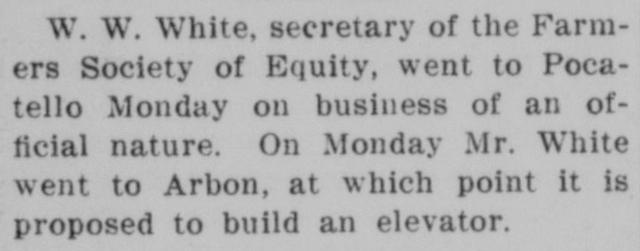
The original article
American Falls Press, June 25, 1914, page 5. Transcribed from the page scan.
W. W. White, secretary of the Farmers Society of Equity, went to Pocatello Monday on business of an official nature. On Monday Mr. White went to Arbon, at which point it is proposed to build an elevator.
Sources
- American Falls Press, May 2, 1912, page 10
- American Falls Press, September 11, 1913, page 2
- American Falls Press, October 9, 1913, page 6
- Logan Republican, January 15, 1914, page 4
- Up-to-Date Farming (Indianapolis), February 15, 1914, “A Chatty Little Letter from Idaho”
- Salt Lake Tribune, February 18, 1914, page 13
- Shoshone Journal, February 20, 1914, page 1
- American Falls Press, March 5, 1914, page 5
- American Falls Press, March 12, 1914, page 1
- American Falls Press, April 2, 1914, page 11
- American Falls Press, June 25, 1914, page 5
- American Falls Press, February 4, 1915, page 4
- American Falls Press, June 17, 1915, page 1
- American Falls Press, July 20, 1916, page 1
- Twin Falls Times, July 25, 1916, page 4 (from the Pocatello Tribune)
- American Falls Press, November 16, 1917, page 1