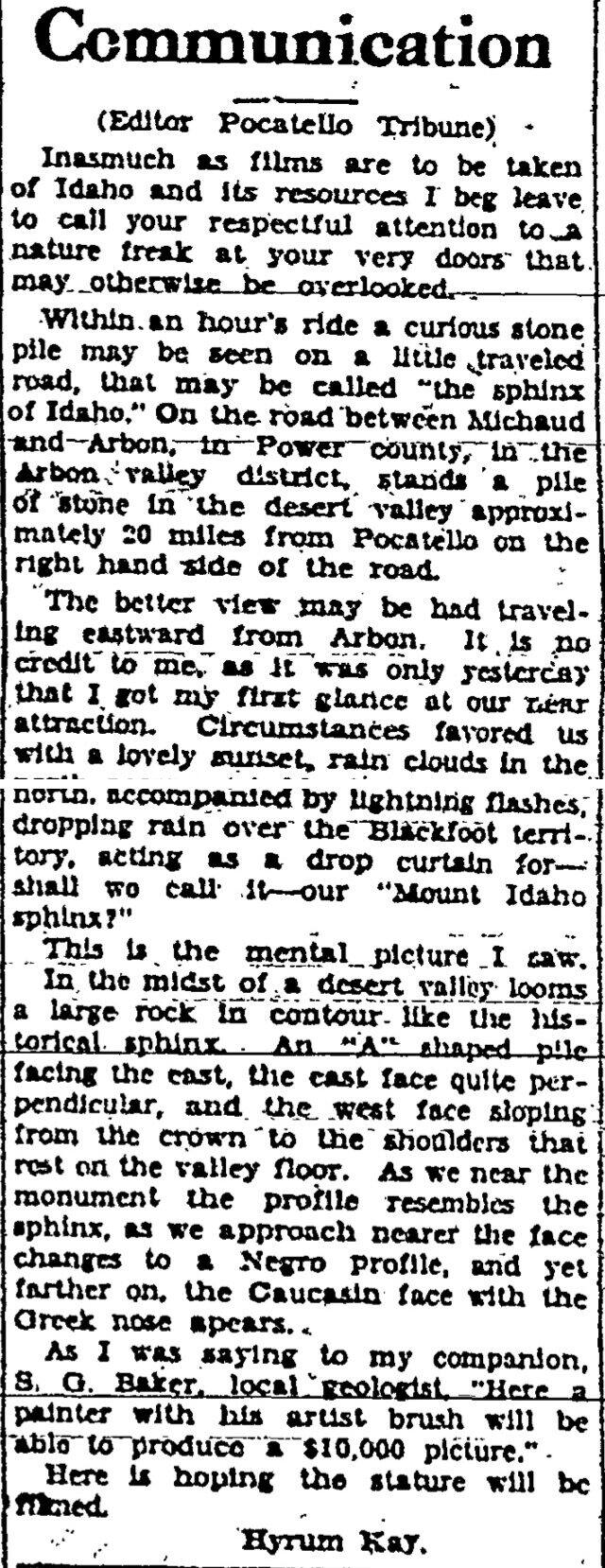
In late August 1929 a Pocatello man named Hyrum Kay had his first look at a big pile of rock standing alone in Arbon Valley, on the road between Michaud and Arbon. Seen against a sunset, he wrote, its outline looked like the Sphinx of Egypt. Over the next five years he wrote to the Pocatello Tribune about it at least four times, hoping to see it filmed and photographed, and its picture sold on postcards.
A nature freak at our doors
His first letter, printed on August 30, 1929, began with the news that films were to be made of Idaho and its resources. Kay did not want the rock left out. He put it on a little-traveled road between Michaud and Arbon, in the Arbon valley district of Power County, about 20 miles from Pocatello and within an hour's ride. Michaud was the siding on the Oregon Short Line between Pocatello and American Falls where valley farmers had long hauled their wheat by the road down Bannock Creek.
Kay had first seen the rock the day before he wrote. The best view, he said, was had traveling east from Arbon. He described an "A"-shaped pile facing east, with a nearly sheer east face and a west face that sloped from the crown down to "shoulders" resting on the valley floor. As the traveler drew nearer, the profile seemed to change from the Sphinx to other human faces, which he named in the racial terms of his day. His letter is printed in full below.
With him that evening was S. G. Baker, whom he called a local geologist. This was probably the S. G. Baker who was secretary-treasurer of the Gem State Petroleum Company, which had drilled for oil beside the Arbon school from January 1924 into 1929. The letter does not name his company, so the match rests on the name and the Arbon connection. Kay told Baker that a painter could make a $10,000 picture there.
Asking again
Kay kept at it. In a short letter printed on September 11, 1931, after praising the Tribune's photographs of the Ross Park garden in Pocatello, he again called the rock the "Sphinx" of Idaho. This time he described a pile of lava rock beside the way into Arbon Valley, in which a viewer could make out first an Ethiopian's likeness and then the Sphinx.
On July 24, 1932, he wrote again, this time to the columnist he addressed as Ing, who had lately been touring scenic spots near Pocatello. Kay complained that Pocatello people seemed to have forgotten the rock. He now put it about 25 miles southwest of the city and said that locally it went by another name, "The Old Man of the Valley." To see the likeness, he said, a traveler had to be heading east, back toward the city. Pictures of it, he suggested, would be welcome on home walls, could be sold as postcards and would interest visitors, and Scouts of either sex or amateur guides might be the ones to take them.
The last of his letters found on the subject appeared on July 17, 1934. Ing printed it with a note of agreement after the secretary of the Idaho chamber of commerce, L. F. Parsons, had urged the state to make more of its scenery. Kay noted that this was far from his first letter about the rock. This time he said it was the settlers of the valley who called it the Old Man of the Valley. Anyone wanting the view, he wrote, should go on a summer evening, drive east out of Arbon and watch the left side of the road. In his view, local photographers, whether they did it for pleasure or for pay, could do Pocatello a good turn by putting the rock on a postcard.
What became of it
The letters do not say whether anyone answered Kay's call, and no account of the rock by valley people has been found. One trace survives. The Idaho State Archives holds the papers of Edward C. Manson, longtime superintendent of the Oregon Short Line at Pocatello, and among them are an oil painting and other material on "The Sphinx of Idaho," described as a natural rock formation in Power County. Earlier research for this site noted a postcard in the same folder. Who painted it, and whether Kay's letters had anything to do with it, is not known.
Nor can the rock be placed with certainty today. Kay's letters do not agree in detail: one gives 20 miles from Pocatello and two give 25, and one puts the rock on the right of the road while a later one says to look left when driving east from Arbon. The 1929, 1932 and 1934 letters place it in Arbon Valley and agree that it showed its face best to travelers going east from Arbon, toward Pocatello; the short 1931 letter says only that it stood beside the way into the valley. Readers who know the rock, or its name in the valley, are invited to tell us.
On this site: for another landmark that gained a name in the newspapers, see the naming of the orphan range west of the valley in 1928.
The article as printed
Pocatello Tribune, August 30, 1929, page 3. Transcribed from the page scan.
Communication
(Editor Pocatello Tribune)
Inasmuch as films are to be taken of Idaho and its resources I beg leave to call your respectful attention to a nature freak at your very doors that may otherwise be overlooked.
Within an hour's ride a curious stone pile may be seen on a little traveled road, that may be called "the sphinx of Idaho." On the road between Michaud and Arbon, in Power county, in the Arbon valley district, stands a pile of stone in the desert valley approximately 20 miles from Pocatello on the right hand side of the road.
The better view may be had traveling eastward from Arbon. It is no credit to me, as it was only yesterday that I got my first glance at our near attraction. Circumstances favored us with a lovely sunset, rain clouds in the north, accompanied by lightning flashes, dropping rain over the Blackfoot territory, acting as a drop curtain for—shall wo call it—our "Mount Idaho sphinx?"
This is the mental picture I saw.
In the midst of a desert valley looms a large rock in contour like the historical sphinx. An "A" shaped pile facing the east, the east face quite perpendicular, and the west face sloping from the crown to the shoulders that rest on the valley floor. As we near the monument the profile resembles the sphinx, as we approach nearer the face changes to a Negro profile, and yet farther on, the Caucasin face with the Greek nose apears.
As I was saying to my companion, S. G. Baker, local geologist, "Here a painter with his artist brush will be able to produce a $10,000 picture."
Here is hoping the stature will be filmed.
Hyrum Kay.