The farmers of Arbon Valley chose April 20, 1920, as the day they would go after the squirrels. Several tons of bait and some strychnine were to be spread across the valley that day, the American Falls Press announced on its front page of April 9, and the work would go on until the farmers were sure the squirrels had lost their yearly raid on the spring crops.
It had been a long time coming. Ground squirrels and gophers ate into the valley’s wheat every spring, and from 1918 on the farmers answered with poisoned oats. Arbon, part of Oneida County until 1913, now belonged to Power County, and the county agent, the Power County Farm Bureau and the county commissioners led the fight.
Stopped by storms
The first try came to nothing. In January 1916 U. S. Ebner, the federal man in charge of rabbit, squirrel and gopher extermination in Idaho, Oregon and Washington, went from schoolhouse to schoolhouse in the county mixing poison while the farmers watched. He “was unable to keep his Arbon and Crystal appointments, owing to storms and other unexpected conditions.”
In April 1918 the county agent tried again with a “poison mixing bee” at the Central school in Arbon, and his successor held another at the Pauline school. “Farmers are requested to bring oats,” ran the Arbon notice. The agent would supply the poison, mix it and teach them to use it.
A robbery without a sensation
That fall the Farm Bureau tallied the damage. The first twenty-five farmers to send back its cards had lost 11,275 bushels of wheat to rabbits and squirrels in 1918, in the worst-infested corner of the county, the Prosperity and Pleasant Valley precincts beside the lava beds. In October County Agent Bruce Lampson met the Arbon valley farmers at the Central school house and promised them strychnine “at not more than half cost.” By November 26 the Arbon column could report that he had named Lucien McLarry district leader at Arbon “for the rabbit and squirrel campaign.” The Press spelled the name both ways, McLarry and McClary.
The full count took the front page on January 3, 1919. More than 1,000 cards had gone out and 525 had come back, claiming 113,376 bushels between them, worth about $225,000. Let a farmer be robbed of $400, the paper reasoned, and it would be a sensation, with the sheriff out after the thieves. Then it went on:
A bigger robbery than that has taken place, a robbery far in excess of the total amount collected as taxes from all the people of the county, and it has created no sensation. It has been taken as a matter of course, and has been going on in a greater or lesser degree, for a number of years. The robbery has not been committed by men, but by rodent pests—rabbits and squirrels.
The commissioners bought 3,000 ounces of strychnine for $5,250 to sell to farmers at half price. Lampson called meetings for January 9 at the Arbon Central school house and the Crystal school house, and that month the Farm Bureau picked its district leaders: J. C. Davis for Crystal, E. C. England for Pauline and Lucien McClary for Arbon. Each leader signed a note for half the cost of his strychnine and collected from the farmers as he handed it out, “or stand good for it.”
That spring a new state law let a county poison squirrels on the land of owners who neglected them, after ten days’ notice, and bill the cost as taxes on the land. Those spreading the bait were to “use every precaution to prevent the destruction of domestic fowl or animals.” J. C. Davis and two federal men mixed bait for the Crystal district, and in April the Arbon correspondent warned, “The gophers and rabbits are becoming quite numerous.” When the Farm Bureau thanked its squirrel leaders by name that December, the list included J. C. Davis and W. S. Snyder of Crystal, E. C. England of Pauline, and Lucian McClary and Joe Arbon of Arbon.
Poison day
By 1920 the county meant to start early and to enforce the new law “to the limit.” Twelve tons of bait stood ready, carrying 2,000 ounces of strychnine, with another 1,500 ounces held back for the farmers. Lampson said the whole county seemed squarely behind the campaign. Van Ellsworth, working for the government, had already poisoned the government land in the Prosperity district, and the work was to move on to the Rockland valley, Landing and Quigley sections.
Then the weather turned. The Arbon column of April 30 described one of the worst storms the valley had known: “The poisoning of squirrels was delayed Thursday by the heavy wet snow. Many farmers were out that day putting out poison, several are waiting for a drier day.” By May 14 the poisoning had become “the diversion of the week, especially Friday which was the day set for the Arbon farmers.” There seemed to be fewer squirrels and gophers than in former years. Either the last year’s work had paid off, the writer guessed, or they had moved on to another settlement. The papers never square that Thursday and that Friday with the April 20 date.
Four of his best horses
In the middle of June the bait killed horses. The Press reported on June 18:
E. H. Davis of Arbon lost four head of his best horses the first of the week when they ate poisoned oats that had been left in a sack in the Davis field by George Iverson. Mr. Iverson had been poisoning squirrels and left the sack open while he went to dinner.
A week later the Arbon column made it “four or five work horses” and called the bait “gopher poison.” E. H. Davis was Edward Henry “Ed” Davis, an early settler who kept a store at Arbon, one of the Davis family. George Iverson was probably George H. Iverson, an Arbon homesteader. The loss is counted among the valley’s tragedies.
The campaign went on. In June 1921 the county agent, T. H. Morrell, planned a week in the valley, and the front page said: “Some of the squirrels in that valley are reported half as large as sheep and Mr. Morrell is preparing an unusually strong dose of strychnine for them.” The Arbon column was plainer: “Several farmers met one day last week at E. H. Davis Store and the Arbon farm to help poison squirrels, but no poison came out.” Ed Snyder, it added, had lost a valuable work horse that showed signs of poisoned oats, though no one was known to have put poison where his horses pastured.
By May 1922 a Farm Bureau meeting at the Crystal meeting house was set to open what the Press now called “the annual poisoning campaign against the squirrels in the Arbon Valley.” Poison day had become a season.
The original article
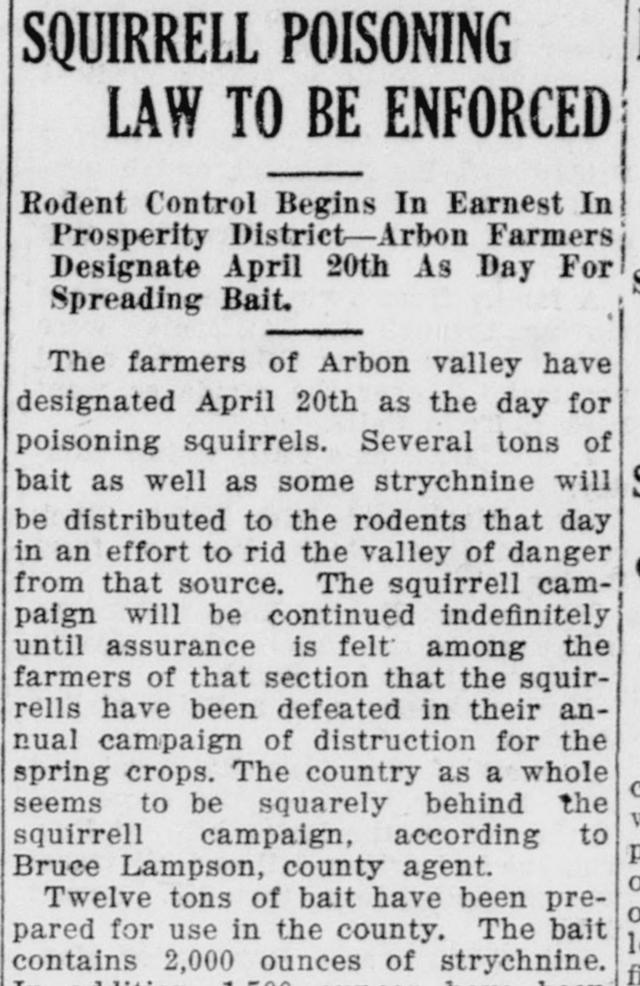
American Falls Press, April 9, 1920, page 1. Transcribed from the page scan.
SQUIRRELL POISONING LAW TO BE ENFORCED
Rodent Control Begins In Earnest In Prosperity District—Arbon Farmers Designate April 20th As Day For Spreading Bait.
The farmers of Arbon valley have designated April 20th as the day for poisoning squirrels. Several tons of bait as well as some strychnine will be distributed to the rodents that day in an effort to rid the valley of danger from that source. The squirrell campaign will be continued indefinitely until assurance is felt among the farmers of that section that the squirrells have been defeated in their annual campaign of distruction for the spring crops. The country as a whole seems to be squarely behind the squirrell campaign, according to Bruce Lampson, county agent.
Twelve tons of bait have been prepared for use in the county. The bait contains 2,000 ounces of strychnine. In addition, 1,500 ounces have been reserved for the use of farmers. Van Ellsworth, working for the government, has poisoned the government land in the Prosperity district and has received the complete cooperation of the farmers of that section. The campaign will be carried to the Rockland valley, Landing sections. [illegible] and Quigley sections of the county. By beginning the campaign [illegible] it is expected to control the squirrell problem completely. The campaign last year was begun much later to the season and even then saved the farmers of the county considerable amounts that would have resulted from damage.
The county commissioners are squarely behind the squirrell campaign and will inforce the state poisoning law to the limit. In this way they expect to have the full cooperation of the farmers of the county.
Sources
- American Falls Press, January 13, 1916, page 1
- American Falls Press, January 20, 1916, page 1
- American Falls Press, April 9, 1918, page 3
- American Falls Press, April 16, 1918, page 4
- American Falls Press, October 18, 1918, page 8
- American Falls Press, November 19, 1918, page 1
- American Falls Press, November 26, 1918, page 3
- American Falls Press, January 3, 1919, page 1
- American Falls Press, January 24, 1919, page 1
- American Falls Press, January 24, 1919, page 9
- American Falls Press, March 28, 1919, page 9
- American Falls Press, April 4, 1919, page 7
- American Falls Press, April 18, 1919, page 12
- American Falls Press, December 26, 1919, page 8
- American Falls Press, April 9, 1920, page 1
- American Falls Press, April 30, 1920, page 2
- American Falls Press, May 14, 1920, page 2
- American Falls Press, June 18, 1920, page 1
- American Falls Press, June 25, 1920, page 6
- American Falls Press, June 17, 1921, page 1
- American Falls Press, June 17, 1921, page 2
- American Falls Press, May 25, 1922, page 1