B. O. Kelley meant to be home in American Falls when the day’s hauling was done. He planned to load wheat at Pauline, run it out to the railroad at Michaud and drive on from there, so he started well before dawn. At about six o’clock on the morning of December 23, 1918, in the dark, his truck went off the Bannock Creek bridge at Pauline, and he was killed. The American Falls Press carried the news on its front page the next day.
The long haul to Michaud
Pauline sat at the north end of Arbon Valley, on Bannock Creek, and its grain had far to travel before it reached a train. In July 1918 the Press reckoned the trip from the valley to Michaud, a stop on the Oregon Short Line, at twenty-five to thirty-five miles. Motor-truck routes, the paper added, were being laid out for farming districts that lay well back from any railroad.
E. E. Zaring, an American Falls grain buyer, already had his company working at Pauline. In the fall of 1917 he was taking in grain at Ed England’s place, a mile north of the Pauline church, and England ran the scales. Late the next summer the Zaring Grain Company celebrated the opening of a Pauline warehouse with a dance. The Arbon column of October 8 reported the building “about full,” with teams “standing for hours waiting to unload.” The Pauline and West Fork area history tells more of that warehouse and of the long pull to the railroad.
From the warehouse, trucks took the wheat the rest of the way. A few weeks before the opening, at about 3:30 on the morning of August 13, 1918, Zaring’s driver Fred Hochbaum was burned at the Michaud siding as he filled his tank by the light of a lantern. He had just come in with “the last load of 1917 wheat from the Zaring platform at Pauline.”
Zaring knew the road’s hazards firsthand. He was at Pauline on election day that November and came out of it a Power County commissioner, though the Press noted that he “had more trouble in getting home than he did in getting elected.” On the way home that night “his car got frightened and skidded into a bridge at Pauline,” and the steering was ruined. The car was fixed “after a fashion,” and the next day it slid off the grade near Bannock Creek into a roadside ditch, ruining the steering once more. Wheat haulers were taking him toward Michaud when Dr. Schlitz came by and drove him home.
Before daylight
By December, Kelley was one of the men hauling for Zaring. On Sunday night he stayed at Pauline with a Mrs. England; the paper did not say which of the England households there took him in. Early Monday he left for the warehouse to take on a load. According to the Press, he had no light on the truck and apparently took the bridge for more of the road. He went through it, the truck rolled over, and he was pinned between it and the creek ice after a drop of eight feet or more.
He died at once, the paper said. The word went by telephone to the Zaring company, his employer, and Sheriff D. B. Jeffries set out as soon as he was free. He was back with the body around four that afternoon.
A family in American Falls
Kelley had moved to American Falls from Walla Walla, Washington, some two years earlier, and had made his living there in ice and in trucking. A year or so before the accident he had married Mrs. Nell Danielson. Besides his wife he left four sons, an adopted daughter and two daughters who lived in Washington. Lavere, Sam and Echo, the three boys still at home, were between eleven and fifteen. The fourth, Robert E. Kelley, was serving in France with the aviation branch. The war had ended with the armistice of November 11, six weeks earlier, but he was still overseas.
Kelley was well thought of by all who knew him, the Press wrote. He had been through a few hard years, and things had begun to turn for him. The paper called him industrious and said a request would go in for the soldier son’s discharge, so that he could come back and help the family. The funeral was held at the Kelley home at one o’clock on the afternoon of December 24, Christmas Eve. The papers read for this post do not tell whether Robert’s discharge was granted.
“Some will surely be killed”
Gravel came to the valley road the next spring. In April 1919 Independent Highway District No. 3, whose secretary was William Allard of Arbon, asked for bids to haul and spread gravel along fifteen miles of wagon road running south along Bannock Creek, the first graveling contract let on that road.
The bridges were another matter. In late June an unsigned letter from “A Citizen” of Arbon Valley reached the Power County commissioners. The board seated that January had R. W. Peterson as chairman, with E. E. Zaring and E. C. England of Pauline, the same Ed England who had weighed Zaring’s grain, as its other members. The writer wanted whoever was responsible for “the roads and bridges in and around Arbon, down toward Pauline” made to fix them “without further delay.” The surviving print garbles part of the letter, but it appears to say that some bridges were safe only if taken “just in a certain way,” and that people drove two or three miles out of their way to miss them. “If this is not seen to at once,” he wrote, “some will surely be killed through accident.” Costly vehicles would be wrecked too, he said, and the county would answer for it. He added:
There is much valuable time wasted by people being hung up on those bridges without saying anything of the damages done, and no one in that precinct seems to know who the road overseer is. They say they have none.
He had lost time and had damages of his own, he said, and might ask the county to pay them. In the Press of July 4 the board replied that it would act once he gave his name. “The author of the letter should not be ashamed to sign his letter,” said the board’s clerk, C. Lee French.
Nowhere does the letter name B. O. Kelley, and none of these reports says which Pauline bridge he went through or whether it was ever repaired or replaced. His death stands among the valley’s hardest days in Tragedies and hard times. What the record keeps is a hauler who set out in the dark to get home early, and a family that buried him on Christmas Eve.
The original article
American Falls Press, December 24, 1918, page 1. Transcribed from the page scan.
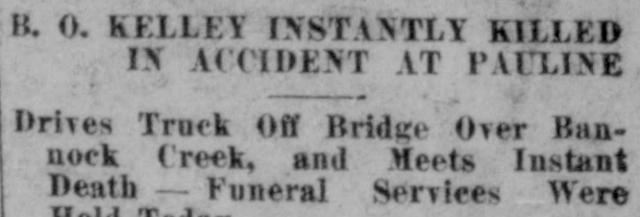
B. O. KELLEY INSTANTLY KILLED IN ACCIDENT AT PAULINE
Drives Truck Off Bridge Over Bannock Creek, and Meets Instant Death — Funeral Services Were Held Today.
B. O. Kelley was instantly killed Monday morning about 6 o’clock, by driving a truck off the Bannock creek bridge at Pauline, Mr. Kelley had stopped the night before at the home of Mrs. England, and was on his way to the Zaring Grain Company’s warehouse to load with wheat for Michaud. He expected to come to his home in American Falls from Michaud, and was therefore getting an early start. It is reported that Mr. Kelley was driving without a light, and evidently mistook the bridge for a part of the road, and crashed through it. The truck turned completely over, crushing Mr. Kelley between it and the ice. The drop at the bridge is eight feet or more.
News of the tragedy was at once telephoned to the Zaring Grain Company, for whom the unfortunate man was hauling, and arrangements were made to bring the body home. Sheriff Jeffries left as soon as he could get away and returned with the body about 4 o’clock.
Mr. Kelley came to American Falls from Walla Walla, Washington, about two years ago, and has been engaged in the ice business and trucking since his arrival. About a year ago he was married to Mrs. Nell Danielson. He is survived by his wife, four sons and two daughters, and by an adopted daughter. One son, Robert E. Kelley, is in France, in the aviation branch of the service. The three boys at home are Lavere, Sam and Echo, ranging in ages from 15 to 11. The daughters of Mr. Kelley are in Washington.
Mr. Kelley was highly regarded by all who knew him, and his untimely death is greatly deplored. He has had a hard struggle during the past few years, but was getting in better shape. He was very industrious and a hard worker. The discharge of the son in the service will be asked for, so that he may return home to assist the family. Funeral services for Mr. Kelley were held at the family home this afternoon at 1 o’clock.
Sources
- American Falls Press, October 30, 1917, page 3
- American Falls Press, July 30, 1918, page 1
- American Falls Press, August 13, 1918, page 1
- American Falls Press, September 3, 1918, page 3
- American Falls Press, October 8, 1918, page 4
- American Falls Press, November 8, 1918, page 4
- American Falls Press, November 12, 1918, page 1
- American Falls Press, December 24, 1918, page 1
- American Falls Press, January 24, 1919, page 9
- American Falls Press, April 25, 1919, page 4
- American Falls Press, July 4, 1919, page 3