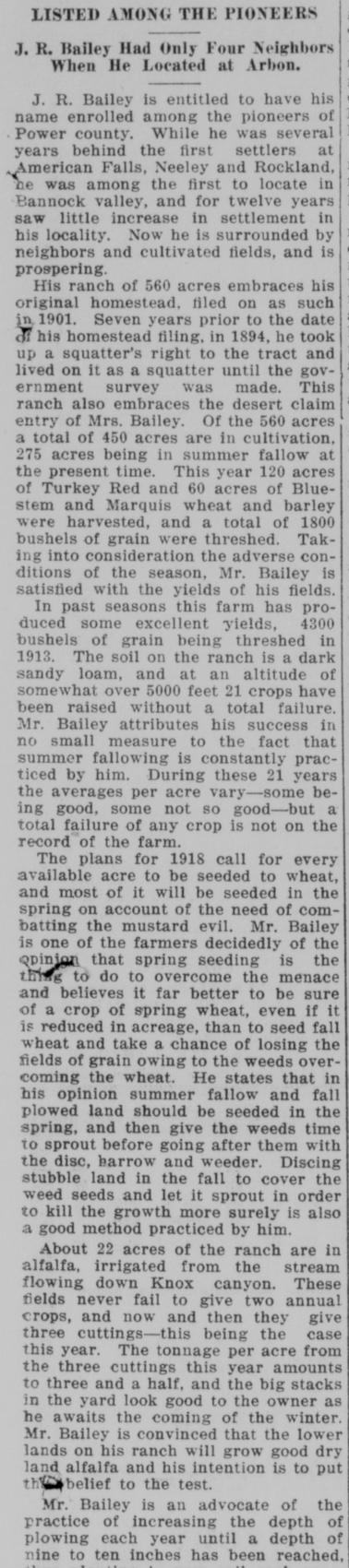
J. R. Bailey and his wife started out at Arbon with ten cents in cash, a few debts, two cows and some chickens. When the American Falls Press sent its farm writer up the valley in the fall of 1917, the place had grown to 560 acres, and the Baileys were raising a houseful of children who almost never missed a day of school.
The writer signed himself “The Pilgrim,” and his profile ran on November 20, 1917, under the headline “J. R. Bailey Had Only Four Neighbors When He Located at Arbon.” Arbon had belonged to Oneida County until 1913, when the new Power County took it in, and the Pilgrim put Bailey on the roll of that county’s pioneers. He had come later than the first settlers at American Falls, Neeley and Rockland, the writer allowed, but he was one of the first in the valley then called Bannock, and for a dozen years hardly anyone joined him there.
A tent before the survey
By the Pilgrim’s account the Baileys arrived in 1894 and settled as squatters, since no one could file a homestead on land the government had not yet surveyed. They cleared sagebrush, broke the ground and raised crops anyway. They lived first in a tent, then in a log cabin, and at last in the frame house they still called home in 1917. Bailey filed on the homestead in 1901, and Mrs. Bailey entered a desert-land claim that became part of the ranch.
Just when Bailey came is less settled than the 1917 piece makes it sound. The profile and a 1940 item both say 1894, but his two obituaries in 1948 give 1892, and in 1908 the Press quoted him as a man “who has lived there for seven or eight years,” which would mean about 1900. The family remembers him first seeing the valley while freighting through it as a young man, exploring it with D. J. Bowen and the Davises in June 1892, and settling in the spring of 1894, though some of the children were born in Utah as late as 1905. The dates may mark different steps, a first look, a first crop and a family home. The valley’s other claims are set out under first settlers.
Twenty-one crops, no failure
The 1917 season was a hard one. The ranch threshed 1,800 bushels of grain, down from 4,300 in 1913, and Bailey said he was satisfied. What pleased the Pilgrim more was the long record: on dark sandy loam a little above 5,000 feet, the farm had brought in 21 crops without one total failure. Bailey gave much of the credit to summer fallowing, resting a field for a season and working it to kill weeds and hold moisture. Other families are credited with bringing the practice to the valley, as the summer fallowing entry shows, and the Pilgrim did not claim it as a Bailey first.
He went through the rest of the place with a farmer’s eye: alfalfa watered from the creek in Knox Canyon, a registered Percheron stallion, a dozen cows whose butter went to market and fifty Plymouth Rock hens.
Neither absent nor tardy
The schoolhouse got almost as much space as the fields. The year before, four Bailey daughters at the Central school had been “neither absent nor tardy” for the whole term, through an unusually hard winter, and a son was now in high school at Hyrum, Utah. Bailey chaired the school trustees, and the Pilgrim wrote that he had been “for seventeen years” the Arbon postmaster. The appointment records summarized on this site give him two terms instead, 1900 to 1903 and 1906 to 1916, with Susannah Evans keeping the post office in between.
The greased pig
Annie Bailey, whom the papers also called Anna or Ann, was a daughter of Thomas and Jane Kerr, and she and James were both born in Wellsville, in Utah’s Cache Valley. In December 1922 the Press’s Arbon column noted, in a line the scan has garbled, that the J. R. Baileys had gone to Wellsville for her parents’ golden wedding, and the Logan Journal’s Wellsville column confirms they were there.
Their own fiftieth came on June 11, 1940, a few months after their youngest son, Earl Kerr Bailey, born at Arbon in 1913, died in a Pocatello hospital the previous November. Two days after the anniversary the Ogden Standard-Examiner told how it had begun. Married in the Logan temple in 1890, the couple went straight to Huntsville, Utah, where James laid track for a railroad between Ogden Valley and Ogden. Three months later they left for work on the Bear River canal system, taking along “our first and only possession—the greased pig,” which he had won in a July contest at Huntsville. The pig was long gone, the paper said, but the Baileys were still going strong, with nine children living. It, too, dated their move to Arbon from 1894. The family tells the rest in James R. Bailey’s history.
Leaving the farm
In 1941 the Baileys gave up farming and moved to Pocatello, and their son Melvin bought the Arbon place. Annie died in Pocatello on May 28, 1946, at 72, after a short illness. The Logan Herald Journal ran her obituary on its front page, remembering her church welfare work and her years as president of the Arbon Ward Relief Society. Of the nine children who survived her, three still lived at Arbon: Melvin, Mrs. Dave Lusk and Mrs. Joseph G. Arbon.
James married Nancy Livingston in Idaho Falls that October. He died in a Pocatello hospital on July 12, 1948, at 81. The Pocatello Tribune called him an Arbon Valley pioneer, and the Salt Lake Tribune remembered his years as Sunday school superintendent of the Arbon Ward. Among his survivors were Anna Lusk, Melvin Bailey and Edna Arbon, all still at Arbon, along with 36 grandchildren.
More of the family is on the Bailey family page, and two of the Bailey daughters, Jennie Gibbons and Erma Lusk, have entries of their own in the valley’s Stories. It was a long way from ten cents and two cows.
The original article
American Falls Press, November 20, 1917, page 3, in the farm department “With Power County’s Farms and Farmers,” by “The Pilgrim.” Transcribed from the page scan.
LISTED AMONG THE PIONEERS
J. R. Bailey Had Only Four Neighbors When He Located at Arbon.
J. R. Bailey is entitled to have his name enrolled among the pioneers of Power county. While he was several years behind the first settlers at American Falls, Neeley and Rockland, he was among the first to locate in Bannock valley, and for twelve years saw little increase in settlement in his locality. Now he is surrounded by neighbors and cultivated fields, and is prospering.
His ranch of 560 acres embraces his original homestead, filed on as such in 1901. Seven years prior to the date of his homestead filing, in 1894, he took up a squatter’s right to the tract and lived on it as a squatter until the government survey was made. This ranch also embraces the desert claim entry of Mrs. Bailey. Of the 560 acres a total of 450 acres are in cultivation, 275 acres being in summer fallow at the present time. This year 120 acres of Turkey Red and 60 acres of Bluestem and Marquis wheat and barley were harvested, and a total of 1800 bushels of grain were threshed. Taking into consideration the adverse conditions of the season, Mr. Bailey is satisfied with the yields of his fields.
In past seasons this farm has produced some excellent yields, 4300 bushels of grain being threshed in 1913. The soil on the ranch is a dark sandy loam, and at an altitude of somewhat over 5000 feet 21 crops have been raised without a total failure. Mr. Bailey attributes his success in no small measure to the fact that summer fallowing is constantly practiced by him. During these 21 years the averages per acre vary—some being good, some not so good—but a total failure of any crop is not on the record of the farm.
The plans for 1918 call for every available acre to be seeded to wheat, and most of it will be seeded in the spring on account of the need of combatting the mustard evil. Mr. Bailey is one of the farmers decidedly of the opinion that spring seeding is the thing to do to overcome the menace and believes it far better to be sure of a crop of spring wheat, even if it is reduced in acreage, than to seed fall wheat and take a chance of losing the fields of grain owing to the weeds overcoming the wheat. He states that in his opinion summer fallow and fall plowed land should be seeded in the spring, and then give the weeds time to sprout before going after them with the disc, harrow and weeder. Discing stubble land in the fall to cover the weed seeds and let it sprout in order to kill the growth more surely is also a good method practiced by him.
About 22 acres of the ranch are in alfalfa, irrigated from the stream flowing down Knox canyon. These fields never fail to give two annual crops, and now and then they give three cuttings—this being the case this year. The tonnage per acre from the three cuttings this year amounts to three and a half, and the big stacks in the yard look good to the owner as he awaits the coming of the winter. Mr. Bailey is convinced that the lower lands on his ranch will grow good dry land alfalfa and his intention is to put [illegible] belief to the test.
Mr. Bailey is an advocate of the practice of increasing the depth of plowing each year until a depth of nine to ten inches has been reached, thus planting in new soil each year, and then starting again with a depth of only five inches. He follows the plow with the harrow, the weeder, the disc—any implement that will get and kill the noxious growths. The soil is thoroughly cultivated by the harrow before seeding, the utmost importance being attached to the necessity of getting a good seed bed for the grain.
In fall plowing for spring seeding this rancher sets the plow to go to a depth of five to six inches, and lets the land lie in the rough until spring operations commence. Then the ground is gone over several times with disc and harrow before seeding. Mr. Bailey expresses the belief that every time the harrow is taken over the grain land the yield is increased from one to three bushels per acre and that harrowing after seeding will do no harm whatever.
Spring plowing for spring seeding is not practiced on this ranch, summer fallowing being the only spring plowing done.
The main reliance for the creation of mulch to hold the moisture is placed on the harrow, and the same implement is depended upon in the main to get the weeds. Not only is the harrow used on the plowed land before and after seeding, but the springtooth harrow is taken over the alfalfa fields to stimulate the growth of the plants, and to eradicate weeds and grasses that have no place in a well regulated alfalfa field. Treating the alfalfa fields to this combing every year will surely keep out all noxious and foreign growths.
The garden on this ranch always supplies the household with plenty of vegetables and the potatoes this year gave a particularly fine yield.
A large bunch of work horses is needed for a ranch of more than 500 acres and the equine crew on this farm numbers an even dozen. Among them are two fine high grade Percheron brood mares and the horses on the place are being graded to this favorite standard. Mr. Bailey is the owner of “Percheron,” a registered dapple grey Percheron stallion. A number of high grade Percheron colts are attaining a fine growth, the raising of horses for the market being a feature of this ranch.
A dairy herd of twelve cows of mixed stock is one of the principal revenue producers on the ranch, and at the present time ten are being milked. During the summer both cream and butter were marketed, but at present the latter product only is sold. The intention is to dispose of the mixed stock and establish a dairy herd of pure bred Shorthorns on a large scale. The dairy herd, in the opinion of the owner of this ranch, is ever to be considered one of the indispensable features of a well conducted farm. His barn is so arranged as to accommodate a large number of cows, because the feeding of hay in a barn means the prevention of waste.
A flock of 50 laying Plymouth Rock hens adds to the income of the farm, and a number of geese and ducks are “doing their bit,” too.
Mr. Bailey is a native of Cache county, Utah, and came to Idaho in 1894. His father, Charles R. Bailey, was a native of Lancashire, England, and came to America when a child. He crossed the plains in 1856 in one of the early Utah ox team immigrant trains, and later returned east several times. In 1861 he was married to Susannah Hawkins and they settled in Wellsville, Utah. “Father Bailey,” as he was affectionately known to all in Utah, took an active part in the upbuilding of that territory and in the annals of the state his name is honored and revered. He died in 1909 and is laid to rest in the cemetery at Wellsville, Utah. Mother Bailey resides at Wellsville, aged 73 years, and each year the descendants of these pioneers hold a family reunion. Last year more than 200 relatives were present at the reunion held in Wellsville, including the children, more than 100 grandchildren, and [illegible] great-grandchildren.
J. R. Bailey is the oldest of eighteen brothers and grew to manhood in Utah. In 1890 he was married to Miss Anna Kerr, daughter of Thomas and Jane Kerr, also Utah pioneers. Her father was a native of Scotland and her mother a native of Utah, one of the first white children born in Cedar valley. When J. R. Bailey and his wife came to their present home in 1894 he had only four neighbors. They went to work clearing and breaking the sagebrush lands and putting in crops long before the land was surveyed and opened to entry. Their first domicile was a tent and later a log cabin was built for the family. Still later a frame dwelling was erected and is now occupied by the family. In the early days the handicap of poor school facilities had to be overcome, and this was a source of sincere worry to the parents. The records of the schools in Arbon valley show that these pioneers insisted that their children attend the schools unremittingly. One of their daughters has the record of attending eight terms of school with just one tardy mark opposite her name. Last year four daughters attended the Central school and all of them have a record of “neither absent nor tardy” during the entire term and this includes the past exceptionally severe winter. This year five daughters are attending the same school and to date their record of attendance reads the same. One of their sons is attending high school at Hyrum, Utah, and upon his graduation there next spring will enter the agricultural college at Logan, Utah. Mr. and Mrs. Bailey rejoice in the opportunity of giving to their children the best education possible.
For seventeen years Mr. Bailey was postmaster at Arbon, and fifteen years of his residence in the valley he has been at various times a member of the board of school trustees, at the present time being chairman of the board.
When they came to the valley these pioneers had ten cents in actual cash capital, some debts, two cows and a small flock of chickens. While poor in material wealth, they had plenty of energy and even more raw material to expend it upon. That their opportunity was not wasted is proved by their farm with its well tilled fields and the homesite with its dwelling, big barn, granaries and implement sheds. Son and daughter of the early pioneers of the west, they have followed the precepts of their forebears in all things—and not the least of these is that they have seen to it that their children learned to cheerfully acquire the education necessary to success in life.
Sources
- American Falls Press, November 21, 1908, page 1
- American Falls Press, November 20, 1917, page 3
- American Falls Press, December 21, 1922, page 4
- Logan Journal, December 23, 1922, page 6
- Deseret News, November 24, 1939, page 20
- Ogden Standard-Examiner, June 13, 1940, page 10
- Logan Herald Journal, May 30, 1946, page 1
- Pocatello Tribune, July 13, 1948, page 6
- Salt Lake Tribune, July 14, 1948, page 18