Sophia Larsen Andersen never homesteaded in Arbon Valley. Her sons did, and so did two of her daughters. From 1929 until her death in May 1939, the newspapers show the Andersen family of Arbon coming back to her in Mendon, in Cache Valley, Utah: for holidays, vacations and a reunion, for a funeral held at her home, and at last for her own.
The six brothers and their parents
Late in 1917 a writer who signed himself "the Pilgrim" was touring the farms of Power County for the American Falls Press. Arbon had been part of Oneida County until Power County was formed in 1913. On November 30 he wrote about one family:
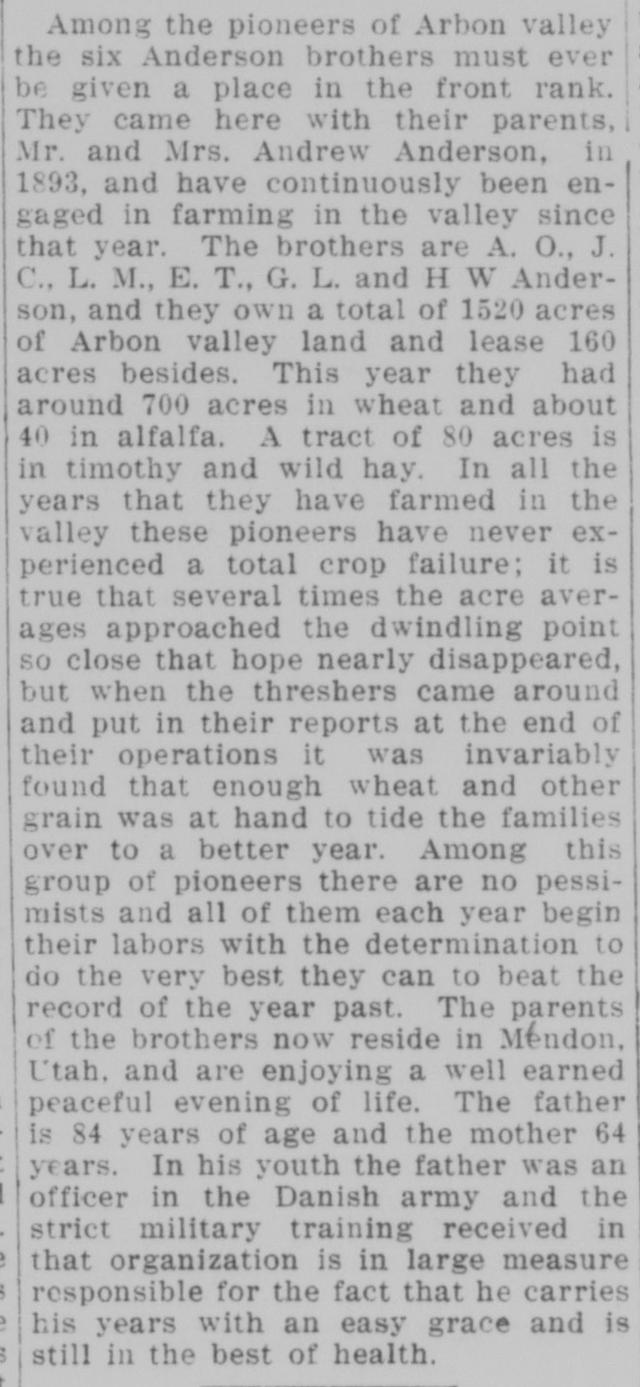
Among the pioneers of Arbon valley the six Anderson brothers must ever be given a place in the front rank. They came here with their parents, Mr. and Mrs. Andrew Anderson, in 1893, and have continuously been engaged in farming in the valley since that year.
The brothers were A. O., J. C., L. M., E. T., G. L. and H. W. Anderson, known on the family pages as Otto, John, Magnus, Ezra, George and Walt. Together, it said, they owned 1,520 acres and leased 160 more, and that year they had about 700 acres in wheat. It went on:
In all the years that they have farmed in the valley these pioneers have never experienced a total crop failure; it is true that several times the acre averages approached the dwindling point so close that hope nearly disappeared, but when the threshers came around and put in their reports at the end of their operations it was invariably found that enough wheat and other grain was at hand to tide the families over to a better year.
The parents, the Pilgrim added, now lived in Mendon and were enjoying "a well earned peaceful evening of life." He gave the mother's age as 64. The father's age is garbled in the text but is probably 84, and the Pilgrim noted that he had been "an officer in the Danish army." The family's own accounts differ from the article on one point: Andrew brought his sons to the valley, but he never lived there himself, and Sophia kept the home in Mendon.
Andrew died at Mendon in July 1922. The Deseret News printed his obituary on July 25, but the scan is jumbled with other columns. It shows that he was one of Mendon's first settlers and presided over its Scandinavian members. He served on the city council, managed the co-op store for many years, and was "made captain in the militia" because of his military training in Denmark. He had married Sophia Larsen on November 13; the year is unreadable in the scan, and family records give 1871. The legible part of the list of survivors places Otto, John, Ezra and Mrs. Annie Pett at Arbon, Idaho. Catherine Gibbons's life sketch of her father tells more of his life.
Guests of Mrs. Sophia Anderson
After 1922 the Mendon columns of the Logan Journal, Logan Herald Journal and Cache American recorded Sophia's visitors, and those from Arbon came often. Over Memorial Day in 1932 her guests included Otto and his daughters and Mr. and Mrs. John Anderson of Arbon, and she and her granddaughter Hilda served dinner. The next Decoration Day she gave a dinner for Otto and his daughters Clara and Ruth. George's family came from Malad, and Otto's daughter Norma from the Budge hospital in Logan. Her daughter Annie Pett, Mrs. Bruce Pett of Arbon, came for Thanksgiving in 1932, in January 1934, and in June and August 1935, sometimes with Bruce and the children. Ezra came with his wife and children in November 1935, and with his wife in May 1938. A Pett granddaughter spent her summer vacation with Sophia in 1930, and in November 1933 John's sons Mark and Willard were "guests of their grandmother." Her eldest daughter, Catherine Gibbons, a nurse at a Pocatello hospital, came home to Mendon on visits as well.
One gathering at her house was a funeral. Otto's wife, Retta Hansen Andersen, died at the family home in Arbon on Saturday, November 7, 1931. The Mendon column reported that Sophia had received word that day. It added that Mrs. Anderson, probably Retta, had fallen and broken her hip about three months earlier. On Tuesday, November 10, a funeral was held at Arbon in the morning. Her body was then taken to Mendon, and a second service was held that afternoon at Sophia's home. Retta was buried in the Mendon cemetery.
In August 1936 the Logan Herald Journal reported an Anderson reunion at Sophia's home, with dinner at two long tables. John's and Otto's families came from Arbon, and George's from Malad. Catherine, then matron of the hospital in Pocatello, was there too. The paper gave Sophia's age as 87. Her recorded birth date would have made her 83.
May 1939
Sophia Larsen Andersen died on Sunday, May 7, 1939, at 86. Her obituary on the front page of the Logan Herald Journal the next day called her a "pioneer resident of Mendon." It said she had lived there 77 years, having "crossed the plains with an ox team in 1862." She had been born in Denmark on February 7, 1853, a daughter of Magnus and Mary Hansen Larsen.
The list of her surviving children showed where the family now lived. Catherine Gibbons and Magnus were in Mendon, and George was at Malad. A. O., J. C. and E. T. Andersen and Mrs. Bruce Pett were "all of Arbon, Idaho." She also left a brother, Peter Larsen of Mendon, 28 grandchildren and 22 great-grandchildren. Walt, the youngest of the six brothers, had died in Oregon in 1923. The funeral was set for Tuesday in the Mendon ward chapel, with burial in the Mendon cemetery.
The Mendon column of May 19 named the mourners from out of town. Though jumbled in the scan, the list names Otto and his family, John and his wife, and Ezra and his wife, all of Arbon, along with George and his wife from Malad. Miles and Guy Larsen of Arbon also came with their wives to the funeral of "their aunt." They were the sons of her brother Peter M. Larsen, who had ranched at Summit. Hilda, who was teaching school at Murray, came home for her grandmother's funeral. Afterward about 90 people were served dinner at the home of Magnus and Catherine.
The article as printed
American Falls Press, November 30, 1917, page 3. Transcribed from the page scan.
ALONG THE HIGHWAYS
Gleanings by the Pilgrim in His Wanderings Here and There.
F. W. Swim is farming 560 acres three miles south of Pauline and enjoys it. This year he threshed Turkey Red and Bluestem wheat and all of it graded high, the former testing out 59 pounds and bringing $1.70 per bushel. The Bluestem tested 58 pounds per bushel—the standard for that variety—and no dockage was exacted; in other words, the grain was perfect. It brought the very satisfactory price of $1.68 per bushel.
Mr. Swim has seeded 80 acres to Turkey Red this fall, but the vast bulk of his grain for the coming season will be of the spring variety. The plans made by him call for a total of 250 acres of wheat next year, and summer fallow will be utilized for the seeding of spring grain. This rancher is an advocate of the practice that spring seeding will exterminate the mustard, and he further believes that all farmers should get together and practice this method. This fall he raked up a great deal of the frost-killed mustard on his ranch and destroyed it by fire, and all the plowing on this ranch is done deep in order to make sure that the wheat will get all the sustenance needed. On this ranch is some sub-irrigated land and an acre and a half in one of the swales seeded to Turkey Red yielded at the rate of 35 bushels per acre. Ultimately these sub-irrigated areas will be seeded to alfalfa and there is no doubt in the mind of Mr. Swim that he will get some good yields of hay therefrom.
Mrs. G. M. Houk, residing two miles southwest of Pauline, had good success with her garden this year, the potatoes yielding so well that the surplus was sold at a good figure. All other varieties of vegetables planted gave a good crop, and in another year the area devoted to the garden will be enlarged: there is never any trouble in disposing of the surplus garden products and this item of revenue will not be neglected. Mr. and Mrs. Houk have been on this ranch four years, coming here without any means. Hard and persistent work, coupled with close observation of the best methods to be employed, have put Mr. Houk in the ranks of the ranchers in the valley who now can look forward to the future with complacency. Last winter he had an opportunity to test out his theory that it pays to raise hogs on a dry farm. Another rancher had some young pigs, nearly dead from exposure, and Mr. Houk bought them for a dollar each under condition that they live ten days. They did; and on November 5, with only three weeks of fattening ration, they weighed 200 pounds each and are now worth several times the amount originally paid for them. The hogs on this ranch are of good strains, graded Duroc Jerseys and graded Poland-Chinas, and the rule is never to dispose of all brood stock. Many a farmer has done that to his sorrow when the market happened to sag, for somehow it turns out that just about the time the brood stock has all been traded off for a bunch of dollars the market takes an upward jump and the farmer without hogs to sell is not in a position to gather in the money awaiting him for a bunch of nice fat porkers. "Safety first"—keep the brood stock.
Speaking of weather signs, the Pilgrim was stopped the other day and informed that there would be no winter at all this trip. Asked for particulars, Friend Farmer gave out the following: One of the signs on which Indians base their predictions as to whether the winter will be severe or mild is the avidity displayed by trout in grabbing a bait at this season of the year. If the trout grab it eagerly, look out for a hard winter—deep snows and all the other trimmings and embellishments. If, on the other hand, the trout let the bait just float around the water and do not give a continental for it, then a mild winter may be looked for. Now, Friend Farmer explained that a few days ago he went out to a nice little stream with plenty of trout in it and tried out the theory mentioned. He dangled most tempting morsels in the pools, let them float down the riffles and in shallow waters, but no trout bothered to investigate; in two hours' effort the fisherman did not get one solitary strike, and yet trout could be seen in the water. According to the Indian dope it should be summer all winter this season; at the very least it should be spring-like, for he admits that one big trout took a look at one of his baits. But, Friend Reader, while faith may move mountains, if you happen to run across a mountain of coal get busy with your hands and do not wait for faith—for even Indian predictions now and then get off the wood road.
It has been noticed by more than one farmer fighting for the eradication of the Jim Hill mustard plant that it is the only double-action weed plant coming under his observation. On examination of the plant it will be found that the seed-containing pods branch out from the main stem of the plant and that both sides of the pods are laden with seeds in a manner not unlike that of the belt of a machine gun filled with cartridges, only the weed seeds are arrayed in double file while the deadly machine gun affair is satisfied with a single file. The heavy winds throughout the county this fall have lined the fences with these plants and it is safe to say that not a single plant of the crop-destroying stuff can be found that does not contain some seeds after having, in many instances, traveled for miles over seeded and unseeded lands, and what they did in the way of scattering seed during these travelings is in nowise a matter for guessing but is an absolute certainty. In some cases the farmers have touched a lighted match to the stuff bunched up against the fences and destroyed it completely. It is true that by getting rid of the plants in this manner a few fence posts meet an undeserved end, but they are readily replaced while the fields of grain destroyed by the weed are a total loss. There is no question that the weed will be eradicated from the fields of this county by the united efforts of the wheat growers and the enforcement of the weed law, but it has been urged that at least one of the Jim Hill plants in first class working order be preserved and sent to the Smithsonian institute in Washington so that future generations may see what a formidable pest their forbears had to fight. The curator of the institute mentioned should be warned, however, to see to it that the specimen in his charge be confined to a glass case of extraordinary thickness so as to be sure that none of the seed may escape and do to eastern lawns and gardens what it has done to western grain fields.
Throughout the trips into the farming section of the county the Pilgrim has noticed that the farmers rarely discuss politics or the issues of the forthcoming campaigns. The wheat growers are engrossed in the problems confronting them on the farm and in the wehat market, and taken altogether they are a contented lot and the grouch and kicker is conspicuous by his rarity. Somewhere in the neighborhood of 200 farms have been visited during the pilgrimage so far and if a more cheerful and contented lot of men and women is to be found in the state of Idaho they must have reached a degree of perfection. The war is discussed freely among them—as it is everywhere—but when it comes to talking with the farmers about their farms and their methods everything else takes a back seat and the farm and its welfare is uppermost in their minds. Another thing noticed is the frank and emphatic denunciation of men who leave their homesteads and ranches, giving them over to the unhindered growth of weeds, and thus contaminating the lands of their neighbors who have tried their level best to keep their holdings free of weeds. Under the terms of the weed law soon to go into effect the industrious farmers will seek relief from the depredations caused by the slovenly farmer, and it is hoped that this relief will be prompt and lasting.
Among the pioneers of Arbon valley the six Anderson brothers must ever be given a place in the front rank. They came here with their parents, Mr. and Mrs. Andrew Anderson, in 1893, and have continuously been engaged in farming in the valley since that year. The brothers are A. O., J. C., L. M., E. T., G. L. and H W Anderson, and they own a total of 1520 acres of Arbon valley land and lease 160 acres besides. This year they had around 700 acres in wheat and about 40 in alfalfa. A tract of 80 acres is in timothy and wild hay. In all the years that they have farmed in the valley these pioneers have never experienced a total crop failure; it is true that several times the acre averages approached the dwindling point so close that hope nearly disappeared, but when the threshers came around and put in their reports at the end of their operations it was invariably found that enough wheat and other grain was at hand to tide the families over to a better year. Among this group of pioneers there are no pessimists and all of them each year begin their labors with the determination to do the very best they can to beat the record of the year past. The parents of the brothers now reside in Mendon, Utah, and are enjoying a well earned peaceful evening of life. The father is 84 years of age and the mother 64 years. In his youth the father was an officer in the Danish army and the strict military training received in that organization is in large measure responsible for the fact that he carries his years with an easy grace and is still in the best of health.
On this site: the Andersen family history follows each of Sophia's children, and the Mendon store fire of 1893 tells why her sons first looked north to Bannock Valley.
Sources
- American Falls Press, November 30, 1917, page 3
- Deseret News, July 25, 1922, page 6
- Logan Journal, June 24, 1929, page 2
- Logan Journal, July 11, 1930, page 3
- Box Elder News Journal, November 10, 1931, page 1
- Logan Herald Journal, November 11, 1931, page 4
- Logan Herald Journal, November 14, 1931, page 1
- Logan Herald Journal, June 4, 1932, page 3
- Logan Herald Journal, November 26, 1932, page 8
- Logan Herald Journal, June 3, 1933, page 4
- Cache American, November 28, 1933, page 5
- Cache American, January 30, 1934, page 5
- Cache American, June 14, 1935, page 6
- Cache American, June 18, 1935, page 8
- Logan Herald Journal, August 27, 1935, page 12
- Logan Herald Journal, November 12, 1935, page 14
- Logan Herald Journal, August 6, 1936, page 9
- Logan Herald Journal, May 2, 1938, page 4
- Logan Herald Journal, May 8, 1939, page 1
- Logan Herald Journal, May 19, 1939, page 12