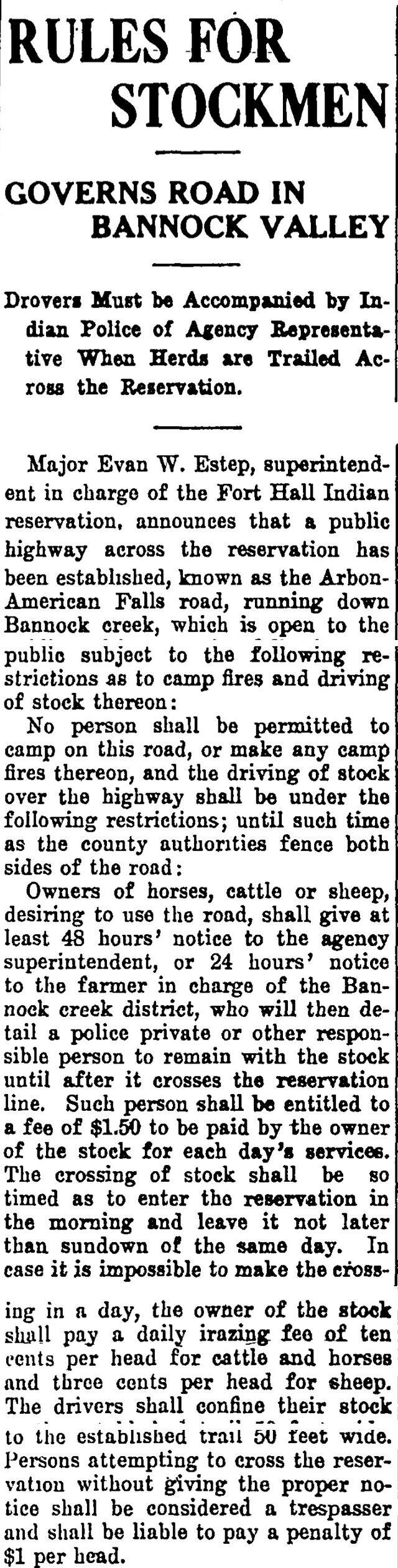
A herd bound out of Bannock Valley in the fall of 1911 could take the short way to American Falls, straight down Bannock Creek, but only if it went in at morning, came out by sundown and had an escort from the agency riding along.
That was the bargain Major Evan W. Estep, the superintendent in charge of the Fort Hall reservation, laid out in a brief notice the Pocatello Tribune ran on October 18 under the heading “Rules for Stockmen.” The creek flows north from the homesteads of what was then usually called Bannock Valley, now Arbon Valley, and crosses the reservation on its way toward the railroad. The valley still belonged to Oneida County, and its farmers and stockmen who went to American Falls by the creek had to pass over reservation land to get there. Estep announced that a public highway had been established across the reservation, “known as the Arbon-American Falls road, running down Bannock creek.” Anyone could travel it, so long as they kept his rules on camp fires and the driving of stock.
Escorted, by daylight
One rule bound every traveler: nobody was to camp on the road or light a camp fire along it. The others were for stockmen, and they would stand until county authorities put up a fence on each side of the road.
A man with horses, cattle or sheep to move had to tell the agency superintendent 48 hours ahead, or the farmer in charge of the Bannock Creek district 24 hours ahead. That officer would then assign a private of the Indian police, or some other responsible person, to stay with the animals until they were over the reservation line. The owner paid the escort $1.50 for each day. Stock was to come onto the reservation in the morning and be off it by sundown. If the crossing could not be made in a day, the owner owed a grazing fee of ten cents a head daily for cattle and horses and three cents for sheep. Drivers had to keep their animals on the established trail, 50 feet wide. Anyone who crossed without giving notice would be counted a trespasser, liable to a penalty of $1 a head.
Estep offered no reasons. What the rules did was plain enough: no campers or fires on reservation ground, and herds held to a narrow strip, under watch, in daylight, with a charge for the grass if they lingered. The notice did not say which county was to build the fence, and no report has turned up that the road was ever fenced or that anyone paid a fine under these rules. The farmer in charge of the Bannock Creek district goes unnamed.
The creek road was one of two new ways out of the valley that fall. The other came from American Falls over the Moonshine divide, and in November the American Falls Press described it as “new and uncompleted.” The story of the road over Moonshine is told separately, as is that of the first engineered road out of the valley, built in 1908.
A right of way, on paper
Estep still held the post in June 1913, when F. R. Burrus told the Pocatello Commercial Club of a conversation with him. The club was collecting money for a road over Trail Creek into the valley. As the Tribune summed up the superintendent’s reply, the government would grant no right of way over the reservation until the Power County commissioners applied for one, with a survey and a map. Luther Estep turns up in the Tribune’s Arbon Valley news in 1915, but no record read here ties the superintendent to his family.
Allotment closes the old road
Allotment remade the route within four years. In October 1915 the Power County commissioners put into their minutes, dated back to April, a resolution that the government was “now allotting” the reservation’s Bannock valley lands and would give no permission for a highway once the work was done. A contract of June 14, 1915, had Highway District No. 1 building a new road across the reservation, with the county paying for the 5.2 miles that fell outside the district. That fight is told in the 1915 road across the reservation. On December 2, 1915, the North Arbon column reported “the old road over the reservation to Michaud” abandoned and the traffic gone over to the new county road. That was most likely the road Estep opened in 1911, though no paper says as much. In May 1918 the highway district was told that Superintendent H. H. Miller considered the old road from Bannock Creek to Michaud, laid on the old railroad grade, out of line with the allotments and bound to close in time. More on that period is in the Bannock Creek allotments.
The papers that carried Estep’s rules never pinned down exactly where the road ran. Nor did they ask the Bannock Creek families who lived on the reservation, neighbors of Pauline and West Fork, how they felt about a public highway and passing herds crossing their land. Theirs is the side of the 1911 notice the record leaves blank.
The original article
Pocatello Tribune, October 18, 1911, page 6. Transcribed from the page scan.
RULES FOR STOCKMEN
GOVERNS ROAD IN BANNOCK VALLEY
Drovers Must be Accompanied by Indian Police of Agency Representative When Herds are Trailed Across the Reservation.
Major Evan W. Estep, superintendent in charge of the Fort Hall Indian reservation, announces that a public highway across the reservation has been established, known as the Arbon-American Falls road, running down Bannock creek, which is open to the public subject to the following restrictions as to camp fires and driving of stock thereon:
No person shall be permitted to camp on this road, or make any camp fires thereon, and the driving of stock over the highway shall be under the following restrictions; until such time as the county authorities fence both sides of the road:
Owners of horses, cattle or sheep, desiring to use the road, shall give at least 48 hours’ notice to the agency superintendent, or 24 hours’ notice to the farmer in charge of the Bannock creek district, who will then detail a police private or other responsible person to remain with the stock until after it crosses the reservation line. Such person shall be entitled to a fee of $1.50 to be paid by the owner of the stock for each day’s services. The crossing of stock shall be so timed as to enter the reservation in the morning and leave it not later than sundown of the same day. In case it is impossible to make the crossing in a day, the owner of the stock shall pay a daily irazing fee of ten cents per head for cattle and horses and three cents per head for sheep. The drivers shall confine their stock to the established trail 50 feet wide. Persons attempting to cross the reservation without giving the proper notice shall be considered a trespasser and shall be liable to pay a penalty of $1 per head.
Sources
- Pocatello Tribune, October 18, 1911, page 6
- American Falls Press, November 23, 1911, page 1
- Pocatello Tribune, June 26, 1913, page 1
- Pocatello Tribune, October 30, 1915, page 12
- American Falls Press, October 28, 1915, page 6
- American Falls Press, December 2, 1915, page 3
- American Falls Press, May 24, 1918, page 2