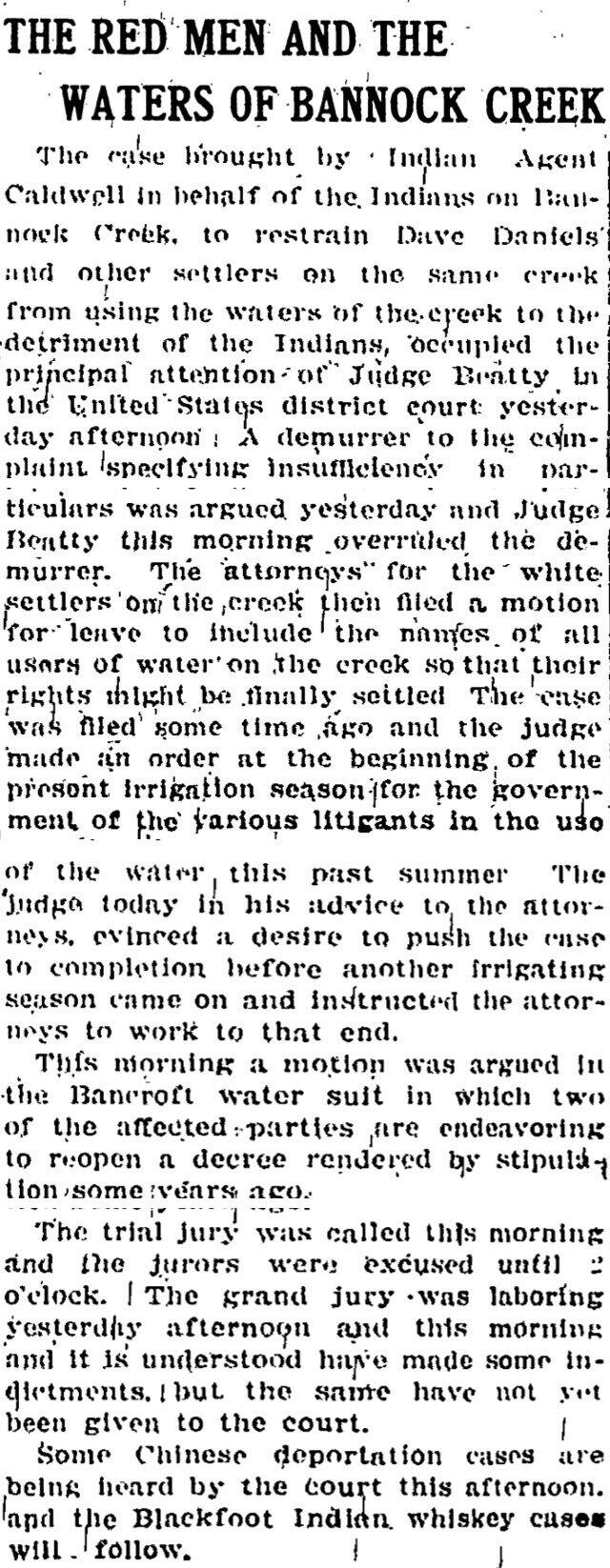
The settlers who watered their fields from Bannock Creek lost the first round in federal court in the fall of 1904. On Tuesday morning, October 4, Judge Beatty of the United States district court overruled their objection to a suit brought for the Indians at Fort Hall, and the case against Dave Daniels and his neighbors went on. That evening the Pocatello Tribune put the news on its front page under the heading “The Red Men and the Waters of Bannock Creek.”
The creek runs north out of what settlers then called Bannock Valley, past the mouth of the West Fork and into the Fort Hall Reservation. Upstream, settlers had been taking its water for more than a decade, under rights later dated to 1892. Downstream on the same creek lay the reservation’s Indian farms.
A demurrer overruled
Caldwell, the Indian agent, had brought the case on behalf of the Indians on Bannock Creek; two days later the same paper called him “Indian agent at Fort Hall.” He asked the court to stop Dave Daniels and other settlers along the creek from using its water “to the detriment of the Indians.”
The suit filled most of the judge’s Monday afternoon, October 3. Lawyers for the settlers had filed a demurrer, a formal objection claiming the complaint fell short in its particulars, and they argued it that day. Beatty ruled against it the next morning. The settlers’ attorneys answered with a motion to add the name of every water user on the creek, “so that their rights might be finally settled.”
The case was not new. The paper said it had been filed “some time ago,” and when the 1904 irrigation season opened, the judge had issued an order setting how the parties would share the water through the summer. What that order allowed went unreported. Now he told the attorneys he wanted the matter done before another irrigating season arrived, and he set them to work toward that.
The court cleared its docket and adjourned on Thursday, October 6. The Tribune’s report that day said a new complaint naming several more ranchers on the creek would be filed in the Bannock Creek water suit at the next term of court. Part of that sentence never reached readers. A line from a ball notice elsewhere on the page was set in place of one of its lines, leaving a gap between “among the” and “at the next term of court.”
The stock king of Bannock Creek
The paper never said which Dave Daniels it meant. Most likely it was David Moroni Daniels, the West Fork cattleman whose story is told with the rest of the Daniels family. The family account places his ranch above the mouth of the West Fork, in the country described on the Pauline and West Fork page, and when the county surveyed a new road over Moonshine from American Falls in 1911, the line ran to the Daniels ranch.
His second son, David Albert Daniels, is the less likely defendant. The family page has him born in 1883, while a 1915 notice of his death put his age at about 28, so in 1904 he was somewhere from about 17 to 21, and nothing shows him running cattle then. A year and a half after the hearing, on April 16, 1906, the Tribune noted that “Dave Daniels, the stock king of Bannock creek,” was in Pocatello on business. Those were the years when Bannock Valley was cattle range.
The decree of 1907
The papers read for this post lose track of the case after October 1904. On April 9, 1907, a federal decree settled the water rights of Bannock Creek and its branches, as the site’s Stories entry on United States v. Daniels tells, along with the dry-year warning of 1935. The decree kept the Tribes’ earliest right and fixed the settlers’ shares, dating the Daniels, Lusk and Bolingbroke rights on Rattlesnake Creek to April 1, 1892. It still governs the creek.
The 1904 suit was probably where that case began. Both were federal suits brought for the Indians over the same creek, each led by a defendant named Daniels, and the settlers’ 1904 motion to bring in every user fits a decree that fixed the rights of many. The Stories entry says it is not known which Daniels was the lead defendant. These reports name Dave Daniels.
A good deal is still missing: the day the suit was filed, the other settlers and their lawyers, the terms of the 1904 summer order, the course of the case between 1904 and 1907, and anything the Indian farmers on the lower creek said. The site’s account of the Bannock Creek allotments picks up the reservation side of the creek in later years.
Judge Beatty had wanted the case done before another irrigating season. It took two more, and the decree that came of it still divides the water.
The original article
Pocatello Tribune, October 4, 1904, page 1. Transcribed from the page scan. The paper reprinted it unchanged in its semi-weekly edition the next day.
THE RED MEN AND THE WATERS OF BANNOCK CREEK
The case brought by Indian Agent Caldwell in behalf of the Indians on Bannock Creek, to restrain Dave Daniels and other settlers on the same creek from using the waters of the creek to the detriment of the Indians, occupied the principal attention of Judge Beatty in the United States district court yesterday afternoon. A demurrer to the complaint specifying insufficiency in particulars was argued yesterday and Judge Beatty this morning overruled the demurrer. The attorneys for the white settlers on the creek then filed a motion for leave to include the names of all users of water on the creek so that their rights might be finally settled. The case was filed some time ago and the judge made an order at the beginning of the present irrigation season for the government of the various litigants in the use of the water this past summer. The judge today in his advice to the attorneys, evinced a desire to push the case to completion before another irrigating season came on and instructed the attorneys to work to that end.
This morning a motion was argued in the Bancroft water suit in which two of the affected parties are endeavoring to reopen a decree rendered by stipulation some years ago.
The trial jury was called this morning and the jurors were excused until 2 o’clock. The grand jury was laboring yesterday afternoon and this morning and it is understood have made some indictments, but the same have not yet been given to the court.
Some Chinese deportation cases are being heard by the court this afternoon, and the Blackfoot Indian whiskey cases will follow.