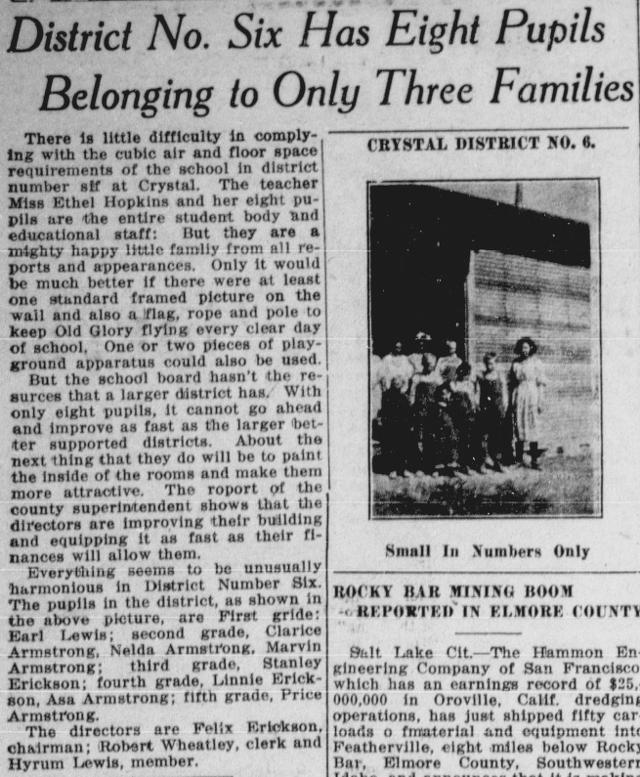
The whole of School District No. 6 fit in one photograph. On December 23, 1921, the American Falls Press ran a picture of the teacher, Miss Ethel Hopkins, and her eight pupils, under a headline that said the rest: “District No. Six Has Eight Pupils Belonging to Only Three Families.”
The paper did not pretend the school was rich. It was short of a standard framed picture for the wall, it had no flag or pole for one, and a piece or two of playground equipment would not have hurt. A district of eight pupils could not keep pace with bigger, better funded ones, the Press explained, but its board was mending and equipping the building as fast as the money came in, and the next job was to paint the rooms inside. The writer came away charmed all the same. “Everything seems to be unusually harmonious in District Number Six,” the story ran.
Carved from two districts
The district was not two years old. Arbon had belonged to Oneida County until 1913, and by 1920 its schools answered to Power County. In April 1920 the county commissioners approved “the formation of a new school district No. six, from 13 and 14 in Pauline and Crystal.” Thirteen was the Pauline school; fourteen was Crystal’s, home to the Central School of 1912. That spring the voters of the new district, listed as “Davis,” chose Sheldon Armstrong, Robert Wheatley and Owen Marley as trustees. This Wheatley was probably the man who bought grain at the Pauline platform in 1917. Melvin Thomas is the first teacher on record.
The Press called it the school “at Crystal,” yet its families came from both directions. A 1938 U.S. Geological Survey map, cited in the site’s Daniels family history, which also maps the homesteads around the school, puts the Armstrong school in Section 32, Township 9 South, Range 34 East, north-east of Pauline on the way to Crystal. The site’s pages on Crystal, on Pauline and West Fork and on the Schools of Arbon Valley tell more of the neighborhood.
Three families
For 1921–22 the county superintendent, Miss Goldie Drake, put Miss Hopkins down as a teacher at Crystal, in the slot where District 6 belonged. The December picture showed Earl Lewis, in first grade; Clarice, Nelda and Marvin Armstrong, in second; Stanley Erickson, in third; Linnie Erickson and Asa Armstrong, in fourth; and Price Armstrong, in fifth. Felix Erickson chaired the board, Robert Wheatley kept its books as clerk, and Hyrum Lewis was the third member.
The census of the year before fills in a little. Hyrum Lewis’s household at Pauline included a son Earl, then four, likely the first grader. At Crystal, a Virginia-born farmer named Walter S. Armstrong had an Asa, 8, a Marvin, 5, and a girl of 7 whose name was read as Melda and may have been Nelda, so Asa and Marvin were very likely his. Whose children Clarice and Price were, the papers never said.
A flag bought with pencils
The school soon took the Armstrong name. In the fall of 1923 Mrs. Cora Darling, now county superintendent, spent two weeks going from school to school in the valley, among them “the Armstrong school in district six taught by Miss Rosa Sack.” Some days she rode between them on a grain rack, and now and again “she walked two or three miles rather than have anyone stop harvest to take her around.”
That year the Press opened its columns to rural honor rolls and school news, and the Armstrong pupils wrote much of their own. Their Halloween program and dance earned money toward a clock. In one contest Asa Armstrong carried the most pumpkin seeds on a knife blade from one end of the room to the other.
The flag the Press had wished for two years earlier was theirs by December. “The school has sold pencils for a flag,” the children wrote. “The flag has arrived and all salute it every morning.” On the blackboard Miss Sack kept a “grave yard” where bad English such as “ain’t and hain’t” went to be buried. The same report told of a noon hour that went wrong:
The pupils of Dist. 6 were out sleigh riding last Friday during the noon hour and run off the road down in a deep ditch and got stuck and all had to get out till the team could pull the sleigh back on the road.
The Armstrong, Crystal and Lapland schools meant to put on a joint program on December 21. It did not happen as planned. On December 20 the Press reported the Armstrong school shut for the week because children had scarlet fever, and the Crystal Central school had pushed its program past New Year’s “because of so much sickness in Crystal.”
A swing and a teeter-totter
On Washington’s birthday in February 1924 the pupils gave their parents a program that included a salute to the flag. They were also due to sit down with the trustees “to decide on a play ground apparatus which is going to be built,” and they had made up their minds: a swing and a teeter-totter. By March the poles were on hand and they wanted someone to help raise them. By April they were scanning the paper for themselves:
We looked in the Press to see if our names were in there. Some could find the first name and others part of their last name. We hope next week we can find one or two of our names. We are anxious for next week’s Press to come.
In June Stanley Erickson earned a county gold certificate for a year without missing a day. Rural attendance that year ran “about twice as good as usual,” Mrs. Darling said, and she gave much of the credit to the honor roll the Press printed each month.
In September 1925 the county assigned Amelia Neff to the Armstrong school. A month later Mrs. Darling wrote about a small school whose district number is lost in the scan, but whose clerk was Hyrum Lewis and whose third trustee was O. Armstrong, so it was almost surely District 6. The swing and teeter-totter were up, plain things built of poles from the hills, and the clerk made sure she knew that he and another man had walked through the snow to fetch them. Seven boys and girls had “a gentleman teacher” to play with them at noon and recess. Why a man stood where the September list had named Amelia Neff, the papers do not say, nor when District 6 closed.
All the school still lacked, Mrs. Darling decided, was a well and more pupils.
The original article
American Falls Press, December 23, 1921, page 4. Transcribed from the page scan.
District No. Six Has Eight Pupils Belonging to Only Three Families
There is little difficulty in complying with the cubic air and floor space requirements of the school in district number sff at Crystal. The teacher Miss Ethel Hopkins and her eight pupils are the entire student body and educational staff: But they are a mighty happy little family from all reports and appearances. Only it would be much better if there were at least one standard framed picture on the wall and also a flag, rope and pole to keep Old Glory flying every clear day of school. One or two pieces of playground apparatus could also be used.
But the school board hasn’t the resources that a larger district has. With only eight pupils, it cannot go ahead and improve as fast as the larger better supported districts. About the next thing that they do will be to paint the inside of the rooms and make them more attractive. The roport of the county superintendent shows that the directors are improving their building and equipping it as fast as their finances will allow them.
Everything seems to be unusually harmonious in District Number Six. The pupils in the district, as shown in the above picture, are First gride: Earl Lewis; second grade, Clarice Armstrong, Nelda Armstrong, Marvin Armstrong; third grade, Stanley Erickson; fourth grade, Linnie Erickson, Asa Armstrong; fifth grade, Price Armstrong.
The directors are Felix Erickson, chairman; Robert Wheatley, clerk and Hyrum Lewis, member.
Sources
- American Falls Press, April 16, 1920, page 1
- American Falls Press, May 28, 1920, page 1
- American Falls Press, January 21, 1921, page 3
- American Falls Press, September 16, 1921, page 5
- American Falls Press, December 23, 1921, page 4
- American Falls Press, November 1, 1923, page 1
- American Falls Press, November 22, 1923, page 2
- American Falls Press, December 13, 1923, page 7
- American Falls Press, December 20, 1923, page 2
- American Falls Press, March 6, 1924, page 1
- American Falls Press, March 13, 1924, page 2
- American Falls Press, April 3, 1924, page 4
- American Falls Press, June 12, 1924, page 2
- American Falls Press, September 17, 1925, page 4
- American Falls Press, October 29, 1925, page 1
- 1920 U.S. census, Power County, Idaho, Pauline precinct (household of Hyrum Lewis)
- 1920 U.S. census, Power County, Idaho, Crystal precinct (household of Walter S. Armstrong)