In the fall of 1917 a correspondent for the American Falls Press who signed himself "The Pilgrim" spent the better part of three months on the roads of Crystal, Pauline and Arbon, mostly on foot. His ranch profiles are stories of their own; this post follows the man himself through his road notes, "Along the Highways."
Arbon had been in Oneida County until Power County was created in 1913. Crystal is a high basin of springs and creeks that feed Bannock Creek, and the valley's north end lies beside the Fort Hall Reservation, which some of the roads and short cuts out of Pauline and Crystal crossed.
A department for farmers
On August 3, 1917, the Press announced a new department on the county's farms, promising that every farmer would be visited by "The Pilgrim" in the course of his travels. On August 31 it reported that he would leave the next week for Crystal and "may possibly get to Pauline and Arbon before returning."
His name was never printed in the columns read for this post. He mentioned that he had "served in the United States regular army," and later that he had "lived in Utah so many years." He also sold subscriptions, and when he moved from Crystal into the Arbon country early in October the Press asked readers to give him their farming methods, their mistakes and $2. The Arbon correspondent wrote that the valley was "looking for the Pilgrim out our way."
Up Mink Creek with the mail
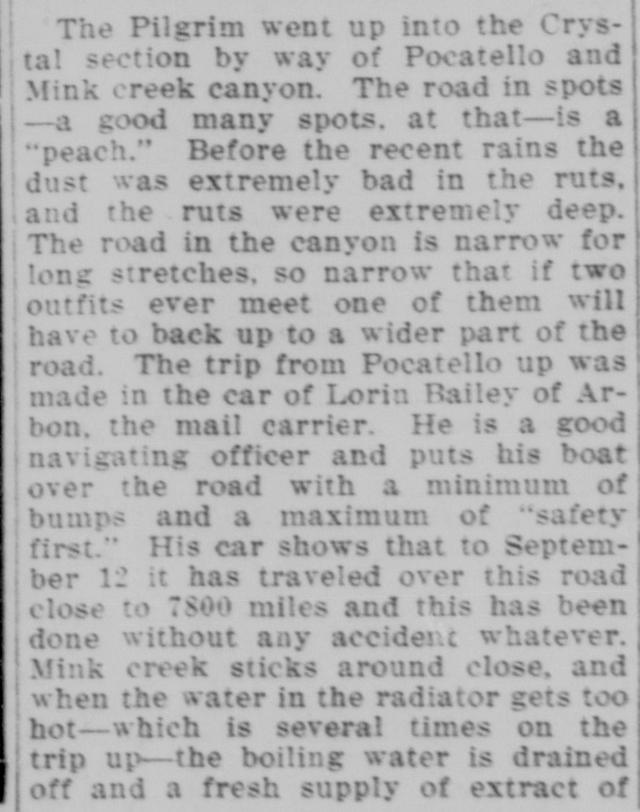
He went up to Crystal by way of Pocatello and Mink Creek canyon in the car of Lorin Bailey of Arbon, the mail carrier. In places the canyon road was so narrow that if two outfits met, one had to back up. When the radiator boiled, as it did several times on the trip up, the hot water was drained off and "a fresh supply of extract of Mink creek" put in. The winter before, in the deep snows of 1916–17, the mail had gone by sleigh behind six horses. Bailey, the Pilgrim later wrote, "beats it to Pocatello," as one of his little daughters put it, three times a week. This site counts it as probably the valley's first mail route from Pocatello.
Short cuts and roadside rests
In mid-September he took a short cut across the reservation toward Pauline and was stopped by an older Indian man, who told him quite seriously that he had to get off the reservation at once. When the Pilgrim answered that this was exactly what he was doing, the man laughed and stayed to talk, and the two smoked together for a while, the man's cigarette and the Pilgrim's old corncob pipe. The road came out near the David Daniels ranch, run by Walt and Eli Daniels, probably the sons of David Moroni Daniels, and he urged that someone photograph its old pioneer cabin.
On the Pauline road one morning he met a man hauling a load of household furniture toward Crystal.
About a mile further down the road a nice rocking chair was standing in the middle of the highway, evidently having dropped from the rear of the wagon. It is not every community that offers such a fine rest to the wayfarer; that chair came in just right for a rest and to jot down a few happenings in the note book.
In the Arbon country
By late October he was in Arbon. He had noticed that storms announced themselves with a frown on Bannock Peak, and on October 23 he reported a cold spell:
Last Monday night the old weather witch hanging out on the summit of the peak mixed a dose of winter weather and kicked the bucket over prematurely, and as a result an icy blast blew down the mountain and over the far-flung domain of the valley the following two days and nights.
Range stock was a hazard to a man on foot. One Sunday noon, about a hundred yards north of D. B. Ripley's ranch, a two-year-old heifer charged him down the middle of a highway at least sixty feet wide. He threw his hat in its face and sidestepped, and remarked that "this business of playing at being a torreador" was not in the curriculum.
Counting 312 sacks of wheat stacked in a field a few miles west of Pauline, he offered to bet "312 cents against 30 corncob pipes" that the owner was satisfied.
An old Indian man on the highway predicted an open winter, with snow two feet deep. "Here's hoping he is a true prophet," the Pilgrim wrote. On the main road south from Arbon toward Oneida County he met an Indian man and his family walking north toward the reservation. The man had been loading sugar beets into a wagon and hauling them to the factory in Utah for about $4 a day, and had quit: the wagon was too high, he said, and the beets too heavy. The Pilgrim's accounts of such meetings often carry the slighting terms papers of the day used for their reservation neighbors, and those are left out here.
Dave Lusk's three-year-old son told Mrs. Lusk that the "Program" was here. The Pilgrim thought the name not far off, since he had come "with a well defined program and carried it out." On November 13 the Arbon correspondent called him "a persistent and energetic worker." Two days later he came back to American Falls after two weeks or more in Arbon, bound next for the Rockland valley.
Back in December
By the end of November he reckoned he had visited about 200 farms across the county, and he found "the grouch and kicker is conspicuous by his rarity." He was not done with Arbon Valley:
Hiking from Pauline to Arbon one day in the sunny month of December a flivver was seen coming north, wabbling down the road like a ship on a stormy sea. It didn't look good to the Pilgrim and to prevent being charged by the wabbler he took the precaution of climbing through a fence, and still the juggernaut tried to get at him.
The driver blamed his steering gear, and then the hiker's Ingersoll watch. When Ernest Poppie wrote home from Camp Lewis with sympathy for the valley's "deep snow and cold weather," the column of January 8, 1918, answered that it was "nice and balmy in Arbon valley and all over the county." So far the winter was as open as the old man on the highway had predicted.
The article as printed
American Falls Press, September 18, 1917, page 3. Transcribed from the page scan.
ALONG THE HIGHWAYS
Gleanings by the Pilgrim in His Wanderings Here and There.
The Pilgrim went up into the Crystal section by way of Pocatello and Mink creek canyon. The road in spots—a good many spots, at that—is a "peach." Before the recent rains the dust was extremely bad in the ruts, and the ruts were extremely deep. The road in the canyon is narrow for long stretches, so narrow that if two outfits ever meet one of them will have to back up to a wider part of the road. The trip from Pocatello up was made in the car of Lorin Bailey of Arbon, the mail carrier. He is a good navigating officer and puts his boat over the road with a minimum of bumps and a maximum of "safety first." His car shows that to September 12 it has traveled over this road close to 7800 miles and this has been done without any accident whatever. Mink creek sticks around close, and when the water in the radiator gets too hot—which is several times on the trip up—the boiling water is drained off and a fresh supply of extract of Mink creek put in. An admirer of mountain scenery will find plenty of it on this trip. Mr. Bailey the other day carried 1100 pounds of mail and miscellany to Crystal and made schedule time, too. The journey up is made in from [illegible] to three hours, and from Crystal down it is made in about two hours. Last winter when the snows were so deep the mail was carried by sleigh, drawn by six horses, and all sorts of troubles and tribulations assailed the carrier. With [illegible] hope and [illegible] that [illegible] fulfilled Mr. Bailey looks forward to an open winter.
On Tuesday of this week the way of the Pilgrim led through the Indian reservation, using the "Johny" road as a short cut to reach a point below Pauline. Hiking along the road he was stopped by an Indian of mature years who quite seriously informed him that he had to get off the reservation at once, and when the Indian was informed that this was exactly what was being done the old [illegible] laughed and halted for a further chat. He got the tobacco part of the "makins" and his cigarette and the Pilgrim's old corn cob fogged away for a spell and everything was serene. The road traveled emerges from the reservation near the David Daniels ranch, two and a half miles from Pauline, near one of the typical pioneer cabins of the early days. Walt and Eli Daniels are running the ranch now. The old cabin was built, as near as could be learned, about 25 years ago and contains two large rooms. Great poles or beams support the boarded roof in the old fashioned pioneer way. Some [illegible] the pioneer history of this country will be written and this cabin will take its place in that history. A good photograph of it should be made while it is standing there at the edge of the reservation and its exact history [illegible] possible.
R. Connelly, whose ranch is located in a picturesque spot three and a quarter miles southwest of Crystal, right up against the Indian reservation, has just finished a new granary. He has threshed [illegible] acres [illegible] average of [illegible] bushels per acre. He has a fine tract [illegible] Last winter there was nothing to hold back the heavy [illegible] He intends [illegible] a home this fall about a [illegible] removed from that hill. [illegible] Connelly took some pictures [illegible] winter and they show an [illegible] depth of snow.
Some grain has been delivered and stored on the platform at Pauline. An additional platform is being built.
The [illegible] of the engine and the trail of the smoke down the [illegible] trains. It is merely evidence that [illegible] threshing [illegible] Crystal way.
[illegible] is a healthy climate in the hills and [illegible] in the Crystal section. [illegible] trouble at all to sleep nine hours a night, and less trouble to eat everything set before one. Several times the Pilgrim has stopped in a grove of wild choke cherries to appease his appetite between dinner and supper.
Mr. and Mrs. Albert Beale are [illegible] on the ranch of their daughter, Mrs. Wm. Johnson, two miles southwest of Crystal. Mr. Beale proved up on a homestead near his daughter's ranch and later sold it. Mr. Beale has [illegible] distinction of being the youngest member of the Grand Army of the Republic in the state of Idaho. In 1864, [illegible] years he enlisted in the Fifth Pennsylvania Volunteer Infantry. His sixteenth birthday anniversary was celebrated on the skirmish line at Winchester, in the Shenandoah valley. [illegible] Lee surrendered to Grant, [illegible] Before he reached the age of seventeen years he had taken part in three engagements and numerous skirmishes. The veteran is in his [illegible] year and his memory of the [illegible] war is vivid and clear. Mr. Beale has the further distinction [illegible] eligible to [illegible] Sons of Veterans, for [illegible] father [illegible] a member of the [illegible] Pennsylvania Volunteer Cavalry [illegible] first call [illegible] months. [illegible] this enlistment he [illegible] for the war and served until [illegible]
Mrs. M. A. Dennison, residing on a ranch about a mile southwest of Crystal, has a fine garden partly irrigated from a well. The potatoes are giving an especially fine yield this year, and altogether it is the best yielding garden ever raised on this ranch during the seven years that Mr. and Mrs. Dennison have lived on it. Mr. Dennison is the owner of a splendid dog who more than earns his "keep." He is trained to keep off hawks and he does it. Not only does he keep them from alighting on the ranch, but he chases them far into the hills. As soon as he gets his supper "Shep" retires to the stable and guards the horses, sleeping in the stable with them.
While in the Pauline neighborhood last Tuesday a young fellow was encountered sitting in the shade of a bush by the roadside. Ever after a news item of some sort or another, the Pilgrim accosted the fellow. Now, it should be stated that the Pilgrim has served in the United States regular army, and when it comes to kicking a soldier is a past master at the art: also the Pilgrim has had a sneak ace trumped in a solo game, and when that happens all records of kicking are in imminent danger of being broken: further, he has played baseball and been maltreated by an umpire: has lost a nice big trout off his hook: has had three aces beaten to a fare-you-well: has been compelled to eat fried steak after eating the splendid cooked meals provided by the women of the Power county ranch households, and all these misfortunes have been resented by earnest kicking. But that young fellow sitting by the roadside beat any kicker that ever kicked. He had been working and had a pocket full of money. He kicked about the rains that had fallen—they were too wet; he kicked about the hail—it was too hard; he kicked about the road, then kicked because the graveled road was too hard on his poor tender feet; the sun shone too [illegible] "capitalistic" tobacco and the [illegible] nose of the howler got a whiff of the cheering weed he asked for "papers," but it was impossible to supply him—and then he kicked again, and kicked right. When told that a store was within two and half miles he declared that was too far to walk. It is doubtful if that howler would have gone across the road to get a drink of water from the spring unless his very life depended on it. When asked if he belonged to any particular party he answered that he did not, that he had no faith in any of them. The democrats and republicans were capitalistic, the socialists were no less so, and the I W W bunch was weak kneed beyond his power to express. That fellow surely is in hard luck. He is firmly convinced that this is a world of sin and sorrow, of trials and [illegible] impresses one as the most [illegible] and narrow-brained human beings imaginable. Any person that has [illegible] such a fellow is entitled to pity. After being invited to come along to the ranch of Mr. Staley, justice of the peace for Crystal precinct, and thence to American Falls, to repeat his statements to Sheriff Jeffries, the kicker [illegible] discovered that he had [illegible] business down the valley. The last seen of him he was making about four miles an hour down the reservation road.
On this site: the Arbon and Pauline and West Fork area histories, and the Arbon stage that went into Mink Creek in 1925.
Sources
- American Falls Press, August 3, 1917, page 1
- American Falls Press, August 31, 1917, page 1
- American Falls Press, September 18, 1917, page 3
- American Falls Press, September 21, 1917, page 3
- American Falls Press, October 2, 1917, page 2
- American Falls Press, October 9, 1917, page 4
- American Falls Press, October 23, 1917, page 3
- American Falls Press, October 30, 1917, page 3
- American Falls Press, November 2, 1917, page 3
- American Falls Press, November 13, 1917, page 1
- American Falls Press, November 13, 1917, page 3
- American Falls Press, November 16, 1917, page 3
- American Falls Press, November 16, 1917, page 4
- American Falls Press, November 20, 1917, page 3
- American Falls Press, November 30, 1917, page 3
- American Falls Press, January 8, 1918, page 3
- American Falls Press, January 15, 1918, page 3