For six weeks in the late fall of 1912, thirty-six teams at a time were out on the road from Arbon Valley, hauling wheat down Bannock Creek to Michaud and on to American Falls. Pocatello noticed. All year the two railroad towns had been courting the farmers of the valley, which still lay in Oneida County. American Falls cut a shorter road and sent its businessmen visiting, and the Pocatello Tribune spent the summer and fall warning its readers that the trade was slipping away. In December an Arbon man came over the divide to tell Pocatello what it would take to win it back.
A train of wagons
Grain left the valley by wagon. In early December 1911 E. E. Zaring reported to the American Falls Press that forty Arbon people had just delivered roughly 160,000 pounds of wheat to Michaud in “a train of wagons.” Michaud was a siding on the Oregon Short Line, between American Falls and Pocatello, and the way there ran down Bannock Creek.
A shortcut through the Moonshine country
American Falls meant to shorten that haul. In the summer of 1911 the county surveyor put in about five days laying out a new road to Arbon through the Moonshine country. His line measured 22.97 miles from American Falls to Dave Daniels’s ranch, on far easier grades than an older road. (How the valley got its first engineered road out is told among the site’s firsts.)
On May 30, 1912, the Press ran the news as a “Short Cut to Arbon.” Arbon’s farmers wanted “a winter road to be used for hauling their vast yields to market,” the paper said, and a little over $1,000 had been gathered for it, in cash from American Falls merchants and in work from Arbon people. Ezra Zaring, likely the same man who had told of the wheat train, was in charge of the grading. By July 18 the road reached the Daniels place and was fit for light travel. That was probably the ranch of Dave Daniels above the mouth of West Fork, where the survey had stopped the year before.
The Board of Trade goes calling
Now the American Falls Board of Trade arranged a “Get Acquainted” outing. A group of its businessmen drove out on the morning of Sunday, August 11, 1912, spent the evening meeting farmers and returned on Monday. One of them was L. L. Evans, whose American Falls family was no relation to the Evanses of Arbon. They went, the Press explained on August 15, to learn more about the valley and its people “and draw that trade to this city.”
The party came back reporting that Arbon folk were “very happy and prosperous” and grateful to American Falls for the road. The haul to Pocatello had been a little longer, the paper allowed, yet the poor state of the American Falls road had pushed many farmers that way, and a load of grain dropped at the siding still left a second trip into town to shop. With the new road, it said, the valley lay “twelve miles nearer than Pocatello.”
Pocatello answers
A week later the Press reported that Pocatello was getting up a trip of its own, a “last strenuous effort to again turn it their way.” It reprinted the Tribune of Friday, August 16. Calling the valley by its older name, Bannock Valley, and the two towns the “Gate City” and the “Power City,” the Pocatello paper explained why the trade had been its own:
Most of this grain during years past has been hauled to Michaud siding and the greater part of the trade has come to the Gate City instead of American Falls. This has been due to the fact that a republican board of county commissioners a few years ago spent a considerable sum of money in building a splendid road over the Mink creek divide, tapping the Rattlesnake and Bannock creek districts.
Since then, the Tribune said, American Falls had “awakened” and built good roads to Arbon. Pocatello merchants, it added, had lately secured a star route, a contracted mail route, from Pocatello to Pauline and Crystal. Mail probably did not run on it that year: the site’s account of the first mail route from Pocatello finds bids called for such a route in December 1912 and complaints in 1915 that Pauline and Crystal still had no service. The Tribune pressed for a Pocatello party to go out, by auto over the divide or up the gentler Bannock Creek road, warning that “Pocatello can ill afford to lose such valuable trade.” If that trip was made, no report of it has turned up.
An Arbon man in Pocatello
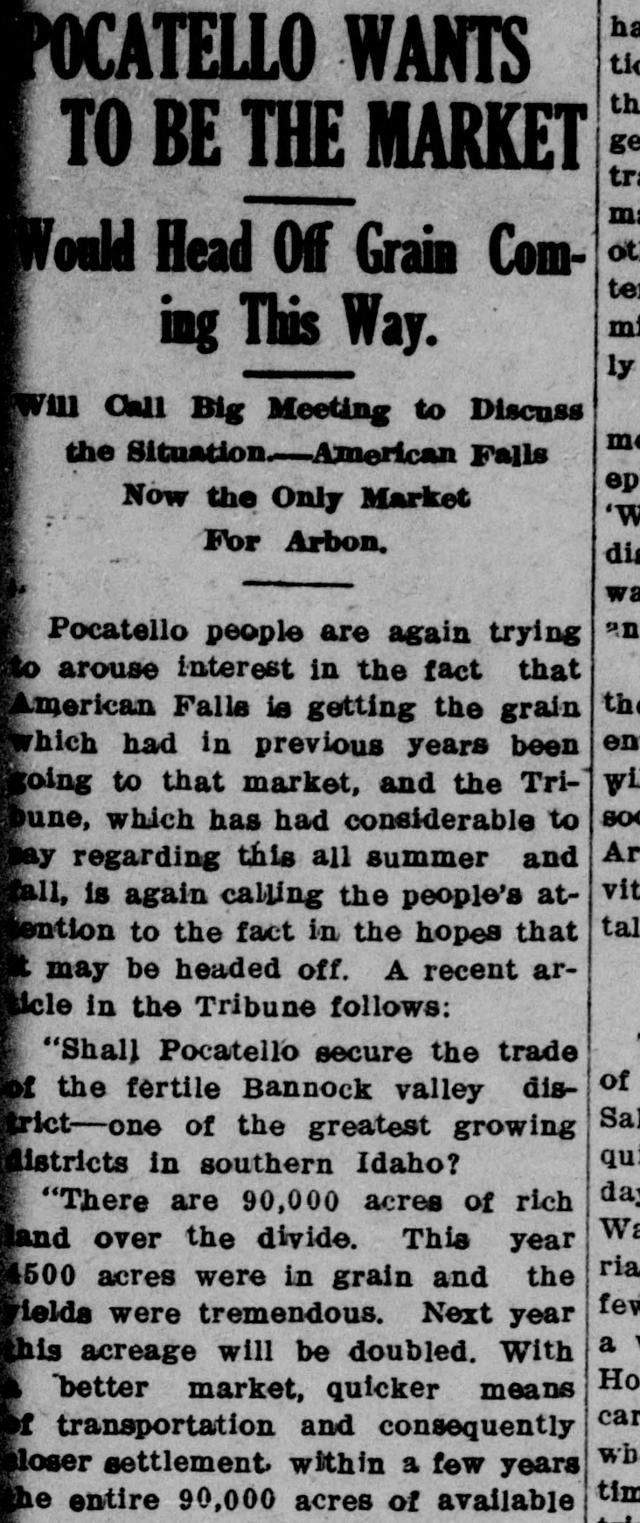
By December the Press could put it in a front-page headline: “American Falls Now the Only Market For Arbon.” Beneath it the paper reprinted a fresh Tribune story, which opened by asking whether Pocatello would win “the fertile Bannock valley district” and its 90,000 acres of rich land over the divide.
The visitor was L. B. Evans, vice-president of the Arbon Commercial Club, almost certainly Lorenzo “Ren” Evans of the Arbon Evans family. He had spent a day with Pocatello businessmen and the officers of its Commercial Club, pushing for a wagon road from Pocatello over the Trail Creek divide. His club counted nearly every grain grower in the valley as a member, the Tribune said, and the settlers on Rattlesnake Creek and at Pauline and Crystal also wanted closer ties to Pocatello.
Rivals were moving on both sides. Malad, the valley’s other market, had set aside $2,500 for a road over a high divide from Arbon, and American Falls was keeping its own road in repair. Bannock County’s commissioners had promised the Trail Creek road, then spent $500 on bridges and repairs to the Michaud Creek road instead, which only sent more business to American Falls.
Evans laid out the numbers. The past six weeks of hauling down the valley to Michaud and on to American Falls had been “record breaking.” A Trail Creek road would cost $2,000. His neighbors would rather do their banking, shipping and buying in Pocatello, he said, but the next move was Pocatello’s. He brought one more offer:
Mr. Evans says the Arbon Commercial club is also anxious for telephone connections with Pocatello. ‘We will furnish the poles free and distribute them along the right-of-way if others will furnish the wire and do the construction work.’
W. H. Bohlschied, president of the Pocatello Commercial Club, was to call his members together with the Arbon men. No account of that meeting has been found.
Poles, wire and a long wait
The map changed first. Early in 1913 the new Power County took in Arbon, Pauline and Crystal, with its seat, temporarily at first, at American Falls. That March W. E. Dawson wrote for the Arbon Commercial Club that it was putting up a telephone line and hoped for “good substantial aid from you our ‘Power Center.’” In September, after what the Press called “a long, hard pull” by the Board of Trade, valley people formed a telephone company on the terms Mountain States required before it would string a toll line out to them from American Falls. The paper expected the line that fall, but it was not tied to the valley’s own line until early December 1915.
The road to Pocatello came slower still. In October 1916 the Salt Lake Tribune reported that the Pocatello Commercial Club had appointed a committee to study a wagon road of about forty miles by the Trail Creek route; an earlier survey had been shelved while it seemed a railroad might come. Lorenzo Evans’s family remembered how hard he worked for a good road over Mink Creek, so that valley people could shop in Pocatello. Four years after he made his case in town, Pocatello was still only talking about the road.
The original article
American Falls Press, December 26, 1912, page 1. Transcribed from the page scan.
POCATELLO WANTS TO BE THE MARKET
Would Head Off Grain Coming This Way.
Will Call Big Meeting to Discuss the Situation.—American Falls Now the Only Market For Arbon.
Pocatello people are again trying to arouse interest in the fact that American Falls is getting the grain which had in previous years been going to that market, and the Tribune, which has had considerable to say regarding this all summer and fall, is again calling the people’s attention to the fact in the hopes that it may be headed off. A recent article in the Tribune follows:
“Shall Pocatello secure the trade of the fertile Bannock valley district—one of the greatest growing districts in southern Idaho?
“There are 90,000 acres of rich land over the divide. This year [illegible] acres were in grain and the yields were tremendous. Next year this acreage will be doubled. With a better market, quicker means of transportation and consequently closer settlement within a few years the entire 90,000 acres of available land will be under cultivation.
“Pocatello is the ideal marketing [illegible] for this immense tract. All that is required is to construct a road leading to the Gate City. Not only would this constitute Pocatello one of the most important grain shipping points in this end of the state, but it would bring to the doors of local merchants a large and growing trade, which is now equally divided between Malad on one side and American Falls on the other.
“L. B. Evans, vice-president of the Arbon Commercial club, a live wire organization, the membership of which includes nearly every grain grower in the fertile Bannock valley, just over the divide to the west of Pocatello, was in the city yesterday, conferring with local business men and with executive officers of the Pocatello Commercial club. His mission in the metropolis of the southwest was to create interest in a proposed wagon road from Pocatello over the Trail creek divide, to tap not only the Bannock valley but the rich Rattlesnake and Crystal communities, populated by many former Pocatello people. The Arbon club, as well as the settlers of Rattlesnake creek, Pauline and Crystal desire closer connection with the Gate City. They want the Trail creek road built so that they may not only market their grain at this point, but do their trading at Pocatello. Under present conditions they are compelled to do their trading at American Falls on the one side and Malad on the other. Both these towns are anxious to hold this trade and Malad has arranged to spend $2500 on the construction of a road leading over a high divide from Arbon, while American Falls is doing everything in its power to keep the Bannock Valley-the Power City road in good repair and encourage Arbon, Rattlesnake [illegible] Crystal [illegible] make that their marketing place. These people much prefer Pocatello as a market, not only because this city affords better shipping facilities, but because there is a wider market for smaller farm products and the stores carry larger [illegible] and make better prices.
“The Bannock county incumbent board of commissioners promised some time ago to build the Trail creek road, but instead they appropriated $500 for bridges and repairs on the Michaud creek road, which diverts business to American Falls.
“According to Mr. Evans, the shipping for the last six weeks [illegible] down Bannock valley to Michaud and thence to American Falls has been record breaking. At all times thirty-six teams [illegible] the road, hauling wheat [illegible] to Power City.
“’To build the Trail creek road and thus open the Pocatello market to the farmers of our community,’ said Mr. Evans, ‘would cost $2000. A road to Malad would cost about $2500. The people of Malad have raised this sum and construction of a highway will begin in the spring. It is up to Pocatello to get busy or loose a large growing trade. We prefer Pocatello as a market for banking, shipping and other reasons. The business interests of Pocatello will make a mistake if they fail to act promptly in this matter.’
“Mr. Evans says the Arbon Commercial club is also anxious for telephone connections with Pocatello. ‘We will furnish the poles free and distribute them along the right-of-way if others will furnish the wire and do the construction work.’
“President W. H. Bohlschied, of the Pocatello Commercial club is enthusiastic over the matter and will call a meeting of the club very soon when representatives of the Arbon Commercial club will be invited and the proposition will be talked over.”
Sources
- American Falls Press, July 6, 1911, page 1
- American Falls Press, December 7, 1911, page 1
- American Falls Press, May 30, 1912, page 1
- American Falls Press, July 18, 1912, page 6
- American Falls Press, August 15, 1912, page 1
- American Falls Press, August 22, 1912, page 1
- American Falls Press, December 26, 1912, page 1
- American Falls Press, February 6, 1913, page 1
- American Falls Press, March 20, 1913, page 7
- American Falls Press, September 11, 1913, page 1
- Salt Lake Tribune, October 1, 1916, page 14