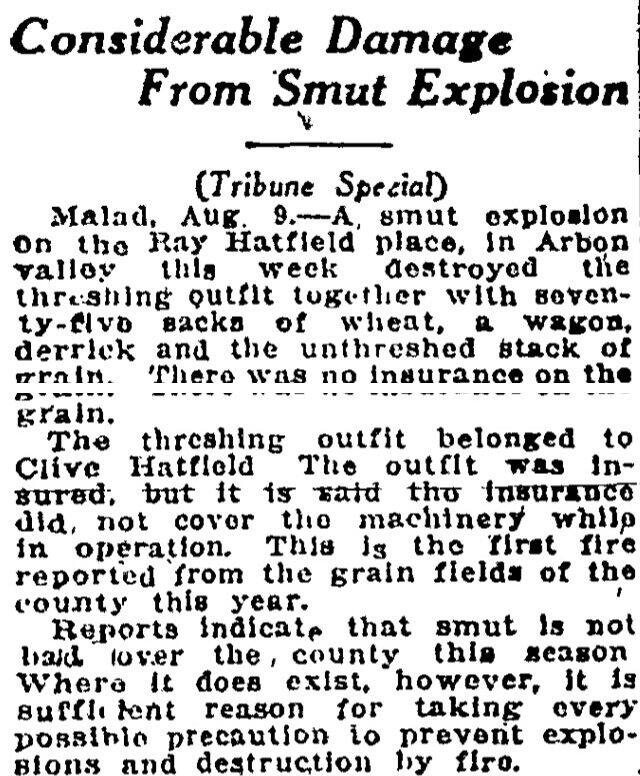
A threshing crew on the Ray Hatfield place in Arbon Valley had a stack of wheat still waiting its turn in the first week of August 1924 when smut dust inside the machine exploded. By the time the fire burned out, the outfit was gone, and with it seventy-five sacks of threshed wheat, a wagon, a derrick and the unthreshed stack.
The news reached Pocatello by way of Malad. The Pocatello Tribune’s correspondent there sent it in on August 9, and the paper ran it the next day on its Idaho State News page under the headline “Considerable Damage From Smut Explosion.” The Ogden Standard-Examiner had a shorter version on August 9.
No one had insured the grain. The machine belonged to Clive Hatfield, and it did carry a policy, but the correspondent passed along word that the coverage did not reach machinery while it was running. It was, he wrote, the first fire reported from the county’s grain fields that season. Neither paper says whether anyone was hurt, and neither says what the loss came to, whether the insurer paid anything or how the Hatfields got the rest of their crop threshed.
The Ogden paper’s scanned text reads “five sacks,” and the site’s Stories entry on smut explosions follows it; the Tribune’s page plainly says seventy-five. As scanned, the Ogden story also stops with the uninsured grain and never reaches Clive Hatfield and his outfit.
A black dust in the wheat
Smut, also called bunt, is a fungus that turns the kernels of wheat into a black powder. In a threshing machine that powder could ignite. It had become a serious problem in the county in 1914, and the valley brought in a smutty harvest in 1915, as the story of Henry Shandrew’s clean wheat tells. That October the American Falls Press South Arbon column reported that the Sorenson brothers’ machine (the family spelled the name Sorensen) had suffered an explosion “caused by smut.” They put out the fire before it did serious harm and were threshing again after a few hours of repairs.
The Hatfields were not so lucky. The Tribune ended its report with a caution: smut was not bad over the county that year, but wherever it turned up, it was reason enough to take every care against explosion and fire.
News by way of Malad
The report came from Malad, not American Falls, because the valley’s south end lay across the line between Power and Oneida counties, and to a Malad correspondent “the county” meant Oneida. In November 1917 the Press placed C. H. Hatfield’s 160-acre ranch “just over the line in Oneida county.” The papers never say where the Ray Hatfield place stood, though a report filed from Malad points to the Oneida side as well.
The Hatfields had come from Dayton, Washington, with other families who took up land near Summit. Clive H. Hatfield filed on 160 acres in Bannock Valley in October 1913. By 1917 he was leasing 640 acres on top of his own ground and plowing with a 10-20 tractor, as told in Horses and the first tractors.
Ray Hatfield was almost certainly a son of P. A. Hatfield “of Arbon valley.” A 1927 death notice for another son, Ralph, names P. A. Hatfield as his father and lists five brothers, Max, Phil and Ray Hatfield of Arbon among them, though the scan is too faint to read the other names with any confidence. No second Ray Hatfield turns up in the valley. The site’s family research counts Clive as one more of P. A. Hatfield’s sons, which is likely, though nothing in the 1924 reports says so. Ralph and Lee Hatfield had spent March 1924 hauling grain from Pauline to the railroad at Schiller, during the wheat-buying war at Schiller.
The fire did not drive the family out. On October 30, 1924, the Tribune reported that women of the south end and “the adjoining canyon community” had organized the Sunshine Canyon club. Mrs. Walter S. Fredrich of Bull Canyon was its president, and its vice president was Mrs. Clive Hatfield.
The original article
Pocatello Tribune, August 10, 1924, page 2. Transcribed from the page scan. Two periods missing on the page are supplied in brackets; small comma-like marks after “A,” “did” and “the” (before “county”) are taken as specks in the print and left out.
Considerable Damage From Smut Explosion
(Tribune Special)
Malad, Aug. 9.—A smut explosion on the Ray Hatfield place, in Arbon valley this week destroyed the threshing outfit together with seventy-five sacks of wheat, a wagon, derrick and the unthreshed stack of grain. There was no insurance on the grain.
The threshing outfit belonged to Clive Hatfield[.] The outfit was insured, but it is said the insurance did not cover the machinery while in operation. This is the first fire reported from the grain fields of the county this year.
Reports indicate that smut is not bad over the county this season[.] Where it does exist, however, it is sufficient reason for taking every possible precaution to prevent explosions and destruction by fire.
Sources
- Pocatello Tribune, August 10, 1924, page 2
- Ogden Standard-Examiner, August 9, 1924, page 3
- American Falls Press, October 16, 1913, page 8
- American Falls Press, October 7, 1915, page 1
- American Falls Press, November 23, 1917, page 3
- American Falls Press, March 6, 1924, page 4
- Pocatello Tribune, October 30, 1924, page 3
- Salt Lake Tribune, December 16, 1927, page 27