The envelope that reached the Pocatello Tribune from Dublin held comic postcards, a card of Irish shamrock seed and a request: plant the seed in the best soil the editors could find and keep it somewhere warm. The man who sent it, John C. Cairns, ran a ranch at Arbon, up Bannock Valley in what was then Oneida County. He had been away in Great Britain for well over a year as a missionary for the Latter-day Saint church, and on March 7, 1912, the paper printed his letter. For the next two months it kept track of him all the way home.
A booster for the valley
Pocatello already knew him. The Tribune called him “the old time Pocatello boilermaker” who now held “a valuable ranch at Arbon,” and it ranked him among the settlement’s “kingpin boosters.”
He had earned the name. In July 1910 he drove into town with his two sons-in-law and told a reporter that Arbon meant to start a Commercial club, “not to boom the town, but to work for its steady growth and progress.” A new Arbon Irrigation company planned to bring water out of Buck Wright creek, he said, and the settlers hoped to lay out a townsite and incorporate. On July 25 they would hold a Pioneer Day, and he wanted Pocatello to send them some speakers. He had warm words, too, for the new road up Mink Creek and across the divide, which settlers had helped build with their own labor under Road Supervisor Tom Reynolds. He called it “one of the best pieces of road building I ever saw.” The valley’s later talk of a townsite in 1911 and its Pioneer Day gatherings from 1916 show where that kind of boosting led.
No paper we have found says just when he left for the mission field. He was still in Pocatello at the close of September 1910, and on March 20, 1912, the Tribune said he had gone “last year,” so he likely set out between that fall and the first weeks of 1911.
Fifteen months in Scotland
His Dublin letter said he had spent “the last fifteen months” going from city to city in Scotland, which he called “my native home,” and the past few weeks in Ireland. Dublin struck him as about the finest city in the British Isles. Everywhere he went he talked with businessmen, a great many of them, and he never failed to bring up Pocatello. Several, he wrote, had since sent inquiries to the Commercial club about the country. He signed off by wishing the paper a bright new year, so the letter had likely been on its way for some weeks before it saw print.
A second packet arrived, and on March 20 the paper described its cards: the station at Crewe with its five miles of platform, the engine that had drawn the king and queen on their coronation journey, the Liverpool landing stage, the house where Shakespeare was born and the Midland station at Nottingham. Cairns, the Tribune said, expected “to return shortly.”
A foghorn off Newfoundland
He had already gone. On Thursday, March 7, the same day the Dublin letter ran, he sailed out of Liverpool on a Royal Mail steamer of the Allan Line. The ship was very likely the Corsican, though the name is smudged in the printed copies.
On March 28 the Tribune ran the letter he wrote from Halifax on March 16, under the headline “Missionary Tells of Life at Sea.” Some 1,700 people had sailed, he reported, and only about 500 of them felt well enough for breakfast the first morning out. On Sunday a service was held, with a collection taken for the Liverpool Seamen’s Orphans. Tuesday turned cold and rough. Two concerts helped pass the evenings. Then, nearing Newfoundland, the ship ran into thick fog:
“When approaching the coasts of Newfoundland we encountered a very severe fog and we were awakened on Thursday morning by the terrible screaming of the fog horn, which sounded as near as I am able to describe, like a hungry lion in a circus or zoo.”
Eight days out of Liverpool, late on the afternoon of Friday, March 15, the steamer tied up at the Halifax landing stage. Idaho had come up in conversation aboard time after time, he wrote, and he “did not forget to boost Idaho and especially the neighborhood of Pocatello.”
A bride from Crewe
Within a month he was married. The Deseret Evening News of April 11 reported that John C. Cairns of Arbon, Idaho, and Elizabeth A. T. Halley of Crewe, England, had been wed in the Salt Lake Temple the day before. A Mrs. Kelso gave the couple a party that night, and they planned to be at home in Idaho after April 15. The notice says nothing of a mission, but with the same name, the same town and those dates, the groom can hardly have been anyone else. The bride’s name is faint in the copy we have seen; her first name may be Elisabeth, and the surname in particular may be spelled wrong here. How the two met, and whether she made the crossing with him, the papers do not say. All that is certain is that she came from Crewe, whose station had turned up on his postcards.
Welcomed home
On April 26 Arbon turned out for him. The Tribune of May 6 described “a grand reception” for the returned missionary, with a big crowd at a supper and dance. The brief item put his time away at about fifteen months, and its typesetter printed “she” where “he” was meant.
Cairns stayed in the valley. In July 1914 the Power County commissioners paid a bill from “John C. Cairns” for road work. Other pages on this site follow the same years: Pocatello and American Falls competing for the Arbon trade in 1912, the first thirty years of the Arbon Ward, and the story of another valley missionary, Mathew Bird of Buist.
Whether Arbon ever got its Commercial club, no paper has told us. Nor did the Tribune ever say whether the shamrock came up.
The original article
Pocatello Tribune, March 7, 1912, page 6. Transcribed from the page scan.
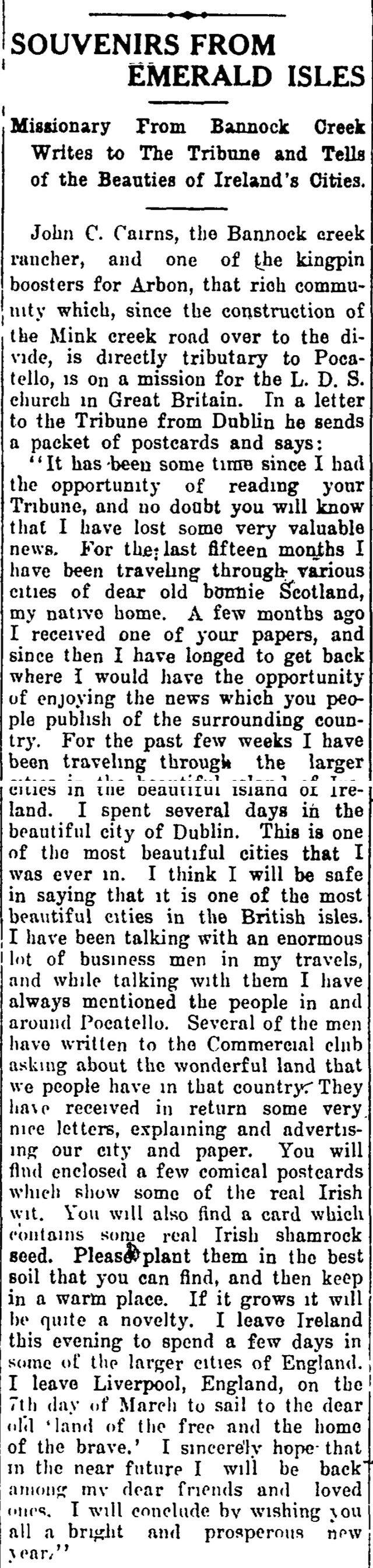
SOUVENIRS FROM EMERALD ISLES
Missionary From Bannock Creek Writes to The Tribune and Tells of the Beauties of Ireland’s Cities.
John C. Cairns, the Bannock creek rancher, and one of the kingpin boosters for Arbon, that rich community which, since the construction of the Mink creek road over to the divide, is directly tributary to Pocatello, is on a mission for the L. D. S. church in Great Britain. In a letter to the Tribune from Dublin he sends a packet of postcards and says:
“It has been some time since I had the opportunity of reading your Tribune, and no doubt you will know that I have lost some very valuable news. For the last fifteen months I have been traveling through various cities of dear old bonnie Scotland, my native home. A few months ago I received one of your papers, and since then I have longed to get back where I would have the opportunity of enjoying the news which you people publish of the surrounding country. For the past few weeks I have been traveling through the larger cities in the beautiful island of Ireland. I spent several days in the beautiful city of Dublin. This is one of the most beautiful cities that I was ever in. I think I will be safe in saying that it is one of the most beautiful cities in the British isles. I have been talking with an enormous lot of business men in my travels, and while talking with them I have always mentioned the people in and around Pocatello. Several of the men have written to the Commercial club asking about the wonderful land that we people have in that country. They have received in return some very nice letters, explaining and advertising our city and paper. You will find enclosed a few comical postcards which show some of the real Irish wit. You will also find a card which contains some real Irish shamrock seed. Please plant them in the best soil that you can find, and then keep in a warm place. If it grows it will be quite a novelty. I leave Ireland this evening to spend a few days in some of the larger cities of England. I leave Liverpool, England, on the 7th day of March to sail to the dear old ‘land of the free and the home of the brave.’ I sincerely hope that in the near future I will be back among my dear friends and loved ones. I will conclude by wishing you all a bright and prosperous new year.”
Sources
- Pocatello Tribune, March 7, 1912, page 6
- Semi-Weekly Pocatello Tribune, March 9, 1912, page 4
- Pocatello Tribune, March 20, 1912, page 5
- Pocatello Tribune, March 28, 1912, page 2
- Semi-Weekly Pocatello Tribune, April 3, 1912, page 7
- Deseret Evening News, April 11, 1912, page 5
- Pocatello Tribune, May 6, 1912, page 5
- Pocatello Tribune, July 15, 1910, page 1
- Pocatello Tribune, September 30, 1910, page 2
- American Falls Press, July 30, 1914, page 2