At the beginning of February 1916, the snow at Arbon, in what was still often called Bannock Valley, stood about three feet deep. The American Falls Press said in a headline that there had been "Nothing Like It for Quarter of Century," and its weekly valley columns followed the winter from the first storms of November to the thaw.
Arbon had been in Oneida County until 1913 and now belonged to Power County, whose county seat, American Falls, was the home of the Press.
Storms and mud
"The storms have been quite numerous here lately," the North Arbon column began on December 2, 1915. Wind and snow made it very disagreeable for the grain freighters, and in parts of the valley the roads were so muddy they were almost impassable for cars. The spring crops had failed that year, which made beardless barley scarce, and Frank Turner had sold a large amount of it. Several horses in the valley were sick with distemper and lung fever.
In early December, too, the valley was connected by long-distance telephone with American Falls, and people were soon calling friends and relatives there and in Pocatello.
The January storms
By mid-January the snow had come in earnest. On January 20 the column reported that Bannock Valley farmers were "satisfied with the abundance of snow that has fallen the past week," with a good depth everywhere and many deep drifts. The wind was another matter. Storms had blown some buildings down, among them Dan Roderick's barn, though there was no stock in it at the time. The new telephone line to American Falls had been down during the storms, "causing much inconvenience here."
Valley life went on where it could. A leap-year dance was held at the Pauline meeting house on a Friday evening early in January. "An enjoyable time was had by those present," the column said. But the storms kept out U. S. Ebner, who was leading a campaign against rabbits; he could not keep his Arbon and Crystal appointments "owing to storms and other unexpected conditions."
The column of January 27 told of worse weather:
Bannock valley is experiencing the worst storm they have had for many years and there is no sign of its abating. The snow has been wet the past few days making it very disagreeable. Some roads are impassable, the wind is blowing most of the time. The weather man must have had an accident as there were two days last week that the wind forgot to blow.
The advertised basket dance on Saturday night, January 22, was called off because of the storm. F. E. Jones left to spend the rest of the winter in Pocatello. "He says there is too much snow and wind here for him."
Three feet at Arbon
On February 3 the Press reported on its front page eighteen inches of snow at American Falls, about three feet at Rockland and Arbon, and three to four feet on the desert west of American Falls. At Rockland a forty-mile gale on Wednesday, February 2, had piled the snow and stopped traffic, and the Rockland mail had not come for two days. That night, it was reported, all the trains on the Short Line were stopped for a time. A Mr. Evans who came in from Arbon (his initials are garbled in the print; probably L. B. "Ren" Evans, who the next week's paper says was in town from the Arbon district) reported about three feet there, which he said was "more snow than for years."
The Central school's literary society met again on Tuesday, February 8, after what the column called "the long lapse between meetings on account of the storms."
The first vehicle out
That same Tuesday, G. M. Houck set out for Pocatello. The Press reported on February 10:
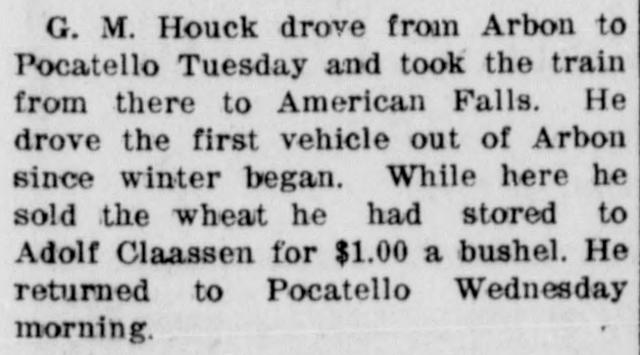
G. M. Houck drove from Arbon to Pocatello Tuesday and took the train from there to American Falls. He drove the first vehicle out of Arbon since winter began. While here he sold the wheat he had stored to Adolf Claassen for $1.00 a bushel. He returned to Pocatello Wednesday morning.
Claassen had a grain warehouse at American Falls. Houck was probably the George Houck who a month later was elected a director of the valley's telephone company. The paper did not say what it counted as a vehicle; Jones and Evans, at least, had already made it out, by means it did not record.
That week a chinook, a warm winter wind, brought a flood that washed out the Gish road about three miles east of American Falls. On Wednesday, February 9, S. W. Nulph of Arbon, coming to town, nearly lost his saddle horse there. It fell in crossing and could not get up on the ice. "Help fortunately, was near, however," the Press reported, "and the animal was saved."
The thaw
By February 24 the North Central Arbon column could say that the weather had "kind of moderated," with several pleasant days, and that school had reopened. Between Malad and Arbon the route was so blocked with snow that "the mail carrier had to change horses four times." There were sleighing parties on the moonlit nights. The column struck a hopeful note:
Something is surely going to happen as we have had no storms or wind for the past two weeks. The snow is gradually disappearing, all of which is going into the ground. More moisture—more wheat for the dry farmers.
Dry farmers grew wheat without irrigation, on moisture stored in the ground.
A severe storm of wind and snow struck on Sunday, March 12, and late in the month some roads were impassable on account of the water: "Many places in the main roads a horse can easily get down and drown." That month the column said that Alfred L. Ray, a teacher at the Central school, "made himself a pair of skis and went back and forth on them most of the winter." On April 6 the Press's Arbon News column reported the snow about all gone and several farmers busy in the fields. There were still strong winds and a flurry now and then, the writer added, "but we are quite used to it by now."
The next winter, 1916–17, hay ran short and deep snow killed stock in the Arbon and Rockland valleys. That story is told in the stock-killing winter of 1916–17.
The article as printed
American Falls Press, February 10, 1916, page 5. Transcribed from the page scan.
G. M. Houck drove from Arbon to Pocatello Tuesday and took the train from there to American Falls. He drove the first vehicle out of Arbon since winter began. While here he sold the wheat he had stored to Adolf Claassen for $1.00 a bushel. He returned to Pocatello Wednesday morning.
On this site: the Arbon area history, Pauline and West Fork, and L. B. "Ren" Evans.
Sources
- American Falls Press, December 2, 1915, page 3
- American Falls Press, December 9, 1915, page 1
- American Falls Press, January 20, 1916, page 1
- American Falls Press, January 20, 1916, page 5
- American Falls Press, January 27, 1916, page 4
- American Falls Press, February 3, 1916, page 1
- American Falls Press, February 10, 1916, page 1
- American Falls Press, February 10, 1916, page 4
- American Falls Press, February 10, 1916, page 5
- American Falls Press, February 24, 1916, page 8
- American Falls Press, March 16, 1916, page 7
- American Falls Press, March 30, 1916, page 7
- American Falls Press, April 6, 1916, page 3