Before Arbon Valley was wheat country, it was range for other men's cattle, horses and sheep. The newspapers caught that stockmen's valley only in glimpses, beginning with an old settler's 1915 memory of the winter of 1879–80, but taken in order they show the range giving way to farms. Bannock Valley, as it was then called, lay in Oneida County until Power County was created in 1913.
The winter of 1879–80
In early 1915 the American Falls Press was printing old settlers' stories. On February 4 it carried the recollections of W. T. Oliver, whom the same page calls Judge Oliver and places on the Shilling ranch, about nine miles north of American Falls, in those years. Under the heading "Hardest Winter We Ever Had" he set down the winter that killed most of the Oregon cattle wintering there.
In the fall of 1879, he wrote, stockmen were driving large herds of Oregon cattle to Granger, in Wyoming, the nearest shipping point. Four outfits whose cattle were poor stopped in the Snake River country to winter "on account of the splendid feed." Three, with permission from the Indian agent at Ross Fork, the Fort Hall agency, wintered on the Fort Hall reservation; one of them, with 4,000 head, built a dugout for winter quarters on Bannock Creek, about fifteen miles from American Falls, near where the Oregon Short Line crosses the creek.
The snow began in November and lay about two and a half feet deep. Then, Oliver wrote:
Early in January there was a thaw, followed by a sleet storm and freezing weather, forming so hard a crust on the snow that horses could not travel without being all cut up. It was not strong enough to sustain their weight, but was so hard that stock could not break through it to get at the feed buried beneath it.
In June 1880 the three outfits on the reservation began their roundup with fifty men. They found more dead cattle than live, he said, from Shoshone Falls to Idaho Falls and in the foothills and valleys along the river, and every small stream "filled with carcases." Near Arbon (Oliver used the name the place had by 1915), cattle lay dead where they had been snowed in on about half an acre. The number is lost in the scanned text. Of that ground he wrote:
The sage brush on this land had been six feet high, but it was eaten, clean as a floor, clear to the ground. Along the streams, willows up to two inches through, had been eaten clear to the roots.
Of the 12,000 head brought in, Oliver reckoned, only 4,000 survived the winter, and the survivors were driven to Granger and shipped. He wrote thirty-five years afterward, from memory; no report from that winter has yet been found to check his figures.
A stockmen's summer range, 1888
In 1888 the valley was still range. On May 22 the Salt Lake Herald printed a column of Malad news credited to the Malad Enterprise. Quite a number of people, it said, were leaving Malad Valley to locate ranches in Bannock Valley, "about twenty miles north and west of this city." It warned them what to expect:
Settlers in the Bannock are apt to meet with some difficulty at first because the valley is now occupied by stockmen as a cattle range and is in fact one of the best summer ranges in this whole region. No doubt the stockmen will make great efforts to keep settlers off but they will have to succumb to the inevitable at an early day.
It also suggested that they "be careful to keep off the Fort Hall Indian reservation." In 1906 the church historian Andrew Jenson wrote from Arbon that most of the valley had been reservation land, closed to settlement, until a few years before, though stockmen found it convenient for grazing in season.
The Malad column named no stockmen. The site's histories tell of the American Falls cattle firm of Sparks & Herman, whose Bull Canyon claims of 1885 are the earliest dated land claims in the valley's histories, and of a cattle outfit, probably theirs, that by family account built a cabin inside Donum Daniels's claim posts about this time. Whether they were among the column's stockmen is not known; who came first is a question of its own.
Roundups and sheep bands, 1903
By 1903 there were farms on the Arbon floor, but the stock had not gone. In 1919 the Press reprinted items from its first volume, when it was the American Falls Advertiser. The Arbon column of September 12, 1903, reported that "Two bands of sheep trailed through here recently," alongside news of a light second crop of lucern and the thresher starting work at T. B. Evans's ranch. The column of October 17 reported that the cattle roundup would start the next day, and that "Rock creek and Marsh valley men have been rounding up horses here the last week." Rock Creek, around Rockland, lies west of the valley, and Marsh Valley east, over the mountains. In November Walter Sparks was in the valley and bought some cows and two-year-old steers, and Jack Woodman was there on business for the Fall Creek Sheep company.
A trail around the farms, 1909
By 1909 sheepmen were looking for a way around the farms. On February 8 the Ogden Daily Standard reported that the Ogden wool growers had chosen A. G. Fell and Herman Kuchler to go to Pocatello and confer with the supervisor of the Portneuf forest reserve, in the mountains to the east, "with the view of securing trailing privileges over the reserve from the Bannock Valley eastward to Oneida." When the sheep moved from winter to summer range, the paper explained, the sheepmen wanted to cross the reserve "so as to obviate the necessity of passing through a farming district." The paper did not say which farming district it meant, and the answer they got has not been found.
Wheat
By late 1914 the change was plain. On November 26 the Press reported an Arbon farmer's estimate that Arbon and Crystal farmers had at least 46,000 acres seeded or ready for wheat, "two solid townships," and it looked back: "Six or seven years ago there was scarcely any grain grown there, the few settlers devoting themselves to stockgrowing." That was a broad stroke, since the paper's own Arbon column had a thresher at work in 1903, but it is how the change looked from American Falls.
The article as printed
American Falls Press, February 4, 1915, page 1. Transcribed from the page scan. Oliver's full article also tells of the death and burial of Chief Pocatello, of the Bear River Massacre of January 1863, which he calls the Battle Creek fight and in which United States soldiers killed several hundred Shoshone people, many of them women and children, and of the first Shoshone and Bannock farms on Bannock Creek. It is given here as printed in 1915, with the period's slurs and its one-sided telling of those killings; the words are Oliver's and the paper's, not this site's.
DEATH OF NOTED CHIEF POCATELLO
FINAL RESTING PLACE OF HERO OF BATTLE CREEK FIGHT, IN BIG SPRING NEAR MOUTH OF PORTNEUF.
First Farming Operations of Indians Began on Bannock Creek Above Railroad Crossing [illegible] Winter of 1879-80 Most Severe Since White Men Came to Snake River Valley.
(Recollections of W. T. Oliver)
The death of General Pocatello, the noted Shoshone chieftain, occurred in April, 1881.
While I was living on the Shilling ranch General Pocatello and his retinue came and camped near my house. He was a wanderer, and always accompanied by seven or eight families who brought all their horses and dogs. I was told that General Pocatello was very sick. At two o'clock in the morning about two days after they came we were awakened by the most unearthly sounds mortal man ever heard. This was kept up for two days and nights and ceased as suddenly as it began. They had finished mourning and were preparing to perform the last sad rites in honor of their noted chieftain. China Eye came to the house and I expressed a desire to witness the burial, and was invited by him to go along. One of General Pocatello's best horses was made to do the duties of hearse. A long pole was fastened to each side of the horse, the other end lying on the ground. On the litter the body of Pocatello was lain and secured and the funeral procession started. It went about two miles northward and stopped by a big spring on the banks of the Portneuf. The spring is about a mile up the Portneuf from Snake river, is located in Power county, and is about forty feet across. The cortege stopped by the spring and the body of Pocatello, wrapped in a blanket, was placed in the spring. It sank rapidly to the bottom, leading to the belief that it was weighted down with rocks. The hearse horse was then led [illegible] the spring and shot and its body rolled into the spring. This was continued until about ten horses had been killed and left with their former owner to provide him with horses in the happy hunting ground to which he had gone.
General Pocatello was a [illegible] Indian and could not become friendly to the whites. The probable reason for this was the dealing out by a party of emigrants, of summary justice to a band of Shoshones. It was about 1860 that a band of Indians were harrassing an immigrant train on the Truckee river in Nevada. The immigrants were too strong for the Indians and captured one of them. Fastening the tongues of three wagons together, so as to make a tripod, they hanged the captured Indian, who happened to be Pocatello's father. Whatever Pocatello's conduct up to that time had been, he at once became an implacable foe of the whites. The Battle Creek fight, in Franklin county, when all but four of Pocatello's band were slain, was a direct result of his continued harrassing of settlers and immigrants.
The settlement of Franklin was made in 1860. There were quite a number of families there, and Pocatello's band was a continual menace to them. They finally appealed to General Conor at Fort Douglass for protection. Without waiting for authority from Washington, Connor left Ft. Douglass with three companies of soldiers, to put a quietus to Pocatello's depredations. It is said that on the way he issued orders to spare none, neither warriors, squaws or papooses. They found the Indians camped about five miles north of Preston, on a small creek since called Battle Creek. The soldiers had the advantage of position, the Indians being in a ravine with soldiers on three sides of them and Bear river running full of ice, on the other side, effectually preventing retreat. The battle was fought either in December or January, 1863. When it was over General Connor thought the entire band had been wiped out. Four escaped, however, among the number being General Pocatello and China Eye. China Eye later said they had escaped by getting into the river and hanging to the willows overhanging the water, and working their way down stream to safety. The water was quite swift at that place and at that time running full of ice. China Eye said this fight made a "good Indian" of him.
W. A. Bennett, postmaster here for many years, who died about five years ago, was one of General Connor's men. All I knew of this battle was what he and China Eye who later became my best Indian friend, have told me. An incident during the fight, as related by Mr. Bennett, was the shooting of a squaw and papoose by a soldier. The squaw was advancing towards the soldiers with both hands up. A soldier had his gun pointed at her. "Don't shoot that woman, let her come [illegible] here," shouted the General, but too late to stop the speeding bullet. The soldier justified himself by saying "We had orders to kill everything." The morning after the fight it was 23 degrees below zero. Three wagon loads of dead soldiers were gathered up, frozen stiff and loaded in wagons like cordwood. Mr. Bennett's feet were quite badly frozen and he rode in the back of one of the wagons with his dead comrades all the way back to Salt Lake.
General Pocatello was always dressed in a Colonel's uniform, cast off by some of the officers at Ross Fork, and wore a fine sword at his side which had been given him by the officers. He was very proud of his uniform and wore it all the time. By reason of this he was called General. He was buried in this uniform and the sword with him. He was a great character and gave Pocatello its name. The enterprising citizens of Pocatello could do nothing more appropriate than to erect a monument to his memory at the spring where his bones lie.
Pocatello was succeeded as chief by Gibson Jack, a well educated Indian, who could converse intelligently on almost any subject, and a friend of the whites. The [illegible] gave no trouble to the settlers under his leadership.
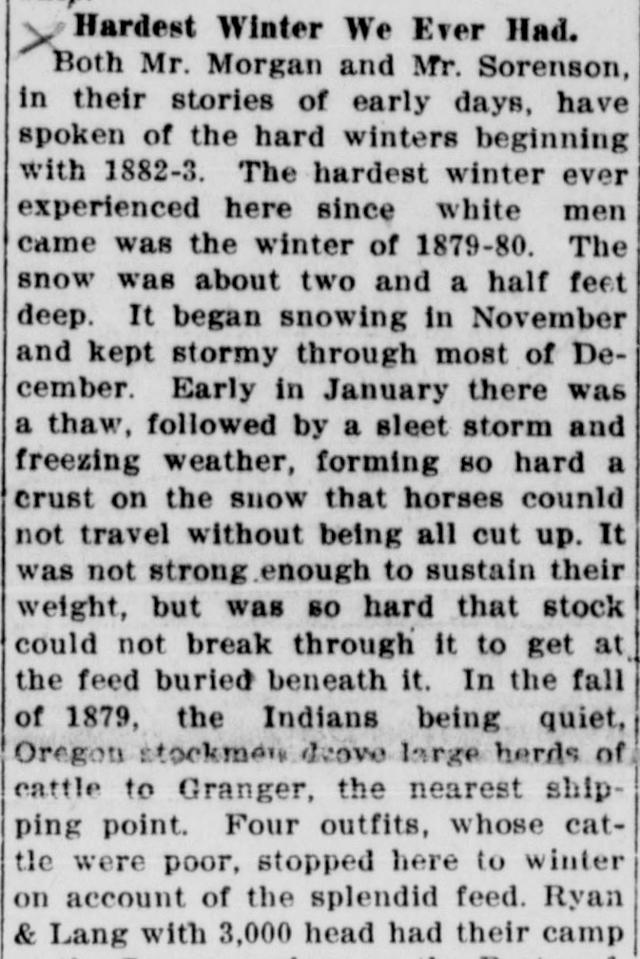
Hardest Winter We Ever Had.
Both Mr. Morgan and Mr. Sorenson, in their stories of early days, have spoken of the hard winters beginning with 1882-3. The hardest winter ever experienced here since white men came was the winter of 1879-80. The snow was about two and a half feet deep. It began snowing in November and kept stormy through most of December. Early in January there was a thaw, followed by a sleet storm and freezing weather, forming so hard a crust on the snow that horses counld not travel without being all cut up. It was not strong enough to sustain their weight, but was so hard that stock could not break through it to get at the feed buried beneath it. In the fall of 1879, the Indians being quiet, Oregon stockmen drove large herds of cattle to Granger, the nearest shipping point. Four outfits, whose cattle were poor, stopped here to winter on account of the splendid feed. Ryan & Lang with 3,000 head had their camp at the Swanson place on the Portneuf, [illegible] of Pocatello. [illegible], with 4,000 head of cattle, built a dugout for winter quarters on Bannock Creek, [illegible] of the Oregon Short Line [illegible] about fifteen miles [illegible] of American Falls. [illegible] Bros., with 4,000 head, wintered at old Fort Hall. The men used the officers quarters and [illegible] barracks. These outfits [illegible] permission from Major Danielson, Indian agent at Ross Fork, [illegible]. C. H. Beemer, with [illegible], stopped at Warm creek and built the house [illegible] was living in at [illegible] tragic death. There was no hay to be had at any [illegible] Beemer lost all of his cattle, [illegible] packed his worldly possessions on saddle horses and [illegible] The winter lasted [illegible] March, [illegible] found 25 head [illegible]
In June, 1880 the three outfits that camped on the reservation, with fifty men, began their round-up. They found cattle more dead ones than live—all the way from Shoshone Falls to Idaho Falls, and in the foothills and valleys all along the river. Every small stream was filled with carcases. Near Arbon, we [illegible] dead, which had been snowed in on about a half acre. The sage brush on this land had been six feet high, but it was eaten, clean as a floor, clear to the ground. Along the streams, willows up to two inches through, had been eaten clear to the roots. Of the 12,000 head brought in, only 4,000 had survived the winter. I have seen 300 dead cattle in a distance of four blocks. The cattle were driven to Granger and shipped and Mr. Shilling who had the store at Ross Fork, got about all the money. The men in charge had unlimited credit, and lived high. They had no idea that any large number of their cattle were dying.
First Indian Settlement
Association with the cowboys in charge of these outfits, gave the Indians their first idea of settling on lands and making permanent homes. They were all wanderers aside from a very few who hung around the agency at Ross Fork, attracted by the activity there. Mosho, for whom Michaud siding was named, Pocatello Tom, Pocatello John, China Eye and Big Lipped George settled on Bannock Creek, just above the railroad crossing in 1881, and broke the first ground there that year. They planted a few potatoes and a few acres of wheat. A boss farmer was appointed to instruct them. The Indians would cut poles in the [illegible] and build fences, and in the winter use the fences for wood. The boss farmer had hard work to stop this practice and succeeded in doing so only by threatening to put the Indians in jail if they did not quit.
The Indians sold wheat, delivered to American Falls, or anywhere near, for [illegible] cents a sack. If anyone went after the wheat the price was one dollar a sack. Asked the reason for this they said: "You come to my wickiup you [illegible] maybe so you don't want 'em at all."
On this site: the Daniels family, cattlemen at West Fork; the Summit area history, on cattlemen and sheepmen there; and the stock-killing winter of 1916–17.
Sources
- Salt Lake Herald, May 22, 1888, page 2
- Deseret Evening News, July 14, 1906, page 8
- Ogden Daily Standard, February 8, 1909, page 3
- American Falls Press, November 26, 1914, page 1
- American Falls Press, February 4, 1915, page 1
- American Falls Press, September 19, 1919, page 3
- American Falls Press, October 17, 1919, page 3
- American Falls Press, November 7, 1919, page 6