A year after the drought of 1919, the rain came back to Arbon Valley, and the talk on the dry farms turned from whether there would be a crop to what it would fetch. By the middle of June 1920 the valley’s growers had their answer, or thought they did. They had promised most of the coming harvest to a new cooperative, the Oregon, Washington and Idaho Wheat Growers Association, which would market their grain together in one pool rather than leave each farmer to sell alone.
The American Falls Press, the newspaper of Power County, carried the valley’s part in the venture from that hopeful spring into a bitter winter. Arbon had been in Oneida County until 1913.
A million-dollar rain
Late in May a soaking Sunday rain fell, and the Press thought it came close to “a million dollar rain.” Its writer was nearly lyrical:
The Arbon and Rockland valleys are beautiful beyond description. An even stand of grain decorates the valleys with a waving coat of green. General conversation now centers on the price of grain rather than the prospects entertained for a crop failure.
From Arbon the local correspondent sent word that “there is more water this year than the ditch will hold.” On June 18 the paper’s front page named Arbon Valley as the only part of the county with no shortage of moisture, and it counted on 25 bushels an acre there even should the summer turn dry.
Signing up
Price, then, was the trouble, and the association promised to fix it: a member put his wheat under contract and one organization did the selling. Its state organizer was J. T. Fisher, who headed the Rockland State Bank. Bruce Lampson, the county agent, had spent several days in Arbon in May working on its behalf.
The June 18 front page carried Fisher’s tally. Some 400,000 bushels were under contract in the county, and he had particular praise for Arbon: of the 200,000 bushels the valley was expected to raise in 1920, 161,000 had been pledged, “practically 80 per cent.” Roy, by his count, had signed up 90 per cent.
The next week’s Arbon column gave the names of the local committee that had been “securing many signers”: W. E. Dawson, W. A. Nunnelley and Wm Allard. Dawson lived at Pauline. Nunnelley was most likely Walter A. Nunnelley, of the Summit homestead family. William Allard had taken up a homestead on Knox Canyon Road in 1909 and had served in the Idaho House in 1915 and again in 1919–20, a record taken up in the story of the first legislator from the valley.
In July Allard traveled to Spokane to talk with the association’s officers “for the interests of the Arbon farmers,” and he returned having sat down with its directors “as one of the representatives of Power County.” By August 6 the Press could report that the association was ready to trade. Lampson was giving up his county job to organize for it, contracts covering 325,000 bushels had been accepted, and “Platforms will be built immediately at Arbon and Roy.” No page read for this story says whether Arbon ever got its platform. The valley’s pool wheat went instead to the association’s platform at Michaud.
Harvest in the rain
The same August 6 issue noted new combines at work in the valley and J. E. Keeler cutting volunteer wheat, with the correspondent’s forecast: “It appears it will be a rainy harvest.” A week later the column, calling the place by its old name, showed how right that had been:
Bannock Valley has been visited the past week with quite a number of heavy rains, delaying the harvesting for about a half a day at a time nearly every day. Thursday we had quite an electrical storm, tearing down the telephone line in a few places. No serious damage has been reported. Due to the rains and the breaking of combine parts, the farmers are kept pretty busy these days trying to get their grain cut and making trips to Pocatello for extras.
Even so, yields ran 18 to 20 bushels an acre, and better in some fields.
On Monday, August 16, two cars left for Galveston, Texas, the opening shipment on a 40,000-bushel export order, sold at $2.42 a bushel at American Falls. The association advanced its members $1.80 a bushel, and the paper told of a Malad farmer who had been paid just $1.76 and now wanted in. The record does not say if any of that first shipment was Arbon grain. By the middle of September Charles Palmer had come out from Pocatello with a big truck and was “extra busy hauling grain to the Association platform at Michaud.” On September 14 the wheat market at Chicago broke hard.
Snow on the stacks
Thanksgiving Day brought a blizzard. On December 3 the Arbon column had trucks running to Michaud again on frozen roads, with a good deal of grain still waiting for the thresher: “The steam thresher works when the weather permits, which is not very often these days.” The following week the Burnside Brothers of Pocatello brought their big trucks in for “hauling the Association Grain,” and on December 17 came the short report, “Threshing is delayed again.”
Allard sat in on the directors’ monthly meeting at American Falls on December 2. Turkey Red wheat was bringing $1.90 a hundredweight on the local market, roughly $1.14 for a 60-pound bushel, and the Press counted that as twenty cents better than the low point of the year. In January a grain dealer in town asked families to buy their flour by the barrel and so help farmers who had been taking “less than the cost of production.” By March the county agent was reporting a great deal of Power County ground prepared since fall and still not seeded, since farmers could not afford seed. “They had no money,” he said. Into early May, trucks were still carrying “the balance of the Wheat Growers Association grain to Michaud” out of the valley.
The board changes
The pooling idea had not lost its hold. On May 16, 1921, Allard, Keeler and B. D. Lindley of Arbon were in Pocatello when a touring committee of the U.S. Grain Growers met with southeastern Idaho farmers, and by the Press’s count just two votes were cast there against compulsory pooling of every bushel. That week the front page ran Allard’s picture beside those of H. D. G. Cox of Roy and Fisher, now a state senator, under the line “These Men Are Doing Their Bit.”
A month later, at the June 25 annual meeting of the renamed Southern Idaho Wheatgrowers Association, a new board took over. “Retiring members of the board are Wm. Allard of Arbon and H. D. G. Cox of Roy,” the paper reported, without giving a reason.
How much the pooled Arbon wheat of 1920 finally paid, the pages read for this story do not tell. What came next is clearer. In the foreclosures of 1920–1925, farmers who had borrowed against their homesteads while prices were high could not meet the notes. In 1933 Allard chaired the committee that founded the Arbon Valley Grange.
The original article
American Falls Press, June 18, 1920, page 1. Transcribed from the page scan.
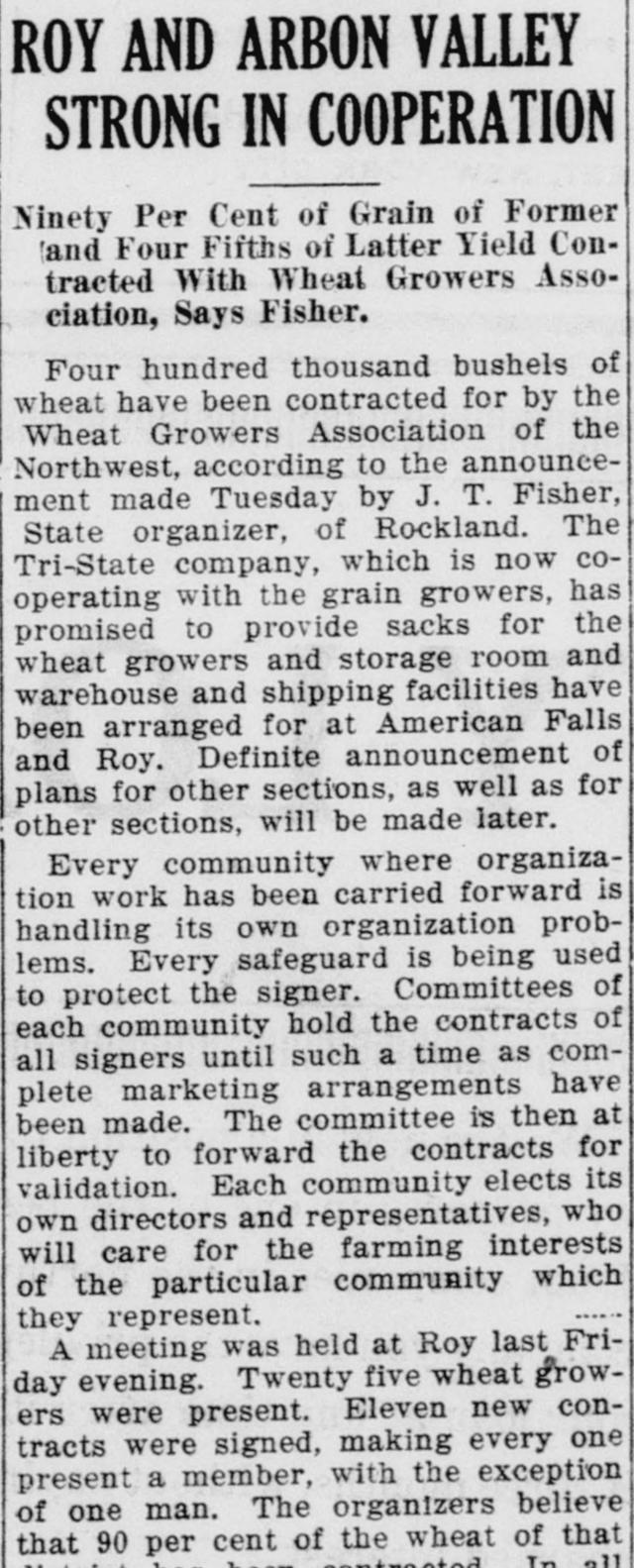
ROY AND ARBON VALLEY STRONG IN COOPERATION
Ninety Per Cent of Grain of Former and Four Fifths of Latter Yield Contracted With Wheat Growers Association, Says Fisher.
Four hundred thousand bushels of wheat have been contracted for by the Wheat Growers Association of the Northwest, according to the announcement made Tuesday by J. T. Fisher, State organizer, of Rockland. The Tri-State company, which is now cooperating with the grain growers, has promised to provide sacks for the wheat growers and storage room and warehouse and shipping facilities have been arranged for at American Falls and Roy. Definite announcement of plans for other sections, as well as for other sections, will be made later.
Every community where organization work has been carried forward is handling its own organization problems. Every safeguard is being used to protect the signer. Committees of each community hold the contracts of all signers until such a time as complete marketing arrangements have been made. The committee is then at liberty to forward the contracts for validation. Each community elects its own directors and representatives, who will care for the farming interests of the particular community which they represent.
A meeting was held at Roy last Friday evening. Twenty five wheat growers were present. Eleven new contracts were signed, making every one present a member, with the exception of one man. The organizers believe that 90 per cent of the wheat of that district has been contracted. In all their total is 154,000 bushels, based on the 1918 crop.
The members of the Association have decided to build a platform at Roy, where their wheat will be stored. By making a small assessment and spreading the cost over a six year period they expect to keep the cost of their platform below one per cent of the price received for their wheat.
Arbon Valley has gone strong for the Wheat Growers Association, according to Mr. Fisher. Out of an estimated yield of 200,000 bushels in 1920, the Wheat Growers have been promised 161,000 bushel. This is practically 80 per cent of the total production of the valley. The canvass of Arbon Valley is by no means complete, and it is expected that several others now on the outside will come into the organization as soon as they investigate its merits more thoroughly.
“As far as we have gone, we are meeting with far greater success in our work than I had hoped for,” said Mr. Fisher Tuesday. “I believe the next thirty days will place Power County on the map as the most closely organized co-operative county in the United States, and that will mean advertising in a way and on a scale that it could not have in any other way.”
Sources
- American Falls Press, May 28, 1920, page 2
- American Falls Press, May 28, 1920, page 4
- American Falls Press, June 18, 1920, page 1
- American Falls Press, June 25, 1920, page 6
- American Falls Press, July 2, 1920, page 1
- American Falls Press, July 16, 1920, page 3
- American Falls Press, July 23, 1920, page 9
- American Falls Press, August 6, 1920, page 1
- American Falls Press, August 6, 1920, page 2
- American Falls Press, August 13, 1920, page 8
- American Falls Press, August 20, 1920, page 1
- American Falls Press, September 17, 1920, page 1
- American Falls Press, September 17, 1920, page 2
- American Falls Press, December 3, 1920, page 1
- American Falls Press, December 3, 1920, page 2
- American Falls Press, December 10, 1920, page 7
- American Falls Press, December 17, 1920, page 4
- American Falls Press, January 7, 1921, page 5
- American Falls Press, March 18, 1921, page 1
- American Falls Press, May 6, 1921, page 2
- American Falls Press, May 20, 1921, page 1
- American Falls Press, May 27, 1921, page 2
- American Falls Press, July 1, 1921, page 1