Plenty of people had stood on top of Bannock Peak by the summer of 1911. Hardly anyone had driven all the way around it between sunup and dark. On Sunday, July 16, four men from American Falls set out to do just that, and by evening their automobile had logged 127 miles, out by Rockland and Holbrook and back north through the Arbon country.
The American Falls Press put the trip on its front page four days later, with two photographs of the valley. The peak it circled is the tallest of the mountains looking down on the valley, as the site’s page on Joseph Arbon puts it, and the paper called it “the sentinel” for travelers “across the plains since the days of the overland trail.” Just two weeks before, the Press had written up a party from Aberdeen and American Falls who camped at its foot and climbed it.
Out before breakfast
The automobile was D. W. Davis’s, and he was very likely the man who headed the First National Bank of American Falls. Riding with him were Arthur W. Davis; O. H. Barber, who managed the Press; and one more man whose name is lost where the scan’s text breaks down. Nothing ties either Davis to the Davis family of Arbon. Theirs was not the first motor car in the valley, either; the Firsts page finds the earliest one on record at the close of 1910.
They pulled out at six in the morning and rolled home at a quarter to eight that night. Ten miles out they spotted Martin Garn, a bachelor, up on his roof, “possibly trying to figure how long it was until church time.” Rockland was still asleep, “before breakfast time—for Rockland people,” except for T. J. Lawson and L. W. Cotant out enjoying the morning air. The Holbrook road suited wagons but rode too high in the middle for an auto, and the paper asked that “some one please have it fixed.”
Three hours and thirty-eight miles from home they reached A. B. Reece’s, “the first place across the divide from Landing,” and spent fifty minutes there photographing and patching a flat tire. Past his place the car broke in three miles of brand-new road, the first vehicle ever to cross it, and a little more than thirteen miles on came Holbrook.
Lunch on a well trough
Here the text of the page scan turns to a jumble, and whatever road the party took after Holbrook drops out of the story. When it comes clear again, the men seem to have come into the Arbon country from the south, and they are eating:
The table was set on the water trough of a new well 350 feet deep, and an elegant spread consisting of 4 cans of sardines, twelve egg sandwiches, a can of peaches and a dozen oranges and forty cents worth of cake taken care of in record time.
Over the next two hours they turned down four more offers of dinner. “Funny how one’s appetite fails when traveling,” the writer remarked.
While they were packing up, a Mrs. Walker stopped to ask if they lacked anything. Only a road headed their way, they told her, and she led them out to the main one. A mile farther on were the Walker brothers, nailing shingles on a house. They had dropped their almanac down a well and supposed it was somewhere near midweek. It was Sunday. The Walkers had hauled a traction engine and gang plows into the valley, and their blacksmith shop was “much appreciated by their neighbors.” The paper printed no first names, so there is no telling which Walkers they were. Two pictures were made at their places.
The party called next at the home of W. A. Nunnelly, most likely Walter Albert Nunnelley of Summit, and found him gone to Malad. “During his absence another picture was added.” The family remembers that in their hard first winter, Joe Arbon had carried hay out to the Nunnelleys and Ed Davis had brought them groceries.
Calling on the pioneers
Then the car swung due north, past one good field after another. The paper singled out the crop of E. H. Davis as “particularly good,” and his page tells more of that farm. The men stopped briefly with Joseph Arbon, “the pioneer of the valley,” who had lived there “near fifteen years” and had seen more change in the last two than in all the years before. That was most likely Joe, George Arbon’s son, and fifteen years back would put him in the valley around 1896, close to what the family tells of its first winters there.
John Payne, George Arbon’s son-in-law, was next, “the pioneer store keeper and hotel man.” He had 320 acres, nearly all of it broken, with water for some forty, and he guessed the valley would send out 150,000 to 200,000 bushels of grain that fall. Calling him a hotel man supports the Firsts page, which has a hotel in the valley by March 1911 and thinks it likely the Paynes ran it.
The men stopped at the schoolhouse just long enough for a photograph, then visited a few minutes with Tom (T. B.) Evans, “said to have more land in cultivation than any other man in the valley.” His page has more about that place. Leaving the valley, they kept to the Pocatello road until they met the pole line, then made quick work of the run home.
“The Arbon country was the most beautiful of any seen on the trip,” the Press concluded, and it had grown as fast as any section they saw. Farmers there were eager for the newly surveyed road to American Falls, which would cut the distance to market. “The marketing of their grain is a growing problem.”
A million bushels
Alongside the trip, the front page sized up the harvest ahead. Four newcomers, G. S. Butler, John Butler, G. W. Allard and Mr. Keeler, looked to sell 25,000 bushels of wheat between them. Three years before, “when the valley contained about forty families,” the entire crop had been put at 45,000 bushels; guesses for 1911 reached 200,000. Give it a little more time, the paper said, and the Arbon country would be “capable of marketing a million bushels.”
The two photographs on the page were probably made that Sunday. Their captions read “View in the Arbon Country, From T. B. Evans’ Place” and “Dry Farm Grain Field in the Arbon Country.” None of the others has surfaced in the later 1911 issues searched for this post.
More than half a century on, the peak still drew the family the party had stopped to see. In the summer of 1965, Joe Arbon marked his coming ninetieth birthday by riding a horse to the top of it.
The original article
American Falls Press, July 20, 1911, page 1. Transcribed from the text of the page scan; passages the scan’s text does not show clearly are marked [illegible].
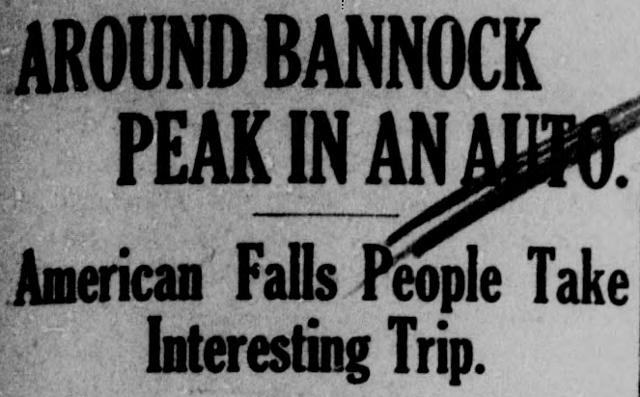
AROUND BANNOCK PEAK IN AN AUTO.
American Falls People Take Interesting Trip.
One Hundred and Twenty Seven Miles Through Fine Grain Fields—New [illegible] is Extensive and General.
A good many people have climbed Bannock peak, the sentinel for [illegible] across the plains since the days of the overland trail, but few have gone around it in a single day. This feat was accomplished Sunday by D. W. Davis, Arthur W. Davis, [illegible] and O. H. Barber. The trip was made in D. W. Davis’ automobile and the distance recorded was exactly 127 miles. This included some meandering over the Arbon country and a little added distance on the road home from Arbon, because all roads do not lead to Rome, or American Falls. The start was made at 6 a. m. and the party returned at 7:45 p. m., thirteen and three fourths hours. At a number of places stops were made some voluntary and some otherwise, a number of pictures were taken and calls on a few friends made.
The first scene of interest was the home of Martin Garn, about ten miles out. Mr. Garn was taking astronomical observations from the roof of his home, possibly trying to figure how long it was until church time. Being a bachelor he has no substitute for an alarm clock and has to depend upon his own resources to get up in the morning.
The party passed through Rockland before breakfast time—for Rockland people—if not before their getting up time. T. J. Lawson and L. W. Cotant, probably having forgotten to go to bed at all, were up reveling in the morning air, and constituted the only visible signs of life seen there.
The next stop made was on the Holbrook road, about opposite Daniel Reinman’s place where the party worked out their road tax and took notes for the benifit of the road overseer. The road is very good for wagons, but is too high in the center for automobiles, and will some one please have it fixed.
Just three hours from home, and exactly thirty eight miles distant, the party stopped at the home of A. B. Reece, the first place across the divide from Landing. Fifty minutes were used to good advantage here in taking pictures and repairing a puncture. Mr. Reece located here two years ago and has a splendid piece of land and some fine grain and an excellent garden. He has three varieties of early maturing potatoes growing. Potatoes from his place were exhibited at the fair at Garland, Utah last fall and took the sweepstakes. He has a fine place for stock raising, with a good water supply provided by a number of springs, and an excellent range provided by the mountains. It is his intention to engage in the stock business. He is from Minnesota and a hustler. The altitude at his place must be considerably in excess of 5,000 feet, and the crops he is growing is a splendid recommendation for the character of the soil.
Leaving his place the party traveled three miles of new road, taking the first vehicle over it. While the road can be made good there is at the present plenty of room for improvement. But for lack of time a little more road tax would have been worked out here. The grades are not bad but there are more rock than are required for a good foundation and plenty of sagebrush.
Thirteen and three tenth miles beyond Mr. Reece’s Place is Holbrook a beautiful and thrifty appearing community. Grain here is a week farther advanced than at any other point on the trip and while [illegible] the starting point, the party headed a [illegible] to take dinner with the gentlemen.
The table was set on the water trough of a new well 350 feet deep, and an elegant spread consisting of 4 cans of sardines, twelve egg sandwiches, a can of peaches and a dozen oranges and forty cents worth of cake taken care of in record time. It was only a light repast, yet the gentlemen felt called upon to politely decline invitations to stop and have dinner four times within the next two hours. Funny how one’s appetite fails when traveling. Just as the dishes were being washed and put away Mrs. Walker came up and inquired if there was anything the party wanted that they had not succeeded in finding. She was told that road leading in the direction they wished to travel was the only thing and piloted the party to the main road. They were not lost but the road they were following showed a persistent tendency to go in the wrong direction all the time. Out on the main road, about a mile distant the Walker brothers were found. They had lost their almanac and were shingling a house, confident in the belief that the day was along about the middle of the week. They explained that there was not much need for an almanac in a new country, and they had carelessly dropped theirs in the bottom of a well, and Sunday came whenever the weather was too bad to work. The Walkers came into the valley [illegible] bringing a traction engine and gang plows, and have torn up a considerable part of the earth’s surface in their neighborhood. They operate a blacksmith shop, which is a convenience much appreciated by their neighbors. Two pictures were taken at the Walker places.
The next stop was made at the home of W. A. Nunnelly, but before arriving there several fields of fine grain were passed. Fortunately for himself, Mr. Nunnelly was in Malad. During his absence another picture was added. From here the road due north was taken, past numerous fine fields. That of E. H. Davis was particularly good. A short call was made on Joseph Arbon, the pioneer of the valley, who has been a resident of that beauty spot for near fifteen years. He has seen greater changes during the last two years however, than in all the others that have gone before.
The next stop was at the home of John Payne, the pioneer store keeper and hotel man. Mr. Payne has 320 acres of fine land, nearly all of which is in cultivation, and he has water for about forty acres of it, making it one of the best places in the valley. Mr. Payne estimated the amount of grain that would be hauled out of the valley this fall at from 150,000 to 200,000 bushels. Three years ago the total yield was estimated at 45,000 bushels. This shows what progress has taken place.
A stop was taken at the school house long enough to take a picture of it. A call of a few minutes was made at the home of Tom Evans, who is said to have more land in cultivation than any other man in the valley. He has been in the valley several years and has his land well improved. His estimate of the grain [illegible] storehouse of information, pointing [illegible] a large number of people [illegible] filled.
Marshal Johnson who had ridden [illegible] land to see when his grain [illegible] ready to harvest, was seen near home. [illegible] G. S. and John Butler, [illegible] Allard and Mr. Keeler will harvest 25,000 bushels of grain. Inasmuch as these are all new settlers it denotes great progress.
After leaving the valley the run home was made in good time the road to Pocatello being followed until the pole line was reached. The Arbon country was the most beautiful of any seen on the trip, and the development there was fully as great as that of any other section. The [illegible] there are very much interested in the new road that has been surveyed to American Falls, as it will shorten their haul to market [illegible] them a good grade at the same time. The marketing of their grain is a growing problem.