In the homestead years the American Falls Press reported at least twice on potatoes from the Arbon country of Bannock Valley. The first report, in December 1909, was about a sample grown without irrigation and brought to town. The second, in November 1912, told how one homesteader grew vegetables the old-timers had said would not mature, and won over his own doubting father from Kansas. Arbon was still in Oneida County then; Power County was created in 1913.
A pound apiece
On December 4, 1909, the Press ran a short front-page item headed "Dry Land Potatoes." Dry-land farming meant raising crops on rainfall alone, without irrigation. The item began:
A sample of dry land potatoes, as fine as any exhibited here Farmers Day, were brought down from Arbon the first of the week. ... The potatoes average about a pound in weight, are smooth and shapely, and of a quality to tempt the highest market price.
Farmers' Day was the exhibit of the season's best farm products that American Falls held that fall. The Press had announced it for September 30, 1909, with T. B. Evans of Arbon among its vice-presidents. The potatoes had been planted in June, six miles from the Arbon post office, which then stood at postmaster J. R. Bailey's house, by today's Bailey Road (see the Bailey family).
The item calls the grower Francis, but his surname is uncertain: the digitized text of the page gives it two different ways in the same item. He was probably Francis F. Binggeli. A Francis F. Binggeli, 28, was counted with his wife, Gertrude, in the Arbon precinct in the 1910 census. In 1916 Francis F. Binggeli Jr. received the patent to a homestead about six miles due south of the Bailey post office, the distance the Press gave. No later report of his potatoes has been found.
The paper used his sample to make a prediction: "Potato growing without irrigation is destined to assume vast proportions within the next few years." It claimed that dry-land potatoes were of better quality than irrigated ones and that growing them could be more productive than grain. It closed with news of the valley itself. The settlement near Arbon, it said, "has about doubled during the past year," and open homestead land was drawing "a steady increase of immigrants." Three weeks later the Press reported four young men from La Crosse, Washington, who had found land that suited them in the Arbon country and each filed on a quarter-section, the usual 160-acre homestead.
The gardener on Bannock Creek
George Stahl Butler was one of the newcomers of those years. He was the eldest of the Butler brothers from Americus, Kansas, cousins of Frank Swim, whose family's story is told in the Swim family history. On November 21, 1908, the Press printed his homestead filing on the northeast quarter of Section 26, Township 10 South, Range 33 East. The land lies on upper Bannock Creek, about three miles south of present-day Pauline.
The Butlers also raised wheat. In July 1911 the Press reported that two Butlers, G. W. Allard and Mr. Keeler, all new settlers, would have 25,000 bushels of wheat between them to market that fall, by their neighbors' estimates. The Butler fields, it added, were good but "not considered quite as good as those of Allard or Keeler." That spring, by a later account, the valley's first Protestant Sunday school had been organized in George Butler's home (the first Protestant Sunday school).
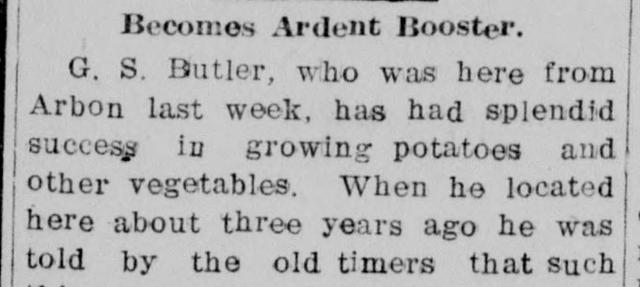
On November 21, 1912, under the heading "Becomes Ardent Booster," the Press turned to his garden:
G. S. Butler, who was here from Arbon last week, has had splendid success in growing potatoes and other vegetables. When he located here about three years ago he was told by the old timers that such things would not mature and now he is supplying many of them with their needs in this line.
The paper explained that because of the altitude where he lived, "ice forms nearly every month of the year," yet the cold did not seem to hold his plants back. It did not name the old-timers.
Then the item turned to Butler's father, whose home was in Kansas. On his first visit, soon after his son settled, the father scolded him for choosing such a place, "predicting he would meet with failure." The Press went on:
The next year the father made another visit, and after seeing what was produced, modified his opinion somewhat, but still was only half convinced. The next season he came out again and his conversion was complete.
Butler, the paper ended, was now living at Arbon and was one of the place's most enthusiastic boosters.
What the records add
The dates do not quite line up. Butler's filing was printed in November 1908, but four years later the Press said he had come "about three years ago." He may have filed in the fall of 1908 and moved onto the land in 1909. The paper gives no years for his father's three visits.
The family records on this site show that the father was John Lucas Butler of Americus, a Civil War veteran. They also show that a John L. Butler, probably the same man, received the patent to the quarter-section just north of George's claim in November 1913. If so, the father who had predicted failure took up a homestead on upper Bannock Creek himself. George Butler did not stay at Arbon. By about 1914 or 1915 he had moved to a dry farm north-west of American Falls.
The article as printed
American Falls Press, November 21, 1912, page 1. Transcribed from the page scan.
Becomes Ardent Booster.
G. S. Butler, who was here from Arbon last week, has had splendid success in growing potatoes and other vegetables. When he located here about three years ago he was told by the old timers that such things would not mature and now he is supplying many of them with their needs in this line. Although on account of the altitude in his locality, ice forms nearly every month of the year, the cold does not appear to injure or retard growth of vegetation. When he first located there he was visited by his father, whose home was in Kansas. The father chided Mr. Butler for locating in such a place, predicting he would meet with failure. The next year the father made another visit, and after seeing what was produced, modified his opinion somewhat, but still was only half convinced. The next season he came out again and his conversion was complete. He is now living at Arbon and is one of the most enthusiastic boosters of that promising locality.
On this site: the Swim family history, which includes the Butlers and their homesteads; Pauline and West Fork; and the first Protestant Sunday school.
Sources
- American Falls Press, November 21, 1908, page 1
- American Falls Press, September 4, 1909, page 1
- American Falls Press, December 4, 1909, page 1
- American Falls Press, December 25, 1909, page 1
- American Falls Press, July 20, 1911, page 1
- American Falls Press, November 21, 1912, page 1
- American Falls Press, March 29, 1917, page 7
- 1910 U.S. census, Oneida County, Idaho, Arbon precinct, images n91–n101 (household of Francis F. and Gertrude L. Binggeli)
- Homestead patent to John L. Butler, November 29, 1913 (IDBL 0011398)
- Homestead patent to Francis F. Binggeli Jr., April 8, 1916 (IDBL 0006163)