In the fall of 1908 Arbon Valley had about fifty families, a store, two schools and a great deal of empty land. Its settlers wanted neighbors, and they found a newspaper willing to help them look. For nine months, beginning that November, the American Falls Press, about thirty miles away, put the valley on its front page again and again: first in interviews and news of the government’s township plats, then, from January on, in photographs.
The valley then lay in Oneida County. Power County was not created until 1913.
A surprise for the visitors
When Mrs. E. A. Logan wrote the valley’s first history for the Press in 1917, she traced the campaign to a 1908 visit by John L. McKown and O. H. Barber, the paper’s editor. The two were surprised at how much land at Arbon was still open to homestead entry. The settlers asked them for help and promised in turn to answer every letter that came. “Pictures of farming scenes in the valley were printed, yields and the names of farmers given to substantiate them,” she recalled.
The papers of 1908 bear her out, though only McKown’s name appears in them. On November 7 the Press gave his judgment that for dry farming the valley beat anything he had seen in southern Idaho. The figures came from Julius Abter, who ran a threshing machine there: some 45,000 bushels of wheat that season, at an average of 25 to the acre. Abter’s brother Joe had already come out from McFarland, Kansas, to join the settlement.
The next Saturday, November 14, the headline read “Arbon Valley, Homeseekers’ Paradise.” J. R. Bailey, Arbon’s postmaster and one of its pioneer farmers, was in American Falls that Tuesday and told the paper the valley had room for hundreds of families more. At its lower end, he said, lay about a township and a half without one settler on it, and “there is not ten acres in the entire tract that cannot be plowed.”
Farming had begun there about seven years earlier, by Bailey’s reckoning, and no crop had ever failed. He gave readers a list of men to write to: himself, Joseph Arbon, W. F. Arnn, Julius Abter, John Payne, Bert Evans and G. W. Jensen, “or any resident of the valley, all of whom are desirous of having it settled.” He also had news of a $300 appropriation for a new road that he expected to bring the lower valley within about fifteen miles of American Falls. Work was to start the following week, and it became the valley’s first engineered road. Inside a month his crop figures had been reprinted in papers at Mountain Home, Montpelier and Blackfoot.
A committee for the mail
The valley organized. Early in the week before November 21, settlers met at the upper schoolhouse in Arbon and named Adam Affleck, Lorenzo Evans and John Payne a committee “to answer correspondence and to send out literature,” as the Press put it, so that “the thousands of fertile acres that abound there” would be settled and farmed. The committeeman was very probably Lorenzo B. Evans. A booklet on the valley was planned.
The paper sketched the place for its readers: a valley some six miles wide and thirty long, with timber, a sawmill and good wells. The settlement took up about one township. Between it and the Fort Hall reservation line was a township and a third that Bailey called nearly all good plow land. The first settler, the paper said, had come fourteen years before, and its page of “A Few Facts About Opportunities” on November 28, run again the next July, set his arrival in 1894. Family accounts reach further back, as the entry on the first settlers shows.
On December 5 Abter reported that many homestead filings had lately been made in the valley. A filing staked a claim on government land, and the homesteader earned title by living on it and farming it. The government plats had just reached the United States commissioner at American Falls. They showed vacant sections even in township 11 south, range 33 east, “in the heart of the Arbon settlement,” and only thirteen filings in the township below it.
Committee work did not stop for injury. On December 19 the paper mentioned that Affleck, “one of the men appointed by his neighbors to answer inquiries of homeseekers,” had recently stitched his own badly cut foot. Not every reader believed the yields being reported around American Falls, and on January 2 the Press answered the doubters that “no reputable newspaper would dare put forth false statements of such a nature.”
The pictures
The photographs began on January 9 with a view across the valley from its middle, looking west, and a note that about 75,000 acres were open to entry. By March the Arbon correspondent was cheerfully overworked:
Arbon valley is settling up fast. There have been twenty-eight homesteads taken since November, and the writer has gone broke twice this winter answering letters of homeseekers. Come along, boys, we have the room and good land, and lots of it. We have two good schools in the valley and will need more.
The same column said Bishop Joseph Arbon was arranging to lay out a townsite. It also carried a death. Bert Evans, 22, a son of T. B. Evans of the Evans family, had died on February 16 after five days’ illness. He was probably the same Bert Evans whose name had been on Bailey’s list in November.
On April 3 the Press ran a photograph of T. B. Evans’s wheat field at Arbon, which had averaged 35 bushels an acre and was, in the paper’s words, “far from being the best field.” Of the whole American Falls district it added: “The Press hammered away for a year before it created interest enough to cause people to investigate, but investigation convinced.” On April 17 came an illustrated front-page feature, “An Inviting Land for Homeseekers.” For dry farming, it said, the Arbon valley was “beyond question the best there is here.” It described settlers who were “thrifty, enterprising and neighborly,” two schools, a general store, a townsite in the works and 75,000 to 100,000 acres still to be taken.
A copy that traveled
That page went a long way. Paul Ellis of Aberdeen mailed his copy to R. E. Smith in Dayton, Washington. In May Smith, R. F. Payne and Isaac S. Broyles filed on homesteads about eight miles south of Arbon. The story printed Broyles’s name as “J. S. Broyer.” “The Press has not magnified the advantages of that part of the country,” Smith told the paper. “We found it just as described.”
Not every figure in the campaign held still. In one issue the valley was ten miles wide and two weeks later six; the open land ran anywhere from 150,000 acres down to 75,000; the settlement was forty families one week and fifty another. The promised booklet never shows up in these papers again.
It may not have been needed. Looking back from 1917, Mrs. Logan wrote that within two years nearly all the vacant land had been homesteaded. The Arbon area history follows the valley those homeseekers filled. The men who had promised to answer every letter had, in the end, very little land left to write about.
The original article
American Falls Press, November 14, 1908, page 1. Transcribed from the page scan.
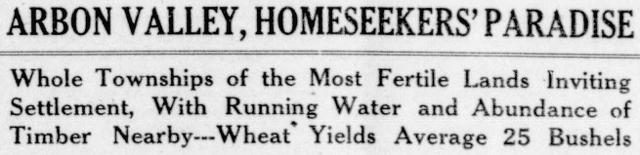
ARBON VALLEY, HOMESEEKERS’ PARADISE
Whole Townships of the Most Fertile Lands Inviting Settlement, With Running Water and Abundance of Timber Nearby—Wheat Yields Average 25 Bushels
J. R. Bailey, postmaster and one of the pioneer farmers of Arbon, was here Tuesday. He says many new settlers are coming into the valley, but there is room for hundreds of families yet, and the finest land in the valley still open to settlement. At the lower end of the valley is a body of land, he says, embracing about a township and a half, upon which there is not a single settler, and there is not ten acres in the entire tract that cannot be plowed. Water of the finest kind is there in abundance, and near the surface. Above this tract is a much larger body of sparsely settled land, with schools and a store convenient, which is equally [illegible]
The first farming in Arbon valley was begun about seven years ago. There has never been a crop failure, and this year there are 45,000 bushels of wheat to be hauled out. The average yield this year was 25 bushels of wheat, and about 50 of oats. The settlement embraces about fifty families, and is growing.
Those familiar with the valley claim it to be the finest dry farm section in the state. Moisture is kept [illegible] the surface by drainage from the hills, and alfalfa is matured without irrigation. Timber is abundant for wood, fencing and building purposes, a small sawmill providing all the lumber needed. Water is abundant and is used to some extent for irrigation, but the dry farming conditions are so advantageous that irrigation is little resorted to. Information regarding this section will be furnished upon application to J. R. Bailey, Joseph Arbon, W. F. Arnn, Julius Abter, John Paine, Bert Evans, G. W. Jensen, or any resident of the valley, all of whom are desirous of having it settled.
An appropriation of $300 has been made for a new road to the valley which Mr. Bailey believes will shorten the distance ten or twelve miles and bring the lower end of the valley within about fifteen miles of American Falls, with a water grade most of the distance. An ordinary team of horses will bring about thirty sacks of wheat to market here without difficulty. Work on the road will probably begin next week, and its completion should only be a matter of a short time.
Sources
- American Falls Press, November 7, 1908, page 1
- American Falls Press, November 14, 1908, page 1
- American Falls Press, November 21, 1908, page 1
- American Falls Press, November 28, 1908, page 1
- Mountain Home Maverick, December 3, 1908, page 3
- Montpelier Examiner, December 4, 1908, page 6
- American Falls Press, December 5, 1908, page 1
- Idaho Republican, December 11, 1908, page 3
- American Falls Press, December 19, 1908, page 1
- American Falls Press, January 2, 1909, page 1
- American Falls Press, January 9, 1909, page 1
- American Falls Press, March 20, 1909, page 8
- American Falls Press, April 3, 1909, page 1
- American Falls Press, April 17, 1909, page 1
- American Falls Press, May 22, 1909, page 1
- American Falls Press, July 24, 1909, page 4
- American Falls Press, March 29, 1917, page 7