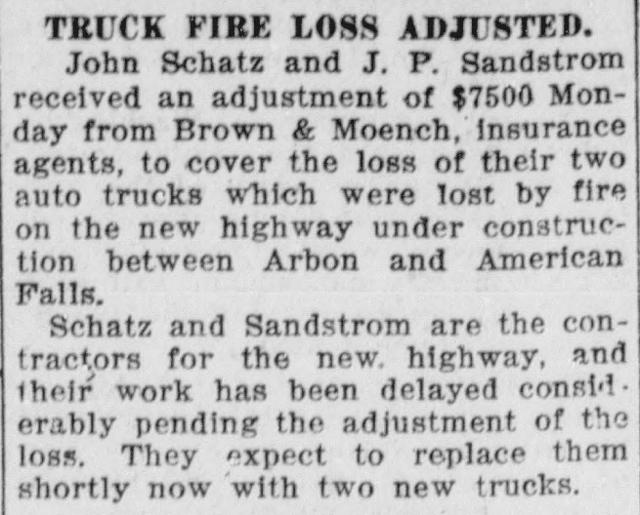
On a Tuesday afternoon in June 1919, probably the 10th, two trucks hauling lumber and gasoline for the new Arbon Valley road caught fire near Arbon and burned to the ground. John Schatz had pulled over to drain his gas tank, and the driver ahead of him turned back and stopped alongside. A spark from an exhaust was thought to have set off the gasoline. Both trucks “became a mass of flames,” the American Falls Press said, and the two drivers barely got clear.
The fire stopped the work. On the Monday before the paper of June 20, the insurance agents Brown & Moench paid Schatz and J. P. Sandstrom $7,500 for the two trucks, and the Press reported that the partners, contractors on the highway between Arbon and American Falls, had been held up a good deal while they waited on the claim. They planned to have two new trucks on the job before long.
The valley’s new highway district had only begun its road that spring, and the summer it was built in turned out to have almost no rain.
A district of its own
The valley had been known as Bannock Valley, and until 1913 it lay in Oneida County. By 1919 it was part of Power County, though its south end still belonged to Oneida. On June 12, 1918, voters at the Bannock Center school house decided without a single vote against to form Highway District No. 3, with commissioners and bonds of its own. That fall a $50,000 bond issue for the district was declared carried. The Pauline precinct favored it 56 to 10; the paper did not give the Arbon precinct’s tally.
The district’s chairman, J. E. Keeler, and its secretary, William Allard, advertised on April 14, 1919, for bids to gravel fifteen miles of the wagon road that ran south along Bannock Creek. By the Arbon column of April 18, a crew camped near the Pauline bridge had started cutting down the steep hill there. They would soon be rid of a narrow ledge above the creek that had been dangerous. The district had bought ground from Mr. Bolingbroke so the road could go straight through instead of curving in from the north to reach the bridge. The column left out his first name; the Bolingbroke family were among the pioneers of Pauline and West Fork.
The graveling contract went to Duke Sandstrum of American Falls, the Press said on May 2, and he meant to haul with trucks rather than teams. Those may have been the first motor trucks on record in the valley. He was most likely the same man as the J. P. Sandstrom paid for the burned trucks in June; the papers spelled his name three different ways.
No rain in June
The weather observer at American Falls wrote down the last rain of the spring on May 29. For the month that followed his record was a single line: “June, 1919. Precipitation, none.” On June 25 the thermometer reached 101. The valley did catch a little rain. Orval Mikkelson of Arbon, visiting Hyde Park, Utah, in the middle of June, told the Logan Republican of “a refreshing shower, doing much good to their grain.”
By the Fourth of July the grain buyers at American Falls were still hopeful about the fall grain. It had been planted the previous autumn, and its roots had worked down through the hardpan to damp ground. C. Y. Wilson of the Northern Grain Company said the Rockland and Arbon valleys were holding up under the drought. The spring grain that covered much of the Roy and Crystal valleys was another matter: without a good rain, the Press said, it would come to nothing.
The rain held off too long. Harvest opened at the end of July, and the Arbon column found the grain short, with only a few kernels to a head. “Most of the spring grain that didn’t freeze burned up,” it said. The fall grain had burned as well, hay and feed were hard to come by, and “there is no pasture.” A week later the Pauline correspondent reported yields of ten bushels at best among those who had threshed, and some barely over two. A good deal of the spring grain, the writer said, was not worth cutting:
It is almost impossible for the farmers to get hay to do their harvest work let alone get feed for winter. There was a nice rain fell here last week which has made the roads better, settled the dust and refreshed the air. It came too late to do crops any good.
On August 22 the Pauline column had better news, “a plentiful rain came again this week,” and farmers had begun to think about fall plowing. Then on September 5 the Arbon column described a storm as hard as any in years: “Everything in the low places and hollows was on the move.”
Work for the farmers
The road, meanwhile, was gaining standing. Early in August the Blackfoot Idaho Republican reported that the state commissioner of public works had named a state highway from Pocatello to Arbon, to be carried on into Oneida County. It was the valley’s first state highway.
On August 25 the Salt Lake Herald-Republican ran a survey of road work in southeastern Idaho, sent from Rockland. Across the mountains to the east, it said, the Arbon Valley highway district was putting a graded road the length of the valley, from the Fort Hall Indian Reservation down to the Oneida County line. The valley grew nothing but wheat, and farmers there had always faced long hauls over bad roads to reach the elevators. With the drought cutting Power County’s crops so deeply, the paper said, work had to be found for farmers so they could keep their families and their stock. The highway commissioners planned to hire only farmers and laborers who lived inside their own districts, so that people would have money in hand when it came time to plant again.
Most of that article was about the Rockland district. Neither it nor any 1919 Press report found so far says how many valley men actually worked on the Arbon road, and the spring graveling contract, at least, had gone to a man from American Falls. The dry year did lasting harm all the same: the drought of 1919 helped drive families from the valley.
The district kept building. Allard’s annual report, printed in July 1921, counted fourteen miles of graded and graveled road in the district, six miles of it new in 1920. The same Salt Lake Telegram story brought bad news. When the Bannock bank failed, the district lost all the cash it had available. It had expected about $2,000 for road upkeep that year, with the wheat hauling still ahead.
The original article
American Falls Press, June 20, 1919, page 8. Transcribed from the page scan.
TRUCK FIRE LOSS ADJUSTED.
John Schatz and J. P. Sandstrom received an adjustment of $7500 Monday from Brown & Moench, insurance agents, to cover the loss of their two auto trucks which were lost by fire on the new highway under construction between Arbon and American Falls.
Schatz and Sandstrom are the contractors for the new highway, and their work has been delayed considerably pending the adjustment of the loss. They expect to replace them shortly now with two new trucks.
Sources
- American Falls Press, June 25, 1918, page 3
- American Falls Press, November 15, 1918, page 3
- American Falls Press, April 18, 1919, page 4
- American Falls Press, April 18, 1919, page 12
- American Falls Press, May 2, 1919, page 7
- American Falls Press, June 13, 1919, page 1
- Logan Republican, June 19, 1919, page 15
- American Falls Press, June 20, 1919, page 8
- American Falls Press, July 4, 1919, page 1
- American Falls Press, August 1, 1919, page 2
- Idaho Republican, August 5, 1919, page 7
- American Falls Press, August 8, 1919, page 9
- American Falls Press, August 22, 1919, page 2
- Salt Lake Herald-Republican, August 25, 1919, page 2
- American Falls Press, September 5, 1919, page 2
- Salt Lake Telegram, July 11, 1921, page 14