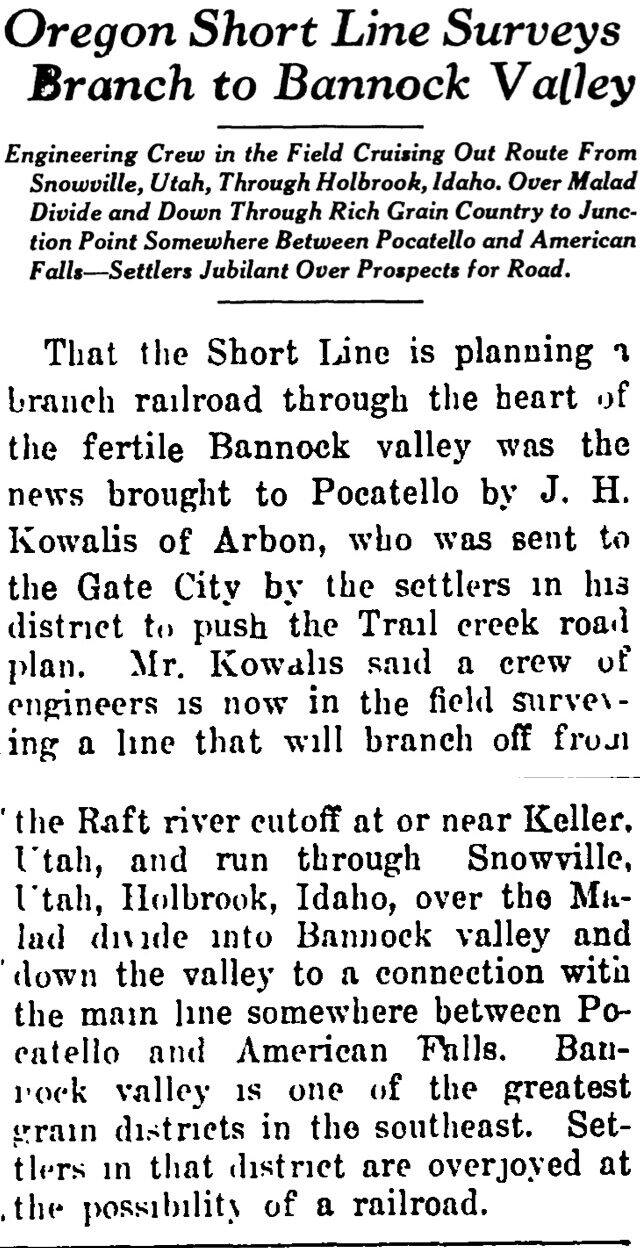
A man from Arbon came to Pocatello in June 1913 to talk about a road and left the town talking about a railroad. Engineers were already in the field, he said, running a survey for a Short Line branch that would come over the Malad divide and down Bannock Valley. On June 26 the Pocatello Tribune put his news across its front page under the headline “Oregon Short Line Surveys Branch to Bannock Valley.”
The valley, known today as Arbon Valley, had no rails of any kind. Every bushel it grew left behind a team of horses, and all that year its settlers and their neighbors wondered aloud how a line might find its way in.
Rumors from over the mountains
The first whisper of the year came from the far side of the range. In February the Semi-Weekly Pocatello Tribune repeated an item from the Downey Idahoan. S. F. Johnson had come home from Logan with word that promoters of northern Utah’s electric railways meant to ask Downey for a franchise. Their line, as he heard it, would cross Marsh Valley, pass into the Hawkins Creek country, “cross the divide in Bannock valley and thence on to American Falls.” The Downey editor remembered surveyors working quietly through Marsh Valley a year before, never explaining their business, and allowed that nobody could say whether the rumor held anything.
A month later Arbon made its own case. Writing to the American Falls Press on behalf of the Arbon Commercial Club, W. E. Dawson reported that the settlers were stringing their own telephone line and had put in more ground than in any season before. He urged the Press to keep in mind that the valley was “a splendid field for an electric line and the sooner the better.”
The road that brought the news
The June report rode in on a fight over a wagon road. According to the Tribune, “J. H. Kowalis of Arbon” had come as the settlers’ delegate to push the Trail Creek road plan, a new route over the Trail Creek divide into Pocatello. During his visit he described the survey crew. Their line, he said, would leave “the Raft river cutoff at or near Keller, Utah,” pass through Snowville, Utah, and Holbrook, Idaho, climb over the Malad divide into Bannock Valley, and run the length of the valley to meet the main line at some point between Pocatello and American Falls. Where Keller and that cutoff lay, the paper did not explain. It counted the valley among the finest grain districts in the southeast and reported its people “overjoyed at the possibility of a railroad.”
Elsewhere on that page the Tribune explained why the errand had stalled. The Trail Creek road would cross the Fort Hall Reservation, and getting a right of way meant a formal application from the Power County commissioners, backed by a survey and a map. The paper suspected the commissioners were in no hurry to send trade toward Pocatello and away from American Falls. Pocatello had pledged about $1,200 and the Rattlesnake and Bannock valleys $700 to $1,000, against an estimated cost of $7,500.
The paper spelled the visitor’s name Kowalis and gave him the initials J. H., but no J. H. Kowallis turns up in the valley. Two brothers of the Meadow Ward at Pauline are the likeliest candidates, Bishop Wilhelm F. Kowallis and John E. Kowallis, the bishop’s ward told in Pauline’s beginnings. Whether either of them brought the news is unknown.
A summer of steam-car dreams
For the rest of the summer people wrote as though the tracks were as good as laid. On July 5 the Rev. B. W. Rice sent the Tribune a letter from Arbon, one of the pieces gathered in A minister’s portrait of Bannock Valley in 1913:
Five years from now we will be riding through here on the steam cars pointing out to companions this place and that place that could have been bought now at a poor man’s figure, but cannot be bought then for $7000 for the quarter section.
By his figures, the year’s crop of 700,000 bushels would cost 15 cents a bushel just to get to the railroad for sale. On July 14 word of two new Congregational churches in the valley looked for one meetinghouse to rise “in the little valley village that is sure to follow the advent of the new railroad.” Ten days later the Pocatello bankers C. A. Valentine and Ezra J. Merrill came home from a drive through the valley predicting bumper crops, and the Tribune added:
Its development is handicapped by lack of transportation, but it is said the Short Line is contemplating the construction of a branch line to tap it soon.
In October the American Falls Press picked up a Rockland Times note that several engineers had passed through Rockland Valley, just to the west, during the summer.
The line that stayed on paper
Nothing more about the June survey has turned up in print, and no Short Line record of it has been checked. In January 1914 the Logan Republican, writing up a visit from Bishop Kowallis, said some valley farmers still hauled their grain twenty-two miles to market and that “a railroad is expected within a few years,” as told in Great Change at Arbon. That September the Short Line’s chief engineer came across from Malad by way of Holbrook, returned through the valley, and announced nothing. Petitions, pledges, promoters and even the Double-P monorail plan of 1914 followed, and they are told in The railroad that never came to Arbon Valley, 1914–1922.
On June 30, 1963, fifty years on, the Idaho Sunday Journal reran the opening of the June report in its “50 Years Ago” column. The valley was still waiting. No track was ever laid.
The original article
Pocatello Tribune, June 26, 1913, page 1. Transcribed from the page scan.
Oregon Short Line Surveys Branch to Bannock Valley
Engineering Crew in the Field Cruising Out Route From Snowville, Utah, Through Holbrook, Idaho. Over Malad Divide and Down Through Rich Grain Country to Junction Point Somewhere Between Pocatello and American Falls—Settlers Jubilant Over Prospects for Road.
That the Short Line is planning a branch railroad through the heart of the fertile Bannock valley was the news brought to Pocatello by J. H. Kowalis of Arbon, who was sent to the Gate City by the settlers in his district to push the Trail creek road plan. Mr. Kowalis said a crew of engineers is now in the field surveying a line that will branch off from the Raft river cutoff at or near Keller, Utah, and run through Snowville, Utah, Holbrook, Idaho, over the Malad divide into Bannock valley and down the valley to a connection with the main line somewhere between Pocatello and American Falls. Bannock valley is one of the greatest grain districts in the southeast. Settlers in that district are overjoyed at the possibility of a railroad.
Sources
- Pocatello Tribune, June 26, 1913, page 1
- Semi-Weekly Pocatello Tribune, June 28, 1913, page 5
- Semi-Weekly Pocatello Tribune, February 26, 1913, page 2
- American Falls Press, March 20, 1913, page 7
- Pocatello Tribune, July 8, 1913, page 4
- Semi-Weekly Pocatello Tribune, July 12, 1913, page 6
- Pocatello Tribune, July 15, 1913, page 8
- Pocatello Tribune, July 24, 1913, page 5
- Semi-Weekly Pocatello Tribune, July 30, 1913, page 7
- American Falls Press, October 16, 1913, page 8
- Logan Republican, January 15, 1914, page 4
- American Falls Press, September 17, 1914, page 1
- Idaho Sunday Journal, June 30, 1963, page 4