Between notes on the rain, the hay and the coyote pups killed that spring, the Central Arbon correspondent of the American Falls Press slipped in a line on June 3, 1915, that said a good deal about the valley. A few newcomers had lately filed on land in Knox Canyon, the horseback route across the mountains to Rockland, and were putting up buildings there. “Even the mountain ranges are being homesteaded,” the writer added, “which is gradually crowding out the sheepmen.”
The sheepmen were not gone yet. Two weeks later Mr. Eliason and his brother had a crew at their shearing corral in Knox Canyon, and in June 1916 the brothers sheared there again. But all that year the paper’s Arbon columns told of a valley still filling up, with settlers arriving from Washington and Kansas, wells going down, houses going up and claims changing hands. Arbon had sat in Oneida County until 1913. Now it belonged to Power County, whose seat was American Falls.
Two carloads from Dayton
The season had opened on April 1 under the headline “New Settlers Arrive.” Tom Donnely, Fred Banks and a Mr. Turner, all of Dayton, Washington, had shipped in two carloads of stock and farm implements. Donnely planned to run a stock ranch on unsurveyed ground in the valley, where the Donnely brothers already had plenty of friends, a good number of them “old acquaintances in Dayton.” Dayton people had been settling the valley’s south end since 1909, the Summit area history notes.
More came behind them. On June 3 the South Arbon column welcomed Jack Folsom and his bride, just arrived from Dayton to make their home. In July C. K. Jones of Dayton, out to visit his daughter, Mrs. Robert Stott, went looking for land of his own, being “well pleased with the Arbon country.”
Kansas sent people too. The Central Arbon column of June 3 said Frank Swim, one of the valley’s Kansas homesteaders, had gone off to Twin Falls and the country around it in search of a stock ranch, leaving his farm leased to a Mr. Johnson, “a recent arrival from Kansas.” Swim did not let go of the place. He still held his homestead in the 1940s.
Forty-one feet to water
Every claim faced the same first test. The Arbon area itself has few creeks or springs, as the Arbon area history explains, and a settler who struck water close to the surface counted himself lucky. The South Arbon correspondent wrote that week:
Mr. James Lickingteller was fortunate in getting water on his homestead at a depth of forty-one feet. The people on the west side of the valley have had to go from two hundred and thirty to four hundred and sixty feet for water.
On the same page, the Parma Brothers, well drillers, had just finished one for Peck Winnet and Albert Poppy, probably Albert Poppie. By mid-June W. W. Harvey was boring a well for Frank Burke. Tom Stott and Emmett Lee bought some springs, meaning to pipe the water down to their farms, and in September W. H. Smith had to go all the way to Malad for a new cylinder for his pump. Knox Canyon, where the new filings were going in, also fed the valley’s first irrigation ditch.
A tent and a for-sale notice
Harvey himself seemed to have one foot out the door. The South Arbon column of June 3 ran two items one after the other, a settler hoping to sell and another just moving in:
W. W. Harvey has a Fairbanks engine, horses and hogs for sale. If he can dispose of his property he is going to leave this part of the country.
Tracy Lee has moved onto his homestead and has been living in a tent while building a home.
Two weeks on, Harvey was still at work on Frank Burke’s well. The paper does not say whether he left after that.
Plenty of others were digging in. In July William Allard, the valley’s first legislator, was putting up a five-room house on his Arbon ranch. In August he was one of five “of Arbon” hauling “house bills,” that is, lumber for houses, out of the Idaho Lumber Company’s yard in American Falls. In September Roy Smith was building a bungalow on his claim, and George Bollinger, already proved up on his own, was raising a house on “the homestead belonging to his wife.” Proving up meant satisfying the land office that a homesteader had lived on the claim and farmed it for the years the law required. The government then issued a patent, which was the title.
Nothing as good as Arbon
Some who went looking came back. In June the South Arbon column followed Joe Jenson on business trips, first to Oregon and then to Nevada. On July 8 it had him home from Nevada, where he had been shopping for land; after crossing Oregon, Utah and Nevada he had seen nothing “that looks as good to him as Arbon.” The scanned text calls him J. W., but the trips are Joe Jenson’s. On September 30 the column reported that J. A. Gardner had sold his ranch to Joe Jenson for $2,900 and that the Gardners would soon head home to Cache Valley. The buyer was Joseph C. Jenson, the Summit homesteader whose family history records the purchase, and very probably the man who had come back from Nevada.
Other ground changed hands that September. Clarence Barrett sold his homestead to Harve Fletcher, lately of Dayton and “very much pleased with the country.” Fred Durkee bought a section in the valley, a square mile of 640 acres. Thomas Zimmerman of Dayton bought another, “the S. Randall place,” in a deal closed by M. A. Johnson. The American Falls real estate man was also advertising 640 more Arbon valley acres on ten years’ time.
The county books showed it. When the commissioners fixed the tax levy that month, the Press reported that Power County’s valuation had climbed from $6,900,000 to $8,100,000. Public utilities and town lots made up part of the gain. Most of the rest, the paper said, came from 31,636 more acres of patented land across the county, ground that had passed from the government to private owners and could now be taxed. Everything outside the county’s two independent road districts, “composing the Arbon and Crystal neighborhoods,” came to about $670,000. The Crystal area history tells more of the second of those neighborhoods.
A Washington man
In December the North Arbon column said Add Affleck, Tom Evans’s son-in-law, had sold his large homestead beside the Evans place to “a Washington man,” with M. A. Johnson handling the sale. In May 1916 the paper reported Affleck selling his farm to S. E. Harris, and it is not known whether the two items describe one sale. That year two Kansas homesteaders sold out at the valley’s first farm auction.
The December column closed the year on a settler who meant to stay. Jesse Secrist had advertised that he would prove up on his homestead the next month. If the land office was satisfied, the ground would be his.
The original article
American Falls Press, June 3, 1915, page 4, the “Central Arbon News” column. Transcribed from the page scan.
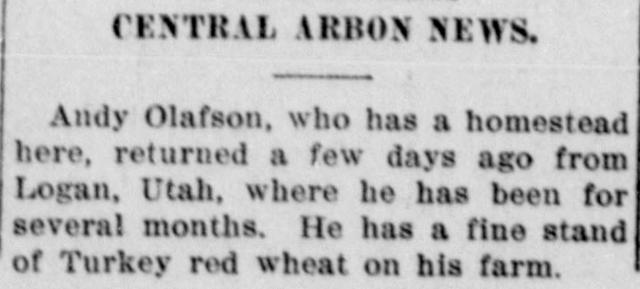
CENTRAL ARBON NEWS.
Andy Olafson, who has a homestead here, returned a few days ago from Logan, Utah, where he has been for several months. He has a fine stand of Turkey red wheat on his farm.
Frank Swim has gone to Twin Falls and district surrounding in search of a stock ranch. He has a valuable farm here, which he has leased to Mr. Johnson, a recent arrival from Kansas.
Many of the Pauline and Central Arbonites attended the ball game last Sunday.
We are still having rainy weather. It has rained considerable the past week and hay crops are looking better.
W. E. Titus of Pocatello was a visitor in the valley Friday, returning to Pocatello Saturday.
There are a few new homesteaders who recently filed on land in Knox canyon, that are building on their land. Even the mountain ranges are being homesteaded, which is gradually crowding out the sheepmen.
John Payne and Mr. Thyberg went to Pocatello last week on business.
Mrs. Evnas has a few hats left yet and expects a new shipment soon.
Clifford Gerkings is busy these days turning the sod over for Mr. Porter.
Mr. Porter has leased the old Rodema place and expects to commence breaking on the place this summer.
Mrs. D. B. Evans was a Malad visitor the last of the week.
A pastor has been engaged for the Congregational churches of Arbon valley. Mr. Robert W. Sturges of New York City, a student in Union Theological Seminary, will be in Arbon for the next four months. Mr. Sturges arrived here Friday of last week and held services Sunday morning at the Highland Congregational church and also at the Arbon Congregational church. Everyone is cordially invited to attend the services, whether you are members or not. Come and bring your friends. Time and place of meeting will be published elsewhere in the Arbon items.
There has been several coyotte dens found this spring and many of the pups have been killed, which makes them that many less for the chickens.
The Parma Brothers, well drillers, completed a well for Peck Winnet and Albert Poppy recently.
Mrs. Sherman Randall who has been ill, is improving.
Mr. Lorenzo Lovin and J. R. Bailey were in Malad Tuesday on business, returned home Wednesday.
Mr. Porter was also a Malad visitor during the week.
George Williams, a resident and mayor of Pocatello, came out with a party of business men a few days ago to look after the interests of Mr. William’s mining claim here. They report fine prospects for crops here this year.
Sources
- American Falls Press, April 1, 1915, page 1
- American Falls Press, June 3, 1915, page 4
- American Falls Press, June 17, 1915, page 1
- American Falls Press, July 8, 1915, page 1
- American Falls Press, July 8, 1915, page 2
- American Falls Press, July 15, 1915, page 1
- American Falls Press, August 12, 1915, page 5
- American Falls Press, September 2, 1915, page 8
- American Falls Press, September 16, 1915, page 1
- American Falls Press, September 16, 1915, page 2
- American Falls Press, September 23, 1915, page 7
- American Falls Press, September 30, 1915, page 5
- American Falls Press, September 30, 1915, page 6
- American Falls Press, December 2, 1915, page 3
- American Falls Press, May 18, 1916, page 2
- American Falls Press, June 22, 1916, page 8