The farmers’ day at the Central school in Arbon had a school band, a Senator, a May Pole and a table of crocheted lace. It also had a wreck. On the afternoon of Wednesday, May 10, 1916, a car borrowed from the county agent turned over on a valley road, and two grown people were caught beneath it.
Apart from that, the valley’s correspondent told the American Falls Press, “everything went off fine at the fair.” It was, in that writer’s words, “our first fair.”
Five fairs in a row
Until 1913 Arbon had been part of Oneida County. By 1916 it belonged to Power County and looked to American Falls as its county seat, and the new county’s officers wanted the outlying districts to show what they could raise and make. In January the agricultural agent, A. W. B. Kjosness, said he was encouraging community fairs that would send their winners on to the county fair. Early in April he spoke to the valley’s literary society and proposed that the Bannock Valley farmers hold a fair day, presumably soon after school let out, “the farmers bringing their best in the line of stock.” The county school superintendent, Madge E. Whistler, backed the idea as well.
On April 27 the Press announced a run of five such fairs. Crystal’s came first, and Arbon’s was set for May 10. The committee at Arbon was William Allard, J. D. Dawson and a third man the paper named only as “Bishop Arbon.”
Maps, lace and a carpet-loom bag
The weather was poor and spring work was pressing, but the correspondent counted “a fair crowd” all the same. From American Falls came the school band, Senator D. W. Davis, Dr. Noth and a long list of townspeople.
The exhibits filled the school’s primary room. Two teachers had taught their pupils to sew: Mildred Warren of the Pauline school and Claudia Cox, who evidently taught with Mr. Ray at the Central school, though the report places her at the Bannock school. Mr. Ray’s pupils showed relief maps of Idaho and of Power County. Mrs. Abter and Mrs. Lindley brought crocheted lace, Mrs. Bullock and Mrs. Jenks embroidery, and Mrs. Tallon (printed Talion), Mrs. Allard, Mrs. Keeler and Miss Cox other handwork. Mr. Abter showed a bag he had woven on his carpet loom. The women’s display was small, the Press admitted, but a creditable start.
The band played, and the pupils put on a May Pole drill and a flag drill. Davis, invited by the committee, spoke on “Business Methods in the Management of Our State Resources,” and the Press, a paper from his own town, called him “a man with a vision.”
Miss Amy Kelly of the University of Idaho extension department (her name also appears as Kelley) talked with the Arbon women about running a household and then about bread. “You people of Power county grow an excellent grade of wheat,” she told them, and so their flour and their loaves ought to be better than most. The women asked her to come back in July. Mrs. R. B. Greenwood, speaking for the American Falls Woman’s Club, urged them to form a club of their own and invited them to the county fair in September. The boys had a stock-judging contest, run by Kjosness.
Pinned under the car
That afternoon Mr. Fjelsted, an agricultural lecturer from Twin Falls, was at the wheel of Kjosness’s car, with Mrs. Roberts and two of her children along. A radius rod snapped and the car went over, trapping both adults. The children, thrown clear, ran for a man at work in a field close by, and he pulled Fjelsted out. J. P. Mehlhaff and J. F. Kosanke came along about then and raised the car off Mrs. Roberts.
Fjelsted had a broken arm, a broken rib and a sprained back. Mrs. Roberts was “bruised quite badly but not seriously injured,” and the children were not hurt. The two reports give different errands: the Press of May 11 says the party was going for pans to show grain in, while its Arbon correspondent wrote a week later that they were fetching wheat samples from her home. Fjelsted was taken to the home of Mr. and Mrs. Evans, printed “T. U.” but probably Thomas Bowen Evans, whose new house stood west of the Central school. There Dr. Noth and a second doctor set his arm.
The correspondent ended by thanking Miss Whistler and Mr. Kjosness “for their great help in making our first fair a good one.”
“Aired instead of Allard”
Not everyone thought it a good one. The Power County News, another American Falls paper, printed an unsigned letter dated at Arbon on May 11, with a comment of its own. That issue has not been found, but going by the reply, the writer objected to Davis speaking at the fair and held Kjosness responsible.
William Allard answered on May 23. He was the Arbon homesteader who had sat for Power County in the Idaho House in 1915, the first legislator from the valley. He sent his letter to the News and a copy to the Press, in case the News did not set things right, and on June 1 the Press ran it under the heading “Communication Ignored.” The unsigned piece, he wrote, did “an injustice to County Agent Kjosness, D. W. Davis, and the people of Arbon.” Arbon people on a committee had planned the fair, and Allard himself had asked Davis to speak. As for calling Davis the next governor, “I wish to plea guilty as I consider him the ablest candidate for the office,” and he forecast a big win in November. Then he turned to the critic:
Being well known to the people of Arbon I cannot conceive of anyone here who would spell my name Aired instead of Allard as it is, and I further think that if he is as deeply interested in this valley and county as he pretends to be that he should give his name so that we may know to whom to extend credit.
On the same page the Press reprinted a Boise Statesman story in which Miss Kelly looked back on the Power County fairs: “At Rockland the fair was equally good, and also at Arbon.”
Two years early
Miss Kelly planned to return for a bread demonstration. The pages found do not say whether she did, whether the women ever started the club Mrs. Greenwood urged, or who wrote the unsigned letter.
In September several valley people went to the county fair at American Falls for its “Bannock Valley day,” and the premium list gave “Best mounted relief map of Power county” to the Arbon school.
Allard’s forecast failed that fall. Governor Alexander beat Davis in November, and the Press argued that Davis had been “counted out” because election officials misread conflicting ballot laws, though it blamed no judge. By January 1919 Davis was governor after all, and the Press was praising “the message of Governor Davis.” Allard had picked the right man, two years early.
The original article
American Falls Press, May 11, 1916, page 1. Transcribed from the page scan.
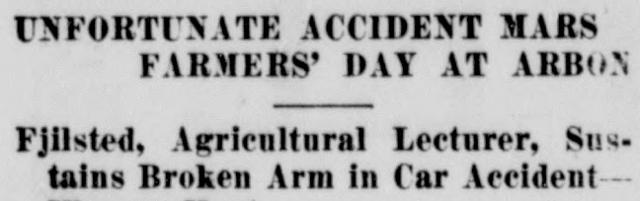
UNFORTUNATE ACCIDENT MARS FARMERS’ DAY AT ARBON
Fjilsted, Agricultural Lecturer, Sustains Broken Arm in Car Accident—Woman Hurt.
While going after some pans in which to exhibit grain, Wednesday afternoon, Mr. Fjelsted, who was to have charge of this part of the exercises, broke the radius rod of the car he was driving, overturning it and pinning himself and Mrs. Roberts beneath the car. Two children of Mrs. Roberts were thrown clear of the car. They summoned a man who was working in a field nearby, who got Mr. Fjelsted out. About that time J. P. Mehlhaff and J. F. Kosanke came along and lifted the car from Mrs. Roberts. Mr. Fjelsted sustained a broken arm and rib and a sprained back. Mrs. Roberts was bruised quite badly but not seriously injured. The children were unhurt. The car belonged to County Agent Kjosness and was badly disabled. Dr. [illegible] was fortunately present and attended the injured. Mr. Fjelsted was brought to American Falls by H. C. Ehrlich and left for him home at Twin Falls this morning.
Many American Falls people were in attendance, among the number being Mr. and Mrs. Greenwood, Mr. and Mrs. Barber, Mrs. Noth, Mr. and Mrs. Davis, Mrs. Gregory, Mr. and Mrs. Forter, Mr. and Mrs. Hansen, E. E. Zaring, Chester Greene, M. J. Unger, James Vaughan, Jay Gibson, William Baker, H. C. Ehrlich, J. T. Sykes, H. R. Wallis, J. P. Mehlhaff, J. F. Kosanke, H. C. Wones, W. R. Griswold and the American Falls School band.
In the primary room of the school building, the work of the children and the women was displayed. Misses Mildred Warren of the Pauline school and Claudia Cox of the Bannock school had both secured excellent results in teaching sewing, in addition to the drawing, paper cutting and sewing cards, more common in the rural school. There was also a fine display of maps, done by the pupils of the two schools. Mr. Ray’s pupils also had a good collection of maps, two especially noteworthy, being a large relief map of the state of Idaho and one of Power county.
The women’s exhibit was not a large one but it made a creditable showing for a beginning. Mrs. Abter’s and Mrs. Lindley’s crocheted lace, Mrs. Bullock’s and Mrs. Jenk’s embroidery were much admired. Mrs. Talion, Mrs. Allard, Mrs. Keeler and Miss Cox also made exhibits. Mr. Abter showed a work bag woven on his carpet loom. Mrs. W. E. Dawson showed a handy household device for the farm woman who finds it necessary to keep the toilet articles of several members of the family in one place, in the shape of a set of wall pockets. The whole piece is made of oil cloth bound with tape. There are large pockets for which whisk broom and clothes brush, smaller pockets for combs and hair brushes and still smaller pockets for tooth brushes, etc. Most useful, under a mirror, over a wash stand.
Another article which deserves mention was the sewing case, loaned by Mrs. T. E. St. John of American Falls. This case has very convenient holders for thimbles, cushions for needles, hooks for scissors and emery ball, rows of pegs for thread and pockets for buttons, snaps, etc., an especially large one for mending or a piece of work. Closed, the sewing case occupies very little space. Open, it saves long minutes of searching for the particular thread or needle one wishes for a special sewing task. The women were very grateful to Mrs. St. John for giving them the opportunity of seeing this ingenious device and the school girls whose patient fingers had wrought the artistic sewing bags and neat doll aprons, all resolved to have one like it as soon as possible.
A much admired group of water colors were the work of the children of the Garn school. The idea was to paint Cheney Eye’s wigwam and his camp fire just at sunset. Some of the productions were decidedly artistic.
The teachers of the American Falls school loaned a fine display of the handwork of their pupils. Rugs and hammocks from Miss Drum, raffia frames and napkin rings from Miss Owin, Hiawatha books from Miss Becksted, water color paintings and reed baskets from Miss Hughes, collections of flowers from Mrs. Brown, maps and illustrated compositions from the various grades brought new ideas and perhaps more definite standards to the boys and girls who saw them.
One feature of the afternoon’s program pleased everybody, the concert by the American Falls School band. They are only boys, some not yet in High school, but they do enjoy music and they play like professionals. Arbon regretted that a previous engagement prevented them from remaining until evening.
The Bannock pupils directed by Mr. Ray and Miss Cox gave a brief program. Mrs. Fuller played the piano accompaniment for a May Pole drill, two songs by the Ripley children, a flag drill and two songs by the school.
At the invitation of the fair committee, Hon. D. W. Davis made a brief address on a topic which appeals to the mind of every intelligent citizen of Idaho because it is so directly related to his pocket book—“Business Methods in the Management of Our State Resources.” This is a day of organization. Whether we are willing to admit it or not, ours is an age of socialization, also by this we mean that in every plan for the betterment of the home, the school, the church, the community, the county, the state, or the nation, the one who originates such plan must have at heart the highest good of the most obscure workman as well as the essential check on the richest capitalist. Senator Davis has such a plan. He is a man with a vision. This vision, if realized, will place Idaho at the forefront of the forty-eight states of these United States of America. Looking back, Senator Davis sees other western states largely owned by capitalists. He see our state, rich today by virtue of the land it owns. He sees the Idaho of tomorrow, prosperous, and tax free, by the capitalization of its resources.
Miss Amy Kelley of the Extension department of the university addressed the Arbon women on the subject of “Household Management.” She spoke of economy of time and strength for the housewife by ararnging the kitchen so that the stove, water and work table would be close together; of blocks to raise the work table to a convenient height; of castors to permit its being moved about.
She then discussed the value of good bread in the family diet and the progress made through the Girls’ Bread clubs toward making the quality of Idaho bread better. “You people of Power county grow an excellent grade of wheat. Your flour is therefore superior and so should the bread be which is baked from it.”
Such interest was shown in Miss Kelly’s talk that a July meeting, the time and place to be definitely arranged later, was asked for.
Mrs. R. B. Greenwood of American Falls represented the Woman’s club of that place and gave a brief but very pleasing address. She spoke of the value of concerted effort on the part of the women and told about a few of the good deeds wrought by the woman’s clubs of the village, which individuals might not have secured so easily. She recommended such an organization for the women of the Arbon valley. She told of the humble beginning of the Power County fair and how interest in it had grown and extended to them a cordial invitation to visit the fair next September, assuring them that the women of the Falls would do everything posisble for their comfort and convenience.
The stock judging contest was the most interesting feature for the men and boys. County Agent Kjosness judged a horse, commenting on its good and bad points, and then turned the boys loose to judge other animals. More will be said of this feature next week.
At Cedar Ridge, Thursday, May 18, and at Rockland, May 19, like fairs will be held, and should be well attended.
Sources
- American Falls Press, December 2, 1915, page 3
- American Falls Press, January 6, 1916, page 1
- American Falls Press, April 13, 1916, page 7
- American Falls Press, April 27, 1916, page 1
- American Falls Press, May 11, 1916, page 1
- American Falls Press, May 18, 1916, page 2
- American Falls Press, June 1, 1916, page 1
- American Falls Press, September 28, 1916, page 4
- American Falls Press, September 28, 1916, page 8
- American Falls Press, November 23, 1916, page 2
- American Falls Press, January 17, 1919, page 4