In October 1915 the American Falls Press gave John Payne of Arbon a title no election had given him. He had been in American Falls on business at the courthouse on Saturday, October 23, and the paper introduced him as "John Paine, mayor of Arbon." Over the next two years the paper filled in a picture of one of the valley's oldest settlers.
He was John Henry Payne, and in 1916 the Press called him both John and Jack. The site's Stories section describes him as an English-born railroad man. His wife, Emily, was a daughter of George Arbon, for whom the Arbon post office, and later the whole valley, was named, and together they kept one of Arbon's early stores; visitors in 1911 stayed at the Payne hotel.
Mayor and justice
The "mayor" was the paper's joke. Mr. Paine, it said, had held the office so long that it was his "by right of continuous and beneficial use," and "he does not have to defend the title." The note called him one of the oldest settlers in the Arbon country.
Arbon had been in Oneida County until 1913 and was now in the new Power County, with its seat at American Falls. Payne held a real office too. In December 1915 the North Central Arbon column called him "Justice of the Peace, John Payne," back from business in American Falls, and said he was "coming out on the Republican ticket" for county commissioner at the next primary.
Arbon Activities
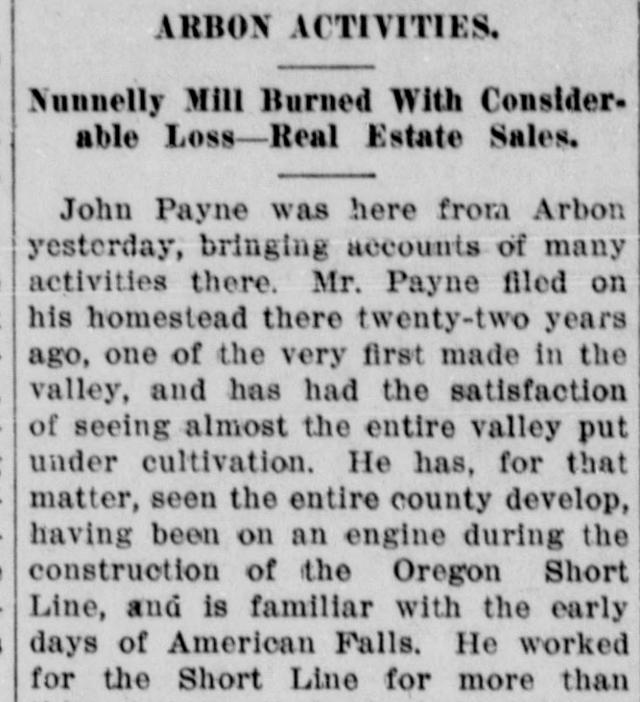
On May 31, 1916, Payne was in American Falls again, and the next day the Press put his news of the valley on its front page under the heading "Arbon Activities":
John Payne was here from Arbon yesterday, bringing accounts of many activities there. Mr. Payne filed on his homestead there twenty-two years ago, one of the very first made in the valley, and has had the satisfaction of seeing almost the entire valley put under cultivation.
The paper added that he had been on an engine during the construction of the Oregon Short Line and knew the early days of American Falls. He had worked for the Short Line more than thirty-two years, it said, beginning as a section hand and working up to engineer.
"Arbon is moving right ahead," he reported. Nearly all the plowing for fall grain was done, frost had done little damage, and a little more rain would be welcome. He brought his neighbors' news too, among it the loss of W. A. Nunnelley's sawmill, told in the Stories section.
His dates do not quite agree with the records. Twenty-two years before 1916 is about 1894, the year Ren Evans filed the earliest dated land claim in the still unsurveyed valley. The land-office registers summarized on the Arbon family page put Payne's first entry on May 3, 1901, a desert-land claim in section 23, and in 1909 the Press printed notice that he would make final proof on the homestead he had entered in April 1906. In November 1917 he told the paper he had farmed in the valley for twenty-one years, which points to about 1896. No filing of his from 1894 has been found, and the papers do not explain the difference.
Trustee and candidate
On Monday, July 10, 1916, Payne went before the county commissioners on behalf of the Lowery family of Arbon Valley. The board, the Press reported, "acted favorably on the representation made by Mr. Payne and granted a monthly allowance of $12.00." The printed proceedings found Mrs. Oliver Lowery and her family "indigent and in destitute circumstances" and ordered a warrant for $12 drawn each month to John Payne of Arbon as trustee for her. The papers read for this post do not say how long the allowance ran.
The July 20 issue that printed the order also carried Payne's announcement: he was a candidate for county commissioner from the third district, subject to the Republican voters at the September primary. On August 31 the Press noted that he would "make the race" and added that Mr. Payne was "a pioneer and has many friends throughout the county who will be glad to give him a boost."
His name is not on the abstract of the September 5 primary that the Press printed on September 14, which lists G. A. Brahmstadt of Arbon as the only Republican for the third district. None of the papers read for this post says why. Brahmstadt became the first county commissioner from the valley in January 1917.
An old engineer who made good
In March 1917 Mrs. E. A. Logan's history of Bannock Valley in the Press counted him among the former railroad men who were making good as grain growers: "John Payne, an old engineer, has made good here, owning a good farm and a good saw mill in Knox canyon." The June before, a valley column had reported that "Jack Payne moved his engine up to his sawmill" and would soon start sawing.
That November the Press's roving columnist, who signed his gleanings "the Pilgrim," found that Payne had threshed about 2,500 bushels. He had raised 100 acres of Turkey Red, which averaged 18 bushels an acre, and smaller fields of Odessa and Bluestem that did better, all on dry land, and the Turkey Red was bringing $1.69 to $1.72 a bushel. In the twenty-one years he had farmed in the valley, Payne said, there had never been a total crop failure. The columnist went on:
The average per acre at times has been very low, almost reaching the total minus point, but still there never has been a crop which went so far as to fail to provide sufficient flour to the farmers of the valley to tide them over to a better harvest. This veteran rancher is an optimist and looks forward to better things instead of wasting energy in deploring conditions that have passed into oblivion.
Afterward
In January 1919 the county board approved his bond as justice of the peace for Arbon precinct. He later left the valley. His death in December 1924 is told among the valley's tragedies: a coroner's jury found that he had shot Mrs. Martha Tuttle and then himself. His son, James L. Payne of Arbon, testified that he had never seen a gun in his father's possession.
The article as printed
American Falls Press, June 1, 1916, page 1. Transcribed from the page scan.
ARBON ACTIVITIES.
Nunnelly Mill Burned With Considerable Loss—Real Estate Sales.
John Payne was here from Arbon yesterday, bringing accounts of many activities there. Mr. Payne filed on his homestead there twenty-two years ago, one of the very first made in the valley, and has had the satisfaction of seeing almost the entire valley put under cultivation. He has, for that matter, seen the entire county develop, having been on an engine during the construction of the Oregon Short Line, and is familiar with the early days of American Falls. He worked for the Short Line for more than thirty-two years, beginning as a section hand and working up to engineer.
Arbon is moving right ahead, according to Mr. Payne. Nearly all the farmers are through with their plowing for fall grain. A little more rain would be welcomed. Frost has done little damage there and grain is looking well.
Among recent real estate transfers of importance, he said, were the sale of the Parley Bailey place to his brother Willard, and the D. P. Roderick place to Mrs. S. Kennedy.
L. B. Evans is building a fine addition to his house. Mr. Evans is, like Mr. Payne, one of the pioneers.
J. R. Bailey, another pioneer, has fallen a victim to the automobile fever and is driving a Dodge. He made his first drive to Wellsville, Utah, where he attended Decoration day services.
W. A. Nunnelly's sawmill was recently destroyed by fire. About 16,000 feet of lumber was burned.
On this site: the Arbon family, the Davis family, into which his son James Lester Payne married, the valley's first stores and sawmills, and the Arbon area.
Sources
- American Falls Press, September 18, 1909, page 3
- American Falls Press, October 28, 1915, page 5
- American Falls Press, December 23, 1915, page 7
- American Falls Press, June 1, 1916, page 1
- American Falls Press, June 22, 1916, page 8
- American Falls Press, July 13, 1916, page 5
- American Falls Press, July 20, 1916, page 4
- American Falls Press, July 20, 1916, page 8
- American Falls Press, August 31, 1916, page 2
- American Falls Press, September 14, 1916, page 2
- American Falls Press, March 29, 1917, page 7
- American Falls Press, November 13, 1917, page 3
- American Falls Press, January 24, 1919, page 9
- Deseret News, December 16, 1924, page 2