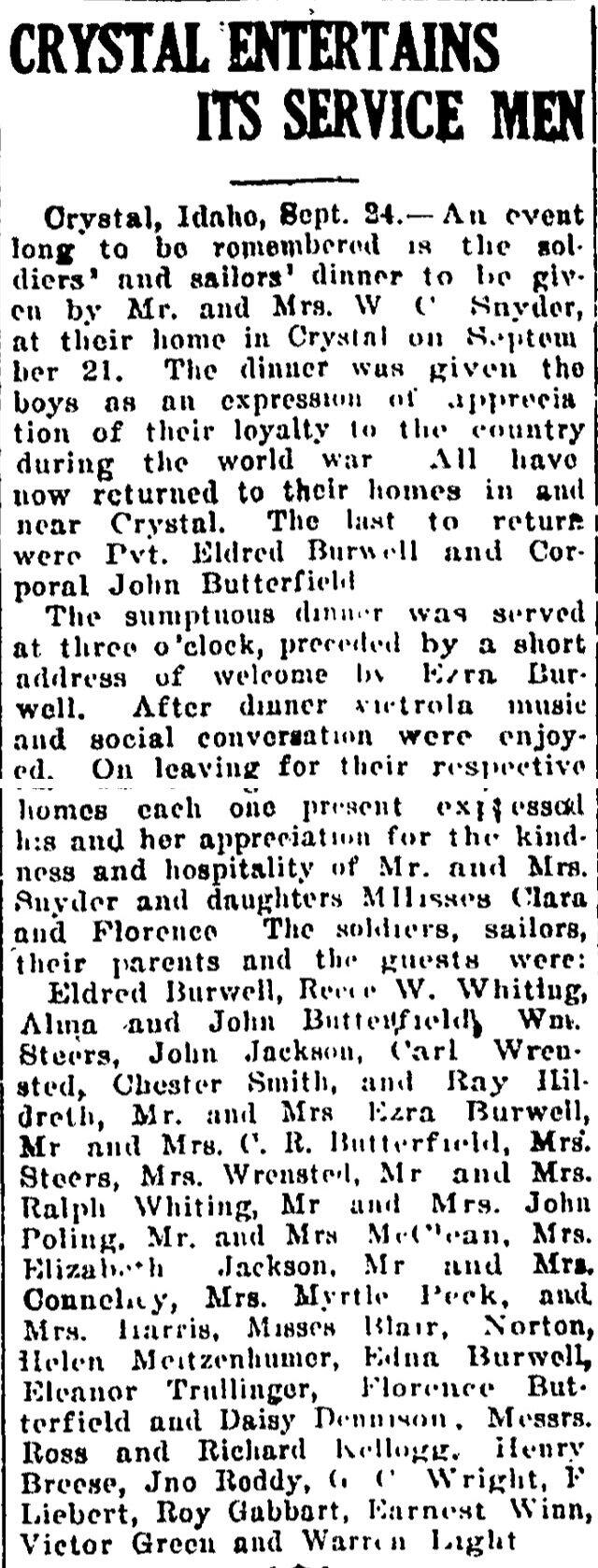
On Sunday afternoon, September 21, 1919, W. C. and Cora Snyder sat the returned soldiers and sailors of Crystal down to dinner at their home. Crystal's store was W. C. Snyder's, though the site's records name Ezra H. Lindsay as its storekeeper and postmaster in 1918–20, and Mrs. Snyder had been Crystal's first postmistress. Three days later the Pocatello Tribune printed a short report from Crystal under the headline "Crystal Entertains Its Service Men." The dinner, it said, was given "as an expression of appreciation of their loyalty to the country during the world war."
The occasion was that the last of them were home. In December 1917, when Alma Butterfield enlisted, the American Falls Press counted fourteen Crystal boys who had gone to the war, and that October Crystal had given farewell dances for its men called in the draft. Now, the Tribune wrote, all had returned to their homes in and near Crystal, and the last two were Pvt. Eldred Burwell and Corporal John Butterfield.
The last two home
Eldred Burwell had told his own story in a letter to the Press, printed on June 20, 1919. He left home on June 26, 1918, and was sent to Camp Lewis and then to Camp Kearney. He reached France on October 3, was sick with influenza for three weeks, and was sent as a replacement to the 330th Infantry near Le Mans. On November 8 he was sent to the 3rd Division, which was ready to go to the front. Then the armistice was signed. On November 15 the division started a march of 225 miles into Germany, and on December 16 it reached Plaidt, at the end of the hike. "There were some happy Yanks when we were told our hike was finished," he wrote. In May he was still with the army of occupation, waiting for the peace to be signed so he could start for home.
John Butterfield was a son of C. R. Butterfield, one of Crystal's early settlers. In July 1918, as far as a damaged column in the Press can be read, his mother and his sister, Mrs. Myrtle Peck, went to town with him and stayed until he left for training camp. The papers read for this post do not say where he served.
Dinner at three
The Tribune called it a "sumptuous dinner." It was served at three o'clock, after a short welcome by Ezra Burwell, Eldred's father. Afterward there was victrola music and conversation, and as people left for home each one thanked the Snyders and their daughters, Clara and Florence.
The paper printed the whole guest list, without saying which names belonged to soldiers and sailors and which to parents and friends. It begins with nine men: Eldred Burwell, Reece W. Whiting, Alma and John Butterfield, Wm. Steers, John Jackson, Carl Wrensted, Chester Smith and Ray Hildreth. Carl Wrensted and John Jackson had gone with the October 1917 draft. Their parents came too, among them the Burwells and the C. R. Butterfields; Mrs. Wrensted was probably Carl Wrensted's mother, and Mrs. Elizabeth Jackson probably John Jackson's.
The list is also a family gathering. Mrs. Ralph Whiting was Irene, the Snyders' married daughter. Among the "Messrs." were Ross and Richard Kellogg; family records gathered for this site say that Clara Snyder married John Ross Kellogg on Christmas Day, 1919, three months later, and the Ross Kellogg at the dinner was probably he. Florence Butterfield is probably the Florence Butterfield Breeze who in 1946 married Ez Andersen of Arbon, though the records do not settle it.
The same neighbors had probably been together the night before. The Press of Friday, September 26, reported a surprise party at the Burwell home for Mrs. Ezra Burwell on "Saturday evening," attended by "Eldred Burwell, son of Mr. and Mrs. Burwell, who just returned from overseas," with the Snyders and many of the same young people.
A few weeks later, in October, the Red Cross gave a welcome-home ball at the Crystal hall under a service flag of 23 blue stars. "The hall was donated by Mr. Snyder." Two years later that hall, with the store and post office, burned in the night, and W. C. Snyder died less than a month afterward. By the end of 1923 Mrs. Snyder had moved to Pocatello and the Butterfields were moving to American Falls.
On this site: the settlement as the papers saw it in 1917 is in Crystal, the hidden settlement up Rattlesnake Creek, 1911–1917.
The article as printed
Pocatello Tribune, September 24, 1919, page 9. Transcribed from the page scan. Punctuation is kept as printed, including the periods the type left out, and so is the misprint "Mllisses" (for Misses).
CRYSTAL ENTERTAINS ITS SERVICE MEN
Crystal, Idaho, Sept. 24.—An event long to be remembered is the soldiers' and sailors' dinner to be given by Mr. and Mrs. W C Snyder, at their home in Crystal on September 21. The dinner was given the boys as an expression of appreciation of their loyalty to the country during the world war All have now returned to their homes in and near Crystal. The last to return were Pvt. Eldred Burwell and Corporal John Butterfield
The sumptuous dinner was served at three o'clock, preceded by a short address of welcome by Ezra Burwell. After dinner victrola music and social conversation were enjoyed. On leaving for their respective homes each one present expressed his and her appreciation for the kindness and hospitality of Mr. and Mrs. Snyder and daughters Mllisses Clara and Florence The soldiers, sailors, their parents and the guests were:
Eldred Burwell, Reece W. Whiting, Alma and John Butterfield, Wm. Steers, John Jackson, Carl Wrensted, Chester Smith, and Ray Hildreth, Mr. and Mrs Ezra Burwell, Mr and Mrs. C. R. Butterfield, Mrs. Steers, Mrs. Wrensted, Mr and Mrs. Ralph Whiting, Mr and Mrs. John Poling, Mr. and Mrs McClean, Mrs. Elizabeth Jackson, Mr and Mrs. Connel[illegible]y, Mrs. Myrtle Peck, and Mrs. Harris, Misses Blair, Norton, Helen Meitzenhumer, Edna Burwell, Eleanor Trullinger, Florence Butterfield and Daisy Dennison, Messrs. Ross and Richard Kellogg, Henry Breese, Jno Roddy, G C Wright, F Liebert, Roy Gabbart, Earnest Winn, Victor Green and Warren Light