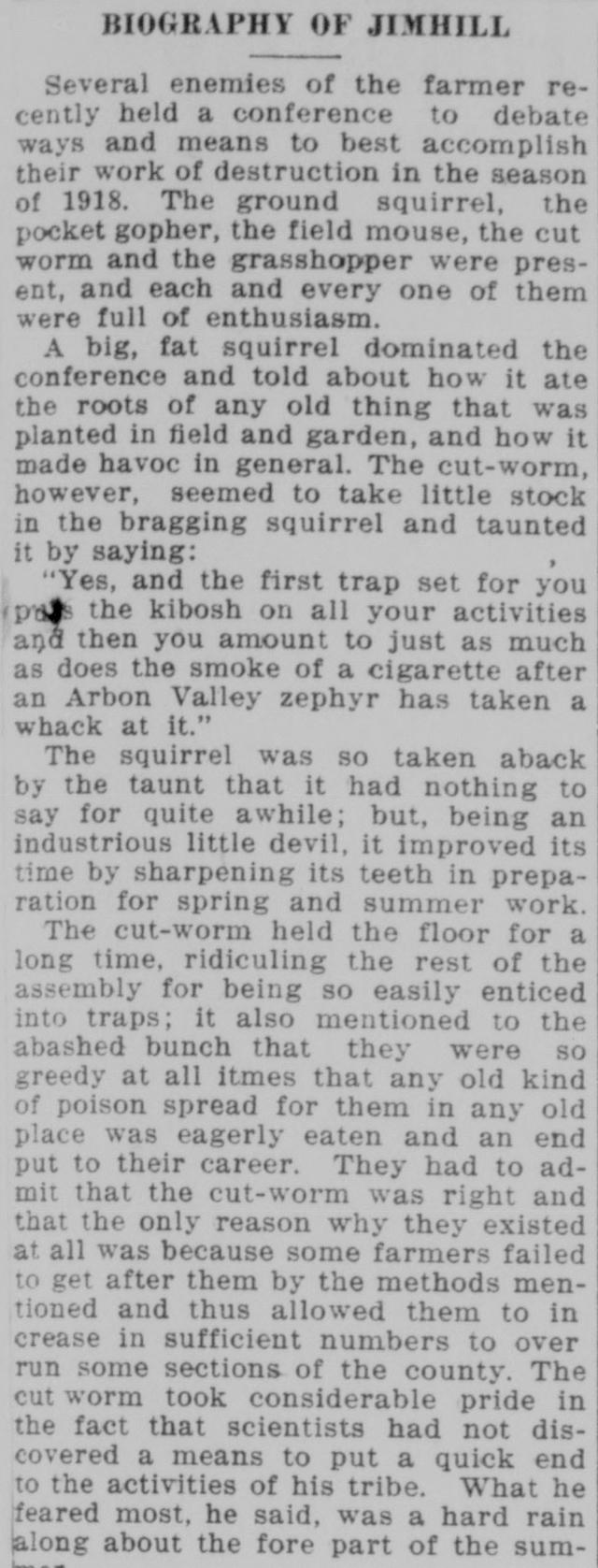
In the fall of 1917 the wheat farmers of Arbon Valley had one problem above all others: Jim Hill mustard, a weed that, once dead, rolled before the wind as a tumbleweed, still full of seed. The American Falls Press's farm writer, who signed himself "the Pilgrim," heard about it all over the valley, and in January 1918 he let the weed speak for itself.
A newcomer in the fields
In June 1915 an item among the Arbon news reminded readers, "Don't forget to pull the weeds," since the Jim Hill mustard was "getting quite numerous in the fields since the rains." D. J. Bowen later told the Pilgrim it had appeared on his ranch only in the last three years.
In September 1917 rain kept the mustard green, and many fields stood uncut while their owners waited for it to ripen. In October the Arbon column reported that Marsdon Tallon (printed Talion) had "a fine stand of Turkey Red wheat but the old Jim Hill has got almost the best of it, making it almost impossible to combine it." Tallon sent a separate header ahead of the combine to cut off the mustard tops, with Roy Porter driving the combine behind. "There are more ways than one of harvesting," the column remarked.
J. N. Arbon cut back his fall seeding because of the weed, and on T. B. Evans's promising stand "the mustard very materially cut down the yield."
Spring seeding, or the Washington way
The Pilgrim found the valley's growers "practically a unit": sow only in the spring for two or three years and accept "a few bushels less per acre." F. W. Swim, three miles south of Pauline (probably Frank Swim), planned mostly spring grain for 1918 and had raked up and burned a great deal of frost-killed mustard. D. P. Ripley, as printed (probably David B. Ripley of the east side), would seed mainly in spring for at least two years, counting on the weed law and the "co-operation of all farmers—with the emphasis on 'all.'"
Tallon disagreed. In eastern Washington, where he had grown wheat for fourteen years, he had seen mustard that "stood as high as a horse's back," and farmers there had beaten it with deep summer fallow, scraped with a "weed skinner," a twelve-foot steel blade drawn two inches under the surface whenever weeds showed. He saw no need to rely on spring seeding alone. Two valley families each credit their own pioneer with first summer-fallowing, resting a field for a season to store moisture.
The neighbors and the weed law
Worse was a neighbor's mustard. On November 20 the Pilgrim wrote:
Many of the farmers around Arbon have done their utmost to keep their lands free from mustard and other weeds, working with harrow, weeder and hoe to keep the pest out. In spite of all their efforts the mustard got the upper hand because some other rancher adjoining them left his land and went to reside in some other county or state, refusing to lease the land except on grasping and exorbitant terms.
Near Crystal, Jacob Meitzenheimer hoped the new law would reach owners who abandoned their places and were "commonly referred to as the 'weed farmers.'"
In July 1917, at the county farm bureau's request, the commissioners of Power County, which had taken in Arbon Valley from Oneida County in 1913, gave notice that the state weed law would be enforced from 1918. Where an owner would not clear his land, the county could have it done and charge the cost to his taxes. The law, the Press said, was "aimed particularly at mustard."
The weed speaks
On January 22, 1918, the Pilgrim printed "Biography of Jimhill." The ground squirrel, pocket gopher, field mouse, cutworm and grasshopper meet "to debate ways and means to best accomplish their work of destruction in the season of 1918." Then a bunch of mustard rolls in and takes over. The others sleep through the winter, it sneers: "Here it is almost the close of the year and still I am at work day and night, spreading seed right and left so it will have an early start in the spring."
It also recalls a farmer at Crystal:
One man over at a place called Crystal had a thundering idea last fall, though. We had covered his field so thick with our growth that when he came along one Sunday morning he put up a harsh line of talk and came near blistering us with the warmth of it; then he went home and came back in a little while and ran an apparatus across the field that laid whole rows of our tribe low.
A few days later he set the rows alight with matches, and then did the same in other fields. "That surely was a warm experience for us," the weed admits.
The weed's friend is "the fellow who gets title to some land and then hikes to some town or other instead of cultivating his farm. The day he leaves we take possession and in a few months we are master." This one was "raised on an abandoned ranch west of Pauline." Under the new law, if such an owner will not clean up, the county will do it and "make our friend pay for it, too." A Russian thistle tumbles in to dispute the mustard's claim to be the farmer's chief enemy, and the fable ends with its warning that if the farmers get together, "we'll roll down to destruction together."
Spring 1918
In April the Crystal column reported that B. W. McClain was "plowing his summer fallow land all over again," because some adjoining farms were so infested with mustard that he could not otherwise seed it. The papers read here do not say how the 1918 crop fared, or whether the valley formed a weed district. In January 1919 C. R. Butterfield of Crystal was proposed as the county farm bureau's executive committeeman for weed control.
The Pilgrim had already offered a last word, on November 30, 1917:
There is no question that the weed will be eradicated from the fields of this county by the united efforts of the wheat growers and the enforcement of the weed law, but it has been urged that at least one of the Jim Hill plants in first class working order be preserved and sent to the Smithsonian institute in Washington so that future generations may see what a formidable pest their forbears had to fight.
The article as printed
American Falls Press, January 22, 1918, page 3. Transcribed from the page scan.
BIOGRAPHY OF JIMHILL
Several enemies of the farmer recently held a conference to debate ways and means to best accomplish their work of destruction in the season of 1918. The ground squirrel, the pocket gopher, the field mouse, the cut worm and the grasshopper were present, and each and every one of them were full of enthusiasm.
A big, fat squirrel dominated the conference and told about how it ate the roots of any old thing that was planted in field and garden, and how it made havoc in general. The cut-worm, however, seemed to take little stock in the bragging squirrel and taunted it by saying:
"Yes, and the first trap set for you puts the kibosh on all your activities and then you amount to just as much as does the smoke of a cigarette after an Arbon Valley zephyr has taken a whack at it."
The squirrel was so taken aback by the taunt that it had nothing to say for quite awhile; but, being an industrious little devil, it improved its time by sharpening its teeth in preparation for spring and summer work.
The cut-worm held the floor for a long time, ridiculing the rest of the assembly for being so easily enticed into traps; it also mentioned to the abashed bunch that they were so greedy at all itmes that any old kind of poison spread for them in any old place was eagerly eaten and an end put to their career. They had to admit that the cut-worm was right and that the only reason why they existed at all was because some farmers failed to get after them by the methods mentioned and thus allowed them to increase in sufficient numbers to overrun some sections of the county. The cut worm took considerable pride in the fact that scientists had not discovered a means to put a quick end to the activities of his tribe. What he feared most, he said, was a hard rain along about the fore part of the summer.
The grasshopper spoke up after a while and stated that he had worked in great numbers, believing in the doctrine of united effort. He bemoaned the fact that many of his aggregation fell victims to the farmers who get up early in the morning and spread a lot of dope around the fields which, when eaten, has the effect of making "good" grasshoppers of them. He got a good deal of consolation out of the lack of co-operation of ranchmen and farmers in applying this method of extermination. What the grasshopper said about the farmers turning loose a bunch of chickens and turkeys to prey on them in the fields is not permitted to be published in this journal; nor [illegible] he said about the two-legged things that grab him in the latter part of the summer and the early fall, put him in a tobacco can, impale him on [illegible] hook attached to a fine line, and then throw the hook into a brook to let some hungry trout grab it; he said that sometimes the fish is yanked out so quickly that the same grasshopper will serve to catch two or three of the [illegible]. It made the grasshopper sad to think that many of his realtives [illegible] to such an end.
The pocket gopher and the field mouse were about to take the floor and put up a little talk of what they intended to do the coming season, but they never got a fair chance; a breeze had sprung up, originating somewhere in the lava rocks west of Pleasant Valley, and on its wings a bunch of Jimhill mustard came merrily rolling along and asked what was doing. When told of the object of the meeting, it [illegible] the leadership of the assembly in its domineering way and proceeded to tell them what's what in the way of injuring the farmer.
"You guys are all insignificant pikers," he began, "for you work only a part of the year: in the winter time you, that is those of you who survive the traps and the poison, crawl into your underground den and sleep the winter away when you might just as well be at work. Look at me: I have got the busy bee beaten a hundred ways when it comes to being industrious. Here it is almost the close of the year and still I am at work day and night, spreading seed right and left so it will have an early start in the spring. I'll tell you another thing; lots of farmers are real glad that their grain is [illegible] this fine open winter but on the [illegible] the seed I have spread is growing just as nicely. There's nothing like an early start, you know.
"Of course, I have many enemies—the same as you have. The other day I picked up a newspaper while rolling across a field of fall seeded wheat and saw three different items on one page [illegible] highbinder who wrote the stuff even said that farmers should burn me up now, what do you think of that? The dickens of it is that some of the ranchers have done that very thing while a bunch of us was hung up against a wire fence; had they waited a while longer our re-enforcements would have broken the fence down and by this time would have been rolling somewhere across the mountains to the west of Arbon valley to see how things are over there. On the way across the country we would have fixed the fields all along the route, for my tribe does not care a continental for anybody. Our business is to grow faster than the grain and show that we are master; that is the idea.
"If one farmer works incessantly and stays after us until late in the day, that makes no difference at all; [illegible] grow in some other fellow's field [illegible] hard-working farmer's fields and spread our seed. And we take [illegible] care not to sow [illegible] all in one field. You can pick up one of the members of the tribe anywhere, even after it has rolled along for miles and miles, and still you will find plenty of seed in it. As long as the farmers don't get together and go after us in unison we'll have easy picking—seeding. I mean. This thing of trying to stop us with a fence doesn't amount to a great deal, for when we get hung up we just await reinforcements and if we can't break the fence down some of us always succeed in getting over the top; then a breeze gives us a swift kick and once we get a good start at rolling it is hard to stop us.
"Oh, yes; we have enemies, but it takes united effort to get rid of us. One man over at a place called Crystal had a thundering idea last fall, though. We had covered his field so thick with our growth that when he came along one Sunday morning he put up a harsh line of talk and came near blistering us with the warmth of it; then he went home and came back in a little while and ran an apparatus across the field that laid whole rows of our tribe low. In a few days he came back again with a number of little sticks in his hand and he walked from row to row; every time he came to a row he swiped one of these little sticks across some of his wearing apparel and touched it to the row of fallen members of my tribe, and then a flame shot up and devoured the whole [illegible] That surely was a warm experience for us, and the sad part of the tale is that the same farmer went over some other fields and did the same thing over and over again.
"I saw a funny thing one time. I can tell you; I saw a man take a pitchfork on a nice quiet day and throw a whole big bunch of us away from a fence, out into the middle of the road. Pretty soon a fellow came along in a buggy which ran by itself, without any horses, and he got his wagon so badly tangled up in our stuff that he had to stop. Good gracious, but that fellow did use some awful words about us [illegible] works, and the man who forked us into the middle of the road. Now, for a week or more we had been tangled up against that fence and every minute we feared some fellow would come along with one of them dinky little sticks and put an end to us. While we lay in the middle of the road a stiff breeze suddenly came down the mountain and lifted the whole bunch of us [illegible] me, we were off on a rolling tour and made up for lost time.
"In lots of places we have been so strong in numbers that we have torn down wire fences. In other places we have been so good at growing that last summer some framers could not cut their wheat because we had kept down so low that it was not worth cutting.
But I must admit that we also have some good friends among the people. For instance, there is the fellow who gets title to some land and then hikes to some town or other instead of cultivating his farm. The day he leaves we take possession and in a few months we are master. You see, we can grow our [illegible] on such a place unmolested and can easily spread [illegible] all over the country from this base. Such abandoned ranches are found in lots of places and we travel far and wide. I have been all over the county myself. I was raised on an abandoned ranch west of Pauline and have been as far east as the depot platform at Pocatello but that outfit that owns that place have got a floor so hard that it was useless to have any seed there. I did the next best thing, from my point of view, and rolled to American Falls along the railroad track, and if you want to see what I did on the way just take a stroll along the track in the spring [illegible] east of American Falls you will [illegible] bare spot about a yard square [illegible] nothing will ever grow there, because a fellow dropped a suit [illegible] and broke [illegible] I don't know what the stuff [illegible] but I noticed that the fellow drank some [illegible] before it all ran out [illegible] he grabbed [illegible] and that after [illegible] rolled worse [illegible] did.
I took a roll down the Clifton creek road from [illegible] one day but didn't waste much time there; two of these abandoned ranches are on that road and my cousins are working overtime on them. But I did stop long enough to hear a farmer say that he was willing to bet his last war savings stamp that these blankety-blank ranches will be taken care of the coming season, and when he said it he [illegible] for my tribe. It seems that a bunch of fellows over in Boise—that's [illegible] a crowd meets every [illegible] must and must not do—put some printing on a paper and that another fellow whom they call the governor, put his name at the bottom of it, and that this paper says that any bunch of farmers can get together and compel the owner of any piece of land who lets us grow unhindered to clean us out and destroy us, and that if he does not do so the county officials will see to it that it is done and make our friend pay for it, too. That's a fine way to treat our friends, isn't it? And then they talk of liberty and freedom and such. Well, I listened to that talk and then I beat it over to Little creek and got in some fine work there for awhile. After that I rolled over some hills and tarried awhile on [illegible] creek, and on my way to Neeley I came across the place where the Warm Springs reservoir used to be and found it so nice that I rolled around there quite awhile. Next spring the evidence of my visit will be seen on every hand over there.
But I can tell the whole bunch of you confederates that we are all doomed if the farmers get together and do what those fellows in Boise said they can do. And I want to say farther that in my travels all over this and other counties I have found that the only real friend we've got is the fellow who leaves his farm to us. Now that they have got after him with one of those papers signed by the governor I don't see how we can survive much longer. You pikers can [illegible] rid of by poison and traps and you are [illegible] to much glory: no one ever gave a whole ranch for you to [illegible] up in by the million, and not one of [illegible] can travel as rapidly and as far as I have done, and all of you together have not done as much damage as I have. But until the farmers all get after me and my tribe, until then, I say, I insist that I am the chief guy in the ranks of the farmer's enemies and you fellows can't even get a place in my cabinet. I am an autocrat and [illegible] along without a cabinet. Get that?"
Just as the mustard plant delivered this ultimatum a merry laugh was heard without, and then a Russian thistle plant came tumbling in.
"You are quite a guy, to hear you say it," said the Russian thistle, "but I want you to know that my hat's in the ring when it comes to being the chief guy in the army of the farmer's enemies. I am here with seeds on, just as many as you have, and I don't intend to stand for your going it alone as the chief guy. I roll on forever and ever, the same as you do: and, like you, I fear nothing but fire or the concerted action of the farmers. I am willing to try conclusions with you in any way you say; am even willing to go with you to one of these abandoned ranches and grow side by side with you, and then we will see who will smother out the other fellow."
"How foolish you talk," said the mustard. "Can't you see the folly of your proposition? Suppose I kill you out, or you kill me out. That, in either event, would leave only one of us. If I was you I would go out and take a long roll for myself and keep going. You take one side of a section of the country and I'll take the other. At any rate, I don't like you for a neighbor: you are too rough. Every time a fellow touches you he's stung. I'm putting up a line of talk here, telling these boobs here what sort of pikers they are and you are buting in and try to lessen my prestige. Beat it, get out. I take in more territory than you do, and I lay claim to being the chief."
"Well," replied the Rusian thistle, "perhaps you are right, but from what I saw in the papers I am included in that law paper those Boise guys got up and if the farmers get together we'll roll down to destruction together."
Sources
- American Falls Press, June 17, 1915, page 1
- American Falls Press, July 10, 1917, page 1
- American Falls Press, July 24, 1917, page 1
- American Falls Press, September 7, 1917, page 8
- American Falls Press, October 5, 1917, page 3
- American Falls Press, October 9, 1917, page 4
- American Falls Press, October 26, 1917, page 3
- American Falls Press, November 6, 1917, page 3
- American Falls Press, November 20, 1917, page 3
- American Falls Press, November 27, 1917, page 3
- American Falls Press, November 30, 1917, page 3
- American Falls Press, December 14, 1917, page 3
- American Falls Press, January 22, 1918, page 3
- American Falls Press, April 23, 1918, page 4
- American Falls Press, January 24, 1919, page 1