Arbon had wheat to sell in the fall of 1908, about 45,000 bushels of it, and a long way to haul it. So on a Tuesday morning in November, probably the 17th, Wilson Barnard took a small crew out to Bannock Creek and started a new wagon road over the foothills to American Falls. The county had given him $300 to build it.
The valley belonged then to Oneida County, run from the county seat at Malad; Power County would not exist until 1913. The settlers’ first way out had been Rocky Ridge, toward Malad, hardly more than an old trail that their wagons had worn wider. In July 1907 the American Falls Press noted that the county had renumbered its road districts, and Arbon was now Road District No. 10. When the commissioners handed out road money the next spring, Rockland and Neeley got some, but “No appropriation for the Bannock road made, as no petition was received.” A road meeting set for the second week of May promised “the Arbon road given consideration.” Whether the Bannock road and the Arbon road were one and the same, and what the meeting settled, the paper never said.
A shorter haul for the wheat
Early that November J. L. McKown of American Falls toured the valley and came back full of praise for its dry farming. The Press, writing up his trip, added that “a water-grade road can be built into American Falls,” which is to say a road of gentle, even slopes. A week later the Arbon postmaster, J. R. Bailey, was in town, and on November 14 the paper passed along his news:
An appropriation of $300 has been made for a new road to the valley which Mr. Bailey believes will shorten the distance ten or twelve miles and bring the lower end of the valley within about fifteen miles of American Falls, with a water grade most of the distance. An ordinary team of horses will bring about thirty sacks of wheat to market here without difficulty.
That same month sixteen wagons from Arbon hauled a carload of wheat to Michaud switch, between American Falls and Pocatello. “American Falls is the natural market for Arbon,” the Press insisted, but the machinery for the town’s elevator had yet to arrive.
Out on the survey
The money, it seems, had been voted some months before, and now it was to be spent without delay. A committee was named to help choose the line: James Bailey, Julius Abter and Otto Anderson. The James Bailey was almost surely J. R. Bailey, the postmaster who had carried the news the week before, and the Otto Anderson of the paper’s spelling was probably Andrew “Otto” Andersen. At the committee’s request, McKown joined them from the American Falls end.
Barnard, the district’s road overseer, rode out with H. G. Hawley, an engineer with the firm of Moench & Hawley, to look for a route over the hills. Someone had surveyed one earlier, but the two men hoped to find gentler grades. As planned, the road would cross Bannock Creek a good way upstream from Rocky Ford, climb into the foothills and come down near C. C. Robinson’s place, east of town, saving ten miles at the least.
Ben McQueen, Frank Allen and Allen’s son made up the rest of the crew. They broke ground roughly a mile upstream from Rocky Ford, at Big Joe’s place on the Bannock, near a rocky butte that stands in the creek bottom. The creek was thought to be crossed at an old bridge. From there the line swung around the hill on an easy climb to the flat and ran on across open country toward town, keeping close for perhaps three miles to a line the government had lately surveyed for extending the Ross Fork canal.
Hawley reckoned the climb out of the valley would average about two per cent, with nothing as steep as five, and an easy run down from the summit into American Falls. He admitted that $300 could not build the road as well as it deserved. Still, he said, it would carry heavy loads and take an hour or two off the trip, and it should be open to teams in a few days.
A week later Barnard, by the paper’s account, had the steepest pitch at 4.6 per cent, and only for a short stretch. The roadbed was ideal, he said, and the road would rank among the county’s best. The trouble was money. The $300 would run out about $50 before the work was done, and with so much wheat waiting to go to market, the Press said, people were trying to raise the difference.
The road goes quiet
That is the last clear word on it. No report of the road’s completion has turned up, and no one knows whether the missing $50 was ever found.
In May 1909 the Press ran a joking account of an automobile trip out along “the proposed route to Arbon.” The car gave out at Rattlesnake gulch, some thirty miles along, and the piece closed: “No report has been made on the proposed road between American Falls and Arbon.” It did not say whether that meant Barnard’s road or some new line. Later the same month two Oneida County commissioners, Harding and Rowe, came up from Malad on road business, and “They came overland, via Arbon.”
That December, in a quarrel over a road near Igo, north of American Falls, the letter writer A. F. Hughes predicted that the road in question would “meet the same fate that the Arbon road has.” What that fate was, he left unsaid.
In July 1911 the county surveyed still another road to Arbon, this one over the Moonshine country. The Press set its grades against those of “the road built two years ago,” which had “a long stretch of 14 per cent and one 17 per cent grade.” The paper gave that road no name, and two years back would mean 1909. If it was Barnard’s road, those figures are far from the 4.6 per cent reported in 1908; if it was another, the pages found so far say nothing more about the road of 1908.
The site’s account of the first engineered road out of the valley sets this road beside the Jenson Pass road toward Malad, and the history of the Arbon area tells of the settlement it was built to serve. For a few weeks in 1908, at least, that settlement had a road crew working its way toward town, and a grade a loaded team could climb.
The original article
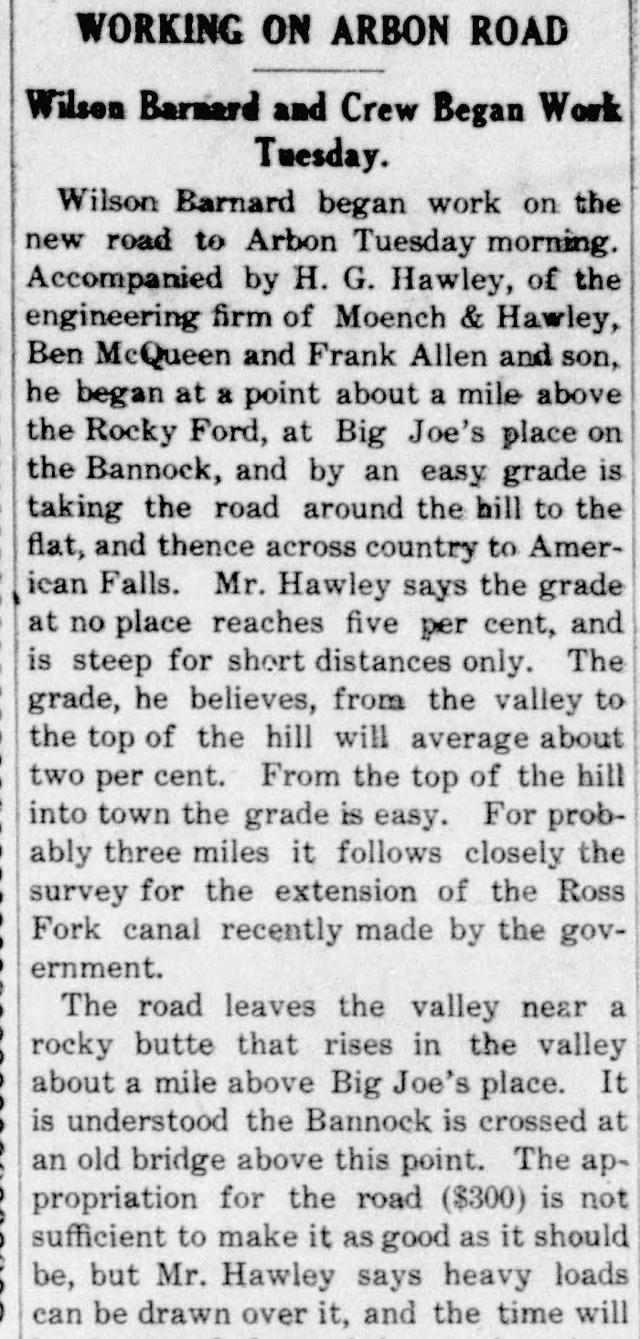
American Falls Press, November 21, 1908, page 1. Transcribed from the page scan.
WORKING ON ARBON ROAD
Wilson Barnard and Crew Began Work Tuesday.
Wilson Barnard began work on the new road to Arbon Tuesday morning. Accompanied by H. G. Hawley, of the engineering firm of Moench & Hawley, Ben McQueen and Frank Allen and son, he began at a point about a mile above the Rocky Ford, at Big Joe’s place on the Bannock, and by an easy grade is taking the road around the hill to the flat, and thence across country to American Falls. Mr. Hawley says the grade at no place reaches five per cent, and is steep for short distances only. The grade, he believes, from the valley to the top of the hill will average about two per cent. From the top of the hill into town the grade is easy. For probably three miles it follows closely the survey for the extension of the Ross Fork canal recently made by the government.
The road leaves the valley near a rocky butte that rises in the valley about a mile above Big Joe’s place. It is understood the Bannock is crossed at an old bridge above this point. The appropriation for the road ($300) is not sufficient to make it as good as it should be, but Mr. Hawley says heavy loads can be drawn over it, and the time will be shortened from Arbon to American Falls from one to two hours. The road will be open for travel within a few days.
Sources
- American Falls Press, July 27, 1907, page 5
- American Falls Press, April 18, 1908, page 1
- American Falls Press, November 7, 1908, page 1
- American Falls Press, November 14, 1908, page 1
- American Falls Press, November 21, 1908, page 1
- American Falls Press, November 28, 1908, page 1
- American Falls Press, May 8, 1909, page 1
- American Falls Press, May 29, 1909, page 4
- American Falls Press, December 25, 1909, page 8
- American Falls Press, July 6, 1911, page 1