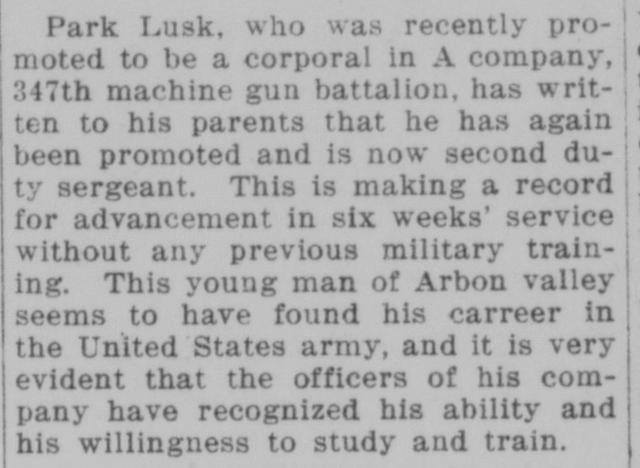
Park Lusk had been in the Army six weeks, with no soldiering behind him, when word reached his parents in October 1917 that he had been made a corporal and then, soon after, second duty sergeant in A company of the 347th machine gun battalion. The American Falls Press passed the news along in the Pilgrim’s column “Along the Highways” on October 30, and it judged the young man of Arbon Valley to have found his career.
He was one of two Lusk brothers from Pauline, at the north end of the valley, who married two of J. R. Bailey’s daughters from Arbon. Over the next half-century the papers followed them through the war, a young wife’s death in 1922 and, at last, a run of obituaries in Utah papers from 1952 to 1960.
Malad and Wellsville
The Lusks were a Malad family. They spent their summers on a ranch on Rattlesnake Creek, at the place now called Lusk Loop. The Baileys had moved to Arbon from Wellsville, in Utah’s Cache Valley. Until Power County was formed in 1913, Arbon belonged to Oneida County.
The obituaries would later bring both families into the valley in the second half of the 1890s. The family accounts date the Lusks’ arrival to 1888 and James R. Bailey‘s settling to 1894.
Dave and Anna
The elder brother, David Thomas Lusk, known as Dave, was born at Malad in 1888. He had entered a homestead near the eastern mountains in 1910, and in August 1913 the Press gave notice that he would make final proof on it. That was the last step in proving up: the settler and his witnesses swore that he had lived on the land and worked it, and the patent came after. The family history says he married Susannah Bailey, called Anna or Annie, at Pocatello on December 24, 1913. No newspaper account of that wedding has turned up.
The Pilgrim, the Press’s roving farm correspondent, stopped at Dave’s ranch in the fall of 1917, and in November he wrote up the visit:
Dave Lusk has a little son three years old, and the little rancher is about as lively and active a chap as can be found anywhere. The other day the Pilgrim was at his father’s ranch and the little fellow announced his coming by telling Mrs. Lusk that the “Program” was here. The appellation was not so far off, either, as the Pilgrim came to Arbon valley with a well defined program and carried it out.
The boy was probably their eldest, John Paul.
Park and Erma
Edward Park Lusk, Dave’s younger brother, was born at Malad on Christmas Day 1895. The draft of 1917 took him. On September 12 Central Hall held a social for “our boys who are soon going to leave,” and his name led the list of seven. By the end of October came the news of his two promotions.
In April 1918 Sergeant Lusk was back from Camp Lewis, at American Lake in Washington, “on ten-day furlough.” Pauline threw a party for him, and on Saturday, April 13, he returned to camp. The day before, by the family history, he had married Erma Bailey at Pocatello. She was seventeen. His 1960 obituary put that wedding on April 13, 1917, but the papers of the day point to 1918: he was home on leave that April, and in 1922 the Press placed the marriage about four years back.
Word came in February 1919, three months after the Armistice, as the Press reported:
Mrs. Park Lusk received word that her husband was in a hospital in France wounded, but does not know how serious. Several of the letters she had written to him were returned with the word wounded written on them.
Nothing more is known of his wound, which the Stories pages count among the valley’s wounded in France. By August 1919 he was home again and visiting his parents at Malad with Erma. On July 10, 1920, their second son, Ralph, was born in his grandmother Lusk’s house at Malad, “a fine big boy,” in the paper’s words.
Winter of 1922
Erma took pneumonia in February 1922. After ten days’ illness she died at Pauline on February 24, not quite four weeks past her twenty-first birthday. When the Press reported her funeral in the Pauline meeting house, it wrote, “She married Park Lusk about four years ago,” and named the two little boys she left behind: Park, three, who was James Park, and Ralph. Her father dug her grave through the snow next to that of her sister Jennie in the Arbon cemetery, as the Stories entry recounts. The same column said Park had taken the children to his parents at Malad until spring.
The family history says Dave and Anna brought the two boys up on the Lusk ranch along with their own children, double cousins near them in age. The boys stayed on with them after Park married Jessie Noble Daniels on October 20, 1927, the family’s date; his obituary gave October 24.
The last notices
The sisters’ brother went first. Melvin Kerr Bailey was born at Wellsville in 1895 and, according to the Salt Lake Tribune, came to Arbon Valley as a baby. He grew up to farm and run cattle there. A poorly scanned Tribune report says a heart attack killed him on the morning of Friday, May 9, 1952, while he was working near his home. Among those he left were his widow, Stella, and his sister Mrs. Dave Lusk.
Dave Lusk died after an illness on Wednesday, December 9, 1953, at 65. The Deseret News placed his death in a Salt Lake hospital; the family history says Pocatello. The paper called him a “prominent Arbon Valley farmer” who had moved to the valley at nine and been schooled there and at Malad. Of his sons, David W. was at Arbon and Vernon was serving in Japan with the Army’s Counter-Intelligence Corps.
Park Lusk died on Monday, March 21, 1960, at 64. The short Tribune notice listed his home as Fort Hall, set down both marriages, said the second had ended in divorce and remembered his service in the First World War. Erma’s sons were living at Fort Hall and at Arbon. The sergeant who had climbed so fast in 1917 got a working life of five words: “Farmer at Arbon many years.”
The original article
American Falls Press, October 30, 1917, page 3. Transcribed from the page scan. The Park Lusk item stands in the Pilgrim’s column “Along the Highways,” given here whole.
ALONG THE HIGHWAYS
Gleanings by the Pilgrim in His Wanderings Here and There.
Newell Leishman, a young bachelor, four years ago homesteaded a 320 acre tract located two and a half miles west of Arbon, snug up against the foot of Bowen’s peak. That young rancher has been industrious in the development of his homestead is attested by the 150 acres in cultivation. This year he harvested some fine No. 2 Turkey Red, and is preparing to harvest an increased acreage the coming year. He is within the registration age for military service and if called upon by Uncle Sam to serve as a soldier will answer “present” and put in no claim for exemption.
W. E. Dawson, who owns and farms a quarter section of fine land, one mile southwest of Pauline, this year harvested an average of 12 bushels of Turkey Red wheat from 130 acres on this ranch, and from 150 acres which he is farming on the Fort Hall reservation he harvested from 10 to 14½ bushels per acre of Turkey Red. Dawson is well pleased with his yields this off year and has plans laid to put every available acre into wheat for 1918. His ranch has been named the Valley View farm, an appropriate name, since from Mr. Dawson’s home, a comprehensive view of Arbon valley may be had. In no small measure does Mr. Dawson attribute his success as a rancher to the fact that he remains on the farm throughout the year—summer and winter.
Mr. Roy Humphrey has sold all his mules except one team. He disposed of two spans of mules last week for $650, and one other span brought $300. Mr. Humphrey has a ranch two miles east of Arbon and will hereafter use horses on the farm. Besides raising grain he intends to go into the business of raising horses, range grazing land being close at hand in the mountains to the east of the valley.
What is wanted from the weather factory just now is one good soaking rain to put the ground in better shape for plowing and seeding. The same good soaking rain would also show the dust that it can’t be the whole thing all the time.
E. L. Davis, a rancher two miles northeast of Arbon, this year threshed 1100 bushels of Turkey Red wheat, which tested a shade better than 60 [illegible] seeded [illegible] acres to Turkey Red [illegible] is an optimist and has faith in the valley.
Park Lusk, who was recently promoted to be a corporal in A company, 347th machine gun battalion, has written to his parents that he has again been promoted and is now second duty sergeant. This is making a record for advancement in six weeks’ service without any previous military training. This young man of Arbon valley seems to have found his carreer in the United States army, and it is very evident that the officers of his company have recognized his ability and his willingness to study and train.
Ernest Poppie has sent his mother, Mrs. Ernest Poppie, several photographs of Camp Lewis at American Lake, Wash. This young man of Arbon valley is getting along well in the service of Uncle Sam and will make good as a soldier.
D. B. Ripley, whose ranch home is three and a half miles southeast of Arbon, has about 40 acres of dry land alfalfa, seeded in 1913, which regularly gives two good cuttings each season and the big stacks of hay in the stockyard show that the tonnage harvested is heavy. Last winter during the hay shortage this rancher had hay to sell and the alfalfa fields of the ranch are a better revenue maker than the grain fields. This ranch has some fine meadow land and eventually all of it will be seeded to alfalfa.
While hiking along the road on the east end of peaceful Arbon valley on Sunday noon the Pilgrim was challenged by a critter of the two-year-old heifer variety and had to perform a quick sidestep to get out of the way of the wild-eyed fool. About 100 yards north of the D. B. Ripley ranch the animal was coming north and the Pilgrim was headed south on a highway at least 60 feet wide. As is customary with range cattle, the four-footed wayfarer stared at the strange sight of a man afoot; usually the range cattle beat it in the opposite direction, but this time there was nothing doing in the “beat it” line. The heifer took the middle of the road charged the hiker, and but for the fact that a hat was thrown in its face and some quick sidestepping done an accident might have resulted. It is all well and good to learn new things from day to day, but this business of playing at being a torreador is not in the curriculm. And further, this blear-eyed critter should be ashamed of itself acting in that way after all the nice things that have been said about cows in the chronicles of this column—it is plain to be seen that it is an ungrateful brat. No damage was done, except that a nice black hat worn only a year and a half was considerably mussed up.
The weather witch on Bannock peak sent down the first snow of the season on Friday morning, October 26. The roads on the east side of the valley were well covered with snow in the early morning, but the sun soon conquered it. During Saturday night the snow valve was again opened and on Sunday morning the mountains on both sides of the valley were well covered with snow and the valley itself had its share of the stuff. This time the sun did not succeed in driving the snow off the mountains, and it seems that the higher peaks have their snow caps for the season.
Sources
- American Falls Press, August 21, 1913, page 7
- American Falls Press, September 18, 1917, page 4
- American Falls Press, October 30, 1917, page 3
- American Falls Press, November 20, 1917, page 3
- American Falls Press, April 9, 1918, page 3
- American Falls Press, April 30, 1918, page 4
- American Falls Press, February 7, 1919, page 6
- American Falls Press, August 1, 1919, page 2
- American Falls Press, July 16, 1920, page 3
- American Falls Press, March 10, 1922, page 4
- Salt Lake Tribune, May 10, 1952, page 19
- Deseret News, December 11, 1953, page 38
- Salt Lake Tribune, March 24, 1960, page 31