From Malad, Idaho · earlier American (Illinois and Tennessee); Wales (Annie Thomas Lusk, emigrated about 1875)
John Winters Lusk Jr. of Malad and his Welsh-born wife Annie came to the north end in 1888 by the family’s account; the oldest record is their Rattlesnake Creek water right with an 1892 priority on the Lusk Loop fields, which Annie patented in her own name in 1913. His brother Perry ran a West Fork ranch from 1906–07 to the mid-1930s and was a Power County commissioner (1923–25); his son David Thomas homesteaded near the eastern mountains and built the Lusk Loop ranch that three generations of Davids have run.
Arrived
By 1892 (decreed water priority, Lusk Loop); 1888 in the family account, 1889 on the original ArbonValley.com no later than
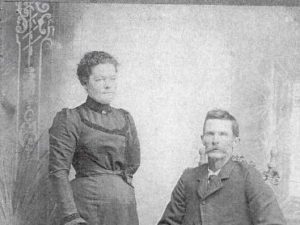
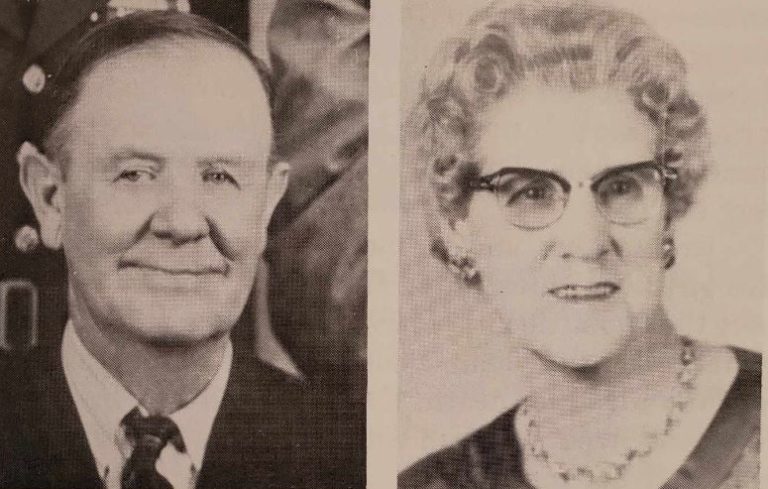
John Winters Lusk Jr. and Annie Thomas LuskDate unknownFOREWORD · THE ORIGINAL ACCOUNT
From the family history
The account first written for this family on ArbonValley.com, kept in full. The chapters after it add what the records and the other family histories tell.
Written by Jacob Andersen1 minute read
About this account · first posted December 30, 2018
Written for the original ArbonValley.com by Jacob Andersen. Memories and documents quoted in the account belong to the people who wrote them. This is the website publication date, not the date of every event described. References to “today” belong to the original account.
The Lusk name is associated with one of the earliest claims in the Bannock Valley. Before the area was officially opened for homesteading, many settlers set up squatter’s rights that they later acquired officially through the Homestead Act. John Winters Lusk Jr. had a Possessory Claim in the Big Meadows (West Fork Area) in 1889. He also acquired water rights on the South Fork of Rattlesnake Creek in 1889. He and his wife Annie both later acquired homestead claims, which were completed in 1913. Idaho wasn’t even a state until two years later.
John’s brother, Perry Park Lusk, also homesteaded in Arbon Valley in 1909, having purchased an existing ranch there in 1906.
By the family account John Lusk Jr. and Annie came in 1888 with their two small daughters, stepped off squatters’ claims before the survey and built a one-room cabin by the creek and a spring; tall creek grass was mown for hay, and Annie Thomas Lusk was the only one who could milk one big cow. The original ArbonValley.com places this first claim in the Big Meadows of West Fork, but all of the family’s documented land and water lay at what is now Lusk Loop: a Rattlesnake Creek right decreed in 1907 with a priority of April 1, 1892, Annie’s desert-land claim of 1908, patented to her in 1913, and John’s forty-acre purchase of 1914. For decades the family summered on the ranch and wintered in Malad, where the 1900 and 1920 censuses list their home.
Perry Lusk worked eight years for his brother-in-law Lorenzo Lloyd Evans, the Malad and American Falls cattleman and banker (not Lorenzo B. Evans of Arbon), before buying the Tom Williams ranch in West Fork — in 1906 by the family account, though Williams made final proof only in March 1907. He homesteaded the adjoining lots against the reservation line (patent 1916) and built a large T-shaped log house that became a gathering place. He was a Pauline school trustee and a Democratic Power County commissioner from 1923 to 1925. About 1935–36 the family moved to its own farm at Bonanza Bar on the Snake River, and the West Fork ranch went to the United States in the reservation purchases (in spring 1939 by the family account).
David Thomas Lusk homesteaded near the eastern mountains in 1910 and married Annie Bailey; in 1927 he and his brother Park bought their parents’ ranch, and he added the Hatch and Horton homesteads and others around it. After Park Lusk’s wife Erma (Annie’s sister) died in 1922, David and Annie raised Park’s two boys with their own. Their son David Wayne chaired the school board, led the branch from 1967, and coached the women’s softball team; Steve Lusk kept the valley’s roads open for nearly forty-seven years.
The Lusks are bound into the north end by marriage: Henry M. Bolingbroke’s wife Mary Elizabeth was a Lusk; three Lusks married Baileys; Park’s second wife was Jessie Noble Daniels; and Perry’s daughters married the Bischoff brothers, Julius Meuleman and Jack Noble. In 1999–2000 CaroLynne Lusk and then Helen S. Lusk took charge of the Arbon post office, and the Lusk Loop ranch is still run by the family.
Earlier: Pleasant Grove, Utah (John W. Lusk Jr. born 1859). Route drawn only between places named in the family history; the lines are schematic, not trail routes.
Pleasant Grove, Utah (John W. Lusk Jr. born 1859)
Wellsville, Cache Valleyabout 1859–66
Malad, Idaho1866
Lusk Loop, north end of Bannock Valley1888 (family account); water priority 1892
35 people of the Lusk family on the valley map, household by household, and 5 histories of their own in the archive. Names open their histories; portraits open in the family album.
The households 4
Each with the people who married in, and their children and grandchildren below, oldest first.
JW
John Winters Lusk Sr.
1829–1899
Father of John W. Lusk Jr., Perry Lusk and (probably) Mary Elizabeth Lusk Bolingbroke by Esther Catherine Park; also father of a second family by Martha Tidwell
More about John
An early Latter-day Saint convert from Illinois who reached Utah in 1851, lived at Pleasant Grove and Wellsville, and settled at Malad in 1866. His wife Esther Park (1838–1893) was a Malad Relief Society counsellor. Through his children the Lusks were tied to the Bolingbrokes and to L. L. Evans of American Falls.
Held one of the earliest claims at the north end: by the family account he and Annie stepped off squatters’ claims at what is now Lusk Loop in 1888, and his Rattlesnake Creek water right there was decreed with a priority of April 1, 1892. The family wintered in Malad. “Never found a horse he couldn’t break.”
Youngest brother of John W. Lusk Jr.; husband of Blanche Wilkes (married July 22, 1903, by the county record; 1902 in family accounts)
More about Perry
Worked eight years for his brother-in-law Lorenzo Lloyd Evans, the Malad and American Falls cattleman and banker, before buying the West Fork ranch; built a large T-shaped log home and good stock herds. Pauline school trustee (1920–21) and Democratic Power County commissioner (January 1923 – January 1925). The family moved to its own farm at Bonanza Bar on the Snake River about 1935–36, and the West Fork ranch passed to the United States in the reservation purchases (spring 1939 by the family account).
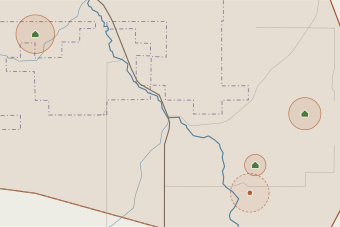
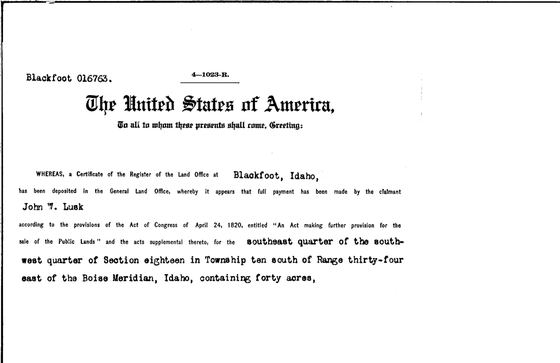
East side of the valley south-east of Pauline. John W. and Annie Lusk’s ranch: the 1892-priority water right on the Sec. 13 forties, Annie’s desert-land patent of 1913 (SE¼NE¼, NE¼SE¼ Sec. 13 T10S R33E; Lots 2–4, SE¼NW¼, SW¼NE¼, NE¼SW¼ Sec. 18 T10S R34E), John’s forty acres (1914) and Park’s (1921), later David T. Lusk’s; three generations named David have run the ranch. Both map versions place the Lusk circle here, on present Lusk Loop, and a 1954 USGS map labels “Lusk Ranch” nearby.
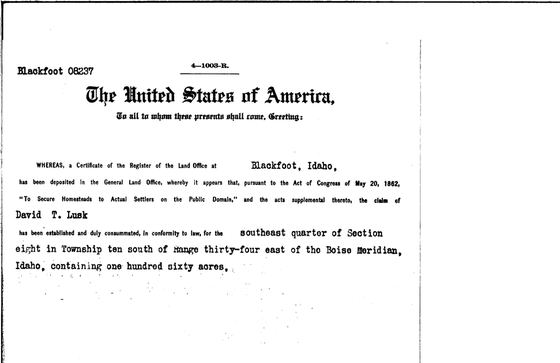
David Thomas Lusk’s homestead “nearer the east mountains”: the SE¼ of Sec. 8 T10S R34E, entered May 20, 1910, and patented in 1914, part of the Lusk ranch.
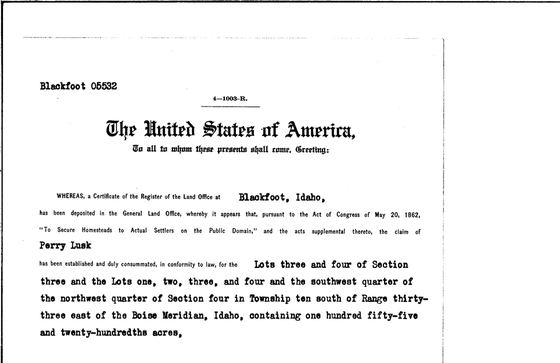
Perry Lusk’s West Fork ranch: the Thomas Williams homestead he bought (S½NE¼, SE¼NW¼, NE¼SW¼ Sec. 4 T10S R33E; Williams entered it in 1901 and proved up in March 1907) and his own homestead on the north-tier lots of Secs. 3–4 against the reservation line (patent 1916). Neighbours were the Daniels, Price and Fink homesteads. The family moved away about 1935–36, and the ranch passed to the United States (in spring 1939 by the family account); it is now within the Fort Hall Reservation.
Park Lusk’s 40-acre homestead, the NW¼SE¼ of Sec. 18 T10S R34E, patented January 13, 1921, inside the Lusk Loop ranch. The Dave Lusk & Sons irrigation well of 1962 and part of its place of use are on this forty.
The land patents
The federal patents that made the homesteads theirs, from the General Land Office records.
Every date the valley map shows when you follow the Lusk family, era by era: the most telling of each era first, the rest a click away. Dates keep the sources’ own wording.
Homestead or landFamily historyEventValley firstTragedy
BEFORE 1884 · 4 DATES
Before Homesteading
A Shoshone and Bannock homeland; trails, travelers and cattle range.
November 1859Family history
John W. Lusk Sr. on the first Cache Stake high council
John W. Lusk Sr., a convert of the Nauvoo years who had reached Utah in 1851, was named to the first high council of the Cache Stake at Wellsville in November 1859.
John Winters Lusk Sr.
1866Family history
The Lusks move to Malad
In 1866 John W. Lusk Sr. moved his families from Wellsville in Cache Valley to Malad, where John Jr. and Perry grew up.
Annie Eliza Thomas, the youngest of nine children of Thomas and Ann Thomas, came from Wales with her parents about 1875, her older sisters having gone before; the family settled at Malad.
When the Malad Relief Society was reorganized in June 1879, Esther Lusk, mother of John Jr. and Perry, was named a counsellor; her 1894 memorial says she served about twenty years.
1884–1892 · 5 DATES
Early Claims
Possessory claims and water rights before the valley opened.
1884–1892Event
Possessory claims and water rights
Before the valley was formally opened to homesteading, settlers took up “possessory” claims — squatter’s rights — and filed on water. When homesteading opened they had to file again and prove up over five years. The oldest dated settler records are water rights on Rattlesnake Creek with a priority of April 1, 1892 (Daniels, Lusk and Bolingbroke), decreed in 1907; the family dates of 1884–89 have not been found in any record. Until the townships were surveyed in 1901 the only federal claim open was the desert-land entry, which Lorenzo Evans (1894) and Gertrude Daniels (1895) used.
1887Event
Daniels water right from West Fork (family account)
By the archive’s account David Daniels was granted a water right on the Bannock Creek drainage from the West Fork in 1887; under the arrangement it describes, tribal members holding 812 acres had first right, the Big Meadows owners (Bolingbroke, Lusk, Price) second, Dave Daniels third, and Henry Daniels and Tom Price a right dated 1891. No 1887 or 1891 Daniels or Price right appears in the decree records of the Bannock Creek Decree (United States v. Daniels, 1907). There the Shoshone-Bannock Tribes’ rights carry the oldest priorities, and the earliest settler priority is April 1, 1892, shared by the Daniels, J. W. Lusk and John Bolingbroke rights on Rattlesnake Creek.
April 18, 1888Family history
A Lusk homestead near Malad
A 160-acre homestead near Malad, the SE¼ of Sec. 26 T13S R36E, was patented to a John W. Lusk in April 1888, possibly John Sr.
John Winters Lusk Sr.
1889Event
Bolingbroke and Lusk claims on Rattlesnake Creek
By the family accounts Henry Mitchel Bolingbroke and other settlers filed water rights on Rattlesnake Creek in 1889, before homesteading opened, and John Winters Lusk Jr. took a possessory claim and water rights the same year (1888 in the Lusk family’s own account). The rights that survive were decreed in 1907 with a priority of April 1, 1892 — “John Bolingbroke” on the Bolingbroke home ranch and “J. W. Lusk” on the Lusk Loop fields — the same priority as the Daniels right. The original ArbonValley.com places the Lusk claim in the Big Meadows of West Fork; all of the Lusks’ documented land and water lay at Lusk Loop.
Lusk Loop ranch: John W. and Annie Lusk’s claim (water priority 1892; Annie’s patent 1913), later David T. and David Wayne Lusk
East side of the valley south-east of Pauline. John W. and Annie Lusk’s ranch: the 1892-priority water right on the Sec. 13 forties, Annie’s desert-land patent of 1913 (SE¼NE¼, NE¼SE¼ Sec. 13 T10S R33E; Lots 2–4, SE¼NW¼, SW¼NE¼, NE¼SW¼ Sec. 18 T10S R34E), John’s forty acres (1914) and Park’s (1921), later David T. Lusk’s; three generations named David have run the ranch. Both map versions place the Lusk circle here, on present Lusk Loop, and a 1954 USGS map labels “Lusk Ranch” nearby.
Homesteads, the first ditch, and the first winters.
1895Event
Stockmen settle the north end (later Pauline)
Latter-day Saint stockmen, among them the Daniels brothers, located at the north end of Bannock Valley “in 1895 and following years” (Jenson); the original ArbonValley.com account’s 1895 list also names Bolingbroke, Davis, Evans and Lusk families. Federal homestead entries at the future crossroads began in March 1901 (Thomas D. Daniels), and Pauline grew into a named crossroads with a store, post office and ward from 1911, on the roads to American Falls and Pocatello. The original ArbonValley.com account’s wider, undated list of “prominent first residents” adds the Nobles and Kowallises, who came in 1905 and 1909.
1900–1912 · 19 DATES
Early 1900s Growth
Schools, churches, stores and post offices in every area.
June 1900Family history
A Malad home for the winters
The June 1900 census counted John W. and Annie Lusk and their children at Malad. By the family’s account they kept a brick house there and spent summers on the Bannock Valley ranch, wintering in Malad so the children could go to school.
Perry Lusk’s West Fork ranch: the Thomas Williams homestead he bought (S½NE¼, SE¼NW¼, NE¼SW¼ Sec. 4 T10S R33E; Williams entered it in 1901 and proved up in March 1907) and his own homestead on the north-tier lots of Secs. 3–4 against the reservation line (patent 1916). Neighbours were the Daniels, Price and Fink homesteads. The family moved away about 1935–36, and the ranch passed to the United States (in spring 1939 by the family account); it is now within the Fort Hall Reservation.
Anna E. Lusk of Arbon made a desert-land entry for 299 acres in Sec. 13 of T10S R33E and Sec. 18 of T10S R34E, the core of the Lusk Loop ranch, which was patented in her own name in 1913.
David Thomas Lusk’s homestead “nearer the east mountains”: the SE¼ of Sec. 8 T10S R34E, entered May 20, 1910, and patented in 1914, part of the Lusk ranch.
In June 1911 the north part of the Arbon Ward was set apart as the Meadow Ward, with Wilhelm F. Kowallis — whose mother Pauline is said to have given the area its name — as first bishop, W. E. Dawson as clerk and Anna E. Lusk as first Relief Society president. It met in a T-shaped log meetinghouse which, by Andrew Jenson’s distances, stood on the main north–south road near Pauline or the Lusk Loop corner rather than in West Fork. Daniels, Lusk and Bolingbroke families attended; about half the area’s people were not Latter-day Saints. Later bishops were H. Perry Howell (1918–21) and Robert Wheatley (1921–29).
Show 13 more from these years
March 19, 1901Family history
John W. Lusk’s first desert-land entry
On March 19, 1901, John W. Lusk made a desert-land entry in Sec. 13 of the Pauline township, where the family’s 1892 water right was used. The entry was cancelled in 1906, and Annie filed on land in the same section two years later.
“Thomas Williams”, giving his residence as Arbon, entered 160 acres in Section 4, T10S R33E on West Fork — one of four entries that took most of the section within a fortnight, alongside those of Jennett Price and Henry and John M. Daniels. He proved up on March 22, 1907, and received the patent on August 24, 1907. The farm became the core of Perry Lusk’s West Fork ranch.
before 1906 (eight years)Family history
Perry Lusk works for L. L. Evans
Before he bought his West Fork farm, Perry Lusk worked eight years for his brother-in-law, the Malad and later American Falls cattleman L. L. Evans, on summer range near the Malad divide and at winter feedlots on the Bannock Creek bottoms.
Jewell Horton of Preston entered Lots 1–4 of Sec. 19, T10S R34E, on October 3, 1904, and proved up in 1911. His parents Elias and Elizabeth Horton were at Pauline by 1910; the land later became part of the Lusk ranch.
1906Event
Perry Lusk buys a West Fork ranch
Perry Park Lusk bought Thomas Williams’s ranch on the West Fork near Pauline (Williams had entered it in 1901) and filed on adjoining land against the reservation line, building an unusually large T-shaped three-room log home that became a neighborhood gathering place. His own homestead, entered about April 1909, was patented on October 5, 1916.
By the family’s account, at eighteen Dave Lusk worked for his uncle L. L. Evans, feeding about a thousand cattle on the Fort Hall bottoms and cooking for seventeen haymen.
A federal court decree of April 9, 1907, United States v. Daniels, settled the water rights of Bannock Creek and its branches, and it still governs the creek. It gave the earliest settler priorities on Rattlesnake Creek — April 1, 1892 — to Thomas D. and Sarah Daniels, J. W. Lusk and John Bolingbroke: the oldest dated records of the Malad families’ use of the north end. The Idaho Department of Water Resources records the Shoshone-Bannock Tribes’ rights with an 1867 priority, older than any settler’s.
A second Malad quarter, the NE¼ of the same section, was patented to John W. Lusk in May 1908, probably John Jr. If so, he had used his homestead right near Malad, which may explain why the Arbon ranch was patented in Annie’s name.
In May 1910 Perry’s wife Blanche and their four children were counted in her parents’ household at Malad, where her father kept a hotel; Perry was not with them.
May 20, 1910 (entry; 1909 in the family account)Event
Dave Lusk homesteads near the east mountains
Born in the family’s one-room log house by the creek in 1888, David Thomas Lusk took up 160 acres of his own nearer the east mountains — the SE¼ of Sec. 8, T10S R34E — entering the homestead on May 20, 1910 (the family remembers 1909, when he turned twenty-one) and proving up in 1913 (patent 1914). The family ranch at Lusk Loop grew around the homesteads.
Annie Lusk’s final proof on her desert-land claim was set for November 2, 1912, at Malad, with John W. Lusk, Thomas D. Daniels, Daniel M. Daniels and John Noble as her witnesses.
A new county, roads and phones — and the first departures.
January 30, 1913Event
The valley is divided between two counties
Power County was created on January 30, 1913, from parts of Bingham, Blaine, Cassia and Oneida counties, two years after the valley voted 109 to 30 to be included. Crystal, Pauline–West Fork and the Arbon floor went to the new county, with American Falls as county seat; the line ran just south of Magnus Andersen’s place, and Summit and Buist stayed in Oneida. Crystal had been in Oneida County, not Bannock.
Park Lusk’s 40-acre homestead, the NW¼SE¼ of Sec. 18 T10S R34E, patented January 13, 1921, inside the Lusk Loop ranch. The Dave Lusk & Sons irrigation well of 1962 and part of its place of use are on this forty.
Twenty-one-year-old Erma Bailey Lusk died of pneumonia at Pauline, too sick to be taken to a hospital, and her father dug her grave through deep snow beside her sister’s.
Families who had harnessed up to eighteen horses a day changed over: the Arbons bought their first gasoline tractor in 1928, the Bolingbrokes a Caterpillar in the early 1930s, the Lusks traded their horses for a Model M crawler in 1937 ($1,650), and Mark Andersen’s family bought its first tractor around 1941.
The valley’s settlers soon held county and state offices. William Allard sat in the Idaho House in 1915 and again in 1919–20. Power County’s third-district commissioner was a valley man from January 1917 to about 1935: G. A. Brahmstadt (1917–19), E. C. England of Pauline (1919–23), Perry Lusk (1923–25), who rode about forty miles to American Falls each month for $25, T. B. Evans (from 1925, probably to 1929) and Roy D. Lindley (probably 1929–35). John Payne was Arbon’s justice of the peace in 1915–19. Lorenzo Evans, elected Oneida probate judge in 1912, was named Power County’s first probate judge but never sat; Ed Davis’s 1914–16 office was the Arbon bishopric, not a county post.
Pauline’s first classes met about 1911 in a log cabin and then in the new Latter-day Saint meetinghouse, taught by H. Perry Howell. In 1913 School District 13 bonded for a two-room school on part of John Noble’s homestead, the building that, enlarged, is still in use as Arbon Elementary. Leslie B. Howell taught and was principal; John Noble and Joe T. Thomas chaired the board, E. C. England was its clerk and Perry Lusk a trustee in 1920–21.
Annie E. Lusk’s desert-land claim at Lusk Loop (299 acres) was patented to her on September 29, 1913, and John W. Lusk Jr. added forty acres by purchase in 1914; Lorin Bailey proved up on 160 acres a mile north of his brother James.
A kitchen fire destroyed the home of Joe and Inez Evans half a mile east of the Arbon post office; nothing was insured.
Inez Matilda Lusk Evans
after 1919 (dates unknown)Family history
The Lusk Loop ranch grows
Dave Lusk built the family ranch out of several neighbouring homesteads, among them Jerry B. Hatch’s (patented 1919), Jewell Horton’s (1911) and probably Frank E. Fredrickson’s (1914), the family’s “John Fredricksen” place.
In January 1920 Dave and Park Lusk were renting farms at Pauline, while John W. and Annie, and Perry and Blanche with their eight children, gave Malad as their usual home; both couples owned their houses there.
Park Lusk received the patent for a 40-acre homestead, the NW¼SE¼ of Sec. 18 T10S R34E, inside the Lusk Loop ranch; the ranch’s 1962 irrigation well was later drilled on it.
In late March 1924 a Pauline schoolchild reported that Perry Lusk had brought his horses home from Zaring’s, moved his family back to “the other place” on the West Fork after a winter near the Pauline school, and turned some of his cattle out on the reservation.
By the family’s account Dave and Park Lusk bought the Lusk Loop ranch from their father, John W. Lusk Jr., in 1927, and Dave later bought out Park’s share.
The Pauline post office was discontinued on November 15, 1929, its mail going to Arbon, and in December 1929 the Meadow Ward was disorganized and its sixty-three remaining members transferred to the Arbon Ward. The original ArbonValley.com account says the whole bishopric had moved away by 1928, but Bishop Robert Wheatley and the John E. Kowallis family were still at Pauline in the 1930 census.
1930–1949 · 8 DATES
Depression & Change
Drought, closures, tractors, electricity, the reservation boundary.
April 1930Family history
Three Lusk wheat farms at Pauline
In April 1930 Perry, Dave and Park Lusk each owned a wheat farm in the Pauline precinct; Park’s household included his wife Jessie’s three Daniels children.
From 1933 the county agent’s wheat-allotment committees of the Agricultural Adjustment program were the valley’s main civic bodies: for Arbon (Roy Lindley, J. N. Arbon, John Anderson and Ed Davis; in 1934 J. N. Arbon, J. L. Payne and Frank Phelps), for Pauline (E. C. England, William Allard and M. V. Tallon), for the reservation side (Perry Lusk), for Crystal (Norman Hayden, Chester Smith and Elva Thacker) and, on the Oneida side, for Summit (J. P. Sorensen, J. I. Nunnelley and I. Y. Rush) and Buist (H. S. Bird), with R. H. Willie also serving. The Arbon Valley Grange No. 349 kept records from 1934 to 1939. Chauncey C. Payne became county AAA chairman in 1941 and War Board chairman in 1942; Norman Hayden chaired the Arbon–Crystal planning committee in 1941–42, with Allard as secretary and Waldo Evans among its members.
On New Year’s Day a car carrying Arbon young people skidded through a guard rail into the Portneuf River; the driver held two Davis girls above the water until help came.
late 1936 – 1939 (project approved 1935)Event
West Fork land bought for the Fort Hall project
In the later 1930s the United States bought farms in and beside the Fort Hall Reservation as “submarginal land” for the Tribes’ use — 8,711 acres in nineteen tracts under project LI-ID-2. The project was approved by July 1935, owners’ options were being closed and paid from November 1936, and one Power County tract was deeded on December 14, 1936. The West Fork and Big Meadows tracts of the Prices, the Finks and Perry Lusk, which now lie inside the reservation, were probably among them. The land was held by the United States and used by the Tribes under permits until Congress placed it in trust for the Shoshone-Bannock Tribes in 1975. The archive says homesteading families were paid but had to relocate; today no roads reach the old ranch sites.
The Lusk West Fork ranch is sold to the government
By the family’s account (Bannock Valley), the irrigation water had been decreed to the tribes, who held the first right, so Perry and Blanche Lusk sold their West Fork ranch to the United States government in the spring of 1939 and moved to a ranch on the Snake River west of American Falls. The April 1940 census shows the family on its own farm at Bonanza Bar, about 16 miles south-west of American Falls, where it had also lived in 1935, and Perry’s 1941 obituary dates the move to about 1936. The sale date has not been checked against the county deed records.
Dave and Anna Lusk’s son David Wayne (July 1941), their nephew Ralph, whom they raised (February 1942), and their son Vernon (November 1943) all registered for the draft at Arbon, naming Dave or Anna Lusk as their contact.
Leland and Vernal Bailey’s stock-raising homesteads
Lorenzo Bailey’s sons Vernal (January 26) and Leland (March 20, 1943) received patents for stock-raising homesteads of about 645 and 643 acres in the foothills west of the Bailey block. Vernal and his wife Blanche, Perry Lusk’s daughter, ranched in Arbon Valley until 1974.
from about 1944Family history
Ralph and Berna Lusk farm at Crystal
Park’s son Ralph Lusk and his wife Berna Deane Brower farmed in the Crystal district from about 1944, when Ralph took out a domestic water right there; the 1950 census found them at Crystal.
Ralph Bailey Lusk, Berna Deane Brower Lusk
1950 ONWARD · 8 DATES
Generations
Fewer, larger farms; descendants on the old homesteads.
April 1951 (accounts differ)Event
The Arbon Ward becomes a branch
With fewer families in the valley, the Arbon Ward was disorganized and continued as the Arbon Branch — in April 1951, according to the Church History Library’s unit records, though a stake president still spoke of “one ward at Arbon” that September. The archive names Joe Arbon, Willard J. Andersen and, from 1967, David Wayne Lusk among the branch’s presidents, and a Branch President Vance Ward — probably Vance E. Ward — conducted funerals in 1984 and 1987.
Dave Lusk & Sons Farms Inc. took out an irrigation-well right with a priority of April 1, 1962, watering about 91 acres in Sec. 18; the well stands on Park Lusk’s old forty.
Steve Lusk, a descendant of the Lusk homesteaders, served almost 47 years as Arbon’s Power County Highway District foreman — plowing snow morning and night, building roads, and helping with fires and floods — retiring at the end of 2011. Earlier, in 1950, Harold J. Andersen farmed and was the road patrolman for the Arbon district.
Stephen Thomas “Steve” Lusk
1967–1968Event
Church through the winter
Until 1968 church in the valley was not held in winter. Branch president Dave Lusk (from 1967) oversaw making the building usable for winter meetings.
CaroLynne Lusk, Steve Lusk’s wife, became officer-in-charge of the Arbon post office on December 29, 1999, and Helen S. Lusk was appointed postmaster on March 11, 2000.
At the time of the archive’s accounts (2018–2019)Event
The valley the homesteaders made
The whole valley is now called Arbon. Of its four post offices (the accounts say five) one remains, in Pauline; instead of ten schools, Arbon Elementary teaches grades K–6 in two classrooms. The accounts name families still farming and ranching on or near the original homesteads, including Andersen, Bradley, Evans, Hayden, Hess, Jenson, Lusk, Swim, Ward and Williams.
Twenty-one-year-old Erma Bailey Lusk died of pneumonia at Pauline, too sick to be taken to a hospital, and her father dug her grave through deep snow beside her sister’s.
A Rattlesnake Creek water right for the Lusk Loop fields, decreed in 1907 with a priority of April 1, 1892 — the same as the Daniels and Bolingbroke rights. The family dates its claims to 1888; the original ArbonValley.com gives an 1889 possessory claim in the Big Meadows and water rights on the South Fork of Rattlesnake Creek.
SETTLEMENT
A ranch in Annie Lusk’s name
The core of the Lusk Loop ranch was patented to Annie E. Lusk herself as a desert-land claim (entered 1908, patented 1913).
PUBLIC SERVICE
County and school service
Perry Lusk was a Pauline school trustee (1920–21) and a Democratic Power County commissioner from January 1923 to January 1925; Blanch Lusk was a Pauline school trustee; David Wayne Lusk chaired the school board for many years.
CHURCHES
Meadow Ward and Arbon Branch
Anna E. Lusk was the Meadow Ward’s first Relief Society president; David Wayne Lusk, branch president from 1967, readied the building for winter meetings.
ROADS
Keeping the roads open
Steve Lusk served almost forty-seven years as Arbon’s Power County highway foreman.
POST OFFICE
The Arbon post office
CaroLynne Lusk took charge of the Arbon post office as officer-in-charge in December 1999, and Helen S. Lusk was appointed postmaster in March 2000.
THE FAMILY ALBUM
Photographs
Portraits and family groups first. Each opens with its caption, date and where it came from.
Everything above comes from the archive’s family histories and the public records the valley map checked them against. Where accounts disagree, the page says so rather than choosing silently.
Where the accounts differ
Perry Lusk’s homestead is dated 1906 or 1909 on different pages: the West Fork purchase is 1906 by the family account (Thomas Williams’s final proof of March 1907 makes 1907 at least as likely), and his own homestead was entered about April 1909.
The 1888 or 1889 arrival rests on family accounts; the possessory-claim list in Bannock Valley (page 9) and the Oneida County books have not been read.
The date of the West Fork ranch’s sale to the United States (spring 1939 by the family account).
Perry and Blanche’s marriage: July 22, 1903, by the county record, 1902 in family accounts.
Both family-map versions place the Lusk circle on present Lusk Loop (David Thomas Lusk’s ranch). The original ArbonValley.com places the 1889 claim in the Big Meadows to the north-west, but all of John and Annie Lusk’s documented land and their 1892 water right lie at Lusk Loop.
The family’s usual residence stayed in Malad (1900 and 1920 censuses); summers were spent on the ranch.
Perry’s employer “Lorenzo L. Evans” was his brother-in-law Lorenzo Lloyd Evans of Malad and American Falls, not Lorenzo B. Evans of Arbon.
Site slips: “David Winters Lusk Jr.” should read John Winters Lusk Jr.; “Park Perry Lusk” should read Perry Park Lusk; the remark that Idaho was not yet a state belongs with the 1888 arrival.
David T. Lusk absorbed the Jerry B. Hatch and Jewell Horton homesteads and probably Frank E. Fredrickson’s (“John Fredricksen” in the family account).
John W. Lusk also made a desert-land entry on Sec. 13 on March 19, 1901, later cancelled; Annie’s 1908 claim covered the same ground.