The Evans surname has been in Arbon Valley from its earliest days. Brothers Thomas (“T.B.” or “Tom”) and Lorenzo (“Ren”) applied for water rights in 1894, taking up “squatters rights” or possessory claims Their younger brother Dave joined them in 1898. At least five families of Dave’s descendants (Dave’s grandchildren, great grandchildren, and great-great grandchildren) still live in the valley today. A road named in honor of these early homesteaders is just south of the Bible Church. Today several families of the fourth and fifth generation of Evans still reside in Arbon Valley.
FAMILY HISTORY · ARBON AREA
Evans
From Samaria, Oneida County, Idaho · earlier Wales (Glamorgan)
Welsh Latter-day Saint brothers from Samaria — Thomas, Lorenzo and David Bowen Evans, sons of Bishop Jonah Evans — took up land on the north Arbon floor from 1894 and brought their families between 1900 and about 1903. They kept a small early store, the post office (1903–06 and 1919–22) and, for a quarter-century, the telephone switchboard; they carried the mail and held county and church offices. Evans Lane honors them, and Dave Evans’s descendants still farmed the valley when the archive’s accounts were written.
- Arrived
- Lorenzo’s claim from August 1894; Tom by September 1900; Dave’s entry April 1901 (family homes by about 1903) date range
- Homesteads and land
- 9 places on the map below ↓
- People recorded
- 19 across 2 generations ↓
- Named for them
- Evans Lane

From the family history
The account first written for this family on ArbonValley.com, kept in full. The chapters after it add what the records and the other family histories tell.
1 minute read
About this account · first posted December 31, 2018
Written for the original ArbonValley.com by Jacob Andersen. Memories and documents quoted in the account belong to the people who wrote them. This is the website publication date, not the date of every event described. References to “today” belong to the original account.
Editorial introductions and navigation were added in September 2026. Original citations remain in the account. How we preserve and annotate the history ↗
Their story
Lorenzo (“Ren”) Evans filed a desert-land claim in the valley from Samaria in August 1894 and worked it for years while his family still lived at Samaria; by family account he wintered in a dugout in 1895–96, and after his 1897 marriage to Anna Morse he settled at the foot of Mine Canyon for its springs. His home was at Arbon by 1903. Dave entered his homestead in 1901 (the family remembers a squatter’s right from 1898) and married Hannah Williams of Samaria. Tom, a railroad engineer at Ogden, filed on land “of Arbon” in September 1900 and brought his family that fall, living first in a dugout and then a log house.
Tom and Susannah — “Aunt Sue and Uncle Tom” — opened a small store about 1902 and made their home a stopping place for travelers heading north or to Crystal. Susannah was Arbon postmaster from 1903 to 1906, and from the line’s installation until 1940 she ran the valley’s telephone switchboard, from December 1915 in their new house west of the Central school; their daughter Ruth also worked the board before 1915 and was postmaster in 1919–22. Tom sat on the telephone company’s first board (1913) and as Power County commissioner (1925, probably to 1929). Ren was elected Oneida County probate judge in 1912, served as Arbon bishop in 1923–24, carried the rural mail and organized the valley’s Fourth and Twenty-fourth of July boweries.
Dave died in 1913, and Hannah married Ed Snyder, who carried the rural mail for many years with her and his Evans stepsons. Her son Waldo farmed Dave’s homestead without ever mortgaging it, carried the mail in the 1940s, sat on the Arbon–Crystal farm committee, and with his wife Jean, Tom Daniels’s daughter, ran the Arbon store from 1960 to 1975. Tom and Susannah sold their farm to Lee and Gena Newport in 1940.
Sources: Evans · Thomas Bowen Evans & Susannah Smith · Lorenzo Bowen Evans & Anna Morse · David Bowen Evans & Hannah Williams · Waldo Evans · Pauline and West Fork (area history) · Arbon map with family names (earlier version, 2018 upload) · Harvey George Andersen
Where they came from
- Glamorgan, Wales (Tom born near Cwmavon, 1860)to 1863
- Ship Amazon to New York; Brigham City, Utah1863
- Samaria, near Malad (Jonah Evans bishop from 1880)c.1880
- Bannock Valley1894–1903
Sources: Thomas Bowen Evans & Susannah Smith · Welsh Saints Project: Jonah Evans, autobiography (written at Samaria, 1885) with later family additions · Saints by Sea, Mormon Immigration Index: Thomas Evans, aged 3, ship Amazon, 1863
The people
19 people of the Evans family on the valley map, household by household, and 4 histories of their own in the archive. Names open their histories; portraits open in the family album.
The households 3
Each with the people who married in, and their children and grandchildren below, oldest first.
Thomas Bowen Evans
1860–1942
Eldest son of Bishop Jonah Evans and Frances Bowen; husband of Susannah Smith (married 1883)
More about Thomas
Railroad engineer from Ogden who brought his family to the valley in 1900. With Susannah he kept a small store from about 1902 and a home that was the travelers’ stopping place; the valley’s telephone switchboard was in their house from 1915. He was a director of the telephone company and a Power County commissioner, and sold the farm to Lee and Gena Newport in 1940.
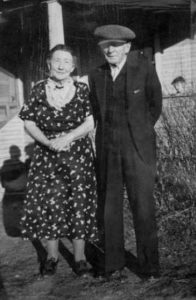
Susannah Smith Evans 1864–1953
Married 1883
Maud Frances Evans Affleck 1884–1966
Wife of Adam A. Affleck (married December 24, 1902)
Bertram Thomas “Bert” Evans 1886–1909
Jonah Edgar “Joe” Evans 1888–1931
Husband of Inez Matilda Lusk (married October 17, 1912)
Ruth Evans Keeler Murphy 1898–1981
Wife of (1) Jesse W. Keeler (married April 8, 1915), (2) Mike A. Murphy (1929)
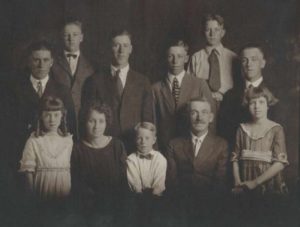
Lorenzo Bowen “Ren” Evans
1869–1934
Son of Jonah Evans and Frances Bowen; brother of Thomas Evans; husband of Anna Morse
More about Ren
Irrigation-company shareholder and a booster of the valley. Elected Oneida County probate judge in 1912 and named Power County’s first probate judge in 1913, he never sat. He was Arbon bishop in 1923–24 and the rural mail carrier in 1919–20, promoted the 1921 oil test and the 1924 cheese factory, organized the July boweries and urged a road over Mink Creek.
Anna Morse Evans 1878–1943
Married 1897
Lorenzo Morse Evans 1898–1965
Jonah Leslie Morse “Leslie” Evans 1901–1975
Husband of Ella Daniels (married July 3, 1923, Malad)
Anna Evans Orison 1912–1987
Wife of Archie M. Orison (licence November 11, 1933)
Thomas Morse Evans 1916–1991

David Bowen Evans
1874–1913
Youngest Evans brother; husband of Hannah Williams (married 1898)
More about David
Remembered in the family as the first rural mail carrier between Arbon and Malad, by horseback, sleigh and packhorse. His homestead, entered in 1901, passed to his widow and children and was farmed by his son Waldo.
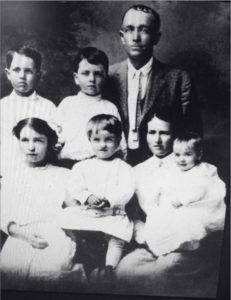
Hannah Williams Evans Snyder 1882–1964
Married 1898 · later of Ed Snyder (married July 29, 1915)
Edward P. “Ed” Snyder 1883–1958
Second husband of Hannah Williams Evans (married July 29, 1915); stepfather of Waldo Evans and his brothers and sisters
Hortense Evans Bowen Aguirrebere 1900–1980
Wife of Brigham Bowen (married September 6, 1919), later of Joe Aguirrebere
David Voile Evans 1904–1971
Waldo Evans 1910–1971
Married Dorothy Jean Daniels Evans
Homesteads and land
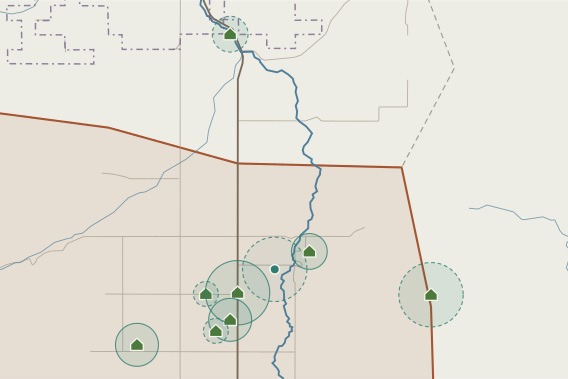
9 places the Evans family took up or held, 1894–1924, placed from the land patents, the entry registers and the family accounts.
 123456789
Evans Lane (near Lorenzo Evans’s lands)
Evans Lane, named for the early Evans homesteaders, runs east from the highway just south of the Bible Church. The earlier version of the family map centres its Evans circle on this lane. On the map the lane lies between Lorenzo Evans’s 1894 desert claim and his 1909 homestead; Dave Evans’s homestead and Tom Evans’s farm lay farther west (see the separate Evans locations).
Tom and Susannah Evans home and switchboard (store site not recorded)
The Evans home on what became Newport Lane, half a mile west of the Arbon Highway and just west of the Green Top (Central) school. In December 1915 the valley’s telephone switchboard was moved into T. B. Evans’s new home “west of the Central school”, where Susannah Evans ran it until 1940; Lee and Gena Newport bought the farm in September 1940 and kept the switchboard in their kitchen — the 1954 USGS map labels “Newport Ranch and Telephone Office”. The family’s land was probably son Bertram’s 1907 homestead (SW¼NW¼ Sec. 1; S½NE¼ and NE¼SE¼ Sec. 2, T11S R33E); the exact house site rests on the archive’s description.
Lorenzo Evans’s 1894 desert claim
Lorenzo B. Evans’s desert-land claim, entered from Samaria on August 24, 1894, and patented in 1902: S½SE¼ Sec. 35 and S½SW¼ Sec. 36, T10S, with Lots 3–4 Sec. 1 and Lots 1–2 Sec. 2, T11S, R33E — 318.81 acres in a strip two miles long astride the township line. His 1909 homestead (NW¼ Sec. 31, T10S R34E) lay just to the north-east; on the map, today’s Evans Lane runs between the two (who the lane was named for is not documented).
Dave and Hannah Evans homestead; later Waldo’s farm
Dave Evans’s homestead — SW¼SE¼ and S½SW¼ Sec. 3 and SE¼SE¼ Sec. 4, T11S R33E — entered on April 9, 1901, and patented in 1909, with 80 acres of desert land in the S½SW¼ Sec. 4 patented to his heirs in 1918. In 1915 it was “the second ranch west above the Arbon postoffice”. Waldo Evans farmed it and never mortgaged it; a spring right on its SW¼SW¼ Sec. 3 was decreed with an 1893 priority.
Tom Evans’s store at Pauline (one account; not confirmed)
John Noble’s store stood at the crossroads from about 1911. Harvey Andersen remembered a store kept by “Tom Evans” just north of the present post office (the storekeeper is not identified by any record; see ‘Where Tom and Susannah Evans’s store stood’). The later log store (run by Tom and Ora Daniels from the early 1940s and by Waldo and Jean Evans 1960–75) stood between the Mink Creek Road junction and the Munn house.
Lorenzo Evans at the foot of Mine Canyon (family account)
By the family’s account Lorenzo settled his family at the base of Mine Canyon, liking its springs. Mine Canyon was also a traditional route by which Native people entered the valley to hunt. His documented lands — the 1894 desert claim and the 1909 homestead — lie about 2–3 km west of this point, on the valley floor; where the Mine Canyon home stood is not recorded.
Bert Evans’s homestead, probably the family farm (entry 1907)
Bertram T. Evans’s homestead — SW¼NW¼ Sec. 1; S½NE¼ and NE¼SE¼ Sec. 2, T11S R33E — entered in April 1907 and patented to his heirs on January 10, 1914. Tom and Susannah Evans’s farm was probably this land: the 1923–24 oil test “on the Tom Evans place” was in Sec. 2. Where their house stood within it is mapped separately (the Evans and Newport home).
Joe Evans’s desert forty (patent 1928; entry about 1924)
Jonah E. “Joe” Evans’s 40-acre desert-land patent of June 6, 1928, lies in the SE¼ of Sec. 2, T11S R33E. The index does not name the forty; the other three forties of that quarter went to Bert Evans’s heirs (NE¼SE¼), J. R. Bailey (SW¼SE¼) and Annie Bailey (SE¼SE¼), so it was probably the NW¼SE¼, near his parents’ farm.
Ren Evans’s homestead (entry 1903)
Lorenzo B. Evans’s homestead, the NW¼ (lots) of fractional Sec. 31, T10S R34E, 147.1 acres, entered in February 1903 and patented July 22, 1909 — just north-east of his 1894 desert claim. The family lived here in 1910, next to James and Margaret Morse Wilson, whose homestead (the SW¼) adjoined on the south.
The land patents
The federal patents that made the homesteads theirs, from the General Land Office records.
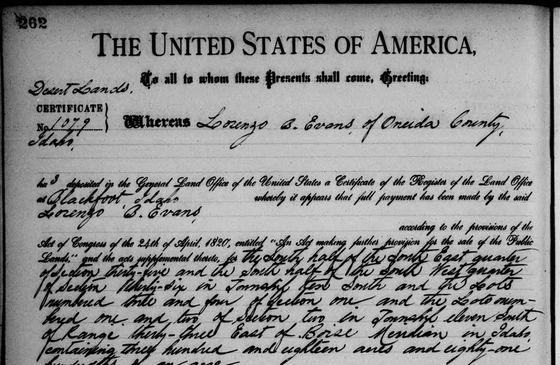
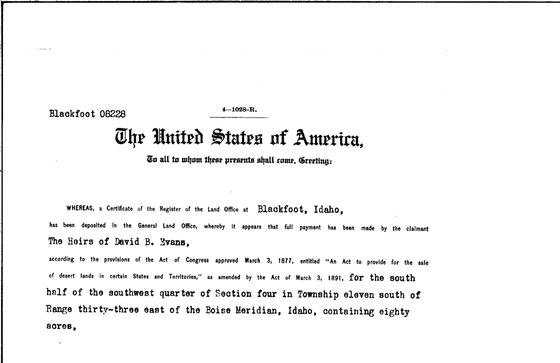
75 dates in the family’s history
Every date the valley map shows when you follow the Evans family, era by era: the most telling of each era first, the rest a click away. Dates keep the sources’ own wording.
Homestead or landFamily historyEventValley firstTragedy
Before Homesteading
A Shoshone and Bannock homeland; trails, travelers and cattle range.
June–October 1863Family history
From Wales to Brigham City
Jonah and Frances Evans sailed from London on the Amazon on June 4, 1863, with their three-year-old son Tom, crossed the plains that summer and settled at Brigham City.
October 31, 1880Family history
Jonah Evans, bishop of Samaria
Sent to Samaria by Apostle Lorenzo Snow, Jonah Evans became its bishop on October 31, 1880, and served until 1897. His sons Tom, Lorenzo and Dave went into Bannock Valley from Samaria.
1890s Settlement
Homesteads, the first ditch, and the first winters.
1893 (claims staked; federal entries from 1901)Event
Squatters’ claims staked
The Arbon area timeline marks 1893 as the year homesteading opened. The townships were not yet surveyed, so the settlers of 1893 staked squatters’ claims — the 1917 valley history has J. N. Arbon, Ed Davis, D. J. Bowen and others staking land that year — and could file at the land office only after the plats were opened in 1901. Filing on 160 acres then cost $16, followed by five years of fencing, breaking ground and building a cabin to prove up. The first families — Andersens, Daniels, Arbons and Evans among them — lived in wagon boxes, tents or dugouts.
August 1893Event
Irrigation company organized in Samaria
The earliest meeting of what became the Bannock Valley Irrigation Company took place in Samaria. Its purpose was to own and control the water of Knox Creek through dams, ditches, pipes, flumes and reservoirs. Members pooled money, labor, equipment and horse teams, and kept detailed minutes — down to the pay for each man’s work and team.
1893–1895 (accounts differ); decreed priority July 24, 1897Event
A mile-and-a-half ditch from Knox Canyon
Working together, the settlers dug a ditch about one and a half miles long from the mouth of Knox Canyon to land they held by squatter’s rights. The Davis account dates it to 1893, the Arbon area history to 1894, and the George Arbon biography to 1895. In later years it grew to several miles — about seven by 1906, when Andrew Jenson described it — and its Knox Canyon Creek water right carries a decreed priority of July 24, 1897.
March 18, 1895Event
Bannock Valley Irrigation Company filed
The company was formally filed in Samaria. Edward Davis held 4⅗ shares and Lorenzo Evans four; George Arbon was a charter member. Within a few years the canal from Knox Canyon reached the Bowen place on present Bowen Lane.
1895Event
Stockmen settle the north end (later Pauline)
Latter-day Saint stockmen, among them the Daniels brothers, located at the north end of Bannock Valley “in 1895 and following years” (Jenson); the original ArbonValley.com account’s 1895 list also names Bolingbroke, Davis, Evans and Lusk families. Federal homestead entries at the future crossroads began in March 1901 (Thomas D. Daniels), and Pauline grew into a named crossroads with a store, post office and ward from 1911, on the roads to American Falls and Pocatello. The original ArbonValley.com account’s wider, undated list of “prominent first residents” adds the Nobles and Kowallises, who came in 1905 and 1909.
1898 (postmaster appointed June 21; office opened in August)Valley first
The first post office and postmaster
The valley's first post office was applied for in January 1898 as "Mountain Side," to be called Arbon, and D. J. Bowen became its first postmaster that June.
Show 12 more from these years
claimed May 15, 1893; decreed priority June 1, 1893Valley first
The oldest water rights on the Arbon floor
On the Arbon floor the oldest water claims date from the spring of 1893.
1894 (borrowed), 1897 or 1907 (accounts differ)Valley first
The first threshing machines
The first harvest was threshed with a machine hauled over the mountain from Samaria, and by 1907 the Arbon floor had a threshing machine of its own.
August 24, 1894Event
Lorenzo Evans files a desert-land claim
Lorenzo B. Evans of Samaria filed desert-land entry no. 1932 at the Blackfoot land office for 320 acres of then-unsurveyed land in Bannock Valley. Yearly proofs of reclamation work followed; final certificate 1079 was issued in June 1901 and the patent in February 1902 — 318.81 acres in a strip astride today’s township line, north of the later Central school. It is among the earliest dated land claims on the Arbon floor; George W. Jacobs filed the neighbouring entry that November.
August 24, 1894Homestead or land
Evans Lane (near Lorenzo Evans’s lands)
1895–96 (family account)Event
Lorenzo Evans’s early seasons in the valley
By family account Lorenzo Evans wintered in the valley in 1895–96, batching in a dugout with other men, and after his marriage to Anna Morse of Samaria (February 24, 1897) settled at the foot of Mine Canyon for its springs. The records show a longer, divided start: he filed a desert-land claim in the valley from Samaria in August 1894, was still counted at Samaria in June 1900, and gave his residence as Arbon when he entered a homestead in February 1903. His obituary says he had lived in “the Arbon and Malad sections since 1896”.
1896Event
One header for the whole valley
After poor first crops, 1896 brought a good harvest. Ed Davis, D. J. Bowen, James Bailey, Lorenzo Evans and Joseph Arbon pooled $263 for a ten-foot Hodges header, which cut all the grain in the valley that year.
about 1897–1900Valley first
The first mail carriers
At first the settlers took turns carrying the mail from Malad over Rocky Ridge, and two families each remember their own man as the first regular carrier.
1897Homestead or land
Lorenzo Evans at the foot of Mine Canyon (family account)
1897Event
A shared Clydesdale stallion
Lorenzo Evans and several other homesteaders pooled their money for a registered Clydesdale stallion to improve their horses. It died soon after arriving.
1898 or 1910 (accounts differ); an incorporated company by 1917Event
Arbon Irrigation Company
The Arbon area history dates the Arbon (Valley) Irrigation Company to 1898 — essentially the same organization as the Bannock Valley company, it says, run by the same early homesteaders and later joined by others, including Davis, Bailey, Hawkins, Williams, Ward, Arbon, Bowen, Roderick and Evans. The Edward Davis biography says it was formed in 1910, with Davis a charter member holding fifteen shares. Records show it was an incorporated company by October 1917, when it was on the state’s list of corporations behind in their licence tax, and a 1923 court notice lists three shares of its stock. The two company names have separate federal canal files, so it may have been a successor or a second company.
1898 (homestead entry April 9, 1901)Event
Dave Evans marries and takes up land
David Bowen Evans joined his brothers Tom and Ren; by family account he held a squatter’s right from 1898, and he married Hannah Williams of Samaria at Pleasantview that summer (June 5 or July 5; accounts differ). He entered his homestead — the S½SW¼ and SW¼SE¼ of Section 3 and the SE¼SE¼ of Section 4, T11S R33E — on April 9, 1901, and received the patent in 1909. Their dugout grew into a modern home; their son Waldo kept the original homestead and never mortgaged it.
Early 1900s Growth
Schools, churches, stores and post offices in every area.
1900 (store about 1902)Event
Tom and Susannah Evans come to stay; a small store
Tom Evans, a railroad engineer at Ogden, filed a 320-acre desert-land claim as “Thomas B. Evans, Arbon” on September 7, 1900, and moved his family to the valley that fall, first into a dugout and then a log house. The 1917 local history says he opened “a small store” in 1902; family accounts call it the valley’s first store and remember the Evans home as the stopping place for anyone heading north or through Crystal. Where the store stood is not recorded. Susannah was Arbon postmaster from 1903 to 1906.
1900Homestead or land
Tom and Susannah Evans home and switchboard (store site not recorded)
The Evans home on what became Newport Lane, half a mile west of the Arbon Highway and just west of the Green Top (Central) school. In December 1915 the valley’s telephone switchboard was moved into T. B. Evans’s new home “west of the Central school”, where Susannah Evans ran it until 1940; Lee and Gena Newport bought the farm in September 1940 and kept the switchboard in their kitchen — the 1954 USGS map labels “Newport Ranch and Telephone Office”. The family’s land was probably son Bertram’s 1907 homestead (SW¼NW¼ Sec. 1; S½NE¼ and NE¼SE¼ Sec. 2, T11S R33E); the exact house site rests on the archive’s description.
March–September 1901Event
The first homestead entries
Once the townships were surveyed, the settlers who had squatted on the valley floor since the 1890s filed at the Blackfoot land office. The register dates the first entries: Jennett Daniels Price and Henry Daniels on March 12, 1901, at West Fork, then Donum and Thomas D. Daniels later that month; Charles A. Bailey on March 28, the first on the Arbon floor; D. B. Evans and Julius Abter in April; John Payne’s and Jane Dalton’s desert-land claims in May; Thomas Gibbons, the Bailey brothers, George Arbon, David T. Davis and Jesse Ward’s desert land in late May; D. J. Bowen and J. A. R. Gibbons on June 6 and William Arnn on June 8; the first Summit entries — Joseph T. Wood, Peter Larsen of Mendon and Frederick J. Manning — on July 2; and John C. and Otto Andersen on September 6. Most gave their residence as “Arbon, Oneida.”
entry on April 9, 1901Homestead or land
Dave and Hannah Evans homestead; later Waldo’s farm
Dave Evans’s homestead — SW¼SE¼ and S½SW¼ Sec. 3 and SE¼SE¼ Sec. 4, T11S R33E — entered on April 9, 1901, and patented in 1909, with 80 acres of desert land in the S½SW¼ Sec. 4 patented to his heirs in 1918. In 1915 it was “the second ranch west above the Arbon postoffice”. Waldo Evans farmed it and never mortgaged it; a spring right on its SW¼SW¼ Sec. 3 was decreed with an 1893 priority.
David Bowen Evans, Hannah Williams Evans Snyder, Waldo Evans
1901–1902 (accounts differ)Event
A log building for school, church and dances
The community hauled logs from the canyons and built a 20×36-foot building “by everyone, regardless of church affiliation.” The original ArbonValley.com accounts put it beside the George Arbon homestead on Church Road, where the present meetinghouse stands, on land they say Lorenzo and Chloa Bailey gave; the Power County history puts the 1902 log school in Section 12 instead. It served as Valley View School, meetinghouse, dance hall and public meeting place, and was Oneida County School District 46 by 1907; around 1904 the logs were covered with lumber.
Maud Frances Evans Affleck
April 1, 1908 (earliest dated grave)Valley first
The first burials in the Arbon Valley Cemetery
The oldest dated grave in the Arbon Valley Cemetery off Bailey Road is that of Tom Henry Roberts, who lived only 23 days in the spring of 1908.
Bertram Thomas “Bert” Evans, Thomas Bowen Evans, Susannah Smith Evans
Show 11 more from these years
1900–1903 and 1906–1916Event
Post office in the James Bailey home
J. R. Bailey followed D. J. Bowen as Arbon postmaster on April 28, 1900, and kept the office in his house on the line between Sections 2 and 3, by today’s Bailey Road. Susannah Evans held the office from November 6, 1903, until February 1906; Bailey was reappointed on February 26, 1906, and served until Louie Leavitt took charge on June 24, 1916 — “nearly sixteen years” in all. His daughters Elizabeth (1922) and Edna (1925–28) later kept the office at the Bailey place. The postmaster’s pay came from cancelled stamps and a share of stamp sales — perhaps $30 in a very good month — plus freight on cream, butter and eggs sent to Pocatello.
entry in February 1903Homestead or land
Ren Evans’s homestead (entry 1903)
February 1903Family history
Ren Evans’s homestead
Lorenzo B. Evans, now giving his residence as Arbon, entered a homestead just north-east of his desert land; it was patented in July 1909. In 1910 the family lived there beside James and Margaret Wilson, probably Anna’s sister.
entry in April 1907Homestead or land
Bert Evans’s homestead, probably the family farm (entry 1907)
Bertram Thomas “Bert” Evans, Thomas Bowen Evans, Susannah Smith Evans
April 1907Family history
Bert Evans’s homestead, probably the family farm
Tom’s son Bertram entered 160 acres in Sections 1 and 2, the land the family probably farmed until 1940; it was patented to his heirs in 1914.
Bertram Thomas “Bert” Evans, Thomas Bowen Evans, Susannah Smith Evans
1907–1909Family history
Tom Evans, dry farmer and thresherman
In 1907 Tom Evans’s 60 acres of dry-farmed wheat averaged 25 bushels and his machine threshed about 2,500 bushels; in 1909 his field was photographed as an Arbon showpiece at 35 bushels an acre.
1908Event
Justice of the peace (one account)
The archive says Lorenzo Evans was elected justice of the peace for the Arbon precinct of Oneida County in 1908. No record of that election has been found; in 1916 he was the Republican candidate for Arbon justice of the peace.
November 1908 – 1910Event
A campaign for settlers
In November 1908 the American Falls Press began a campaign for settlers, advertising the valley as having had no crop failure. An Arbon committee of John Payne, Adam Affleck and Lorenzo Evans answered homeseekers’ letters; J. R. Bailey, Julius Abter and Otto Andersen laid out a new road to American Falls; and Bert Evans, David Roderick and Bishop Arbon called a December meeting on dividing Oneida County. Twenty-eight homesteads were taken between November 1908 and March 1909, families from Dayton, Washington, filed after a copy of the Press reached them, and within about two years nearly all the vacant land was taken.
between about 1907 and 1915Event
The first telephone wires
Adam Affleck, Tom Evans’s son-in-law, who homesteaded next to the Evans place about 1907 and left about 1915, helped string the valley’s first primitive telephone line — barbed wire on fence posts.
April–May 1910Family history
The Evans households in the 1910 census
The 1910 census found Tom and Susannah with their daughter Maude Affleck’s family next door, Lorenzo’s family beside the Wilsons on his homestead, and Dave and Hannah’s family on the Arbon floor.
Thomas Bowen Evans, Susannah Smith Evans, Maud Frances Evans Affleck, Lorenzo Bowen “Ren” Evans and 3 more
November 1912 – February 1913Event
Lorenzo Evans elected probate judge
Lorenzo B. Evans was elected Oneida County probate judge as a Republican in November 1912. When Power County was created in 1913 the governor named him its first probate judge, but the new county board ruled that the judge must live at the county seat; he did not qualify, and A. C. (Adolf) Haag was acting as Power County probate judge by March 27, 1913.
Community Development
A new county, roads and phones — and the first departures.
by April 1915Valley first
The first telephone operator
Susannah Evans was honoured in 1923 as the valley's telephone operator since the line was first installed, yet her daughter Ruth was already called the local operator in April 1915.
Susannah Smith Evans, Ruth Evans Keeler Murphy
January 30, 1913Event
The valley is divided between two counties
Power County was created on January 30, 1913, from parts of Bingham, Blaine, Cassia and Oneida counties, two years after the valley voted 109 to 30 to be included. Crystal, Pauline–West Fork and the Arbon floor went to the new county, with American Falls as county seat; the line ran just south of Magnus Andersen’s place, and Summit and Buist stayed in Oneida. Crystal had been in Oneida County, not Bannock.
1915Valley first
The first rural mail route
Arbon Rural Free Delivery Route No. 1 began in 1915, with Newell Leishman as its first regular carrier.
1918–1926Valley first
The first trucks
Motor trucks came to the valley first for hauling grain, gravel and mail, and only later into the farmyards.
March 5, 1924Tragedy
Thomas Toyn shot in his own kitchen
The rancher Thomas Toyn was shot from behind through the shoulder by the boarder living with his family, who said the rifle went off by accident.
1924Homestead or land
Joe Evans’s desert forty (patent 1928; entry about 1924)
Jonah E. “Joe” Evans’s 40-acre desert-land patent of June 6, 1928, lies in the SE¼ of Sec. 2, T11S R33E. The index does not name the forty; the other three forties of that quarter went to Bert Evans’s heirs (NE¼SE¼), J. R. Bailey (SW¼SE¼) and Annie Bailey (SE¼SE¼), so it was probably the NW¼SE¼, near his parents’ farm.
Jonah Edgar “Joe” Evans
Show 19 more from these years
1913–1935Event
Homesteaders in public office
The valley’s settlers soon held county and state offices. William Allard sat in the Idaho House in 1915 and again in 1919–20. Power County’s third-district commissioner was a valley man from January 1917 to about 1935: G. A. Brahmstadt (1917–19), E. C. England of Pauline (1919–23), Perry Lusk (1923–25), who rode about forty miles to American Falls each month for $25, T. B. Evans (from 1925, probably to 1929) and Roy D. Lindley (probably 1929–35). John Payne was Arbon’s justice of the peace in 1915–19. Lorenzo Evans, elected Oneida probate judge in 1912, was named Power County’s first probate judge but never sat; Ed Davis’s 1914–16 office was the Arbon bishopric, not a county post.
by 1913Event
Central (Green Top) School, District 12
The Central school of District 12 stood on land given by T. B. Evans, east of the later Newport house. It was the community hall of the north Arbon floor: a Congregational church was organized there on July 13, 1913, and the valley telephone company on September 6, 1913, and in 1916 Louie Leavitt built a stone store and post office on the “Central school townsite.” In 1919 at least thirty-three children in grades one to eight attended the school the original ArbonValley.com calls Green Top, named for its green roof; its dances were organized by Leland Bailey and Anna Evans. James Bailey was a trustee from 1916 and chairman to 1921, and in 1925 the school stood “next door to the Arbon oil well.”
September 6, 1913Event
The Falls-Bannock Telephone Company
After an American Falls Board of Trade campaign, seventeen valley households organized their own telephone company at the Central school on September 6, 1913, with [D.] J. Bowen as president, D. B. Ripley vice-president, William Allard secretary and J. E. Keeler and T. B. Evans directors; by 1914 it was the Falls-Bannock Telephone Co., and its 1916 directors were J. R. Bailey, J. N. Arbon, George Houk, T. B. Evans and L. B. Evans. Susannah Evans ran the valley’s telephone exchange from the Evans home for about twenty-five years.
Susannah Smith Evans, Thomas Bowen Evans, Lorenzo Bowen “Ren” Evans
early December 1915Event
Long distance reaches the valley
After the county granted a franchise and the Interior Department approved a right of way across the reservation in July 1915, the Mountain States line from American Falls, thirty-one miles away, joined the valley line in early December 1915, and the first calls went through to Salt Lake. The switchboard moved into T. B. Evans’s new house west of the Central school, where Susannah Evans was the operator — honoured in 1923 as operator “since it was first installed,” and still at the board in 1940. Residents built a Pocatello–Crystal line in 1917, and West Fork homes were connected in 1919.
April – June 1916Event
A stone store and post office at Central
Miss Louie Leavitt of Albion built a stone building on the townsite beside the Central school in April 1916 and opened a store of millinery, notions, jewelry, confections and school supplies. Appointed Arbon postmaster on May 19, 1916, she took charge on June 24, succeeding J. R. Bailey; the office stayed at Central until 1922. She left for Albion about October 1919, and Tom Evans’s daughter Ruth Keeler took over the office with a small store.
Ruth Evans Keeler Murphy
April 1916Family history
A county road across the Dave Evans place
The county commissioners cancelled the tax certificates on Mrs. D. B. Evans’s land, because a former commissioner had promised to remit the taxes in return for a county road across it.
1917–1921Family history
Susannah Evans leads the Arbon Red Cross
Mrs. T. B. Evans was president of the Arbon Red Cross auxiliary in 1917–18, a Victory Loan worker in 1919 and Arbon’s Red Cross roll-call chairman in 1919 and 1921; the society gave her a surprise party in March 1919.
January 7, 1918Family history
Desert land patented to Dave Evans’s heirs
Eighty acres of desert land in Section 4, next to Dave’s homestead, were patented to his heirs; Hannah and her children kept the farm.
October 1918 – early 1919Event
Influenza
The influenza epidemic reached the valley in October 1918. The Evans family were among the first to catch it; schools closed, and the Crystal Latter-day Saints stopped meeting until February 1919. Neighbors went from house to house to cook, do chores and nurse the sick. Several valley households lost members.
December 1919Tragedy
Thirty below, and a rescue on the Pauline road
William Allard rescued three men stranded between Rattlesnake and Pauline, and a five-day storm drove the thermometer to thirty below.
October 1919 – March 1922Family history
Ruth Keeler, postmaster at Central
When Louie Leavitt left, Tom’s daughter Ruth Keeler took over the Arbon post office in the post-office building at Central, near the Evans home, and stocked groceries, stationery and confections. She was appointed on February 10, 1920, and resigned in March 1922.
Ruth Evans Keeler Murphy
December 1919 – January 1920Family history
Ren Evans carries the rural mail
L. B. Evans was the Arbon rural mail carrier that winter; when he began and stopped is not recorded.
late February 1920Tragedy
The Joe Evans home burns to the ground
A kitchen fire destroyed the home of Joe and Inez Evans half a mile east of the Arbon post office; nothing was insured.
Jonah Edgar “Joe” Evans
1920–1943Family history
The Snyder–Evans household carries the mail
From June 1920 “Mrs. Edward Snyder”, probably Hannah, carried the rural route; in 1922 Ed Snyder split it with his stepson Dave Evans, and in 1940 Ed was the carrier with Waldo as substitute. Ed was later remembered as carrying the route for 23 years in all.
Hannah Williams Evans Snyder, Edward P. “Ed” Snyder, David Voile Evans, Waldo Evans
June 1921 – 1925Event
The Arbon oil tests
In June 1921 the first oil test was drilled on Thomas S. Toyn’s ranch — probably the former Ripley ranch — and a two-day celebration on 25–June 26 drew 800 to 1,200 people; L. B. Evans promoted the Arbon Oil Co. and reported a showing of oil in January 1922. A second venture, the Gem State Petroleum Co., whose members included E. C. England, G. A. Brahmstadt, T. H. Hill, E. H. Davis and William Allard, brought a deep-drilling rig in December 1923; its well in Section 2 near the Central school was 950 feet deep by June 1924, and in 1925 the District 12 school stood “next door to the Arbon oil well.” No strike was reported.
1923–1924Family history
Ren Evans, bishop of Arbon Ward
Lorenzo B. Evans was bishop of the Arbon Ward in 1923–24, after D. J. Bowen; a January 1924 report calls him Bishop L. B. Evans.
early 1924Family history
A cheese factory for Arbon
Ren Evans organized an Arbon cheese factory, signing up 23 farmers with 213 cows.
July 1924 – about 1929Family history
Tom Evans, county commissioner
Tom Evans filed in July 1924 as the Republican candidate for Power County commissioner from the Arbon district. He was sitting on the board in July and October 1925 and probably served until January 1929.
June 6, 1928Family history
Joe Evans’s desert forty
Tom’s son Joe Evans received a desert-land patent for 40 acres in Section 2, probably the one forty in its south-east quarter not already held by Bert’s heirs or the Baileys.
Jonah Edgar “Joe” Evans
Depression & Change
Drought, closures, tractors, electricity, the reservation boundary.
1932–1933Valley first
The first 4-H club and Grange
The earliest 4-H club found in the valley was at Pauline in 1932, and in 1933 William Allard chaired the committee that organized the Arbon Valley Grange.
undated (while Jean Daniels was a girl, probably the 1930s)Tragedy
Puppies first: the Arbon store burns
When the Daniels family’s log store caught fire, the children inside threw the puppies out of the window first and then climbed out after them.
April 1940Family history
The last census with Tom and Susannah
In April 1940 Tom, 80, and Susannah, 75 and still the telephone operator, were at Arbon, along with Lorenzo’s widow Anna and two of their sons, the Snyders with Waldo, Ruth and Mike Murphy, and Ruth’s son Jess Keeler.
Thomas Bowen Evans, Susannah Smith Evans, Anna Morse Evans, Lorenzo Morse Evans and 5 more
1940–1942Family history
Waldo Evans in the county farm programme
Waldo Evans was elected to the Arbon–Crystal community committee of the county planning programme in 1940, grew 44 acres of certified Ladak alfalfa in 1941 and served on the Arbon farm fire crew in 1942.
July 6, 1943Tragedy
A boy buried in a wheat slide
Eight-year-old Duane Orison was engulfed by a slide of wheat in the granary while he watched his father load a truck.
Anna Evans Orison, Lorenzo Bowen “Ren” Evans
1943Family history
Waldo takes over the farm and the route
When Ed and Hannah Snyder moved to Pocatello in 1943, Waldo Evans took over his father’s homestead, which he never mortgaged, and the rural mail route, which he carried until November 1946.
Waldo Evans, Edward P. “Ed” Snyder, Hannah Williams Evans Snyder
Show 4 more from these years
1933–1943Event
New Deal farm committees and the grange
From 1933 the county agent’s wheat-allotment committees of the Agricultural Adjustment program were the valley’s main civic bodies: for Arbon (Roy Lindley, J. N. Arbon, John Anderson and Ed Davis; in 1934 J. N. Arbon, J. L. Payne and Frank Phelps), for Pauline (E. C. England, William Allard and M. V. Tallon), for the reservation side (Perry Lusk), for Crystal (Norman Hayden, Chester Smith and Elva Thacker) and, on the Oneida side, for Summit (J. P. Sorensen, J. I. Nunnelley and I. Y. Rush) and Buist (H. S. Bird), with R. H. Willie also serving. The Arbon Valley Grange No. 349 kept records from 1934 to 1939. Chauncey C. Payne became county AAA chairman in 1941 and War Board chairman in 1942; Norman Hayden chaired the Arbon–Crystal planning committee in 1941–42, with Allard as secretary and Waldo Evans among its members.
September 1940Event
The Evanses leave after forty years
Tom and Susannah Evans sold the farm and moved to Pocatello. The Newport family moved into the old Evans home and ran the valley’s switchboard from their kitchen for many years.
after April 1940 and by August 1943 (the original ArbonValley.com: about 1930)Event
The Daniels family keeps the Arbon store
Thomas Calvin (T. C.) Daniels’s family came back to the valley in the early 1940s and kept the Arbon store, with his wife Ora managing the grocery at the 1950 census. By the archive’s account it passed in 1960 to his daughter Jean and her husband Waldo Evans, who ran it until 1975, and then to his daughter LaRue Gunter (1975–78).
after the Second World War (about 1946–47)Event
Sod Williams takes the Arbon mail route
Not long out of the service, Donald T. “Sod” Williams took the Arbon rural mail appointment after Waldo Evans, while feeding cattle for the J. N. Arbon family. In the winter of 1948–49 he carried the mail on horseback. The 1950 census lists him as a farmer and U.S. mail carrier at Arbon; his wife Nelda later carried the route herself for several years.
Generations
Fewer, larger farms; descendants on the old homesteads.
April 1950Family history
Evans farmers in the 1950 census
In 1950 Waldo and Jean Evans were farming on the Arbon Highway with two hired hands, and Lorenzo’s sons Joseph M. and Welling M. Evans were farming at Arbon too.
August 21–23, 2010Event
Fire in the valley
A fire that began at the Lee Bailey homestead jumped into wheat stubble and ran north-east up the east side of the valley into the Rattlesnake area. Farmers cut firebreaks with tractors and discs alongside the county road grader, BLM crews and Fort Hall firefighters; one rancher estimated 8,000–10,000 acres burned.
At the time of the archive’s accounts (2018–2019)Event
The valley the homesteaders made
The whole valley is now called Arbon. Of its four post offices (the accounts say five) one remains, in Pauline; instead of ten schools, Arbon Elementary teaches grades K–6 in two classrooms. The accounts name families still farming and ranching on or near the original homesteads, including Andersen, Bradley, Evans, Hayden, Hess, Jenson, Lusk, Swim, Ward and Williams.
Firsts and tragedies
The valley firsts the Evans family had a hand in, and the hard times it lived through, most remembered first.
What they built
An early store
Tom and Susannah Evans kept “a small store” from about 1902 (1917 history); family accounts call it the valley’s first store and their home a stopping place for travelers. Where it stood is not recorded.
Postmasters
Susannah Evans was Arbon postmaster from November 6, 1903, to February 1906; her daughter Ruth Keeler kept the office, with a small store, at Central from October 1919 to March 1922.
The valley switchboard
Susannah Evans was the telephone company’s operator from the line’s installation until 1940 and was honoured by the company in 1923; from December 1915 the switchboard stood in the Evans home. Ruth Evans worked the board before 1915. Tom Evans was a director of the 1913 telephone company; son-in-law Adam Affleck is said to have helped string an earlier barbed-wire line.
Mail carriers
By family account Dave Evans was the first rural carrier between Arbon and Malad. Lorenzo was the Arbon rural carrier in 1919–20; Ed Snyder, Hannah’s second husband, carried the route about 1920–43 (documented in 1922 and 1940), helped by Hannah and her son David; Waldo was substitute carrier by 1940 and regular carrier about 1943–46.
Irrigation company charter member
Lorenzo held four shares in the Bannock Valley Irrigation Company.
County and church office
Lorenzo was elected Oneida County probate judge in 1912 and named Power County’s first probate judge in 1913, though he never sat; he was bishop of the Arbon Ward in 1923–24 and pushed for a better road over Mink Creek. Tom Evans was Power County commissioner for the Arbon district (sitting in 1925; probably 1925–29).
The first teacher
Tom’s daughter Maude Evans, about seventeen, taught the first school in the 1901 log building (1917 history and family accounts).
Photographs
Portraits and family groups first. Each opens with its caption, date and where it came from.
Photograph from Thomas Bowen Evans & Susannah SmithDate unknown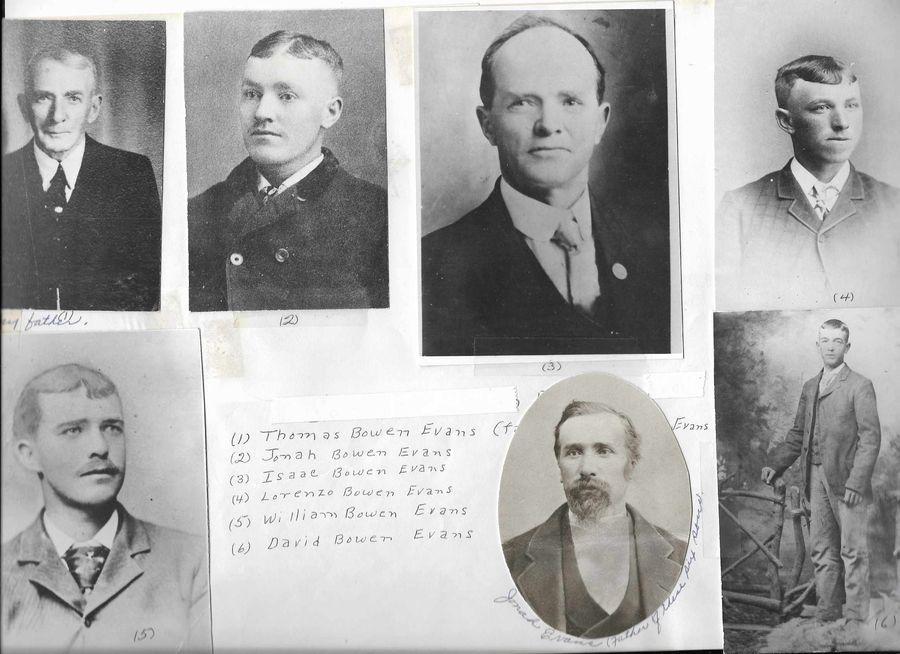 The Bowen Evans brothersDate unknown
 Photograph from Lorenzo Bowen Evans & Anna MorseDate unknownPhotograph from David Bowen Evans & Hannah WilliamsDate unknown
 Photograph from Waldo EvansDate unknown
 Don and Connie jensonDate unknown
6 PHOTOGRAPHS · 2 LAND PATENTS · 4 NEWSPAPER CLIPPINGS · 4 FAMILY TREESOpen the Evans family album ↗
Sources and open questions
Everything above comes from the archive’s family histories and the public records the valley map checked them against. Where accounts disagree, the page says so rather than choosing silently.
Where the accounts differ
- Where Tom’s 1902 store and Susannah’s 1903–06 post office stood is not recorded; the archive’s “Tom Evans, the Pauline store keeper” may be a confusion with Tom Daniels or John Noble (possible only).
- Lorenzo’s permanent move: 1896 (family account) against Samaria in 1900 and “Arbon” in 1903 (records).
- Dave and Hannah married in 1898 on June 5 (archive) or July 5 (family tree and her obituary). Dave died on December 30, 1913 (family tree) or December 28 (Find a Grave), at Ogden.
- Tom Evans’s county commissioner service is documented for 1925; “four terms” in the family biography is not.
- Who carried the first Arbon–Malad mail (Dave Evans or David Thomas Davis) is unresolved.
Sources 33
Show every source
- EvansJacob Andersen · posted 2018
- Thomas Bowen Evans & Susannah SmithMelinda Campbell · posted 2019
- Lorenzo Bowen Evans & Anna MorseMelinda Campbell · posted 2019
- David Bowen Evans & Hannah WilliamsMelinda Campbell · posted 2019
- Waldo EvansMelinda Campbell · posted 2019
- Pauline and West Fork (area history)Melinda Campbell · posted 2019
- Arbon map with family names (earlier version, 2018 upload)
- Harvey George AndersenMelinda Campbell · posted 2019
- NARA M1620 reel 3: Blackfoot land office abstract of desert-land entries, 1888 – November 1894National Archives (RG 49)
- NARA M1620 reel 4, Blackfoot land office register of homestead entries 1897-1908 and desert-land abstractNational Archives (RG 49, General Land Office)
- Desert-land patent to Lorenzo B. Evans, February 7, 1902 (BLM IDIDAA 005110): certificate 1079U.S. General Land Office
- Homestead patent to David B. Evans, May 11, 1909 (BLM IDBL 0000647): indexed as “David B. Anderson”U.S. General Land Office
- Homestead patent to heirs of Bertram T. Evans, January 10, 1914 (BLM IDBL 0003574)U.S. General Land Office
- Homestead patent to Lorenzo B. Evans, July 22, 1909 (BLM IDBL 0000030)U.S. General Land Office
- Welsh Saints Project: Jonah Evans, autobiography (written at Samaria, 1885) with later family additionsJonah Evans; family additions
- Saints by Sea, Mormon Immigration Index: Thomas Evans, aged 3, ship Amazon, 1863Brigham Young University
- American Falls Press, 1917-03-29, page 7 (Mrs. E. A. Logan, ‘Bannock Valley: A Historical and Industrial Review’ (ed. 2))American Falls Press
- American Falls Press, 1915-12-09, page 1 (long distance; switchboard moved to T. B. Evans’s new home)American Falls Press
- American Falls Press, 1923-01-11, page 7 (Mrs. T. B. Evans honoured as operator)American Falls Press
- NARA M841, Record of Appointment of Postmasters: Oneida County, Idaho (register page 115 and cards)National Archives (RG 28)
- Andrew Jenson, Encyclopedic History of the Church of Jesus Christ of Latter-day Saints (1941): Arbon, Crystal, Curlew Stake, Meadow, Mount View, Samaria and Summit entriesAndrew Jenson
- Idaho Secretary of State, Biennial Reports (11th-21st, 1911-1932): county officers, legislators, notariesIdaho Secretary of State
- Welsh Railroad Man and Pioneer Farmer: Thomas Bowen Evans (FamilySearch document)From the Connie Evans Jenson family files
- Susannah Smith Evans Life History (FamilySearch story)Jess Thomas Keeler, grandson; telephone history from an article by Lena Anken Sexton
- IDWR water-right report 29-10380: spring, priority June 1, 1893, used on the old D. B. Evans homesteadIdaho Department of Water Resources
- 1940 U.S. census, Power County, Idaho, ED 39-9 (Arbon precinct)U.S. Census Bureau
- 1950 U.S. census, Power County, Idaho, ED 39-11 (Arbon election precinct; sheet not stated)U.S. Census Bureau
- Deseret News, July 29, 1943, page 14: obituary of Anna Morse EvansDeseret News
- 1910 U.S. census, Oneida County, Idaho, ED 233 (Arbon and Holbrook precincts; sheet not stated)U.S. Census Bureau
- 1920 U.S. census, Arbon precinct, Power County, Idaho, ED 224 (Andersen and Pett households, dwellings 18–22)U.S. Census Bureau
- Salt Lake Tribune, January 15, 1949, page 24: death of Lester William EvansSalt Lake Tribune
- 1930 census, Power Co., ED 39-3, Arbon precinct (IA 15thcensus402unit)U.S. Census Bureau (NARA T626 roll 402)
- FamilySearch Family Tree: Frances Evans (K2QG-1YM)FamilySearch contributors
Research notes
- Evans does not appear on the 2019 family map; the 2018 version centres an Evans circle on present Evans Lane.
- Corrections from the records: the first Arbon post office was D. J. Bowen’s (1898); Susannah Evans held it once, 1903–06 — the “twenty-five years” of family memory belong to the telephone switchboard.
- Lorenzo Evans did not serve as Power County probate judge (1914, 1916) or as bishop in 1914–16: he was named probate judge in 1913 but did not qualify, and was bishop in 1923–24. No record of his 1908 election as justice of the peace was found; he was a candidate in 1916.
- Tom Evans was born near Cwmavon, Glamorgan (his father’s autobiography; place probable), not Aberdare, and came to America aged three on the Amazon in 1863.
- Tom’s farm was probably son Bertram’s 1907 homestead in Secs. 1–2, T11S R33E; the 1923–24 Gem State oil well “on the Tom Evans place” was probably the well in Sec. 2.
- Lorenzo’s ninth child, unnamed in the archive, was Walter Morse “Curley” Evans (1907–1981).
- “Lorenzo L. Evans” of the Lusk pages was Lorenzo Lloyd Evans of American Falls (1857–1934), not Lorenzo B. Evans.
- Name traps: the Bert Evans of Cedar Creek, the Hortense Evans of Brigham City, the Ed Snyder of Crystal and L. L. Evans of American Falls are not of this family.
- A Davis family biography credits David Thomas Davis with carrying the Arbon–Malad mail about 1900; Dave Evans’s claim to be the first carrier is also compiled. They may have been successive carriers.
- Other children named in the records, without a recorded valley role, are not given person records: Lorenzo and Anna Evans’s Joseph Morse (born 1899), Milton Morse (1904), Walter Morse “Curley” (1907), Welling Morse (1909) and Margaret (Mrs. Ross Waters, 1914), and Dave and Hannah Evans’s Lester William (1907) and Frances “Fannie” (Mrs. John B. Forrest, 1912).