AVARBON VALLEYIDAHO · OUR SHARED HISTORY
FAMILY HISTORY · PAULINE AND WEST FORK AREA

Swim

From Americus, Lyon County, Kansas (by family tradition, by way of Spokane, Washington)

Frank Swim and his first cousin J. W. Butler, from Americus, Kansas, filed on homesteads on upper Bannock Creek, two and a half to three miles south of Pauline, in October 1908 — by family tradition after overhearing talk of Idaho land on a Spokane streetcar. Their letters drew J. W.’s brothers and parents, the Johnson in-laws and others, and by 1910 five Kansas households stood side by side. Frank kept his homestead into the 1940s; his brother Bob, who came about 1922, founded the line that stayed, and the family ranch today lies on Crystal Creek in the Rattlesnake drainage.

Arrived
October 28, 1908 (homestead entry; the Kansas group 1908–09) exact date
Homesteads and land
8 places on the map below ↓
People recorded
16 across 4 generations ↓
Frank Swim
Frank SwimDate unknown
FOREWORD · THE ORIGINAL ACCOUNT

From the family history

The account first written for this family on ArbonValley.com, kept in full. The chapters after it add what the records and the other family histories tell.

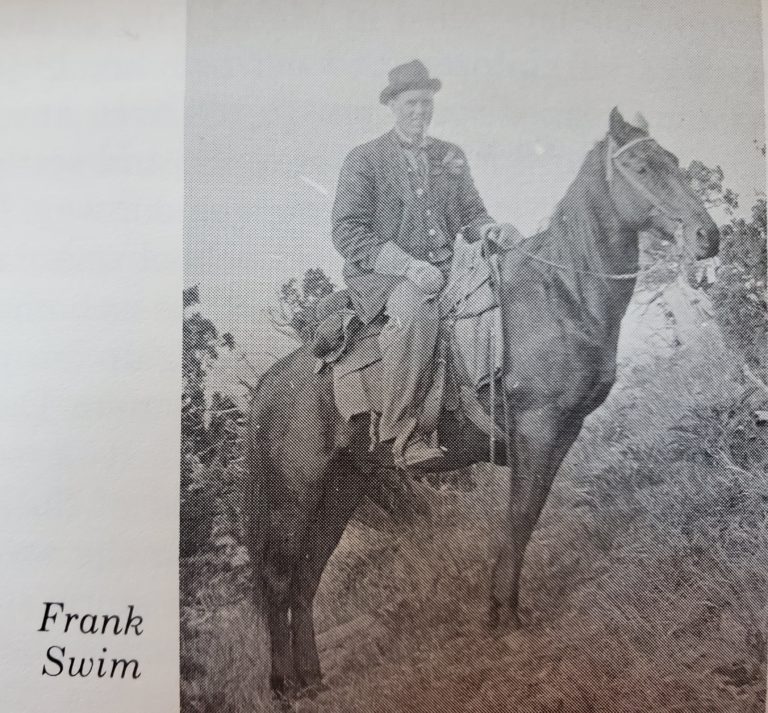
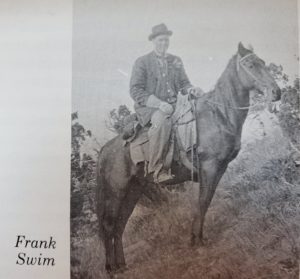
Frank Swim

Brothers Frank, Herb, and Bob Swim

The vagaries of fate punctuate the story of how the Swim family came to Arbon Valley. Frank Swim’s cousin, John W. Butler (“J.W.”) was a conductor on a street car in Spokane, Washington when he heard two men discussing land that had only recently opened for homesteading in Idaho. This might have been a streetcar named Desire, as J.W. certainly had a desire for the freedom land can bring. J.W. talked to the two men about the land and met them again that evening to talk some more. Not long afterwards, he and Frank boarded a train for American Falls, Idaho. There they rented a wagon and team of horses and purchased ropes, axes, and shovels to help them on their new endeavor.

Both young men were originally from hardy Kansas stock, so they were not afraid of hard work and were well acquainted with what their parents had gone through settling the new lands of Kansas after the Civil War. They had both also farmed for an uncle in the beautiful Palouse country of eastern Washington. When they saw Arbon Valley, they liked what they saw and they each staked out 160 acres up Rattlesnake Creek drainage, north of the Pauline area.

They started right in building a cabin with the tools they had had the foresight to bring with them, and within three days had a one-room log cabin built and a well dug. They went back to Pocatello and sent a wire to J.W.’s wife Ida telling her to come quickly, as they needed a cook!

There is a funny family story about J.W. and Ida’s courtship. Their families lived near each other in Lyon County, Kansas. They courted for over five years. When J.W. finally asked Ida’s father for Ida’s hand in marriage, he agreed but only if J.W. promised not to take her to Oklahoma. This promise was solemnly kept – but he took Ida to Washington State and then to Idaho instead.

They worked hard all winter grubbing sagebrush and writing letters to family members lauding the new land. They also build a cabin for Frank on his own 160 acres. Frank went for a visit back to Kansas and returned with a new wife, Hazel Cora Deharsh, who was a dear friend of J.W.’s wife Ida. All those letters must have been pretty convincing, because soon J.W.’s wife’s brother, Maurice Johnson, came to take up homesteading, as did all three of J.W.’s brothers and his parents, and two of J.W.’s cousins with their husbands. Two of Frank’s youngest brothers, Herb and Robert (“Bob”) also came to take up homesteading. It was a family affair!

Frank was a good son to his mother. He told some neighbors that in all the time he’d been away from home, for over forty years there had never been one week when he didn’t write a letter to his mother back in Kansas. It would be wonderful to have those letters now!

In 1918, Frank sold his holdings to his brother Bob. Eventually all the Butlers and Swims sold out and left the valley except the Bob Swim family. Bob’s son Sherman Hale Swim was to become one of the biggest cattlemen in Idaho; he passed away at age eighty-seven in a ranching accident in January 2011 in California, where he spent the winters. Sherm’s children are the last of the Swims living in Arbon Valley. Sherm’s son Kirk continues to live on the original homestead.

And all because of a conversation overheard on a street car!

Sources:

Call, Laurie Jean, Bannock Valley (Providence, Utah: Keith Watkins and Sons, 1982).

https://www.familysearch.org/tree/person/details/K2NQ-G4Z (Frank Swim)

https://www.findagrave.com/memorial/43135291 (Frank Swim)

The links provided here will lead to information on other family members.
THEIR STORY · FROM THE RECORDS

Their story

By the family’s story, J. W. Butler and Frank Swim heard two men discuss newly opened Idaho land, took the train to American Falls, rented a team and wagon, and within three days had built a one-room cabin and dug a well. They wired J. W.’s wife Ida to come at once — they needed a cook. The land records place them not on Rattlesnake Creek but on upper Bannock Creek south of Pauline: Frank’s entry is dated October 28, 1908, and J. W.’s carries the next serial number.

Letters home brought J. W.’s brothers George, Herbert and Dale and, for a time, his parents; Ida’s brother Maurice Johnson; and Frank’s sister Ednah and her husband. In the census of May 1910 five Kansas households stood side by side in the Arbon precinct. Frank married Hazel Daharsh in Kansas in March 1916 and brought her to the homestead. The original ArbonValley.com account says Frank sold to his brother Bob in 1918, but Frank was still the owner in 1920 and 1940; Bob came out about 1922, after his brother Herb.

The Kansas families were a core of the valley’s early non–Latter-day Saint community: G. S. Butler helped canvass every house for the January 1911 vote to join the new Power County, and by a 1917 account the valley’s first Protestant Sunday school was organized in his home that spring. Most had moved on by 1919 — G. S. to a dry farm near American Falls, Herbert to Nevada, J. W. and the Johnsons back to Kansas — while Dale Butler stayed at Pauline and Crystal into the 1930s.

Bob Swim married Nell Roper of a Pauline family in 1922. From the early 1930s he rented a ranch on Bannock Creek at the reservation line north of Pauline, where his son Sherman was a stockman in 1950. Sherm became one of Idaho’s biggest cattlemen, raising quarter horses and Angus, and Sherm or his wife Rhea drove the high-school bus to American Falls. The family’s ranch later moved to Crystal Creek in the Rattlesnake drainage.

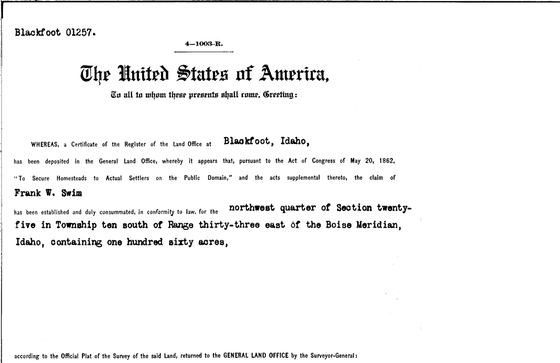
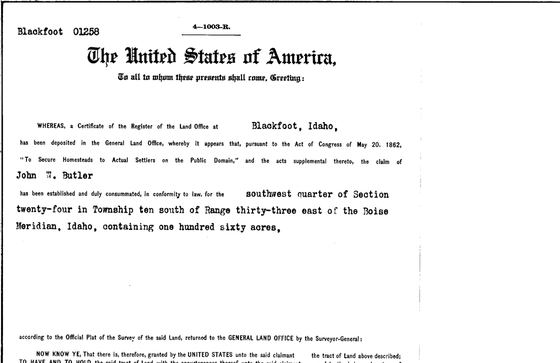
Sources: Swim · Pauline and West Fork (area history) · Remembering Arbon · Homestead patent to Frank W. Swim, August 1, 1913 (BLM IDBL 0001257): NW¼ Sec. 25 T10S R33E; Blackfoot 01257 · Homestead patent to John W. Butler, May 26, 1913 (BLM IDBL 0001258): SW¼ Sec. 24 T10S R33E; Blackfoot 01258 · American Falls Press, 1912-10-31, page 2 (final-proof notice: Frank W. Swim, homestead entry of October 28, 1908, serial 01257) · 1910 U.S. census, Oneida County, Idaho, Arbon precinct, ED 233 (image n99: dwellings 67–80, the Butler, Swim and Johnson households, May 23, 1910) · 1920 U.S. census, Arbon precinct, Power County, Idaho, ED 224 (Andersen and Pett households, dwellings 18–22)

Where they came from

IDAHOUTAHMaladSamariaSnowvilleLoganMendonWellsvilleBrigham CitySalt Lake CityPocatelloAmerican FallsAlmoArbon Valley
Earlier: Americus, Lyon County, Kansas → The Palouse and Spokane, Washington (family tradition). Route drawn only between places named in the family history; the lines are schematic, not trail routes.
  1. Americus, Lyon County, Kansas
  2. The Palouse and Spokane, Washington (family tradition)
  3. Train to American Falls
  4. Upper Bannock Creek, south of Pauline (homesteads)1908–09
  5. Bannock Creek north of Pauline (Bob and Sherm’s rented ranch)1930s–50s
  6. Crystal Creek, Rattlesnake Creek drainage (the later ranch)

Sources: Swim · Find a Grave memorial 26411981: Mary Elizabeth Swim Butler (Americus, Kansas) (with a transcription of her Emporia Gazette obituary, March 9, 1925) · Idaho State Journal, 1952-03-10, page 9 (obituary of Frank W. Swim)

THE PEOPLE

The people

16 people of the Swim family on the valley map, household by household. Names open their histories; portraits open in the family album.

The households 9

Each with the people who married in, and their children and grandchildren below, oldest first.

Mary Elizabeth Swim Butler

1850–1925

Mother of J. W., George, Herbert and Dale Butler; sister of Frank Swim’s father

More about Mary

Her 1925 obituary, naming her brother William W. Swim and her four sons (Dale “of Pauline, Idaho”), confirms that the Swims and Butlers were first cousins. She and her husband spent several months at Arbon in 1916.

John Lucas Butler 1843–1916

Married · father of the Butler brothers

George Stahl Butler

1872–1931

Eldest brother of J. W. Butler; first cousin of Frank Swim

More about George

Helped canvass every house in the valley for the January 1911 vote to join the proposed Power County; by a 1917 account the first Protestant Sunday school was organized in his home in April 1911. About 1914–15 he moved to a dry farm north-west of American Falls.

John William “J. W.” Butler

1880–1974

First cousin of Frank Swim (son of Frank’s aunt Mary Elizabeth Swim Butler); husband of Ida Maude Johnson

More about J. W.

By family tradition a Spokane streetcar conductor whose overheard conversation started the move (he is not in the 1907 Spokane directory). He homesteaded beside Frank, urged a mail route to American Falls (1914) and carried the Crystal ballots in 1916; his letters drew his brothers and parents to the valley. By December 1919 the family was back in Kansas.

Read their history ↗

Ida Maude Johnson Butler 1885–1941

Married 1904 · sister of Maurice M. Johnson

Frank Swim

Frank William Swim

1883–1952

First of the Swim family in the valley; first cousin of J. W. Butler; husband of Hazel Daharsh (married 1916)

More about Frank

Wrote his mother in Kansas every week for over forty years. He kept his homestead into the 1940s, though the family lived in Pocatello about 1927–35; by his obituary he farmed at Arbon until about 1945, and he spent his last years near Lava Hot Springs. He shared a threshing machine with Butler and Keeler (1911) and was probably a director of the Falls-Bannock Telephone Company (1921).

Read their history ↗

Hazel Cora Daharsh Swim 1897–1959

Married 1916

Herbert Lucas Butler

1883–1947

Brother of J. W. Butler

More about Herbert

Homesteaded beside Frank Swim; by 1918 he had gone to Nevada, where he became a cattleman.

Maurice Milton Johnson

1883–1969

Brother of Ida Butler; homesteader with the Kansas group

More about Maurice

Followed his sister’s family in 1909 and homesteaded beside them; his farewell sale in October 1916, reported as the first auction of its kind in the valley, preceded his return to Kansas.

Dale Everett “Pete” Butler

1892–1959

Youngest brother of J. W. Butler; husband of Blenda C. Jones of Malad (married 1916)

More about Pete

The Butler who stayed: married at Malad in 1916, he farmed at Pauline and in the Crystal precinct into the 1930s before moving to Pocatello.

Herbert Charles “Herb” Swim

1898–1927

Younger brother of Frank Swim

More about Herb

Came out to farm with his brothers (no homestead patent to him is known) and was at Pauline in 1921–23. He was one of three men deputized at Pauline on March 17, 1921, and was wounded in the shooting there; he testified at the trial.

Read their history ↗

Robert Hale “Bob” Swim

1900–1971

Younger brother of Frank Swim; husband of Nell Roper (married 1922)

More about Bob

Came out from Kansas about 1922 and married Nell Roper of Pauline; his was the Swim family that stayed. The original ArbonValley.com account says he bought Frank’s holdings in 1918, but he was in Kansas that year and Frank still owned the homestead in 1920 and 1940; Bob may have worked it as a tenant about 1930.

Read their history ↗

Nell Grace Roper Swim 1900–1992

Married 1922

Married 1922 · 1 child

  1. Sherman Hale Swim 1923–2011

    Married Rhea King Swim

THE LAND

Homesteads and land

8 places the Swim family took up or held, 1908–1935, placed from the land patents, the entry registers and the family accounts.

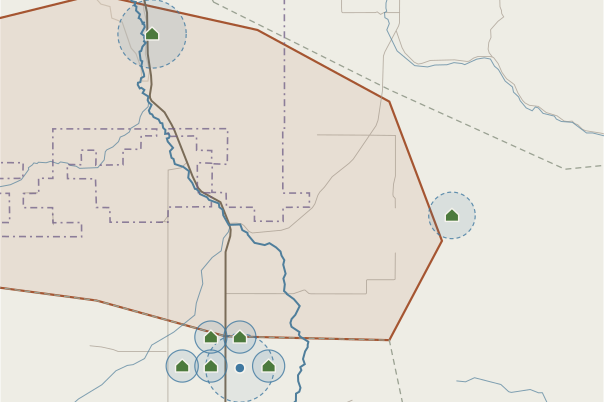
Map of the Swim family’s homesteads and land, numbered as in the list12345678
Numbers match the list. A solid ring marks a place documented from the land records; a dashed one, an approximate place. See the Swim family on the valley map ↗
  1. Swim, Butler and Johnson homesteads (south of Pauline)

    entry in 1908 · Frank William Swim, John William “J. W.” Butler, George Stahl Butler and 2 more Approximate location

    A compact block of six quarter-sections on upper Bannock Creek, two and a half to three miles south of Pauline: Frank W. Swim (NW¼ Sec. 25), J. W. Butler (SW¼ Sec. 24), Herbert L. Butler (NE¼ Sec. 25), G. S. Butler (NE¼ Sec. 26), Maurice M. Johnson (NW¼ Sec. 26) and John L. Butler (SE¼ Sec. 23), T10S R33E — entered in 1908–09 and patented in 1913. In 1910 these households were counted in the Arbon precinct.

  2. Bob and Sherm Swim’s rented ranch on Bannock Creek (1930s–50s)

    1935 · Robert Hale “Bob” Swim, Sherman Hale Swim Approximate location

    The ranch Bob Swim rented from the early 1930s in the reservation part of Power County, where his son Sherm was a stockman in 1950 — the first household down Bannock Creek from the reservation line. The 1954 map labels “Swim Ranch” beside the creek about 2.9 miles north and 1.1 miles west of Pauline.

  3. J. W. Butler’s homestead (entry October 28, 1908)

    October 28, 1908 (homestead entry; the Kansas group 1908–09) · John William “J. W.” Butler, Ida Maude Johnson Butler Strongly documented

    The SW¼ of Sec. 24, T10S R33E, on upper Bannock Creek about two and a half miles south of Pauline: J. W. Butler’s homestead, entered on the same day as his cousin Frank Swim’s (October 28, 1908, the next serial) and patented on May 26, 1913.

  4. Herbert L. Butler’s homestead (entry about November 1908)

    entry about November 1908 · Herbert Lucas Butler Strongly documented

    The NE¼ of Sec. 25, T10S R33E, east of Frank Swim’s quarter: Herbert L. Butler’s homestead, entered about November 1908 by its serial and patented on May 26, 1913. He later became a cattleman in Nevada.

  5. George S. Butler’s homestead (filed mid-November 1908)

    1908 · George Stahl Butler Strongly documented

    The NE¼ of Sec. 26, T10S R33E: George Stahl Butler’s homestead, filed in mid-November 1908 and patented on December 10, 1913. The valley’s first Protestant Sunday school was organized in his home in 1911.

  6. Maurice Johnson’s homestead (entry about March 1909)

    entry about March 1909 · Maurice Milton Johnson Strongly documented

    The NW¼ of Sec. 26, T10S R33E, at the west end of the Kansas block: Maurice M. Johnson’s homestead, entered about March 1909 by its serial and patented on December 10, 1913. He sold out at auction in October 1916 and went back to Kansas.

  7. John L. Butler’s homestead (entry about 1911–12)

    1912 · John Lucas Butler, Mary Elizabeth Swim Butler Strongly documented

    The SE¼ of Sec. 23, T10S R33E, north-west of J. W.’s quarter: the homestead of John L. Butler, probably J. W.’s father, the Civil War veteran John Lucas Butler, entered about 1911–12 by its serial and patented on November 29, 1913. He and his wife lived in the community for several months.

  8. Dale Butler’s homestead (entry about December 1918 – January 1919)

    1918 · Dale Everett “Pete” Butler Approximate location

    Dale Butler’s 160-acre homestead in the SE¼ of Sec. 9 and SW¼ of Sec. 10, T10S R34E, in the late-surveyed corner between Pauline and Rattlesnake Creek: filed when the plat opened (about December 1918 – January 1919) and patented on June 5, 1919. The point assumes the N½SE¼ and N½SW¼ on which he was taxed in 1925.

The land patents

The federal patents that made the homesteads theirs, from the General Land Office records.

THROUGH THE YEARS

52 dates in the family’s history

Every date the valley map shows when you follow the Swim family, era by era: the most telling of each era first, the rest a click away. Dates keep the sources’ own wording.

Homestead or landFamily historyEventValley firstTragedy

BEFORE 1884 · 1 DATE

Before Homesteading

A Shoshone and Bannock homeland; trails, travelers and cattle range.

  1. 1856Family history

    The Swims of Americus, Kansas

    The Swim family, led by Dr. David Swim, settled at Americus in Lyon County, Kansas, in 1856; the Swim and Butler cousins who came to Arbon grew up there.

    Mary Elizabeth Swim Butler

1900–1912 · 15 DATES

Early 1900s Growth

Schools, churches, stores and post offices in every area.

  1. about 1906 (West Fork); 1911 (Pauline); 1913 (two-room school)Valley first

    The first schools at West Fork and Pauline

    The north end's first school was a schoolhouse built in West Fork about 1906, and Pauline's first classes met in a log cabin in the autumn of 1911.

  2. October 28, 1908 (homestead entry; the Kansas group 1908–09)Event

    The Kansas cousins file on upper Bannock Creek

    Frank Swim and his first cousin J. W. Butler, from Americus, Kansas, filed homestead entries on October 28, 1908, on upper Bannock Creek, two and a half to three miles south of Pauline (NW¼ Sec. 25 and SW¼ Sec. 24, T10S R33E). J. W.’s brothers George and Herbert and Ida Butler’s brother Maurice Johnson filed beside them within months, and by May 1910 five Kansas households stood side by side. By the family’s story, a conversation overheard on a Spokane streetcar started the move.

    Frank William Swim, John William “J. W.” Butler, Robert Hale “Bob” Swim, George Stahl Butler and 2 more

  3. entry in 1908Homestead or land

    Swim, Butler and Johnson homesteads (south of Pauline)

    A compact block of six quarter-sections on upper Bannock Creek, two and a half to three miles south of Pauline: Frank W. Swim (NW¼ Sec. 25), J. W. Butler (SW¼ Sec. 24), Herbert L. Butler (NE¼ Sec. 25), G. S. Butler (NE¼ Sec. 26), Maurice M. Johnson (NW¼ Sec. 26) and John L. Butler (SE¼ Sec. 23), T10S R33E — entered in 1908–09 and patented in 1913. In 1910 these households were counted in the Arbon precinct.

    Frank William Swim, John William “J. W.” Butler, George Stahl Butler, Herbert Lucas Butler and 1 more

  4. October 28, 1908 (homestead entry; the Kansas group 1908–09)Homestead or land

    J. W. Butler’s homestead (entry October 28, 1908)

    The SW¼ of Sec. 24, T10S R33E, on upper Bannock Creek about two and a half miles south of Pauline: J. W. Butler’s homestead, entered on the same day as his cousin Frank Swim’s (October 28, 1908, the next serial) and patented on May 26, 1913.

    John William “J. W.” Butler, Ida Maude Johnson Butler

  5. entry about November 1908Homestead or land

    Herbert L. Butler’s homestead (entry about November 1908)

    The NE¼ of Sec. 25, T10S R33E, east of Frank Swim’s quarter: Herbert L. Butler’s homestead, entered about November 1908 by its serial and patented on May 26, 1913. He later became a cattleman in Nevada.

    Herbert Lucas Butler

  6. winter 1910–11; harvest 1911Valley first

    The first steam engine and steam thresher

    Over the 1910–11 holidays a 32-horsepower engine, a threshing machine, a plow attachment and sawmill rigging arrived in the valley, and the paper bade the sagebrush farewell.

    George Stahl Butler, Frank William Swim

Show 9 more from these years
  1. 1908Homestead or land

    George S. Butler’s homestead (filed mid-November 1908)

    George Stahl Butler

  2. entry about March 1909Homestead or land

    Maurice Johnson’s homestead (entry about March 1909)

    Maurice Milton Johnson

  3. January 14, 1911Event

    The valley votes to join a new county

    The county-division question raised at the December 1908 meeting was settled locally on January 14, 1911, when the valley voted 109 to 30 to be included in the new county proposed to be carved from Oneida — the bill that created Power County two years later. G. S. Butler canvassed every household, Jewell Horton was clerk of the meeting, and Julius Abter had moved in December 1910 that the vote be final.

    George Stahl Butler

  4. April 1911Event

    The first Protestant Sunday school

    The valley’s first Protestant Sunday school, the “Bannock Valley Sunday school,” was organized in April 1911 at G. S. Butler’s home, with William Allard as superintendent and Mrs. E. A. (Jennie) Logan as secretary and musician; it met in homes until the Central school was built. A union Sunday school also met at Crystal from 1911.

    George Stahl Butler

  5. September 1911Family history

    Clerk of Arbon School District No. 46

    A bond-election notice for Arbon School District No. 46 was signed “O. S. Butler, Clerk”, almost certainly G. S. Butler.

    George Stahl Butler

  6. 1912Homestead or land

    John L. Butler’s homestead (entry about 1911–12)

    John Lucas Butler, Mary Elizabeth Swim Butler

  7. about 1911–12 (patent November 29, 1913)Family history

    The Butler parents come out

    John L. Butler, probably the brothers’ father, the Civil War veteran John Lucas Butler, entered the SE¼ of Sec. 23 beside his sons; the patent was issued in November 1913.

    John Lucas Butler, Mary Elizabeth Swim Butler

  8. October–December 1912Family history

    Frank Swim proves up

    Frank Swim gave notice of final proof on his homestead, to be made at American Falls on December 18, 1912, with his cousin John W. Butler, John Bishoff, Elias Horton and Eynon Davis as witnesses.

    Frank William Swim, John William “J. W.” Butler

  9. November 1912Family history

    Vegetables on the dry floor

    The paper reported that G. S. Butler, who had come about three years before, was growing fine vegetables on the dry valley floor.

    George Stahl Butler

1913–1929 · 26 DATES

Community Development

A new county, roads and phones — and the first departures.

  1. May 26–December 10, 1913Family history

    Patents for the Kansas homesteads

    The block was patented in 1913: J. W. and Herbert Butler’s quarters on May 26, Frank Swim’s on August 1, John L. Butler’s on November 29, and G. S. Butler’s and Maurice Johnson’s on December 10.

    John William “J. W.” Butler, Herbert Lucas Butler, Frank William Swim, John Lucas Butler and 2 more

  2. September 1913Family history

    Hosts to the telephone party

    G. S. Butler and his Kansas neighbours were among the hosts when a telephone delegation visited Arbon.

    George Stahl Butler

  3. March 1914Family history

    Lobbying for a mail route

    J. W. Butler urged a mail route from American Falls to Arbon.

    John William “J. W.” Butler

  4. June 6, 1915Family history

    A Sunday school at the Central school

    When a Sunday school was organized at the Central school, Mrs. Leslie Featherstone, probably the sister of Maurice Johnson’s wife Grace, was its organist.

  5. June 1915Family history

    Frank leases his farm

    Frank Swim went looking for a stock ranch near Twin Falls and leased his farm to a newly arrived Kansas Johnson.

    Frank William Swim

  6. 1918Homestead or land

    Dale Butler’s homestead (entry about December 1918 – January 1919)

    Dale Butler’s 160-acre homestead in the SE¼ of Sec. 9 and SW¼ of Sec. 10, T10S R34E, in the late-surveyed corner between Pauline and Rattlesnake Creek: filed when the plat opened (about December 1918 – January 1919) and patented on June 5, 1919. The point assumes the N½SE¼ and N½SW¼ on which he was taxed in 1925.

    Dale Everett “Pete” Butler

Show 20 more from these years
  1. about 1914–1915Family history

    G. S. Butler moves near American Falls

    G. S. Butler left Arbon for a dry farm west of American Falls, in the Sunbeam district; by September 1915 visitors from Kansas called on him “west of town”.

    George Stahl Butler

  2. July 1915Family history

    Frank’s parents visit

    Frank’s parents came out from Kansas to visit.

    Frank William Swim

  3. late October 1916Valley first

    The first farm auction

    When two Kansas homesteaders sold out in October 1916, the paper reported their public sale as the first of its kind in the valley.

    Maurice Milton Johnson

  4. January 1917Family history

    Carrying the Crystal ballots

    The county paid J. W. Butler for carrying the Crystal ballots in the 1916 election.

    John William “J. W.” Butler

  5. March 1917Family history

    Farm Loan Association secretary

    G. S. Butler was secretary-treasurer of the newly organized Dry Farm National Farm Loan Association.

    George Stahl Butler

  6. by March 1918Family history

    Herbert Butler goes to Nevada

    Herbert L. Butler became a cattleman in Nevada; by March 1918 the paper called him “Herbert Butler from Nevada”.

    Herbert Lucas Butler

  7. March 1918Family history

    Back from a Kansas winter

    The J. W. Butler family came back from spending the winter at Dunlap, Kansas.

    John William “J. W.” Butler, Ida Maude Johnson Butler

  8. 1918–1919Family history

    A dry-farm leader

    At American Falls, G. S. Butler was probably the “President Butler” of the Power County Farm Bureau in 1918 and one of the state’s agricultural advisors in 1919.

    George Stahl Butler

  9. about December 1918 – January 1919 (patent June 5, 1919)Family history

    Dale Butler’s homestead

    Dale Butler, at Pauline since at least 1916, filed on 160 acres in Secs. 9–10, T10S R34E, when the late-surveyed corner of the township was platted, and proved up within months.

    Dale Everett “Pete” Butler

  10. January 1920Family history

    Frank still owns the homestead

    The 1920 census listed Frank Swim as the owner of his mortgaged farm, against the family story that he sold it to his brother Bob in 1918.

    Frank William Swim

  11. March 12, 1921Family history

    A telephone company director

    Frank Swim was probably elected a director of the farmer-owned Falls-Bannock Telephone Company.

    Frank William Swim

  12. March 17, 1921 (St. Patrick’s Day)Event

    The 1921 shootings near Pauline

    On March 17, 1921, after a quarrel in Pauline that morning, W. H. Ball — a Kentucky-born homesteader on the Pauline–Crystal edge, called “Charlie Ball” in later accounts — shot his neighbour Ed Brandt in the arm on the road near Pauline. That afternoon Deputy Sheriff C. H. Torrance, who was also the county probation officer, went with John E. Kowallis, Herbert Swim and Eric Young, whom he had deputized at Pauline, and the local deputy Hyrum Secrist to arrest Ball at his place. In the exchange of fire Torrance was mortally wounded and Kowallis and Swim were wounded; who fired first is disputed. The wounded Ball reached a neighbour’s farm (the Poling place) and was taken to Pocatello, where his arm was amputated. A jury acquitted him of murder on June 24, 1921, and another jury of assault on Brandt on December 20, 1921.

    Herbert Charles “Herb” Swim

  13. March 1921 – July 1922Family history

    A Roper son-in-law carries the mail

    Oliver Foutz, husband of Nell Swim’s sister Helen Roper, carried the star-route mail from Pocatello by Crystal and Pauline to Arbon.

    Nell Grace Roper Swim

  14. November 1921Family history

    Herbert’s family goes back to Kansas

    Herbert Swim’s family, with Frank’s sister Edna Miller and her daughter, went back to Kansas.

    Herbert Charles “Herb” Swim

  15. November 1922 (paid January 1923)Family history

    Election judge

    Frank Swim was paid as a judge of election, probably at Pauline in November 1922.

    Frank William Swim

  16. January 1923Family history

    An oil investor

    Frank W. Swim of Arbon was among the investors in an Arbon Valley oil company.

    Frank William Swim

  17. November 1923Family history

    Helen Butler teaches the Lyons school

    Miss Helen Butler, probably G. S. Butler’s daughter, taught the Lyons school (District 26) on the Rattlesnake side; in 1930 she lodged with the Bob Swims while teaching a rural school at Arbon.

    George Stahl Butler, Robert Hale “Bob” Swim

  18. March 1924Family history

    Freighting with ten horses

    Bob Swim was freighting with a team of ten horses.

    Robert Hale “Bob” Swim

  19. September 1925Family history

    Dale Butler behind on taxes

    Dale Butler’s homestead was on the county’s delinquent-tax list.

    Dale Everett “Pete” Butler

  20. about 1927–1935Family history

    Frank’s Pocatello years

    Frank Swim’s family lived in Pocatello for about eight years: he was not in the valley’s 1930 census, and in 1940 he gave Pocatello as his home in 1935.

    Frank William Swim, Hazel Cora Daharsh Swim

1930–1949 · 5 DATES

Depression & Change

Drought, closures, tractors, electricity, the reservation boundary.

  1. April 1930Family history

    Bob Swim at Arbon

    Bob and Nell Swim were renting a wheat farm at Arbon, with Nell’s brother Charles Roper and the teacher Helen Butler in the household; Dale Butler was at Crystal.

    Robert Hale “Bob” Swim, Nell Grace Roper Swim, Dale Everett “Pete” Butler

  2. 1935Homestead or land

    Bob and Sherm Swim’s rented ranch on Bannock Creek (1930s–50s)

    The ranch Bob Swim rented from the early 1930s in the reservation part of Power County, where his son Sherm was a stockman in 1950 — the first household down Bannock Creek from the reservation line. The 1954 map labels “Swim Ranch” beside the creek about 2.9 miles north and 1.1 miles west of Pauline.

    Robert Hale “Bob” Swim, Sherman Hale Swim

  3. 1939–1940Family history

    Violet Butler, county superintendent

    Violet Black Butler, a rural teacher in Power County from 1917 and probably G. S. Butler’s second wife, was county superintendent of schools in 1939–40.

    George Stahl Butler

  4. April 1940Family history

    Back on the homestead

    By 1940 Frank was back on the farm he had homesteaded in 1908, the owner of a farm home valued at $300.

    Frank William Swim

  5. about 1945Family history

    Frank leaves Arbon

    Frank farmed at Arbon until about 1945 and lived two years in Salt Lake City; by 1950 he and Hazel were on a farm near the Toponce junction west of Lava Hot Springs, with their son Hugh next door.

    Frank William Swim, Hazel Cora Daharsh Swim

1950 ONWARD · 5 DATES

Generations

Fewer, larger farms; descendants on the old homesteads.

  1. by 1950 (earliest on record)Valley first

    The first school bus

    The earliest school-bus driver on record is Alyce Andersen, Otto Andersen's daughter-in-law, who drove the Arbon school-district bus in 1950.

    Sherman Hale Swim, Rhea King Swim

  2. 1981 (reported July 2)Family history

    Roping at Vernal

    Sherm Swim and Sod Williams of Arbon Valley roped together at the national old-timers’ rodeo in Vernal, Utah.

    Sherman Hale Swim

  3. 1998–2004Family history

    The Crystal Creek ranch

    The water rights of the present Swim ranch, probably Kirk Swim’s, lie on Crystal Creek, a tributary of Rattlesnake Creek, and were decreed in 1998–2004. It is probably the “Rattlesnake drainage” place the family is remembered on, a different place from the 1908 homesteads.

    Kirk Swim

  4. January 18, 2011Tragedy

    Sherm Swim’s death in a ranching accident

    Sherman Swim, 87, one of Idaho’s biggest cattlemen, died in a ranching accident in California, where he spent his winters.

    Sherman Hale Swim, Robert Hale “Bob” Swim

  5. At the time of the archive’s accounts (2018–2019)Event

    The valley the homesteaders made

    The whole valley is now called Arbon. Of its four post offices (the accounts say five) one remains, in Pauline; instead of ten schools, Arbon Elementary teaches grades K–6 in two classrooms. The accounts name families still farming and ranching on or near the original homesteads, including Andersen, Bradley, Evans, Hayden, Hess, Jenson, Lusk, Swim, Ward and Williams.

Follow the Swim family on the timeline: all 52 dates ↗

STORIES OF THE VALLEY

Firsts and tragedies

The valley firsts the Swim family had a hand in, and the hard times it lived through, most remembered first.

Firsts 5

  1. about 1906 (West Fork); 1911 (Pauline); 1913 (two-room school)

    The first schools at West Fork and Pauline

    The north end's first school was a schoolhouse built in West Fork about 1906, and Pauline's first classes met in a log cabin in the autumn of 1911.

  2. winter 1910–11; harvest 1911

    The first steam engine and steam thresher

    Over the 1910–11 holidays a 32-horsepower engine, a threshing machine, a plow attachment and sawmill rigging arrived in the valley, and the paper bade the sagebrush farewell.

  3. April 1911 (Sunday school); July 13, 1913 (church)

    The first Protestant Sunday school and church

    The valley's first Protestant Sunday school, the Bannock Valley Sunday school, was organized in April 1911 in G. S. Butler's home.

  4. by 1950 (earliest on record)

    The first school bus

    The earliest school-bus driver on record is Alyce Andersen, Otto Andersen's daughter-in-law, who drove the Arbon school-district bus in 1950.

All 5 firsts with the Swim family ↗

Tragedies 3

  1. March 17, 1921 (St. Patrick’s Day)

    The St. Patrick’s Day shootings near Pauline

    A Kentucky homesteader shot his neighbour on the road, then fought off a deputized posse at his cabin, mortally wounding Deputy Sheriff Charles Torrance.

  2. May – December 1921

    Two juries acquit W. H. Ball

    Tried for the murder of Deputy Torrance and then for shooting Ed Brandt, Ball was acquitted both times, and the second verdict was attacked in the American Falls paper.

  3. January 18, 2011

    Sherm Swim’s death in a ranching accident

    Sherman Swim, 87, one of Idaho’s biggest cattlemen, died in a ranching accident in California, where he spent his winters.

All 3 tragedies with the Swim family ↗
THEIR PART IN THE VALLEY

What they built

SETTLEMENT

Chain migration from Kansas

Their letters drew several related families to homestead in the Rattlesnake drainage.

RANCHING

Cattlemen

Sherman Hale Swim became one of the biggest cattlemen in Idaho.

LEADERSHIP

Joining Power County

G. S. Butler was among the men who canvassed every house for the January 1911 straw vote, 109 to 30, to put the valley in the proposed Power County.

CHURCHES

The first Protestant Sunday school

By a 1917 account the valley’s first Protestant Sunday school was organized in G. S. Butler’s home in April 1911, with Mrs. Butler as assistant superintendent.

THE FAMILY ALBUM

Photographs

Portraits and family groups first. Each opens with its caption, date and where it came from.

HOW WE KNOW

Sources and open questions

Everything above comes from the archive’s family histories and the public records the valley map checked them against. Where accounts disagree, the page says so rather than choosing silently.

Where the accounts differ

  • The Spokane streetcar story is family tradition; J. W. Butler is not in the 1907 Spokane directory.
  • Frank lived in Pocatello about 1927–35; who worked his homestead then is not shown (perhaps Bob as a tenant).
  • When the Swims acquired the Crystal Creek ranch is not known (probably after the early 1950s).

Sources 12

Show every source
Research notes
  • Arrival dated from Frank Swim’s homestead entry (October 28, 1908); J. W. Butler’s entry has the next serial, and the rest of the Kansas group filed by about March 1909.
  • The homesteads were NW¼ Sec. 25 (Frank W. Swim), SW¼ Sec. 24 (J. W. Butler), NE¼ Sec. 25 (Herbert L. Butler), NE¼ Sec. 26 (G. S. Butler), NW¼ Sec. 26 (Maurice M. Johnson) and SE¼ Sec. 23 (John L. Butler, probably the father), T10S R33E — in the Arbon precinct in 1910, between Pauline and the Central school. Dale E. Butler’s 1919 homestead lay in Secs. 9–10 T10S R34E.
  • Two George Butlers: G. S. (Stahl) Butler of this family and an unrelated “Daddy” George Butler of American Falls.
  • Keep apart: the later Arbon Johnsons (Frank L. Johnson) and the Dayton, Washington, Johnsons (Mima Hunter Johnson) are not the Kansas Johnsons.
KEEP FOLLOWING THE STORY

Connected histories

← All articlesExplore the families ↗
FOLLOW THE GENERATIONS

The Swim family

100%
Your current story

Choose a name to read its history. Scroll or drag the space around the branches to explore.

YOUR BRANCH

Swim

Showing the family histories in this archive.