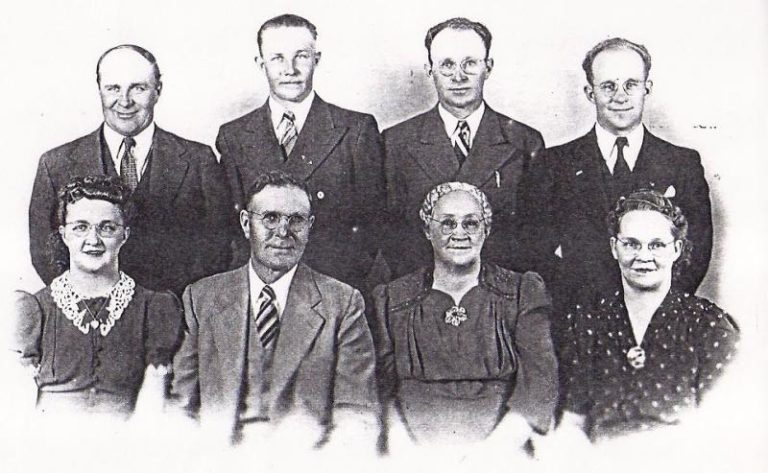
A Danish-immigrant family from Mendon in Cache Valley. By family tradition Andrew Andersen scouted the valley with his sons Otto and John in 1892; after his Mendon store burned in October 1893 the sons settled at the head of Bannock Creek and raised their first crop in 1894. Seven of his children, with his daughter Annie’s husband Bruce Pett, entered neighboring homesteads around today’s Andersen Road between 1901 and 1914; the valley history calls them “the largest family to settle and homestead” there, and John C.’s descendants were still farming there when the family histories were written (2018–19).
Arrived
First visit late June 1892 (family tradition); settled about 1893–94; homestead entries 1901 date range
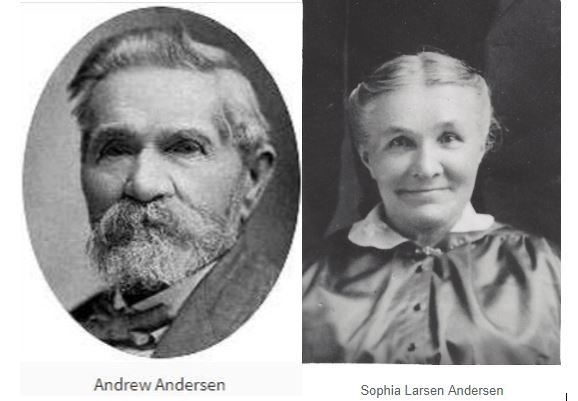
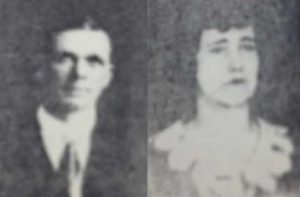
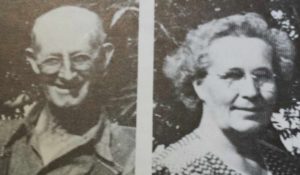
Andrew and Sophia Larsen AndersenDate unknownFOREWORD · THE ORIGINAL ACCOUNT
From the family history
The account first written for this family on ArbonValley.com, kept in full. The chapters after it add what the records and the other family histories tell.
Written by Jacob Andersen2 minute read
About this account · first posted December 30, 2018
Written for the original ArbonValley.com by Jacob Andersen. Memories and documents quoted in the account belong to the people who wrote them. This is the website publication date, not the date of every event described. References to “today” belong to the original account.
The Andersen family was one of the first families to homestead in Arbon Valley (first known as Bannock Valley), coming after the George Arbon family. They were also the largest family to settle and homestead there.
Andrew Andersen [also known as Anders Jorgensen] first hailed from Bromme, Soro, Denmark. He joined the Church of Jesus Christ of Latter-Day Saints and emigrated to Utah in 1858. Most of the individuals in this company coming from Denmark sailed across the ocean on the ship John Bright. About sixty individuals were in the independant wagon company captained by Russell King Homer when it began its journey on July 3, 1858 from the outfitting post at Iowa City, Iowa, arriving in Salt Lake City in October 1858. They made good time, in spite of narrowly averting a Sioux Indian attack, and at one time being hit by lightning that “stunned” thirteen people taking cover in one tent. They also met Jim Bridger as they crossed the plains.
Andrew eventually settled in Mendon, Cache Valley, Utah, where he met his wife Sophia Larsen, married in 1871, and raised a large family of ten children. They also raised one grandchild.
Andrew and his two oldest sons first viewed the Bannock Valley (Arbon) in 1892, returning in 1893 to take up land. Some of Andrew’s great great grandchildren still farm in the valley today. Andersen Lane, named in honor this homesteading family, goes by the original homestead farm; it is about twelve miles south of the school.
Sources:
Call, Laurie Jean, Bannock Valley (Providence, Utah: Keith Watkins and Sons, 1982).
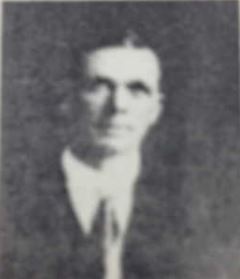
Andrew Andersen (born Anders Jorgensen, 1833) came from Bromme in Denmark’s Sorø district, joined the Latter-day Saints and in 1858 sailed on the John Bright with his first wife, Cathrine Sophie Sørensen, and his father, crossing the plains with the Russell K. Homer company; their only child, Lydia, was born about the time they reached Utah. In Mendon he was a store clerk and merchant, carpenter, farmer, stock raiser and molasses-maker, a director of the 1869 co-op store, a counselor in the bishopric for nearly thirty years, a school trustee and city councilman. In 1871 he married Sophia Larsen, who had come from Denmark at nine on the Athenia in 1862; they had ten children, nine of whom grew up. Land in Cache Valley had grown scarce, and his Mendon farm could not support ten children.
Family accounts tell that in late June 1892 Andrew, Otto (17) and John (15) drove a light covered wagon north past Snowville and up through the valley, camped by a spring in a green meadow, and staked land south-east of George Arbon. No record made at the time mentions that trip. George Andersen’s memoir ties the search for land to the loss of Andrew’s Mendon store, which burned in October 1893, and the 1917 valley history has the Andersen brothers camping in a wagon box in 1893 or 1894 and raising their first crop in 1894. Otto and John settled on opposite banks of Bannock Creek, plowed about fifteen acres by hand and cut logs in Bull Canyon for a 12×16-foot house — the Andersen accounts call it the first house in the valley. Each fall they went back to Mendon for railroad or farm work.
From 1895 the brothers stayed year-round, “batching” together for about ten years; as they married, their families kept winter homes in Mendon until about 1913. Their homesteads lay right below Rocky Ridge, the first road out of the valley; when winter mail came over the ridge from Malad, Otto and John hitched four horses to a sleigh and broke the trail. Otto once found the mail carrier, Tom Davis, nearly frozen by the granary in a three-day west blizzard. The land was not yet open to entry when they settled: John and Otto made the family’s first homestead entries at Blackfoot on September 6, 1901, for the quarters on either side of the creek, giving their residence as Arbon.
One by one the younger children entered land nearby: Ezra north of John (1904, the day after his wedding to Eva Arbon), Magnus just south of John (1905), their widowed sister Catharine and George on two mile-long strips west of John (the same day in March 1907), and finally Henry, whose 312 acres a mile south-east of Otto were patented in 1918. Annie and her husband Bruce Pett homesteaded eighty acres south of Jerry Baker from about 1912 and later bought Magnus’s quarter. The brothers ran sheep and sheared at Dairy Creek, where crews clipped as many as 5,000 head a day, and in 1913 bought a threshing machine together. Annie, trained as a nurse, became the valley’s midwife; Ezra played Santa Claus; and in January 1911 Ezra and Eva lost their son Nicholas in the flood that took two Dalton children.
By January 1920 the households of John C., Otto, Ezra and the Petts stood side by side at Arbon, and Otto chaired the Valley View school board. George had left for Malad in 1916, Henry farmed at Arco, and Magnus lived with their parents in Mendon, where he was elected mayor in 1921. Otto, John, Ezra and Annie lived in the valley for decades; the Petts moved to Parma about 1940, and Otto retired in 1949.
John’s line became the family’s long-term heart in the valley. His son Willard was bishop of the Arbon Ward in the 1940s and, by the family account, long served in the Arbon branch presidency, on the school board and as constable; his brothers Glenn and Norman farmed at Arbon after the war; and Mark restored the original homestead cabin. Ezra’s grandson Ted farmed in Arbon Valley most of his life. Willard’s son Lynn and his wife JoAnn began wintering on the old Pett place in 1978, and Lynn farmed there until his death in 2021. Andersen Lane — today’s Andersen Road — runs along the line between John’s and Magnus’s homesteads, past the original homestead farm.
Earlier: Bromme, Sorø, Denmark → Liverpool to New York on the John Bright (1858). Route drawn only between places named in the family history; the lines are schematic, not trail routes.
Bromme, Sorø, Denmark
Liverpool to New York on the John Bright1858
Salt Lake City (Homer wagon company)1858
Mendon, Cache Valley1860s–1890s
Bannock Valley, by way of Snowville and Blue Creek Valley1893–94
“We did not see anyone all day, just open country and today I think every foot of this ground is farmed.”
George Lionel Andersen, remembering his first trip to the valley, at seven · In his own words ↗
THE PEOPLE
The people
56 people of the Andersen family on the valley map, household by household, and 15 histories of their own in the archive. Names open their histories; portraits open in the family album.
The homesteaders’ parents
The generation before the valley, who helped their children settle.
Danish emigrant of 1858 (the John Bright and the Russell K. Homer company) and Mendon store clerk, merchant, carpenter, farmer and stock raiser, a director of the Mendon co-op (1869) and a church and civic leader. After his Andersen & Danielson store burned in October 1893 — that November the firm assigned its property for the benefit of its creditors — he brought his sons to Bannock Valley, because Cache Valley land could not support them all; he never lived in the valley himself.
Wife of Andrew Andersen (married 1871); mother of ten; sister of Fredrick and Peter M. Larsen
More about Sophia
Mother of the Andersen homesteaders. She sent her two oldest sons back each spring with sugar, flour, baking powder, salt, dried fruit and matches, and her Mendon home was the family’s winter base until about 1913. Her brothers ran cattle in Bannock Valley, and her brother Peter M. Larsen ranched at Summit; his sons Guy and Miles Larsen of Arbon were her nephews.
First wife of Andrew Andersen (married 1857); mother of Lydia
More about Cathrine
Andrew Andersen’s first wife. She sailed with him and his father on the John Bright in 1858 and crossed the plains with the Russell K. Homer company; the 1870 census finds them at Mendon with their only child, Lydia. She belonged to the large Mendon Sorensen family: the Summit Sorensens and the Buist Richards brothers were probably her nephews.
The homesteading generation 11
The men and women who took up land in the valley. Each with the people who married in, and their children below.
LA
Lydia Ann Elvira Andersen Farrell
1858–1896
Daughter of Andrew Andersen and his first wife; half-sister of the Andersen homesteaders
More about Lydia
Andrew’s only child by his first wife, recorded with her parents at Mendon in 1870 — the “daughter by his first wife” of the family history. She probably married George Lionel Farrell (1879); her daughter Gladys Farrell visited “her grandparents, Mr. and Mrs. Andrew Anderson” at Mendon in 1908.
Eldest child of Andrew and Sophia; married Roy B. Pratt (1896; divorced 1899), Nicholas Poulsen (1899), Frank Anderson of Hyrum (1911) and J. A. R. Gibbons of Arbon (1916)
More about Catherine
One of the valley’s women homesteaders. Widowed in 1905, when her second husband, Nicholas Poulsen, died after harvest work in Bannock Valley, she entered 160 acres in her own name on March 9, 1907, the same day as her brother George, giving Arbon as her residence, and built a shanty there; she was living on the homestead in the summer of 1911. She married Frank Anderson of Hyrum in December 1911 and they lived on the place for a time; George farmed eighty acres of her land on shares in 1914–15. A trained nurse, she married J. A. R. Gibbons of Arbon in 1916, was superintendent and then head nurse of the Lynn hospital in Pocatello in the early 1930s, and in later years cared for their mother in Mendon. She wrote the life sketch of her father that the original ArbonValley.com prints.
Eldest son of Andrew and Sophia; husband of Ane Maretta “Retta” Hansen (married June 26, 1902)
More about Otto
One of the earliest young men in the valley; the family’s first log house stood on his place, and once he had livestock he wintered in the valley. His family’s accounts say he filed at Blackfoot in 1893, but his recorded homestead entry was made on September 6, 1901, the same day as John’s. His wife and children wintered in Mendon until June 1913, when he moved them to Arbon. He chaired the Valley View (District 11) school board in 1920–21, was widowed at Arbon in 1931 and farmed until he retired in 1949.
Second son of Andrew and Sophia; husband of DeSena Sorensen (married 1906)
More about John
Helped Otto meet the homestead requirements until he could file himself; his own homestead entry, with Otto’s, was made on September 6, 1901. A hunter who kept the brothers in venison and duck eggs, he sheared sheep at Dairy Creek, farmed with horses and served three years as Arbon Ward Sunday School superintendent. He and DeSena moved to Pocatello in 1946, leaving the farm to their son Mark; their sons Glenn and Norman were farming at Arbon in 1947–50.
Batched with John and Otto for about ten years and sheared at Dairy Creek. He kept his homestead longer than the family account says: he still came out to “his place in Bannock” in 1913 and 1914, and in 1918, while he was in the army, the county refunded his taxes, which Ezra had paid. The Petts bought the quarter later, probably not before 1917. His home was with his parents in Mendon; he left for army training at Fort Douglas in April 1917, served as a corporal in the First World War (1917–19), and was elected mayor of Mendon in November 1921.
Son of Andrew and Sophia; married Eva Arbon (1904), Sadie Renshaw Pett (1919), Mammie Wacaster (1927), Melba Wilcox (probably; 1940) and Florence Butterfield Breeze (1946)
More about Ez
Herded sheep as a boy and was the first of the brothers to appear in a record as a working valley farmer: in 1907 his 32-acre field averaged thirty bushels an acre. In October 1904 he married Eva Arbon, daughter of George Arbon, and entered his homestead the next day; their son Nicholas drowned in January 1911, and their son Harvey later took over the farm. In January 1918, after a large wheat crop, the American Falls paper called him “one of the pioneers of Arbon valley”. He often played Santa Claus, was an avid hunter and fisherman, and spent his last farming years at Crystal.
Lived in Mendon; she probably married Charles Thomas Cunningham in 1905 (the record names the bride only as Mary Anderson). In June 1907 Cunningham sued for divorce; the outcome has not been found, though the archive cites a death certificate that gives her as divorced. Her daughter Hilda was raised by Andrew and Sophia after Mary’s early death. The archive records no Arbon homestead for her.
Son of Andrew and Sophia; husband of Elizabeth “Beth” Shelton (married October 26, 1910)
More about George
As a boy he herded the family’s sheep alone in the mountains for weeks, broke horses bareback, and worked threshing for wages of two bushels of wheat a day. He filed in 1907, served a mission in the Central States (June 1908 – February 1910), and with Beth built a log house of Bull Canyon logs in 1910. They farmed through deep winters, a June frost and a dry year before moving to Malad in 1916; the farm was sold about 1917–18.
Daughter of Andrew and Sophia; wife of Charles “Bruce” Pett
More about Annie
Trained as a nurse in Salt Lake City, she became the valley’s practical nurse and midwife, delivering many babies on “the coldest, stormiest nights,” usually without pay. She and Bruce had an Idaho home by January 1913 and raised eight children at Arbon; the three eldest were born in Utah, the younger ones in the valley — a daughter was born at their Arbon home in August 1920. The Petts moved to Parma about 1940, and later to Nyssa, Oregon.
Youngest child of Andrew and Sophia; husband of Wealthy May Gibbons (married June 29, 1916)
More about Walt
The last Andersen sibling to homestead. He went out with the Mendon homesteaders as a young man, made two homestead entries about 1913–14 and farmed George’s place in 1916–17. In June 1916 he married Wealthy May Gibbons, daughter of Arbon homesteader John A. R. Gibbons, at Mendon during the Andersen reunion. By January 1920 he had his own farm at Arco; the family account says he sold his Arbon land to his brothers. He died in Oregon in October 1923, aged twenty-nine, where he worked as a timber scaler at a sawmill. The archive says he was killed in a logging accident; the contemporary report of his death gives no cause.
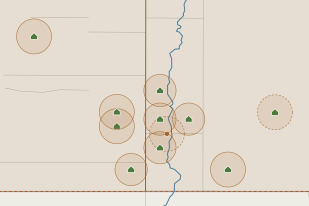
The Andersen homestead block at the head of Bannock Creek, astride present Andersen Road below the old Rocky Ridge trail: the NW, SW and SE quarters of Sec. 25, the S½ of Sec. 26 and the NW¼ of Sec. 36, T11S R33E, with the Pett eighty in Sec. 35 and Henry’s land in the adjoining Sec. 31, T11S R34E. Both versions of the archive’s family map place the Andersen circle about a kilometre east of this point, at the east end of Andersen Road.
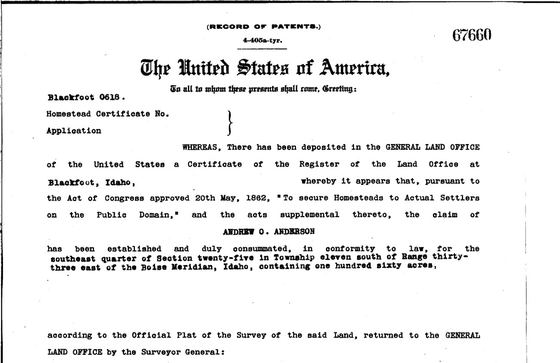
Otto’s homestead, the SE¼ of Sec. 25, T11S R33E, east of Bannock Creek and right below the Rocky Ridge trail (entered September 6, 1901; patent June 17, 1909). The family’s first 12×16-foot log house stood on this place; accounts put it a quarter mile or three-quarters of a mile from John’s.
John Andersen’s homestead (cabin still on the farm)
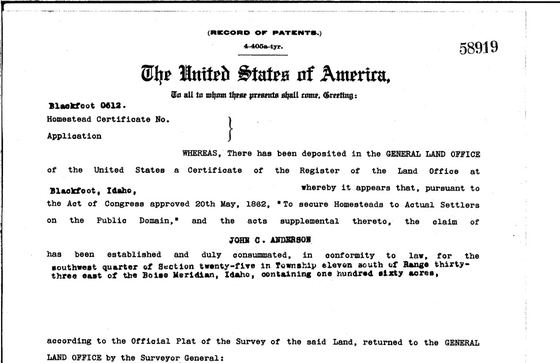
John C. Andersen’s homestead, the SW¼ of Sec. 25, T11S R33E, on the west side of Bannock Creek (entered September 6, 1901; patent May 4, 1909); Andersen Road runs along its south line. The homestead log cabin John and DeSena moved into in 1906 still stands on the farm.
Ezra’s homestead, the NW¼ of Sec. 25, T11S R33E, north of John’s (entered October 5, 1904, the day after his wedding; patent April 3, 1911). Eugene Nelson had entered the same quarter in 1901, but his claim was cancelled in 1904.
Lars Magnus Andersen’s homestead, the NW¼ of Sec. 36, T11S R33E, just south of John’s across Andersen Road (entered March 13, 1905; patent May 25, 1911). Bruce and Annie Andersen Pett bought it later, probably not before 1917; Lynn and JoAnn Andersen later lived there. The present Oneida–Power county line runs half a mile to the south.
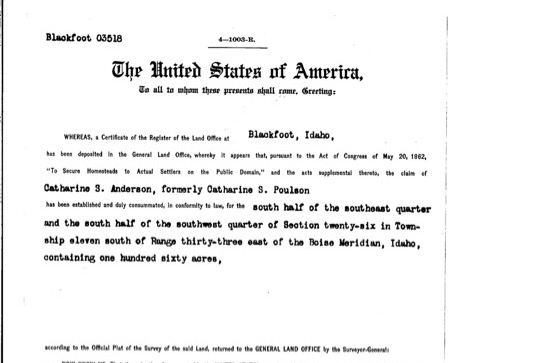
A strip one mile long and a quarter mile wide, the S½SE¼ and S½SW¼ of Sec. 26, T11S R33E, west of John’s and just south of George’s. Catharine entered it as the widow Catherine S. Poulson on March 9, 1907, and received her patent on April 27, 1915.
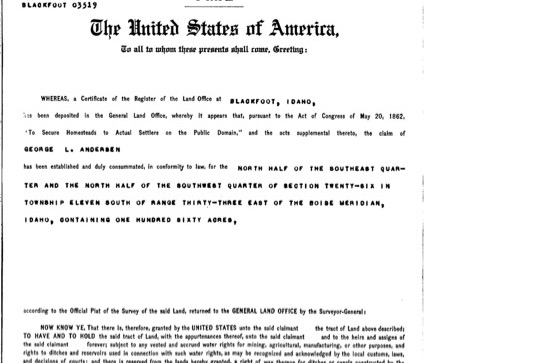
George’s strip, the N½SE¼ and N½SW¼ of Sec. 26, T11S R33E — “one mile long and one quarter mile wide” — entered March 9, 1907, and patented September 16, 1912; his log house of 1910–11 stood on it.
The N½SE¼ of Sec. 35, T11S R33E, just south of Jerry Baker’s quarter: Bruce Pett’s homestead, entered about 1912 and patented February 2, 1917. The Petts later also bought Magnus Andersen’s quarter, which touches it at the corner.
Henry’s 311.99 acres in fractional Sec. 31, T11S R34E (Lots 3–4, E½SW¼, W½NE¼ and W½SE¼), about a mile south-east of Otto’s place: two homestead entries made about 1913–14 and patented on January 8, 1918. Maurice Poppie and Homer Lindley patented the rest of the section.
Eva Andersen’s own claim as Sarah Arbon Bird (entry 1904, given up 1909)
The 160 acres entered on April 14, 1904, by “Sarah Arbon Bird” of Arbon, probably George Arbon’s youngest daughter Eva, half a year before she married Ezra Andersen: the E½NE¼ of Sec. 21 and the S½NW¼ of Sec. 22, T11S R33E, about a mile west of her father’s homestead on Church Road. The entry was relinquished on April 19, 1909; parts of the land were later patented by John J. Infanger and Daniel V. Roberts.
Willard Andersen’s stock-raising homestead (patent 1942; shown from about 1939)
Willard J. Andersen’s 640.72-acre stock-raising homestead in the hills east of the family block: land in Sec. 29 with the NE¼ of Sec. 30 and the NW¼ of Sec. 32, T11S R34E, patented on February 24, 1942, the last Andersen homestead. The entry date is not recorded; the map shows the claim from about 1939, three years (the stock-raising residence period) before the patent.
How the Andersen homesteads fit together
Relative positions as the archive describes them (Annie Andersen Pett, Lars Magnus and Henry Waldemar pages, paraphrasing Bannock Valley, page 29). Each square is a 160-acre quarter section (½ mile on a side). Not to scale and not a survey; exact boundaries are not documented. Select a name to read that person’s history.
“Our land was one mile long and one quarter mile wide.”
George Lionel Andersen, on the strip he homesteaded in Section 26 · In his own words ↗
The land patents
The federal patents that made the homesteads theirs, from the General Land Office records.
Every date the valley map shows when you follow the Andersen family, era by era: the most telling of each era first, the rest a click away. Dates keep the sources’ own wording.
Homestead or landFamily historyEventValley firstTragedy
BEFORE 1884 · 11 DATES
Before Homesteading
A Shoshone and Bannock homeland; trails, travelers and cattle range.
March 22–April 23, 1858Family history
Across the Atlantic on the John Bright
Anders Andersen, a 24-year-old farmer from Zealand, sailed from Liverpool to New York on the John Bright with his wife Cathrine Sophie and his father Jørgen Christian, a carpenter. His stepmother Karen and his two-year-old half-sister Maren travelled with them.
Nine-year-old Sophie Larsen, baptized that spring, sailed from Hamburg to New York on the Athenia with her parents, Magnus and Maren Larsen, and her brothers and sisters.
After the journey by train and riverboat to Florence, the Larsens walked beside the ox-team wagons and reached Salt Lake City on October 1, 1862. They spent a month at Brigham City and then made their home at Mendon.
Andrew was one of the directors of the Mendon branch of ZCMI, the Latter-day Saint co-operative store, from its founding in 1869, with A. P. Shumway, Charles Shumway Sr. and Charles Bird Sr.
The census found Andrew, 37, working as a store clerk, at home with his wife, Cathrine Sophie, and their daughter Lydia, 11, who was at school. Sophia Larsen, 17, was still living in her father’s Mendon household.
Andrew and Cathrine Sophie settled at Mendon in Cache Valley, probably following her family, the Nicolai Sorensens, whose first members took up land there in the spring of 1859. Mendon remained Andrew’s home for the rest of his life.
Newspaper notices of 1922 say Andrew was for many years first counselor to Mendon’s bishop, Henry Hughes. An undated note in the ward record, written after the July 1873 minutes, names “Councilor 1st, Andrew Andersen”, which probably means the bishopric.
The family’s first Mendon home stood on the old Bigler lot in the south-west of town. About 1875 they moved to the house Sophia was still living in when she wrote her life sketch in 1932.
By family tradition, Andrew Andersen and his sons Otto and John came from Mendon in Cache Valley in a light covered wagon — almost to Snowville, up Blue Creek Valley, then north into the valley — and camped near a spring in a green meadow. Land in Cache Valley had become scarce; Andrew decided to help his sons homestead here. They found George Arbon already located to the north-west of the land they staked. No record made at the time mentions the trip, and George Andersen’s memoir places his father’s search for land after the Mendon store fire of October 1893.
late June 1892 (family tradition)Homestead or land
Andersen homesteads
The Andersen homestead block at the head of Bannock Creek, astride present Andersen Road below the old Rocky Ridge trail: the NW, SW and SE quarters of Sec. 25, the S½ of Sec. 26 and the NW¼ of Sec. 36, T11S R33E, with the Pett eighty in Sec. 35 and Henry’s land in the adjoining Sec. 31, T11S R34E. Both versions of the archive’s family map place the Andersen circle about a kilometre east of this point, at the east end of Andersen Road.
Homesteads, the first ditch, and the first winters.
1893 (claims staked; federal entries from 1901)Event
Squatters’ claims staked
The Arbon area timeline marks 1893 as the year homesteading opened. The townships were not yet surveyed, so the settlers of 1893 staked squatters’ claims — the 1917 valley history has J. N. Arbon, Ed Davis, D. J. Bowen and others staking land that year — and could file at the land office only after the plats were opened in 1901. Filing on 160 acres then cost $16, followed by five years of fencing, breaking ground and building a cabin to prove up. The first families — Andersens, Daniels, Arbons and Evans among them — lived in wagon boxes, tents or dugouts.
about 1893–94 (the family accounts say spring 1893)Event
Otto and John Andersen build a log house
Andrew returned with Otto and John. They settled on Bannock Creek — John on the west bank, Otto on the east — plowed about fifteen acres by hand for wheat and oats, and cut logs in Bull Canyon for a 12×16-foot house on Otto’s place, with a door to the west, a window to the south, and a dirt-covered pole roof; John’s own sketch remembers a first summer in a dugout of quaking-aspen logs. The family accounts date this to spring 1893; the 1917 valley history has the brothers camping in a wagon box in 1893 or 1894 and their first crop threshed after the fall of 1894. Otto’s account says he filed at the Blackfoot land office that year, but the township was not yet open to homestead entry; the brothers’ first recorded entries were made in 1901.
Spring 1894 brought back the Samaria homesteaders and others from Cache Valley, including the Andersen brothers on the east side of the Arbon area. Ed and Esther Arbon Davis came with their baby, and George Arbon brought his motherless children. Families shared what they had: wire to fence small fields, D. J. Bowen’s Osborne dropper to cut grain, and a thresher brought from Samaria through Mine Canyon.
While most men lived in their wagon boxes, David Bowen built a one-room cabin, 14 by 16 feet. Andrew Jenson, writing in 1906, says that in 1893 Bowen built the first cabin raised by Latter-day Saints in Bannock Valley, and the 1917 local history also puts the first cabin at the Bowen homestead. The Arbon area history dates it to summer 1894 and calls it the first cabin, “2nd cabin by an Andersen”; the Andersen accounts give that distinction to Otto Andersen’s 1893 log house.
October 1893Event
Andrew Andersen’s Mendon store burns
In October 1893 fire destroyed the building and stock of Andersen & Danielson, the Mendon store of Andrew Andersen and his partner Carl J. Danielson. That November the partners assigned all their property to Jasper Lemmon for the benefit of their creditors. George Andersen’s memoir links the loss to his father’s search for land for his sons, which took him to a meadow at the head of Bannock Creek.
Seven-year-old George rode with his brother John down the Bear River dugway, spent the first night at Michael Murphy’s ranch in Pocatello Valley and reached Bannock Valley the next day. “We did not see anyone all day, just open country.”
The first road in and out of the valley was Rocky Ridge, east of the Andersen homesteads, little more than an old Indian trail widened by the settlers' wagons.
From 1895 John and several of his brothers stayed through the whole year to care for their stock; John, Otto and Magnus “batched” together for about ten years. When winter mail came over Rocky Ridge, John and Otto hitched four horses to a sleigh to break the trail so it could get through.
The Utah medical examiners licensed a Catherine S. Anderson to practise obstetrics. She was very probably Andrew’s eldest daughter Catharine, then 22, who made nursing her career.
At first the settlers took turns carrying the mail from Malad over Rocky Ridge, and two families each remember their own man as the first regular carrier.
Catharine had sued at Logan that April for a divorce from Roy B. Pratt, saying he had deserted her, and asked to have her maiden name back. Judge Hart granted the decree in June, probably on Saturday June 24.
Schools, churches, stores and post offices in every area.
March–September 1901Event
The first homestead entries
Once the townships were surveyed, the settlers who had squatted on the valley floor since the 1890s filed at the Blackfoot land office. The register dates the first entries: Jennett Daniels Price and Henry Daniels on March 12, 1901, at West Fork, then Donum and Thomas D. Daniels later that month; Charles A. Bailey on March 28, the first on the Arbon floor; D. B. Evans and Julius Abter in April; John Payne’s and Jane Dalton’s desert-land claims in May; Thomas Gibbons, the Bailey brothers, George Arbon, David T. Davis and Jesse Ward’s desert land in late May; D. J. Bowen and J. A. R. Gibbons on June 6 and William Arnn on June 8; the first Summit entries — Joseph T. Wood, Peter Larsen of Mendon and Frederick J. Manning — on July 2; and John C. and Otto Andersen on September 6. Most gave their residence as “Arbon, Oneida.”
The community hauled logs from the canyons and built a 20×36-foot building “by everyone, regardless of church affiliation.” The original ArbonValley.com accounts put it beside the George Arbon homestead on Church Road, where the present meetinghouse stands, on land they say Lorenzo and Chloa Bailey gave; the Power County history puts the 1902 log school in Section 12 instead. It served as Valley View School, meetinghouse, dance hall and public meeting place, and was Oneida County School District 46 by 1907; around 1904 the logs were covered with lumber.
undated; probably between about 1900 and 1908Tragedy
Eva Andersen’s own claim as Sarah Arbon Bird (entry 1904, given up 1909)
The 160 acres entered on April 14, 1904, by “Sarah Arbon Bird” of Arbon, probably George Arbon’s youngest daughter Eva, half a year before she married Ezra Andersen: the E½NE¼ of Sec. 21 and the S½NW¼ of Sec. 22, T11S R33E, about a mile west of her father’s homestead on Church Road. The entry was relinquished on April 19, 1909; parts of the land were later patented by John J. Infanger and Daniel V. Roberts.
Ezra’s homestead, the NW¼ of Sec. 25, T11S R33E, north of John’s (entered October 5, 1904, the day after his wedding; patent April 3, 1911). Eugene Nelson had entered the same quarter in 1901, but his claim was cancelled in 1904.
Lars Magnus Andersen’s homestead, the NW¼ of Sec. 36, T11S R33E, just south of John’s across Andersen Road (entered March 13, 1905; patent May 25, 1911). Bruce and Annie Andersen Pett bought it later, probably not before 1917; Lynn and JoAnn Andersen later lived there. The present Oneida–Power county line runs half a mile to the south.
George Andersen and his widowed sister Catharine (as Catherine S. Poulson) entered the two halves of the south half of Section 26, T11S R33E, on consecutive lines of the Blackfoot register, both giving their residence as Arbon — strips a mile long and a quarter mile wide, Catharine’s south of George’s. George cleared and fenced part of his, then left for a mission; with “a great number of people coming in from Washington and other places,” he feared someone would contest a claim he could not live on. His memoir remembers Catharine filing while he was away; the register shows they filed the same day.
Cattle and horses grazed the open country until 1907. Returning in the spring of 1910, George Andersen found that “every piece of land that could be farmed was settled on,” by newcomers from as far as eastern Washington and from Cache Valley: “the valley became alive with people.”
After a January thaw and Chinook wind filled every creek, the Ezra Taft Andersen and Dell C. Dalton families were going home together when their sleigh or wagon box overturned at a flooded crossing. Mr. Dalton lifted it off the others; Mrs. Dalton and Eva Andersen held children by their feet. Two Dalton children (probably George, six or seven, and the infant Dora) and Nicholas Andersen — five by his recorded birth date (four in the May 1910 census), six by the family account — were swept away and found downstream the next morning. The archive says they were buried in the Pauline Cemetery; Find a Grave and a memorial stone place them in the Arbon Valley Cemetery.
The June 1900 census found all six sons in Andrew’s Mendon household: Otto, John C. and Magnus working as farmers, Ezra and George at school, and Henry, six, with their sisters Mary and Annie. Andrew owned a mortgaged farm, and none of the brothers was counted in Idaho.
The family’s right to water stock from the springs at the head of Bannock Creek, on Sections 24 and 25, carries a claimed priority of April 1, 1901, five months before the brothers’ first homestead entries. The right was decreed in 1998.
At the Blackfoot land office John C. Andersen entered the SW¼ and Otto the SE¼ of Section 25, T11S R33E — the quarters on either side of Bannock Creek where the brothers had worked since the 1890s — each giving his residence as “Arbon, Oneida”. Their patents followed in May and June 1909. The township had been opened to entry that spring, and the family’s stock-water right on the springs at the head of Bannock Creek carries a claimed priority of April 1, 1901.
Andrew was a member of the new Cache Valley Implement Company of Logan, with I. C. Thoreson of Hyrum and E. R. Miles Jr. of Smithfield; it had branches at Smithfield, Preston and Hyrum.
A “Sarah Arbon Bird” of Arbon, probably Eva, entered 160 acres in Sections 21 and 22, about a mile west of her father George Arbon’s place, half a year before she married Ezra. The claim was given up in April 1909.
The day after his wedding Ezra entered the NW¼ of Section 25, just north of John’s place, giving his residence as Arbon. Eugene Nelson’s 1901 claim to the same quarter had been cancelled that April.
Lars Magnus, written in the register as Lars Andersen of Arbon, entered the NW¼ of Section 36, just south of John’s place across today’s Andersen Road.
As administratrix of Nicholas Poulsen’s estate, Catherine S. Poulsen of Peterboro published the notice to creditors in November 1905, and his Petersboro farm was sold in the spring of 1906.
Charles T. Cunningham, whose 1905 bride is recorded only as Mary Anderson and was probably Andrew’s daughter Mary Caroline, sued for divorce at Logan. The outcome has not been found; her daughter Hilda was raised by Andrew and Sophia.
The American Falls Press reported that Ezra’s 32-acre field averaged 30 bushels an acre in 1907, and that his oats had made 75 bushels the year before. He is the first of the brothers to appear in a record as a working valley farmer.
By the end of 1907 Fred Larsen of Mendon and his brothers, Sophia’s brothers, were running cattle in Bannock Valley. Peter M. Larsen’s sons Guy and Miles later farmed at Arbon.
Two roads compete for the title of the valley's first engineered road: a county road to American Falls laid out in 1908, and the grade over Jenson Pass toward Malad.
After a farewell party in Mendon, George was set apart on June 16, 1908, for the Central States Mission and served in its East Kansas Conference. He came home on February 15, 1910.
In November 1908 the American Falls Press began a campaign for settlers, advertising the valley as having had no crop failure. An Arbon committee of John Payne, Adam Affleck and Lorenzo Evans answered homeseekers’ letters; J. R. Bailey, Julius Abter and Otto Andersen laid out a new road to American Falls; and Bert Evans, David Roderick and Bishop Arbon called a December meeting on dividing Oneida County. Twenty-eight homesteads were taken between November 1908 and March 1909, families from Dayton, Washington, filed after a copy of the Press reached them, and within about two years nearly all the vacant land was taken.
John C. received the federal patent for his 160 acres, the SW¼ of Section 25. It was one of four patents to the valley’s old squatter families, John C. and Otto Andersen, Dave Evans and George Arbon, issued within six weeks of each other.
Otto was named with Henry E. Shandrew, James L. Payne and Daniel Roberts as a witness for John Payne’s commutation proof on the N½NE¼ of Section 26, to be made at Pocatello on October 18, 1909.
The census found Otto’s family at dwelling 9 and Ezra’s at dwelling 11, with Jerry Baker’s between them, and John C.’s at dwelling 19, next to the bachelor James T. Guthrie. George Arbon, 70, was living four doors from Ezra in his son Joseph’s household.
Lars Magnus Andersen, who had entered the 160 acres just south of John’s place in March 1905, proved up; his patent followed on May 25, 1911. The family account says he sold the place to his sister Annie and her husband Bruce Pett about 1911 and went back to Mendon to care for his parents, but he still came out to “his place in Bannock” in 1913 and 1914, and in 1918, while he was in the army, the county refunded his taxes, which Ezra had paid. The Petts probably bought the quarter after 1917.
Newly married, George and Beth Andersen camped for a week by a small sawmill in Bull Canyon, cutting logs sawed on two sides. His uncle John, an expert log builder from Jackson Hole, with his brothers John and Ezra, raised the house; shingles, windows and doors came from Malad. Winter set in before it could be chinked.
George and Beth’s homestead was “one mile long and one quarter mile wide.” In 1911 he broke ground with a borrowed hand plow, traded a horse for a drilled well, finished the house and built a stable. Plowing two acres meant eight rounds and sixteen miles of walking behind the team.
A Mendon column reported Mrs. Poulson in from Arbon, where she had been living on her homestead. Her brother George remembered that in the spring of 1912 she and her new husband came out to live on the place.
In November 1911 Otto came in to Mendon for the winter with Leo Richards, Henry Sorensen and Henry Bird, and in December a John Anderson, probably John C., moved his family in from Arbon. The John Andersons went back out to Arbon in April.
Snow buried the barbed-wire fences, leaving only post tops showing. George and Beth fed John Andersen’s stock all winter, crossing the half mile on snowshoes; besides family, the Arnn family and Heber Woods were about the only people they saw until the thaw.
George Andersen completes his claim after a mission
Back from his mission in the Central States (June 1908 – February 1910), George Lionel Andersen was relieved to find both his homestead and his girlfriend waiting. He completed his claim in June 1912 and received his patent that September; the family page says he later sold his land to his brothers and moved to Malad.
Still “of Brigham City” that spring, Bruce Pett entered the N½SE¼ of Section 35, eighty acres south of Jerry Baker’s quarter; its serial number dates the entry to about June 1912. The Petts had an Idaho home by the following winter.
A Mendon column listed “Walter Anderson”, very probably 18-year-old Walt, going out to the south-valley homesteads with Otto, the Hardmans, the Sorensens, Jens Jensen and Lon Wood. George remembered Walt first coming to the valley with him in the spring of 1910.
A new county, roads and phones — and the first departures.
January 30, 1913Event
The valley is divided between two counties
Power County was created on January 30, 1913, from parts of Bingham, Blaine, Cassia and Oneida counties, two years after the valley voted 109 to 30 to be included. Crystal, Pauline–West Fork and the Arbon floor went to the new county, with American Falls as county seat; the line ran just south of Magnus Andersen’s place, and Summit and Buist stayed in Oneida. Crystal had been in Oneida County, not Bannock.
August–November 1913Family history
Catharine’s Studebaker
In August 1913 Catherine S. Anderson of Mendon bought a Studebaker “25” and drove it to her ranch. That November she and her brother Magnus drove home to Mendon in it from their places in Bannock Valley.
Henry’s 311.99 acres in fractional Sec. 31, T11S R34E (Lots 3–4, E½SW¼, W½NE¼ and W½SE¼), about a mile south-east of Otto’s place: two homestead entries made about 1913–14 and patented on January 8, 1918. Maurice Poppie and Homer Lindley patented the rest of the section.
After a cold north wind died away in the night, a hard frost struck. George Andersen’s waist-high wheat, “a perfect stand,” broke off “clear to the ground” when they walked through it. He and Beth borrowed money for seed and planted again.
a hard winter remembered as 1919 (year uncertain)Event
Horses driven into the mountains to survive
Deep snow lasted so long that by March the hay was gone. The men drove the horses into the mountains on the east side of the valley, where the ridges blew clear, and carried oats up to them on homemade skis every day or two.
Families who had harnessed up to eighteen horses a day changed over: the Arbons bought their first gasoline tractor in 1928, the Bolingbrokes a Caterpillar in the early 1930s, the Lusks traded their horses for a Model M crawler in 1937 ($1,650), and Mark Andersen’s family bought its first tractor around 1941.
Until about 1913 the Andersen wives and children wintered in Mendon and the valley farms were worked from spring to fall. In June 1913 the Mendon column reported that Otto had moved his family to Arbon; the Petts and Ezra had gone back to their valley homes that January after two months in Mendon. Cache Valley ties continued: several Andersen and Pett babies of 1913–18 were born in Utah.
With all 160 acres finally under cultivation, George and Ezra bought a header, and that fall all the Andersen brothers bought a horse-drawn power threshing machine to do their own threshing. Grain went to Michaud or Malad — three days a trip either way, with no houses or meals on the Michaud road.
Walt made two homestead entries on fractional Section 31, T11S R34E, about a mile south-east of Otto’s place; their serial numbers date them to about December 31, 1913, and February 10, 1914. He was then 19 or 20 and single.
Magnus came in to Mendon from his homestead in February 1914, reporting two feet of snow, and that month Ezra and Walt left Mendon for their ranch in Idaho.
Catharine received her patent for the south strip of Section 26, issued to “Catharine S. Anderson, formerly Catharine S. Poulson”. She had entered the land as a widow eight years before.
Little snow and hardly any rain: most of George Andersen’s grain did not mature, and the crop from Catharine’s land was smutty and sold for less. After harvest the family moved back to Mendon for work.
George summer-fallowed eighty acres of the farm, then in August 1916 took a job at the Malad grain elevator. His brother Walt farmed the place, and “we made more out of the farm than we had ever made before.”
The Arbon column reported that Hyrum Powell had sold his ranch in Section 1 “to Anderson” and was moving to Shelley. Powell was J. A. R. Gibbons’s son-in-law, and Walt married Gibbons’s daughter Wealthy that month, so Walt is the likeliest buyer, but no record names him.
Ezra was marshal of the day at the Arbon Pioneer Day celebration, and a John Anderson, probably John C., was among the committee members and helpers for the program at the Central school and Pauline.
Henry Waldemar (“Walt”) Andersen, the youngest sibling, finalized his claim to about 312 acres a mile south-east of Otto’s place — two homestead entries made about 1913–14 — a day after registering for the WWI draft; the patent was issued on January 8, 1918. The family remembered the land as a homestead plus a desert claim, but the patent is for homestead land only. By 1920 he was farming at Arco; the family account says he sold his Arbon land to his brothers. His brother Magnus had left Mendon for army training at Fort Douglas that April.
1917 harvest (reported January 1918)Family history
Ezra’s Turkey Red crop
The Press called E. T. Anderson “one of the pioneers of Arbon valley” and reported 2,875 bushels of Turkey Red wheat from his 1917 crop, sold at the Malad elevator. He planned to sow 400 acres of Bluestem.
The Power County commissioners refunded $28.36 in taxes assessed to Lars Anderson, “now in the military service”, to Ezra, who had paid them for his brother. The order names no land, but Magnus probably still owned his quarter.
Ezra and Eva had divorced by August 1919; when and where is not recorded. In January 1920 their son Harvey, ten, was living with Ezra, and Eva was not in the household.
The January 1920 census found the households of John C., Otto, Ezra (with his wife Sadie and her children Bert and Ora Pett) and Bruce and Annie Pett side by side on the Arbon sheets, with Jerry Baker’s between Otto’s and Ezra’s. All owned their homes, John C. and the Petts free of mortgage. Andrew and Sophia were at Mendon with Magnus and their granddaughter Hilda, and Henry farmed at Arco. That spring Otto chaired the Valley View (District 11) school board, and Otto, John C. and Ezra were on the Power County jury list.
A Clara Anderson, very probably Otto’s eldest daughter, was among Arbon’s rural eighth-grade graduates of 1920, with George Davis, Earl Ripley, Constance Evans and Edna Bailey.
Clara Andersen Grube
Christmas Eve 1920 (as remembered; possibly another year)Event
Santa in a blizzard
The Joe Arbon family invited neighbors for Christmas Eve. A blizzard blew in, and “Santa (Ezra Andersen) had a hard time getting there with the children’s toys.” The guests stayed the night and dug themselves out at daylight.
After the April 1921 school elections A. O. Anderson was again listed as chairman of District 11 (Valley View), with E. H. Davis as clerk and Chauncey C. Payne as the third trustee. A 1923 tax-roll statement probably still lists him among the district’s officers.
Norma was District 11’s (Valley View’s) eighth-grade graduate in the county’s 1921 list.
Norma Andersen Humphries
November 1921Family history
Magnus elected mayor of Mendon
At the November 1921 election Mendon chose L. M. (Magnus) Anderson as its mayor, and a John Gibbons, probably Catharine’s husband J. A. R. Gibbons, was elected to the council. The town’s list of mayors gives Magnus the years 1921–23.
Earl Wacaster, Mammie Wacaster’s son, was a Valley View pupil by November 1923, when his teacher and schoolmates gave him a party. Birdie Wacaster, probably her daughter, finished the eighth grade there in June 1924, years before their mother joined Ezra’s household.
The Valley View pupils organized their school as “Arbon City”, with Harold Andersen as mayor and Mark Andersen among its sheriffs. Harold, Harvey, Mark, Ruth, Hazel and Ada Andersen and Catherine and Taft Pett were pupils there together that winter.
The Valley View school column reported John Andersen and his son Willard hauling grain from the field into “the shanty and the old house”, while Bruce Pett and Ezra were getting out summer wood.
John C.’s eldest son Willard served a mission in the Southern States from January 1925 to May 1927; a family sketch adds a short time in the East Central States.
The county superintendent’s report on the valley schools listed Bruce Pett as a trustee of District 11 (Valley View), with Eddie Davis as clerk and C. C. Payne as chairman; the teacher was Edna Bailey.
Drought, closures, tractors, electricity, the reservation boundary.
April 1930Family history
The 1930 census at Arbon
In April 1930 John C. owned his farm at Arbon, and Otto, Harvey and Virgie, the Bruce Petts with six children, and Ezra with his wife Mary L. (Mammie) and her son Earl Wacaster were all enumerated in the Arbon precinct. An “Asel Anderson”, probably Ezra’s stepson Ace, was working as a laborer in Jerry Baker’s household.
Catharine, by then Mrs. Catherine Gibbons, left Mendon to take up her old post as superintendent of the Lynn hospital in Pocatello. She was its head nurse in 1934 and matron of a Pocatello hospital in 1936, and by February 1938 she had retired to Mendon.
Matilda Sorensen and her daughter Vena, DeSena’s twin, left Smithfield to stay with the John C. Andersens at Arbon. Vena lived with the family through the 1930s.
Norma, who had trained as a nurse at Logan, was operating-room supervisor at the Budge hospital and came home to Arbon on vacation that summer.
Norma Andersen Humphries
about 1939 (patent February 24, 1942)Homestead or land
Willard Andersen’s stock-raising homestead (patent 1942; shown from about 1939)
Willard J. Andersen’s 640.72-acre stock-raising homestead in the hills east of the family block: land in Sec. 29 with the NE¼ of Sec. 30 and the NW¼ of Sec. 32, T11S R34E, patented on February 24, 1942, the last Andersen homestead. The entry date is not recorded; the map shows the claim from about 1939, three years (the stock-raising residence period) before the patent.
George was the Farmers National Grain Corporation’s representative at Malad, where he had worked in the grain business since leaving the valley in 1916.
A John Anderson, probably John C., sat on the permanent Agricultural Adjustment Administration wheat-allotment committee for the Arbon district with Roy Lindley and Ed. Davis.
Sophia gathered the family at her Mendon home: John’s and Otto’s families and the Bruce Petts from Arbon, Catharine, then matron of a Pocatello hospital, George’s family from Malad, and Magnus.
The Curlew Stake was dissolved on February 11, 1940, and the Arbon Ward passed to the Pocatello Stake (from 1945 the West Pocatello Stake). By July 1940 Willard J. Andersen was bishop of the Arbon Ward, and he was still bishop in January 1949. When Joseph N. Arbon’s second term as bishop ended, and whether Don Jenson served between them, is not recorded.
Willard and Mamie’s household at Arbon included his brother Mark; Otto lived with his daughter Ruth; Ezra was raising two girls listed as his stepdaughters, Evelyn Hess and Maybelle Hatfield; and Charles and Ada Bailey were still at Arbon. Harold and Alyce were living at Crystal, and Harvey and Virgie at the Summit end, two doors from her parents, the Orisons.
After nearly thirty years in the valley, Bruce and Annie Pett left Arbon for Parma, Idaho, about 1940. Their son Taft and his wife Lucille bought a farm near Nyssa, Oregon, which he ran for 41 years.
After the April 1940 census Ada and Charles Kerr Bailey left Arbon for Clifton, Franklin County, Idaho, where he drove a school bus for 23 years.
Ada Andersen Bailey
November 1940Family history
Hazel leaves on a mission
John C.’s daughter Hazel left to serve in the Spanish-American Mission.
Hazel Andersen Terry
July–August 1941Family history
Clara teaches at Little Eagle
After summer school at Wingate, Otto’s daughter Clara took a teaching position at Little Eagle, South Dakota, on the Standing Rock reservation.
Clara Andersen Grube
February 24, 1942Event
Willard Andersen’s stock-raising homestead
Willard J. Andersen, John C.’s eldest son and bishop of the Arbon Ward, received a patent for a 640-acre stock-raising homestead in T11S R34E, in the hills east of the family block — the last Andersen homestead.
A Malad column listed a George L. Anderson of the Soil Conservation Service among the Malad people working at the Minidoka relocation center at Eden. He was probably George, though his son George L. Jr. is possible.
Glenn was an Army lieutenant by January 1943; he was on leave from Miami, Florida, in December 1943 and a first lieutenant at Amarillo, Texas, in October 1945.
Glenn C. Andersen
1943Family history
Mark’s family settles at Arimo
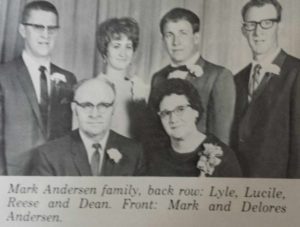
Mark adopted Delores’s children Earl Dean, Lyle and Lucille in 1943, and the family made its home at Arimo, by the family account.
Clara and her husband Roy Grube lived at Pine Ridge, South Dakota, where in 1951 both were employed by the Indian Service. In December 1947, after a visit to Mendon, Otto went home with them to Chadron, Nebraska.
After the war Glenn, Roma and their children were “of Arbon” in the Cache Valley columns, and in April 1950 the census found Glenn farming at Arbon with his brother Norman. No record names the farm, but it was probably their father’s place.
Glenn C. Andersen, Norman D. Andersen
1949Family history
Otto retires from farming
Otto farmed his Arbon homestead until he retired in 1949, more than fifty years after he first came to the valley.
The earliest school-bus driver on record is Alyce Andersen, Otto Andersen's daughter-in-law, who drove the Arbon school-district bus in 1950.
Alyce Neva Chapin Andersen, Harold James Andersen
April 1950Family history
The 1950 census
Harvey was farming at Arbon with his son Reed, next to Joseph G. Arbon, and Ted, 21, was a hired hand in Waldo Evans’s household. Ezra, 67, was living at Crystal.
The April 1950 census recorded Harvey and Virgie as separated. He was farming at Arbon with their son Reed, and she was living at American Falls with their daughter Lorene.
Willard was the original owner of a ground-water irrigation right with a priority of February 15, 1962, decreed in 2004. The decree places its use on about 155 acres of John C.’s and Magnus’s old homestead quarters; what it covered in 1962 is not known.
At the time of the archive’s accounts (2018–2019)Event
The valley the homesteaders made
The whole valley is now called Arbon. Of its four post offices (the accounts say five) one remains, in Pauline; instead of ten schools, Arbon Elementary teaches grades K–6 in two classrooms. The accounts name families still farming and ranching on or near the original homesteads, including Andersen, Bradley, Evans, Hayden, Hess, Jenson, Lusk, Swim, Ward and Williams.
Show 16 more from these years
April 1951 (accounts differ)Event
The Arbon Ward becomes a branch
With fewer families in the valley, the Arbon Ward was disorganized and continued as the Arbon Branch — in April 1951, according to the Church History Library’s unit records, though a stake president still spoke of “one ward at Arbon” that September. The archive names Joe Arbon, Willard J. Andersen and, from 1967, David Wayne Lusk among the branch’s presidents, and a Branch President Vance Ward — probably Vance E. Ward — conducted funerals in 1984 and 1987.
Norman, raised on the family farm at Arbon, stayed until he was 32 and then left for Oakland, California, where he worked 26 years for the East Bay Municipal Utility District.
Norman D. Andersen
1960sFamily history
David Andersen, Farm Bureau secretary
Willard’s son David was secretary of the Arbon Farm Bureau.
Steve Lusk, a descendant of the Lusk homesteaders, served almost 47 years as Arbon’s Power County Highway District foreman — plowing snow morning and night, building roads, and helping with fires and floods — retiring at the end of 2011. Earlier, in 1950, Harold J. Andersen farmed and was the road patrolman for the Arbon district.
Harold James Andersen
by May 1967Family history
Dean comes back to run the farm
Mark’s son Dean and his wife La Rae came back to Arbon to run the family farm, by the family account.
Mark and Delores restored John C.’s one-room homestead log cabin with its original furnishings and used it as a summer and guest cabin, which groups came to visit.
After seasons of summers on the farm and winter jobs in town, Lynn and JoAnn Andersen bought cows and began living in Arbon all winter to keep them fed.
The Snake River Basin Adjudication decreed the family’s water rights on the old homestead land, among them La Rae Andersen’s Bannock Creek and springs stock right with its 1901 priority and Ted M. Andersen’s spring right in Section 28, claimed from 1927.
An annual summer gathering for “anyone with a connection to Arbon Valley” — residents, former residents and friends — held from 2013 at Hayden’s Pond. In 2012 Lynn Andersen made the homemade root beer; the ninth Hay Days was held in July 2019.
The fire that destroyed Andrew Andersen’s Mendon store, and the assignment to creditors that followed, sent the Andersen sons looking for land in Bannock Valley.
Otto and John’s 12×16 log house of 1893, built from Bull Canyon logs, is called the first house in the valley in the Andersen accounts (the Arbon area history credits David Bowen with the first cabin).
MAIL
Breaking trail for the winter mail
Living below Rocky Ridge, Otto and John often took four horses and a sleigh to the top of the ridge to break a trail so the mail could get into the isolated valley.
SETTLEMENT
The Andersen homestead block
Between 1901 and 1914 Andrew’s children entered, and between 1909 and 1918 patented, a solid block at the head of Bannock Creek: the NW, SW and SE quarters of Section 25, the south half of Section 26 and the NW quarter of Section 36 (T11S R33E), with Henry’s 312 acres in the adjoining Section 31, T11S R34E, and the Petts’ eighty acres in Section 35. John C.’s and Otto’s entries of September 6, 1901, were the family’s first, made the year the township opened to entry.
SETTLEMENT
A woman homesteader
Widowed in 1905, Catharine Andersen entered 160 acres in her own name on March 9, 1907, giving Arbon as her residence, lived on the place and received her patent in 1915 — one of the valley’s women homesteaders. A trained nurse, she was later superintendent and head nurse of the Lynn hospital in Pocatello.
RANCHING
Sheep, shearing and cattle
John, Ezra and Magnus sheared sheep at Dairy Creek for several years; George herded the family’s sheep alone on the mountains as a boy. Before they could raise enough hay, the family drove its cattle back to Utah each fall.
FARMING
Dry-land grain with horses
Binder, header and horse-drawn combine harvests needing fourteen men; grain hauled by four-horse wagon to Collinston, Utah, and later to Michaud. Willard drove plows of up to nine horses; the family farmed with horses until about 1941.
ROADS
Laying out the Arbon road
In November 1908 Otto Andersen, with James Bailey and Julius Abter, was named to the committee that helped lay out the new county road from American Falls into the valley.
HEALTH CARE
Midwife to the valley
Annie Andersen Pett, who attended nursing school in Salt Lake City, delivered many of the valley’s babies and served as doctor to families far from Pocatello — usually for free, sometimes for produce, eggs or a little pig.
LEADERSHIP
Church and civic service
Willard served on the Curlew Stake High Council at twenty (said to be the youngest in the Church), was the Arbon Ward’s genealogical chairman in 1939 and its bishop by July 1940 and still in January 1949; by the family account he was also first counselor to Branch President Joe Arbon for ten and a half years and Arbon branch president for nine and a half, on the school board for many years and Arbon constable for two terms. John C. was Arbon Ward Sunday School superintendent for three years, and DeSena drove a buggy for Relief Society visiting.
SCHOOLS
The Valley View school board
Otto Andersen chaired the Valley View (District 11) school board in 1920 and 1921, with E. H. Davis as clerk and Chauncey C. Payne; Bruce Pett sat on the board in 1925. Otto’s daughter Clara later taught at Valley View and Highland.
PUBLIC SERVICE
Road patrol and school bus
In 1950 Otto’s son Harold Andersen farmed and ran the road patrol for the Arbon district, and his wife Alyce drove the Arbon school bus.
MUSIC AND SOCIAL LIFE
Christmas and song
Ezra Andersen often played Santa Claus — once struggling through a 1920 blizzard to reach the Arbon home. Lynn Andersen’s tenor “O Holy Night” became part of Arbon Christmases.
“I remember the long lonesome days and nights I spent there with the thought that maybe I helped accomplish something for someone.”
George Lionel Andersen, remembering his years with the family’s sheep · In his own words ↗THE FAMILY ALBUM
Photographs
Portraits and family groups first. Each opens with its caption, date and where it came from.
Everything above comes from the archive’s family histories and the public records the valley map checked them against. Where accounts disagree, the page says so rather than choosing silently.
Where the accounts differ
Andrew’s daughter remembered him going to Bannock Valley “about 1890”; Lynn’s page says the family homesteaded “about 1895”; the detailed accounts give 1892–93.
No record made at the time mentions the June 1892 trip; contemporary records date the Mendon store fire to October 1893 and the brothers’ first homestead entries to September 6, 1901.
Otto’s cabin is ¾ mile from John’s in one account and ¼ mile in another.
John’s first recorded federal entry was September 6, 1901; the family’s earlier “filing” dates (1893–95) can only have been informal or county claims on land not yet open to entry.
When the Petts bought Magnus’s quarter is not recorded: after February 1914, and probably not before 1917.
Who bought George’s and Catharine’s strips and Henry’s land is not recorded; the family account says the brothers.
Willard became bishop between August 1939 and July 1940; the original ArbonValley.com account’s ten and a half years as counselor and nine and a half as branch president cannot yet be fitted to dates.
The original ArbonValley.com account says Nicholas (1911) was buried in the Pauline Cemetery; a memorial stone in the Arbon Valley Cemetery also bears his name.
Glenn and Norman farmed at Arbon in 1947–50, probably on the John C. place; the original ArbonValley.com account says Mark took over that farm in 1946.
Relative positions of the siblings’ quarter sections come from the Annie Andersen Pett page (paraphrasing Bannock Valley, page 29) and are drawn schematically.
The family map’s Andersen circle falls on the east end of present Andersen Road; the 2018 map also shows a small unexplained Andersen circle about 4 km to the west, west of the highway, which the text does not account for.
“Anderson” does not occur in the archive; no spelling-variant records were found.
Homestead quarters are now placed from their patents (T11S R33E Secs. 25, 26, 35, 36; T11S R34E Sec. 31) on a section grid tied to Andersen Road, which follows the line between Secs. 25 and 36. The 2019 family map’s circle lies about a kilometre east, at the east end of the road.
Mendon newspaper columns of 1911–13 call the whole south end of the valley “Buist”; their “homes in Buist” for Otto, Ezra and the Petts mean the Arbon homesteads.
Namesakes kept apart: Otto E. Anderson of American Falls, the Chesterfield “A. O. Anderson”, Andrew Andersen of Lago and Andrew L. Anderson (T14S R35E). The 1909 patent indexed as “David B. Anderson” is David B. Evans’s.
Kin outside the family record: Sophia’s brother Peter M. Larsen of the Summit Larsens, whose sons Guy and Miles Larsen of Arbon were the homesteaders’ first cousins; Andrew’s first wife was probably an aunt of the Summit Sorensens and the Buist Richards brothers (compiled sources).
The note that “Anderson” does not occur in the archive refers to the archive pages; contemporary records usually spell the name Anderson.