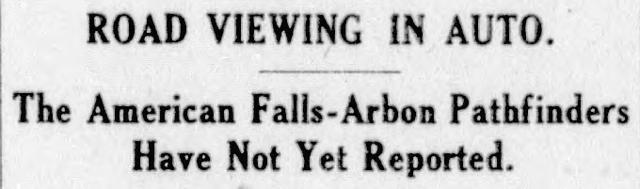
On a Tuesday afternoon in May 1909, three American Falls men and a county commissioner set out in a banker's automobile to look over a proposed road to Arbon. About thirty miles out, at a place the American Falls Press called Rattlesnake gulch, the car broke down, and the four walked back to town through the night.
The Press was well placed to tell the story, since its editor was one of the four. It ran the account on its front page on May 8, 1909, under the headline "ROAD VIEWING IN AUTO" and told it as a joke on everyone aboard.
Why a road mattered
In 1909 Arbon and American Falls both lay in Oneida County, governed from Malad; Power County was not created until 1913. American Falls, which the Press called the Power City, wanted the trade of the dry farms filling up in Arbon Valley, which the Press placed that summer "twenty-five miles southeast of town." In April the paper had praised the valley's wheat yields and admitted it had "every advantage except nearness to market."
The previous November the county had begun a new road over the foothills toward Arbon, laid out with the help of valley men (the story is on the site's Firsts page). By spring the Press was writing of a "proposed road" between the two places. It does not say whether that was the same route.
The pathfinders
The party gathered on Tuesday afternoon, most likely May 4. The car's owner was D. W. Davis, "our estimable townsman," who that year was president of the First National Bank of American Falls. With him rode Wilford Bennion of the American Falls Milling Company; O. H. Barber, editor of the Press; and County Commissioner Roe, one of the Oneida County commissioners, who had driven into town behind his own horses and left them in a barn while "flirting with the more pretentious method of locomotion." Davis was an American Falls man, and nothing in the papers connects him with the Davis family of Arbon.
The paper explained the purpose of the outing this way:
The object of this opulent assemblage was a trip along the proposed route to Arbon, with a view to gaining knowledge and to impart to the lowly public the advantages of that particular route from the rich Arbon valley to the Power City.
The car went through town and out into the sagebrush, where jack rabbits ran for their burrows "at the sound of the honk! honk!" The party left the main road for "a more direct route," and "the man at the wheel" drove so smoothly, the paper said, that his passengers watched him instead of noting the dips and curves of the proposed road. The "pathfinders" agreed that "the road was equal to a city pavement."
Some thirty miles out, at Rattlesnake gulch, Davis was explaining "how he had for years diligently scoured the country for an automobile that required no walking back." He went on to praise the machine they were sitting in, and then, in the paper's words, "just then something happened! An explanation in detail is too painful."
The four walked back toward American Falls, which the Press here calls the "Spokane of Idaho":
Three hours later found the quartette still tramping, with silent faces turned toward the "Spokane of Idaho," with only hills and dales before them. At the break of dawn four silent figures sneaked painfully down different alleys toward their homes, followed several hours later by an automobile drawn by a husky mule team.
Afterward
Later that day Commissioner Roe "hurried out of town behind his trusty cayuses." The paper reported that the flour mill was shut down and, in a passage the digitized text partly garbles, apparently that Bennion had "the grip," the period's name for influenza. Davis, it said, spent his evenings "studying cuss words in seven different languages" and his days "locked in the garage talking to his automobile." The article closed with one plain sentence: "No report has been made on the proposed road between American Falls and Arbon."
Readers found a second broken-down car on the same front page. The "Pathfinder car," a sixty-horsepower Thomas Flyer that the paper said had won the New York to Paris race the year before, had passed through American Falls on Tuesday at noon and snapped a mended steering rod at three that afternoon, in the desert eight miles from Raft River, its fifth breakdown since entering Idaho.
Three weeks later, on May 26, county commissioners Harding and Rowe, probably the same Roe, came up from Malad "on road business." "They came overland, via Arbon," the Press noted, but it did not say which road the business concerned.
On June 26 the paper reported that Davis had received the repairs and his automobile was running again. It added:
He will be careful whom he invites to ride hereafter. A touring car was not designed to carry heavy articles, and until someone imports an automobile van Mr. Bennion will have to walk.
How far did they get?
The paper does not say where Rattlesnake gulch was. Rattlesnake Creek drains the Crystal country into Bannock Creek, and near the valley's north end the Lusk and Bolingbroke families held some of its earliest water rights. If the gulch was on that creek, the car came close to the northern edge of the valley before it quit. That is a possibility, not a fact, and "some thirty miles" was the figure of a paper having fun.
The Firsts page dates the earliest automobile on record in the valley to about December 31, 1910, when Walter Sparks of American Falls drove two companions out for the county-division meeting. The 1909 trip came about twenty months earlier. It was an automobile on the road to Arbon, but nothing in the account says it reached the valley's homes.
No report from the pathfinders has turned up in the 1909 pages of the Press read for this post. In December a letter writer arguing over a different road, near Igo, warned that it would meet "the same fate that the Arbon road has." He did not say what that fate was.
On this site: the Firsts page tells of the valley's first built road and first automobiles, and the Pauline and West Fork and Crystal pages describe the north end and the Rattlesnake Creek country.