The tractors that Arbon Valley families remember came in the late 1920s and after, and this site's record of the first tractors began with newspapers of 1920. The American Falls Press found a few on the valley's dry farms earlier: a 10-20 tractor plowing at the south end in 1916, a Case at Arbon in 1917, and J. E. Keeler's "iron horse" in 1918. They worked beside the big horse teams the same paper described on farm after farm.
A farm column counts the horses
In the fall of 1917 the Press ran a farm column, "With Power County's Farms and Farmers," by a writer who signed himself "The Pilgrim." (Arbon had been in Oneida County until Power County was formed in 1913; the Summit end of the valley stayed in Oneida.) His column described each ranch's crops and methods, and nearly always its "work bunch" of horses.
Near Crystal, F. C. Reiger kept four work horses and pulled his twelve-foot weeder with four. The partners Elmer Beuten and G. C. Wright, also near Crystal, had fourteen work horses on 640 acres. They ran two gang plows with a harrow behind each, and "seven horses are hitched to each gang plow." Near Pauline the column described E. J. Kilgore, a recent arrival from Umatilla County, Oregon, "the land of big wheat farms," who had leased 860 acres. The Pilgrim wrote (a "skinner" was a teamster):
All the work is done with ten horses, and Mr. Kilgore is entitled to the distinction of being one of the best "ten-horse skinners" in the west, besides being a good wheat farmer. He has been hauling wheat with an eight-horse outfit and at one point of his "hauling trail" on the reservation it is necessary to make a sharp double turn to get across a narrow bridge spanning Bannock creek.
He made that turn without a whip or a thrown stone. "Mr. Kilgore talks to his horses in language they understand," the Pilgrim wrote.
Plowing by tractor, 1916
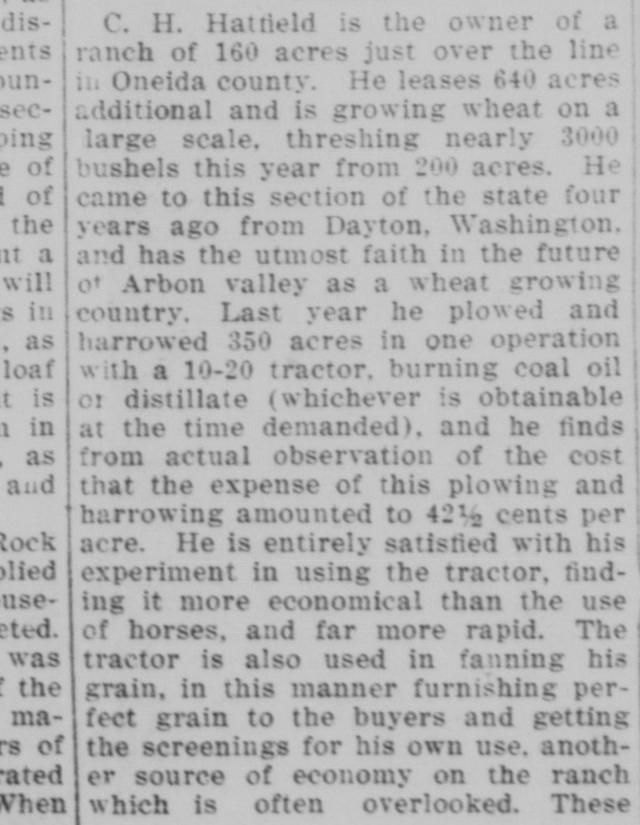
On November 23, 1917, the column turned to C. H. Hatfield, who owned a 160-acre ranch "just over the line" in Oneida County and leased 640 acres more. He had threshed nearly 3,000 bushels from 200 acres that year, and he had come from Dayton, Washington, four years before. He was probably Clive H. Hatfield, whose filing on 160 acres in Bannock Valley the Press listed in October 1913. The Hatfields were among the Dayton families who settled at Summit. Of the year before, 1916, the Pilgrim wrote:
Last year he plowed and harrowed 350 acres in one operation with a 10-20 tractor, burning coal oil or distillate (whichever is obtainable at the time demanded), and he finds from actual observation of the cost that the expense of this plowing and harrowing amounted to 42½ cents per acre. He is entirely satisfied with his experiment in using the tractor, finding it more economical than the use of horses, and far more rapid.
Coal oil is kerosene, and the 10-20 was the tractor's horsepower rating. Hatfield also used the tractor in fanning his grain, cleaning it for the buyers and keeping the screenings for his own use. On the same page the Pilgrim described W. E. Dawson of Pauline, who kept nine Percheron-grade work horses, doing the same double job: he "drags the harrow behind the plow, thus getting two workings of the soil with one operation."
A Case, a gasoline plow and an iron horse
The next machines appear in single lines of the valley news. On July 27, 1917, the Arbon column reported that "C. W. and John Hughes bought a Case tractor a few days ago." On January 15, 1918, the Crystal column reported:
Last week three gang plows might have been seen in operation on the Whiting ranch, one attached to a gasoline engine, the other two drawn by horses.
In May 1918 the Arbon column reported that Mr. Keeler had recently bought a new tractor, apparently a Russell (the name is garbled in the digitized text), and a three-bottom plow, and meant to put it to plowing that summer. He had had some trouble with it, but it was now doing good work. Two weeks later J. E. Keeler "went to Pocatello Saturday to get feed for his iron horse," and "Mr. Keeler's tractor is running along in good style now."
Fordsons and sale bills, 1920–1922
In August 1920 the manager of the Pocatello Auto Company and a man from the Salt Lake branch of the Ford Motor Company, on a crop-inspection trip through southeastern Idaho, found Arbon Valley's crops so good that they decided to stage a Fordson demonstration there soon: plowing, harrowing, disc plowing and harvesting. No report that it was held has been found. That September, as this site's entry on the first tractors records, a Salt Lake dealer sold a tractor to Frank Reiger of Crystal, probably the same F. C. Reiger the Pilgrim had found working with four horses in 1917.
In April 1921 T. S. Toyn of Arbon advertised his 1919 Cleveland tractor, a 12-20, with two-bottom plows, in good condition and "only plowed about 800 acres," for sale or for trade for a good car. That July a public sale on a farm two miles west of the Pauline store, and some distance north (the figure is lost in the digitized page), offered "20 head Mares, 3 to 10 years old," milk cows, Deere gang plows, a Ford touring car and "Harness for 18 head of horses." A "Fordson Tractor and Gang Plow, Complete," a double disc and a Blewett combine were offered by private sale. The owner's name is lost as well. From October into December 1922 Toyn advertised his Cleveland again, now with two 14-inch gang plows, "used very little."
The papers do not give a reason for either sale. Both notices ran in the lean years after the wartime boom, the years of the foreclosures of 1920–1925.
For most families the change came later. As the first-tractors entry tells, the Arbons bought a gasoline Caterpillar in 1928, the Bolingbrokes a Caterpillar in the early 1930s, the Lusks traded their horses for a crawler in 1937, and Mark Andersen's family bought its first tractor about 1941. Hatfield's 10-20 is the earliest gasoline or kerosene tractor found so far in the valley's papers, though a steam outfit had plowed there in 1911.
On this site: the first steam engine and steam thresher, the first combines of 1915, and the histories of Crystal and Pauline and West Fork.
Sources
- American Falls Press, October 16, 1913, page 8
- American Falls Press, July 27, 1917, page 5
- American Falls Press, October 9, 1917, page 3
- American Falls Press, October 19, 1917, page 7
- American Falls Press, November 23, 1917, page 3
- American Falls Press, January 15, 1918, page 3
- American Falls Press, May 10, 1918, page 8
- American Falls Press, May 24, 1918, page 4
- American Falls Press, August 6, 1920, page 2
- American Falls Press, April 8, 1921, page 5
- American Falls Press, July 15, 1921, page 5
- American Falls Press, October 12, 1922, page 5
- American Falls Press, December 7, 1922, page 5