On July 27, 1918, the Power County commissioners, meeting at the courthouse in American Falls, made part of Arbon Valley a herd district. The petition came from the valley's own residents, and no one came forward to oppose it. The American Falls Press printed each step in its reports of the commissioners' proceedings.
What a herd district meant
As the court decision quoted in this site's 2012 letters on the Arbon Herd District explains, the general rule was that a landowner had to fence other people's stock out. A herd district turned that around. A notice for another Power County district, to be heard in January 1916, spelled out what it meant: inside it, "it will be unlawful for horses, mules, asses, cattle, swine, sheep and goats to run at large."
The wish for that protection was not new. In August 1909 the Press, in its local news from American Falls, reported what loose stock could do there:
J. R. Clark found about forty head of range cattle in his grain field Sunday morning. They vaulted the fence with the ease and grace of a deer, and unceremoniously departed for the desert when discovered. They did a great deal of damage.
"The herd law is a necessity," the paper added. Power County's Herd District No. 1 was granted in April 1913, in the county's first year, and other farm neighborhoods followed with petitions of their own. A petition could fail. In July 1915 the board disallowed one after a remonstrance was filed against it with "almost as many signers as the petition."
The Arbon petition
The commissioners met in quarterly session on July 8, 1918. That day they turned down a herd petition advertised for hearing, finding an error in it and that the land it named "is not satisfactory to the residents of said district." That was probably not Arbon's. The petition set for hearing on July 8 was one filed by James E. Ogden and others, and a James Ogden had asked the year before to add Rockland valley land to a herd district.
The next day, July 9, two commissioners were present: Walter S. Sparks, the chairman, and G. A. Brahmstadt, the commissioner from Arbon Valley. The minutes record that "a petition of the residents of Arbon valley" asking for a herd district "in certain territory in Arbon valley" was read, and a hearing was set for July 27. The clerk, Paul Bulfinch, published notice that "a hearing will be had on the merits of a proposed herd district within Arbon valley," at two o'clock that Saturday afternoon at the courthouse.
On July 22 Sparks opened the adjourned meeting, but no other commissioner came, and it was put off to July 27. That day, with the full board present, the commissioners approved the year's real estate assessment roll and then turned to the valley's request:
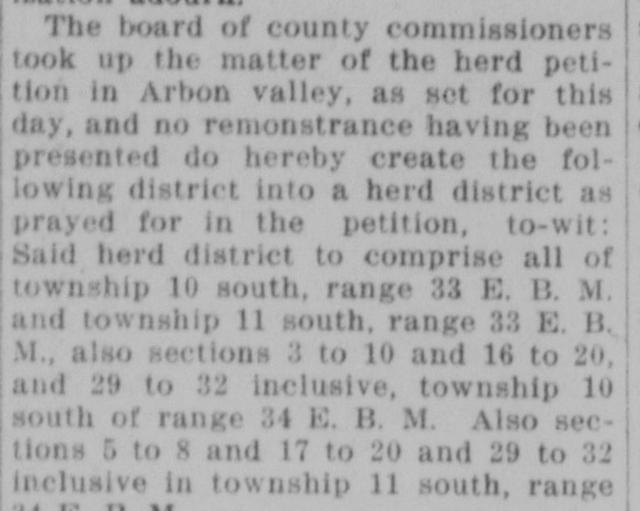
The board of county commissioners took up the matter of the herd petition in Arbon valley, as set for this day, and no remonstrance having been presented do hereby create the following district into a herd district as prayed for in the petition.
The Press noted it in a short item on July 30: "There was no remonstrance to the petition." The full minutes followed on September 10.
Where it lay
The order took in all of township 10 south, range 33 east, and a band of sections along the west side of the township to the east (sections 3 to 10, 16 to 20 and 29 to 32 of township 10 south, range 34 east). It also named land in township 11 south, but that part of the legal description cannot be read with confidence in the surviving text of the page.
Township 10 south, range 33 east is probably best pictured as the stretch of Bannock Creek between Pauline and the Central (Green Top) school. The county's voter-registration notice that spring divided it between the Pauline and Arbon precincts. The Swim, Butler and Johnson homesteads, two and a half to three miles south of Pauline, lay inside it; their story is on the Swim family page.
At the same session the board named the valley's judges of election for the next two years. They were T. B. Evans, Joe Arbon and James Payne for Arbon precinct; E. C. England, W. E. Dawson and J. E. Kowallis for Pauline; and J. C. Davis, J. W. Staley and R. Butterfield for Crystal.
What the papers leave out
The proceedings do not name the petitioners. They do not say which animals the Arbon district barred or what moved the residents to ask for it, and the Arbon news columns read for this post, from June to August 1918, say nothing about it.
More than ninety years later the district was a live question again. In 2012 this site carried letters from the Power County prosecuting attorney about the Arbon Herd District: its taxes, its unfenced boundary, and cattle coming in off federal land. He treated it as a district older than the 1963 change in Idaho's herd-district law. Those letters give no date for its creation. The papers read for this post do not show whether it is the district created in 1918, but the 1918 order is the earliest record of an Arbon Valley herd district found in them.
On this site: the Arbon area, Pauline and West Fork, the Evans family, the Arbon family, and the 2012 herd district posts from April, July and August.
Sources
- American Falls Press, August 7, 1909, page 4
- American Falls Press, May 22, 1913, page 2
- American Falls Press, July 29, 1915, page 4
- American Falls Press, January 6, 1916, page 2
- American Falls Press, October 19, 1917, page 8
- American Falls Press, May 10, 1918, page 6
- American Falls Press, June 25, 1918, page 3
- American Falls Press, July 12, 1918, page 3
- American Falls Press, July 16, 1918, page 2
- American Falls Press, July 30, 1918, page 1
- American Falls Press, July 30, 1918, page 4
- American Falls Press, September 10, 1918, page 2
- Swim family history, on this site
- ArbonValley.com, April 13, 2012, "Arbon Valley Herd District"
- ArbonValley.com, July 18, 2012, "Arbon Herd District"
- ArbonValley.com, August 27, 2012, "Herd District Clarifictations"